Reader's Choice
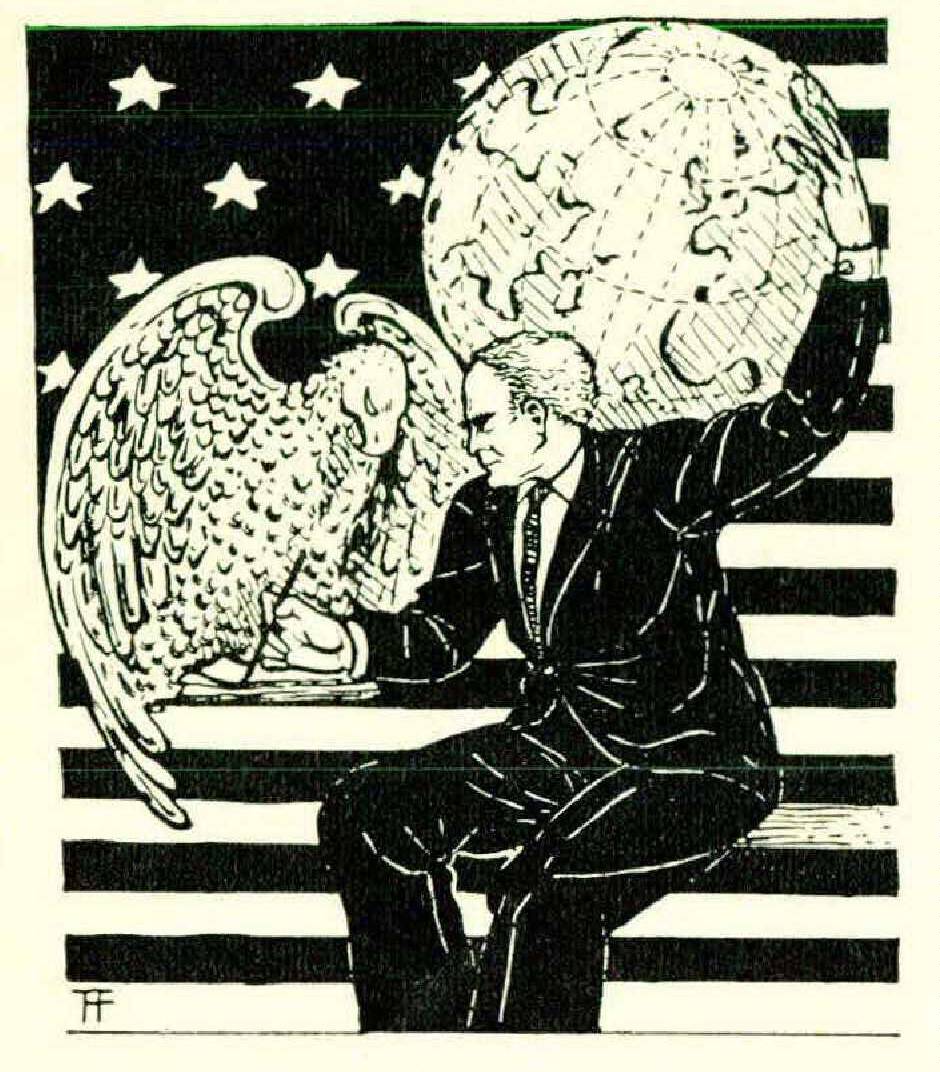
Among the failings of United States foreign policy in the last half century was the tendency to formulate objectives in sweeping, universal terms. Partly, no doubt, because American statesmen had to justify their decisions to a democratic electorate, they were inclined to describe wars as crusades and to promise extraordinary redeeming results from every resort to arms. Since those promises could not be fulfilled, periods of painful disillusion alternated with those of extravagant hope.
It is therefore encouraging to observe a great change in this respect among American policy-makers. Whatever their other shortcomings might be, those charged with the conduct of our diplomacy in the past eight years have made no extravagant claims and conjured up no illusions. Their moderation reflects the awareness that the use of power has both limits and responsibilities.
GEORGE W. BALL in THE DISCIPLINE OF POWER (Atlantic-Little, Brown, $7.50) illustrates the developing maturity of American views of foreign policy. Ball was Undersecretary of State for six critical years during the Kennedy and Johnson Administrations. His thoughtful analysis is a humane and realistic appraisal of the world today and of what it would take to develop a structure conducive to peace.
Ball’s analysis is informed by a sense of the precariousness of life in the 1960s. He has been close enough to power to know how easily the Stone Age could return on the wings of science. The present differs from the past in scale; everything is radically nearer, swifter, and more distinctive. Military and industrial force has become so massive that it can be effectively mobilized only in large units; and the states thus organized must learn to accept the discipline that their size and their strength impose on them. Yet Ball is also a realist who knows that no retreat to isolation is possible for the United States. The nation must therefore unceasingly reassess its situation to be sure that it can use its power and use it well.
Today’s problems are the product of yesterday’s successes. The containment policy of the post-war decades was static and defensive. But it kept us alive and checkmated Soviet power. We bought time on the assumption that the tides of history were with us, but now, Ball argues, it is necessary to move toward a more durable formula for easing world tensions.
He calls for modernization of the political structure of Europe. He sees the necessity of creating in Western Europe an entity that will be capable of mobilizing the resources of the Continent to serve its own resources. The European Coal and Steel Community and the Common Market were first steps. The men who planned those institutions anticipated that they would lead to closer political ties and ultimately to a European parliament. Ball desires the prompt implementation of that intention. To that end, it is desirable that Britain become a part of Europe. It has already set out on that course by surrendering the relics of its imperial past. It should, in addition, dissolve those elements of special relationships with the United States which in the past impeded adherence to the Common Market.
The unity of Europe would make possible a common effort to meet the needs of the Continent and would also permit it to play an appropriate part in world affairs. Only in this context will it be possible to approach a reunification of Germany which would neither threaten the Soviet Union nor be a danger to the neighbors of a revived Reich. The existence of a truly independent Europe would further the détente between the East and West; its developing trade with the U.S.S.R. would increase contacts and help dismantle the Iron Curtain. Europe could also take a more forceful part in aid to the underdeveloped countries. United, it would be able to play a constructive role in areas like Africa with which it had historic connections.
Union would also be a help to the United States. Europe would then cease to be a subservient instrument of the cold war and become capable of entering as an equal into an Atlantic partnership. “Until Europe knows the reality of roughly equivalent power, Europeans will never risk the full acceptance of a partnership relation.” Only when Europe as a whole is strong enough to protect its own interests will it make sense to build more comprehensive institutions for EuropeanAmerican cooperation.
Europe remains central to Ball’s thinking, and properly so, because that is where the weight of military and industrial power outside the United States and the Soviet Union still lies. Yet Ball envisions a comparable pattern of adjustment in Asia. He would like to see Japan assume a much wider role, commensurate with its potential strength, and he hopes that new regional arrangements will relieve the United States of its present security obligations in that region. We need not “permanently maintain our presence in the Far East at anything like the present level. It is sound policy to encourage the Asian people to form regional groupings and to learn to work together for their common economic good.”
Vietnam, in this perspective, seems almost incidental. It is true that Ball wrote before the Tet offensive and may therefore have exaggerated the degree of progress in pacification; and he certainly overestimated the value of the electronic barrier that was to have sealed off the northern frontier. But his comments still have relevance.
Ball was always against bombing the North and was an advocate of a moderate policy in Vietnam. He nevertheless understands the purpose of the American presence in Vietnam. “The lines enclosing Communist power were determined pragmatically by the play of force and counterforce, but now they have been sanctified by a whole series of security assurances of varying degrees of dignity.” One of those lines ran across Vietnam, and the threat to it was a threat to the whole system. As a result, simple withdrawal is impossible.
More important than the rehearsal of past mistakes is the ability to learn from them in order to avoid comparable errors in the future. Ball suggests more forethought and hesitation. Yet he is aware that every situation is complex, that no course is free of risks, and that hard choices are always necessary. He offers no easy formula for success, only a set of helpful guidelines for picking our way through the perils of the future.
Among the nations
S. Y. AGNON was scarcely known outside Israel when he won the 1966 Nobel Prize for Literature. In this case the award was not simply a token of recognition for the literature of a small nation; it went to a man of genuine genius whose merit was not widely perceived because few outside his country could read his writings.
A GUEST FOR THE NIGHT (Schocken Books, $6.95) is the most important of Agnon’s novels thus far to be made available in English. The translation is good, although it cannot convey the full flavor of the religious overtones of the original. The book does give outsiders an adequate basis for judging the merit of a writer who can be measured by the standards of world literature.
A Guest for the Night, which was originally written before World War II, is partly autobiographical, and it is rich in realistic detail. The precise and sympathetic portrayal of people and places vividly re-creates the world of Eastern European Jewry as it existed in the 1920s.
But the novel is more than a story. Agnon never escapes the awareness that there is a religious denotation to the word “writer” and thus to his profession; and he imparts almost a sacred quality to the language he uses. The result is a prose that is often lyrical and always deeply moving, as if the words were put into his mouth by God. In addition Agnon weaves into his narrative parables, dreams, legends, and stories that give full scope to the play of his imagination without diminishing the realism of the book as a whole. There is also a good deal of symbolism in the writing.
The plot itself has two levels of symbolic meaning. On the more literal level, the guest for the night is a man who comes back for a year from Palestine to the place of his birth in Poland. But the guest can also be understood as Israel, which passes fleetingly through the history of the nations. While the story has a particular setting, it also has a universal connotation.
The protagonist returns from the Holy Land to the village of his birth in Poland just after the disasters of World War I and of the pogroms which followed it. The survivors in Szibucz remain alive only to undergo fresh tribulations. Some of them migrate to America and “to other countries where even Adam never set foot.” There they become like the mud of the street, which every passerby wipes off his boots. Among those who stay, faith has drained away. Like Daniel Bach, they are skeptics who no longer know the meaning of “the sanctities, the sanctity of life, and the sanctity of labor, and the sanctity of death,” about which the teachers preach. Others engage in petty wrangling over the details of life.
The guest alone cares about the past of the town, and he therefore receives the key to the house of study in which are kept the books of traditional wisdom. When he loses the key, he has a new one made, for it is important to him to be able to resort to the place of study. There, as the days go by, he recalls his own childhood and unravels the characters of the people of the place. Toward the end he visits the old graveyard where are entombed the great men “who glorified our town with their learning and revealed its merits to the world.”
All this he discovers has little meaning for most of the young people in the village. “Babtchi, the innkeeper’s eldest child, has her hair cut like a boy’s, wears a leather jacket, and is never without a cigarette in her mouth. She behaves like the young men, and not like the best but like the worst of them.” Rachael, whose whole life was an exception, stands apart. But even she asks, “Why should I take on myself the burden of past generations? Let past generations look after themselves and my generation look after itself. Just as the generations before me lived in their own way, so my generation lives in its own way.” And she marries not the intended of her father’s choice, but Yeruham Freeman, a road mender and a Communist.
When it comes time for the guest to depart, he bestows the key he had made upon the newly born son of Rachael and Yeruham. Agnon thereby expresses symbolically his compassion for the world Israel is about to quit. True, the old town and the old learning will never again become alive. The sojourner can only hope that the new society which will rise in the same place will learn to understand the tradition it once sheltered. Yet when the guest returns to Palestine, he discovers that the old key, which he thought he had lost, is still with him. Agnon thus expresses the hope that in the new land there will be a place for the old tradition.
The basic tone of the book is thus optimistic. It does not minimize the tragic quality of Jewish life in Eastern Europe. Nevertheless it voices the fervent belief that the presence of this guest among the nations will eventually be felt, both in the land which temporarily sheltered him and in that to which he ultimately returns.
The end of Europe
Since early in the nineteenth century Americans, like Englishmen, have been fascinated by the society and culture of Spain. That country seemed to mark the borderland beyond which European civilization failed to take hold. To Protestants, rationalists, and liberal democrats, Spain seemed more alien than Italy or the Slavic East, partly no doubt because in the nineteenth century it seemed to reject the dominant economic forces that were transforming the rest of the continent. Here an earlier, more primitive — perhaps more authentic — style of life resisted industrialization and urbanization with all their monotony and uniformity.
JAMES A. MICHENER’S first visit to Spain was as a boy when he shipped on a freighter that carried oranges to the marmalade factories of Scotland. He has traveled repeatedly through the country, and his book IBERIA: SPANISH TRAVELS AND REFLECTIONS (Random House, $I0.00) sums up the observations of four decades. Yet it is more than a travelogue; it incorporates the author’s continuing search for the mystic or romantic aspects of life.
Iberia begins with a series of speculations. Why was Spain not altogether a part of Europe? Why in 1492 did it reverse the pattern of ethnic tolerance which had earlier been characteristic of its society? What accounts for its regionalism, for the inability to industrialize, for the role of the Church, and for the mystical strains that run through much of Spanish culture?
The book does not attempt to answer these questions systematically, although it draws together much relevant material. Michener describes a series of visits to Badajoz, Toledo, Córdoba, Seville, and other cities. In each, the observer’s vision takes in both people and places; and he describes what he sees with sympathy. lucked in among the anecdotes and the personal narratives are bits of history, discussions of art, music, and literature, and reactions to the natural landscape. Each place visited becomes a stimulus to elaborate but interesting digressions, on Seneca as a philosopher, on the flight of the storks and other birds in their migration to and from Africa, on publishing and popular literature, on rounds of festivals, and on politics. The book darts off into a biography of St. Theresa or of the lecherous Isabel II. It recounts the Don Juan legend and the paintings in the is therefore neither coanalytical. But it is interesting. Michener speculations But he introduces the reader to a civilization which is not quite identical with his own.
Tales of three cities
VIÑA DELM MAR’S THE BECKER SCANDAL (Harcourt, Brace & World, $4.75) is an interesting evocation of a criminal case that rocked New York City in 1912. Herman Rosenthal, a fashionable gambler, charged Lieutenant Becker of the police vice squad with being first his partner and then his blackmailer. The day before Rosenthal was to have testified before the Grand jury, he was murdered. Lieutenant Becker was accused of the crime and ultimately convicted and executed. In the process the unsavory aspects of New York life were uncovered, and District Attorney Whitman earned a reputation that took him to the governorship. The scandal rocked the whole city.
Viña Delmar tells the story as it intersected the life of her own family. Her actor father was one of Rosenthal’s friends, raised in the same slum neighborhood. Her mother, aspiring to respectability, disliked the gambler and therefore refused to believe in Becker’s guilt. The story, skillfully told as seen by an adolescent girl, blends the personal conflict of man and wife with the political ramifications of the murder and trial.
Somewhat less than a year after Rosenthal was shot, fourteen-yearold Mary Phagan was murdered in Atlanta. Leo Frank, the Jewish superintendent of die factory in which she worked, was tried and convicted of the crime. The antiSemitism responsible for tHe verdict induced the governor to commute the sentence to life imprisonment, but shortly thereafter Prank was abducted from the jail and lynched.
LEONARD DINNERSTEIN’S THE LEO FRANK CASE (Columbia University Press, $6.95 ) is a meticulous study of the incident, grounded upon a careful examination of the documents. It reveals the deficiencies of the judicial system, the effects of passion, and the corrupting results of violence. It also shows the connection between this case and the founding of the Ku Klux Klan shortly thereafter.
Two years before the Becker case broke, Tom Pendergast took control of the ward organization his brother had built in Kansas City, Pom extended the influence of the machine to the whole county, which he thereafter ruled for a quarter of a century. LYLE W. DORSETT in THE PENDERGAST MACHINE (Oxford University Press, $6.00) gives us a competent history of the Pendergasts and of boss rule in the environment from which Harry Truman climbed to the presidency.
All three of these books treat the disorders of American urban life early in the twentieth century. Yet curiously, none of them says much about the cities themselves. Who were the 150,000 Atlantans who came gleefully to look at Frank’s corpse? Who patronized Rosenthal’s tables? Who filled the ranks of the Pendergast ward organization? Such questions still call for answers.