Lytton Strachey: The Success of Excess
MICHAEL HOLROYD’S two-volume Lytton Strachey: A Critical Biography (Holt, Rinehart and Winston, $21.95) runs to almost 1200 large pages and well beyond half a million words. A performance so immoderate, once a prime target of Strachey’s own campaigning, Mr. Holroyd is the first to confess to, while offering reasons to justify such length. One reason, that his own biography is altogether unlike any of Strachey’s, might seem valid were it not that it is also altogether unlike any “critical biography” I can recall. It’s not that Mr. Holroyd has neglected Strachey’s work; he has treated it, indeed, in painstakingly ample detail. But, when set against all the minutiae of Strachey’s life, all the people he knew, all the details of the way he lived and of the world he lived in, Strachey’s work resembles a respectable hill dwarfed by the great bulky mountain range encompassing it. Nor does one bring the book into focus by designating it a Life and Times, there being much less sense of Strachey’s general era than of his particular environment, of a cultural Zeitgeist than of a clique-ridden Weltanschauung. What leaves much the strongest impress is Strachey’s very private affairs, which involve many other people, some of them still alive. Perhaps the subtitle that would come closest to being accurate is Life and Letters — in the special but crucial sense that there could have been no such Life as Mr. Holroyd has written without such letters, hitherto unpublished, as Strachey wrote. To make no genteel mystery of it all, it is chiefly Strachey’s emotional and homosexual involvements, which I shall presently return to, that seize the limelight; yet it is neither the nature nor the pattern of this that really makes for such disproportion. It is the extraordinary profuseness and increasing unprofitableness of it, the so much greater sense of glare than of light, the sense of Strachey’s history endlessly repeating, one might almost say Xeroxing, itself.
Mr. Holroyd has gone at his elephant of a book with unwearied thoroughness. That there has been no prior life of Strachey may partly explain the dimensions of this one. Strachey the man has for the general public been very little known; and since his death in 1932, there has been a considerable reaction against Strachey the writer. Hence, with man and writer alike, today’s belated, fact-ravenous biographer, embedded in research, can deem it mandatory to start at scratch and tell everything, while a generation after Strachey’s death, he may equally decide that enough time has elapsed to Tell All. To implement both objectives, all of Strachey’s letters and papers have been put at Mr. Holroyd’s disposal “without any form of embargo in using them” by Strachey’s “family and friends.” Mr. Holroyd has not spared himself in telling everything, or spared others in telling all; moreover, he has shown no partiality between the two categories. An obscure Strachey cousin has been given equal space with a weird Strachey crotchet; an adolescent report card with a middleaged billet-doux. Sometimes the same word will speak for both categories: a country inn can mean a wholly calamitous weekend because Strachey forgot to bring along the stopper to his hot-water bottle, or because of a failure of rapport with his traveling companion. Mr. Holroyd’s volumes, in other words, are often as trivial and tame as a Victorian spinster’s journal, and again as unguarded as a reckless black sheep’s diary.
The book’s endless alternation of Bovril and Tabasco may well possess, for those with unbudgeted leisure, the kind of value born of being omniscient about a man and his milieu, in the precise form of the size of the shirts he wore and the shape of the earrings. But any value in coming to know everything is in serious conflict here with that perhaps third of the book which is really worth knowing about. Mr. Holroyd’s Total Research makes for the utter ruin of what one of Bloomsbury’s chieftains once called Significant Form. The problem is intensified because, concerning the Strachey who most deserves a biography — Strachey the writer — there is nothing very new to be said; what is called for is much less revaluation of someone earlier misjudged than rehabilitation of someone unduly neglected. For general background material to Strachey’s world there have been, of course, any number of books — in the form of letters, journals, memoirs, biographies, autobiographies, romans â clef — written by Strachey’s close friends and contemporaries and portraying the Cambridge-cum-Bloomsbury set. By contrast, the thirty-two-year-old Mr. Holroyd never did see Strachey plain, though he has been in touch with many people who did.
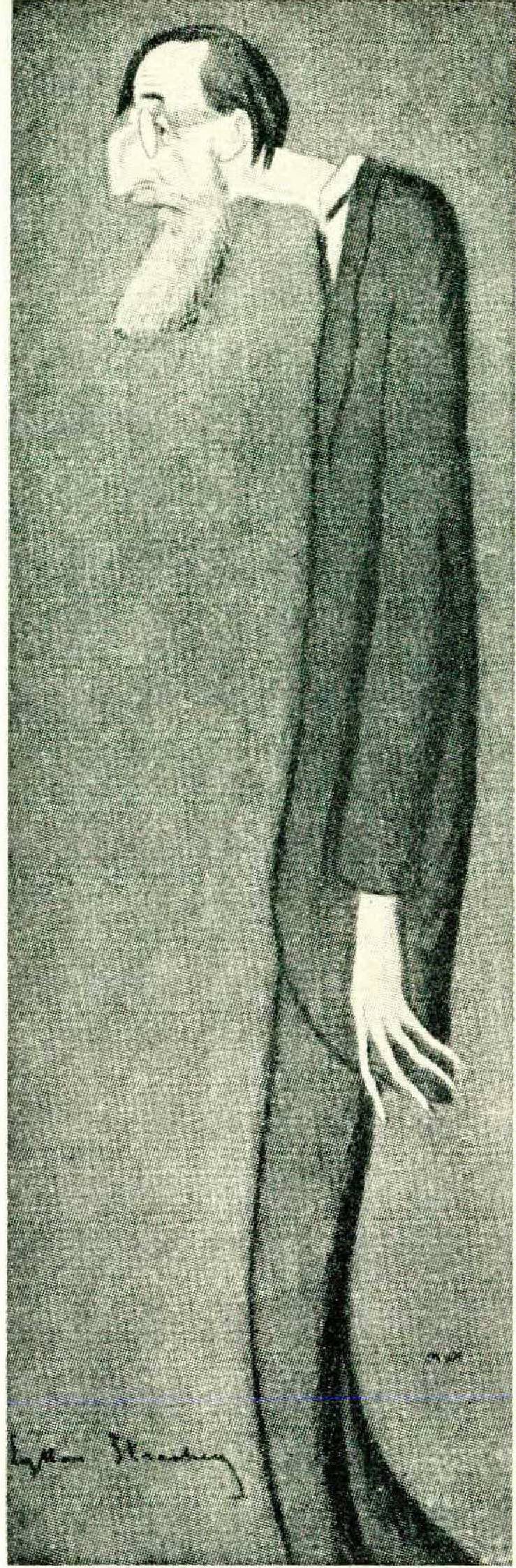
What, in any case, Mr. Holroyd has been dealing with is a man in whom there were decided contradictions, yet an even more pronounced consistency; for, though many things madly clashed in Lytton Strachey, virtually nothing altered. Extremes met, and met so often as to come to seem like practiced dancing partners. Known already in childhood for his high spirits, little Lytton was also “cold to the touch.” The grown-up mingled a fastidious sensibility and a tittering sensuality; a nature that could be as rationalistic as any observation in Voltaire, and as operatic as any climactic scene in Verdi. In life as in letters Strachey was at once the master and the slave of effect, with an appearance eccentric but most effective. “He drooped,” said Frank Swinnerton, “if he stood up and sagged if he sat down”; and the gangling form, the long tubular arms and legs were supported by the large brown beard, the wide-brimmed hats, the horn-rimmed glasses to make him unforgettable, whether in Max Beerbohm’s famous caricature, Henry Lamb’s famous painting, or virtually any good photograph.
THE eleventh of thirteen children and the son of a notable government administrator in India, Strachey was on both sides part of that uppermiddle-class aristocracy of brains and talents containing Darwins and Huxleys, Stephens and Arnolds, Wedgwoods and Trevelyans. A frail, rather sickly child, he was sent to a rather monstrous school run on “natural methods,” which included doing without water closets. It was at Cambridge, and most of all, in that very exclusive intellectual club, the Apostles, that Strachey first found himself. Among his contemporaries were Clive Bell, Leonard Woolf, Thoby Stephen, and John Maynard Keynes, while such elders as G. E. Moore, Bertrand Russell, Desmond MacCarthy, and E. M. Forster were frequent Cambridge weekenders. Though Strachey met people while at Cambridge “with a mixture of distrust and hostility,” he encountered thei’e the atmosphere best suited to his life and made friends who were lifelong; he and they, indeed, were to replant Cambridge in Bloomsbury; and he and they, supplemented by Thoby Stephen’s sisters — the future Vanessa Bell and Virginia Woolf — and such others as Roger Fry and Duncan Grant, became indeed the Bloomsbury Group.
Around them revolved most of Strachey’s personal and artistic interests. He was early dominated, says Mr. Holroyd, by two types: those who became a kind of ideal for him and “excited his lust and adoration,” and those whom he confided in and who bolstered his self-confidence. About Strachey’s infatuations and attachments, even at their most coy and most maudlin, his biographer would seem to be notably explicit, although Lytton’s brother and executor, James, a well-known translator of Freud, taxes Mr.Holroyd with being “unnecessarily prudish.” It is refreshing, when a man’s biography is being written, to find a close relative who puts facts, or Freud, before family; the mere stranger, however, might reject prudish for lavish.
Both Strachey and Bloomsbury represented an elite, a kind of pedigreed bohemia, a nonconformity with exacting house rules, a humanitarianism often conveyed by cold stares, a hospitality by chilly fingertips. Cultivated and enlightened, proFrench and wonderfully English, Bloomsbury created its own version of the salon. In its taste it was unfettered rather than avant-garde (Virginia Woolf called Ulysses “tosh,” and Strachey saw nothing in Matisse and early Picasso). In its temperament, it was faintly ancien régime, quite supercilious, quite mandarin. Everything about it was so unmistakably crème de la creme that it was naïvc in one to expect the mere milk of human kindness. (When Henry Lamb hurt his painting hand, Roger Fry commiserated — it would not seem jokingly — by hoping it wouldn’t affect his piano playing.) Bloomsbury, it appears, had much less run away from home than done over the house, with a good deal more stress on light than air. Being overcivilized, it was, except here and there, militantly neurotic. It could also smack of the purest middle-class gentility: while Strachey’s cultivated mother and Virginia Woolf were having tea, a dog made, between the two women, a “large conspicuous mess on the carpet,”which both of them carefully and completely ignored. It could smack again of bluestocking froufrou, with James Strachey’s wife “reading Rabelais with the aid of six dictionaries.“
There was a kind of Greater Bloomsbury, with Lady Ottoline Morell and others providing a peerage, Mark Gertler and others a peasantry. Behind its protective walls were glass houses where Bloomsbury vibrated with liaisons, realignments, ménages à trois. It also bought country cottages, endorsed rural weekends, went on walking tours, visited back and forth. It had much playfulness, not altogether free from nail-scratching, and much sensibility that tended to choke on its own bones, there were parlor games till all hours and fresh gossip by every mail. Strachey’s letters keep pace with his love affairs, and his confessors emerge at times as his rivals. Amid all this, he one day, despite a heavy cold, dashed across London to propose marriage to the future Virginia Woolf. “I proposed,”he wrote to his brother, “and was accepted. It was an awkward moment . . . especially as I realized, the very moment it was happening, that the whole thing was repulsive to me.”Fortunately Virginia, though perhaps offended, in no way pined, and promptly released him.
Many Stracheyan and Bloomsbury triangles had not just a Freudian but a Euclidean air, with two people amorous of the same person becoming amorous of each other. Such ricocheting relationships, such ticklish contretemps so abound that Mr. Hoiroyd, though badly miscalculating their value, can hardly be accused of merely making capital of them. How, indeed, protest the letters in view of Strachey’s public announcements on the envelopes:
I prithee, postman debonair.
He is the handsome upstairs lodger
At number 14 Brunswick Square.
There was, along with this, a love of indecency in Strachey, sometimes adolescent and callow, sometimes donnish and overripe. This is a taste that others in Bloomsbury seemed to share: at a fancy-dress party, one man appeared as a eunuch and another as a “whore great with child.” A good many of Bloomsbury’s members, it would seem, led rather escapist lives on rococo lines. Conversationally they could be very emancipated at their famous late-at-night cocoa parties; but as E. M. Forster remarked, they “would have shrunk from the . . . freedom which results from a little beer.” Fhe whole thing makes for a somewhat precious, rather than a hearty, coarse chronique scandalease; in the end, indeed, Bloomsbury behavior suggests less this or that form of sexuality than a kind of environmental incest.
THE sense of excess in Lytton Strachey is not confined to sex; it is ubiquitous. After a dozen of Strachey’s weekend jaunts, we can only yawn; with his interminable ailments, we have trouble not laughing. Clearly, he was never an altogether well man; clearly too his ill health was often self-created, was a form of “hysteria.”He took to his bed — often in other people’s houses — with “indigestion,” “lever,“ “palpitations and piles,“ “a chill on the entrails,” “vertigo, ” “influenza,” “colic,” “biliousness,” “back trouble,” “shingles,” “collywobbles,“ ”swollen glands” — on and on, with such sickroom specialties of his own as “a bandage round his head,” “not properly ill,” and “angoisses.” At the theater, he had to sit on the aisle “in case he should faint” during the performance.
He dramatized his plights as he did his plots, as he did so many things. Few skeptics have shown such a turn for histrionics, few outright romantics worn their hearts on so many sleeves or cried on so many shoulders. So much Richardsonian weepsiness, so much self-induced Sturm und Drang argue against real passionateness or intensity, The hints of suicide (“The thought of suicide,” wrote Nietzsche, “is a great consolation: with the help of it one has got through many a bad night”), the melodramatic heartaches and despairs, the dashes across London to propose marriage smack rather too much of the boy who cried Woolf. In other ways — as a pacifist, for example, during World War I — Strachey showed courage and character, and the real if waspish loyalty which was a kind of Bloomsbury badge. He could also be incredibly wrong, and vulgarly snobbish to boot. E. M. Forster, he wrote, is “a mediocre man . . . he will come to no good, and in the meantime he’s treated rudely by waiters and is not really admired even by middle-class dowagers.” Often disliked, Strachey was equally an object of devotion. He could be, it seems, dreadful and delightful by turns, and friendship with him apparently depended less on his becoming an acquired taste for others than on their passing muster with him. His Bloomsbury friends remain something of a blur and individually lack faces; but it is with Bloomsbury as a whole that Mr. Holroyd is perhaps most successful. He provides, in effect, the history of an attitude, itself a short chapter in the cultural history of England. That attitude by now is peeling and discolored; yet it had its own notable distinction, and the best of its work, in Forster, Virginia Woolf, Maynard Keynes, Roger Fry, and in Lytton Strachey, should prosper for a considerable time to come.
As for Strachey, he was not just a brilliant biographer, he was a revolutionizing one. An Eminent Victorians had, indeed, a greater immediate impact than a Ulysses or a Waste Land, for at a stroke it antiquated a method and enthroned a manner. When Eminent Victorians appeared, biography, while displaying hopeless anarchy of form, was all too lacking in freedom of speech. Strachey gave it the polish of style, the sting of plain speaking, the tensions of fiction, and brought, along with his new kind of technique, a new kind of target. He recast four popularly revered Victorian figures; and if, with Cardinal Manning, Florence Nightingale, Dr. Arnold, and General Gordon themselves, there were signs of contrivance, there was truth enough generally to set biography free. There was talent enough to raise biography high. There were tremors enough to break bones and smash statues. Overnight, as it were, biography turned from burying facts to burying reputations.
At times, in proclaiming the truth, Strachey could tamper as shamelessly as others had done to suppress it. In the interests, again, of art, he was not above taking liberties with nature, as in his deliberately shortening Dr. Arnold’s legs a trifle. And indeed, given an inch, Strachey might stretch it out into two feet of clay. The Dr. Arnold is an unjust caricature; Florence Nightingale’s personal faults are made to overshadow her achievement. Manning is pointedly contrasted with Newman, but even if Manning was truly a sinner, Newman was far front a saint. I agree with Mr. Holroyd that the study of General Gordon is much the best of the four. It has the most body, the truest “story,” the deftest storytelling; and its tragic bravura is a fact of history. A desire to indict the vices and faults of an era overhangs the whole book but essentially fails. The indictment, in any case, is perhaps less Victorian than merely English: much that is muddled, scheming, snobbish, ambition-ridden still twitches and throbs at the level of society Strachey dug into. And Strachey himself was overeager to show that a great deal of history’s size and brawn was only excess fat. He pounced on every gaffe or banality or oddity, he dwelt on people’s soup stains and squints and warts, so that in the end he as much showed up his method as his man. Himself no mere debunker, he yet made debunking inevitable. Eminent Victorians is the most trenchant of Strachey’s books and proved the most influential, but I disagree with Mr. Holroyd and others that it is the best of them.
I prefer, though Mr. Holroyd fairly enough speaks of its “softness,” Queen Victoria; for along with the softness goes less pretension to scope. If Strachey in Eminent Victorians sought on too meager grounds to indict large forces, in Queen Victoria the heroine herself is grand scale, but her actual importance quite minor. The empire she really ruled over was her vast, far-flung family; the terror she often inspired evokes the hearthrug or the dinner table; the most ironic contrast she presents is between a tremendous manner and a tiny mind. The tone of the book is not coldly acidulous but comic; Strachey withheld the knife and flourished the dress sword. Queen Victoria gains in texture and tone what it loses of stature and toughness, and is on such modest terms well-nigh perfect.
With Elizabeth and Essex Strachey failed. He stretched rhetoric into verbal melodrama, offered grandiose tapestry passions that do not stir us, and complexities in the Queen that end up as simplification: as I have said elsewhere, she twists and turns, and turns and twists, until she resembles Indecision in a morality play. Far more rewarding are some of the relatively early pieces about eighteenth-century figures, the “Madame du Deffand” and the “Voltaire and Frederick the Great.” Here a “classical,” witty, urbanely malicious era matched Strachey’s own temperament and called forth his best talents. His essays vary, but, to go no further, two of them possessed great pioneering value, paid able tribute to Racine and Stendhal when they had small place among the English-speaking.
Mr. Holroyd has usefully elucidated various controversies concerning Strachey’s accuracy and openmindedness, and has made some sound critical comments on Strachey’s work. Unhappily, turned loose among so much old and slight, so much new and startling material, he has allowed it to swamp him. His use of it is deficient in perspective, architecture, economy of style. Of such weaknesses Strachey was himself never guilty; his writing had shapeliness and grace, so that, though quite lacking greatness, not always loyal to truth or at home with the deeper forces of history, he can still offer us pleasure of the most civilized sort — a gift that only a fool or a prig would decline.