How I Stopped Smoking and Had Fun Doing It
Mr. Poltroon says he is the editor and publisher of the WRETCHED MESS NEWS,West Yellowstone, Montana.
All previous systems for stopping smoking have attempted to remove a most enjoyable habit without replacing it with something equally pleasure-giving. I was the first person who envisioned the application of the “something else instead” principle to these systems, and I helped finance fourteen different research teams, each headed by one or two high-priced psychiatrists who were asked to “discover or create a habit that man can use to replace smoking that will provide every bit as much fun as smoking itself.” I am proud to reveal, for the first time anywhere, the results of their labors to date.
The Eskridge Hypothesis: “St. Louis Blowup”
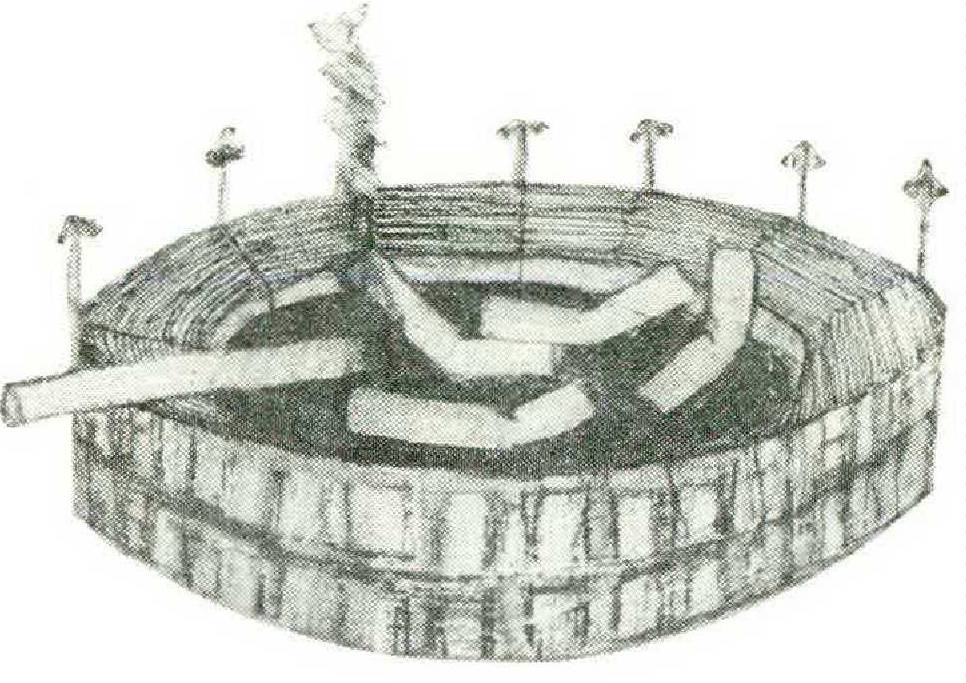
Dr. Robert Eskridge of Palos Verdes, California, advances the theory that man’s smoking habit is nothing more than an outward evidencing of his basic instinct to blow up St. Louis, Missouri. The lighting of the cigarette is thus merely a psycho-subliminal igniting of the bomb fuse. The exhaled smoke is a dream-wish representation of the ash-darkened skies (“the ash wish”) hanging over the ruins of “the garden spot of the Midwest.” Crushing the cigarette butt in the ashtray symbolizes the destruction of the Gateway Memorial Arch, while the ashtray itself represents Busch Stadium.
Based on this hypothesis, the easiest way for mankind to rid itself of the cigarette habit is simply to wipe out St. Louis, Missouri. Dr. Eskridge’s fellow psychiatrists wholeheartedly agree that this proposed solution would end the smoking problem in urban St. Louis.
Dusenberry’s Hypothesis: “Doing Something With Your Hands”
Dr. Garland Dusenberry of Lynchburg, Tennessee, theorizes that people find it necessary to do something with their hands at frequent intervals; some, in fact, feel a compulsion to do things with their hands almost continuously (“chain hand-doing”).
Of the many solutions to the smoking problem based on Dusenberry’s hypothesis proposed so far, the following appear the most promising:
1. Fulmering (Dr. Fulmer’s Solution). When the subject feels the urge to smoke, he is encouraged to dip one hand into a Fulmerpot, a small portable pot full of pleasantly warm glue into which shredded chicken feathers have been well mixed. While there is little evidence that Fulmering is a universally acceptable alternative to smoking, there is no doubting that it does give people “something to do with their hands.”
2. The Pratt-Bascom Knuckle Smash. Two chain smokers face each other across a table, with one player placing his hands palms down on the table surface. The other player swings at the hands of the first with a brick, attempting to smash his (or her) knuckles. The first player endeavors to pull his hands away just before the brick impacts; if he does so successfully, he then gets to swing the brick. Further research is planned, just as soon as Dr. Pratt’s hands heal.
3. The Anderson-Beverly Board. This solution employs a cleverly designed board, made of hardwood and about the size of your average box of hot breakfast cereal. Each Anderson-Beverly board contains ten holes, allowing the subject to push all ten fingers in at once whenever he feels the urge to smoke. Each of the finger holes exerts a tremendous suction, because of an ingeniously designed and completely concealed interior mechanism. Thus endeavoring to extract fingers from the holes gives the subject “something to do with his hands.” Principal drawbacks discovered so far: (a) subjects state it is not always convenient to carry an Anderson-Beverly board about with them at all times, since each one weighs 14 pounds, 9 ounces; (b) subjects state it is impossible to remove fingers from the AndersonBeverly board without breaking at least one or two knuckles.
4. The Tork-Biderman Cure. The claimed “cure” for the smoking habit offered by Doctors Biderman and Tork is beyond doubt the most complex proposed solution based on Dusenberry’s hypothesis. Here raw ground sirloin is mixed with carpet tacks, packaged in memorial urns, and thus supplied to subjects together with accompanying chopsticks, a portable glove compartment, and a rubber hot-water bottle. When the compulsion to smoke strikes, subjects are instructed to take a memorial urn from the refrigerator and then separate the carpet tacks from the ground sirloin, using only the chopsticks. The subject must then place the carpet tacks in the hot-water bottle, and the ground meat in the portable glove compartment.
Dr. Frankelfoot’s Hypothesis: “The Smokey Bear-Arson Syndrome”
According to Dr. Frankelfoot of Tucson, Arizona, man’s smoking habit is a hangover from his caveman days. Eons ago, man discovered that carrying fire around with him at all times was a good idea. It provided warmth, made it possible to grill and barbecue foods, and also helped scare away saber-toothed tigers. So buried deep down in man’s subconscious today is the association of fire and smoke with security. The bigger fire a man builds, according to Dr. Frankelfoot, the more secure he feels. This accounts for the popularity of bigger and bigger cigarettes. (“In another two years,” warns Dr. Frankelfoot, “cigarettes two feet long will be very common.”)
By way of supporting evidence for his theory, Dr. Frankelfoot points out that as the use of Fourth of July fireworks by individuals has been banned and suppressed, cigarette smoking has risen in direct inverse ratio. “First it was good-bye to firecrackers and skyrockets,” laments the good doctor. “After this, the creation of the automatic foolproof toaster took away just about the last personal contact with smoke and flame other than tobacco. Give man back his fire and blazes with flames, and he will naturally give up foul cigarette smoking,” states Dr. Frankelfoot, who strongly advocates making army surplus flame throwers, napalm bricks, and even Fourth of July sparklers available to adults everywhere tobacco is sold. Dr. Frankelfoot also urges that every community post certain sections with signs such as, “Arson Legal in This Area Between 2 and 6 P.M.”
Dr. Gumfudgin’s Solution
Dr. Ormly Gumfudgin of Pasadena, California, accepts only part of the Frankelfoot hypothesis — the idea that primitive man used fire to scare off saber-toothed tigers and that man’s smoking habit today is a symbolic frightening away of his enemies. Dr. Gumfudgin advocates an altogether different solution: shouting. “Man found that making loud scary noises got rid of those dumb tigers just as easily as fire,” states Dr. Gumfudgin. “For this reason, whenever you feel the urge to smoke, if you will just shout certain tigerrepellant words and phrases, your desire to smoke will vanish.”
Dr. Hoffhine’s Hypothesis: “Breathing While Alive Proves You Are Not Dead”
“What is smoking when you come right down to it?” asks Dr. William Hoffhine of Mill Valley, California. “It is simply inhaling and exhaling in exaggerated fashion (faster, deeper, or louder than normal breathing) accompanied by visible evidence (smoke) that further proves you are actually breathing. The whole thing put together is just proving to yourself that you are still breathing and thus not dead as yet.”
Based on this brilliant rationale, Dr. Hoffhine has invented his unique Harbubbleomica, cleverly fashioned from a B-flat harmonica coupled with an automatic bubble-blowing pipe. The action of playing the harmonica requires exaggerated inhaling and exhaling of the breath, as does smoking, while the merry clouds of shimmering bubbles provide the necessary visual proof that one’s lungs are still functioning.
The Work That Lies Ahead
There are a surprising number of other hoped-for cures for the foul smoking habit where research is now just barely under way. One such is Dr. C. Ray Vaughn’s theory that the true satisfaction of smoking comes from the smell of something burning, plus the sensation of spitting out smoke. Dr. Vaughn is experimenting with shooting 110 volts through two wires running to the subject’s tonsils. Vaughn reasons that the smell of burning flesh plus the exhaling of burning sparks may well remove the desire for tobacco.
Professor J. Sample of Billings, Montana, is presently investigating an entirely different idea. He maintains that the pleasures of smoking are involved entirely with physical sensation. The sensation, he says, produced by inhaling-exhaling smoke, isn’t exactly a taste or a smell, but curiously involves both, together with a tickling-rasping sensation at the back of the throat. Sample claims evidence that lightly salted duck feathers (particularly those with the stiffer bristles) drawn over the back of the tongue produce a sensation amazingly similar to that of smoking. Up to now, Sample has not been able to obtain menthol-flavored duck feathers, but hopes to achieve this by feeding ducks mentholated rice.