Up Kilimanjaro
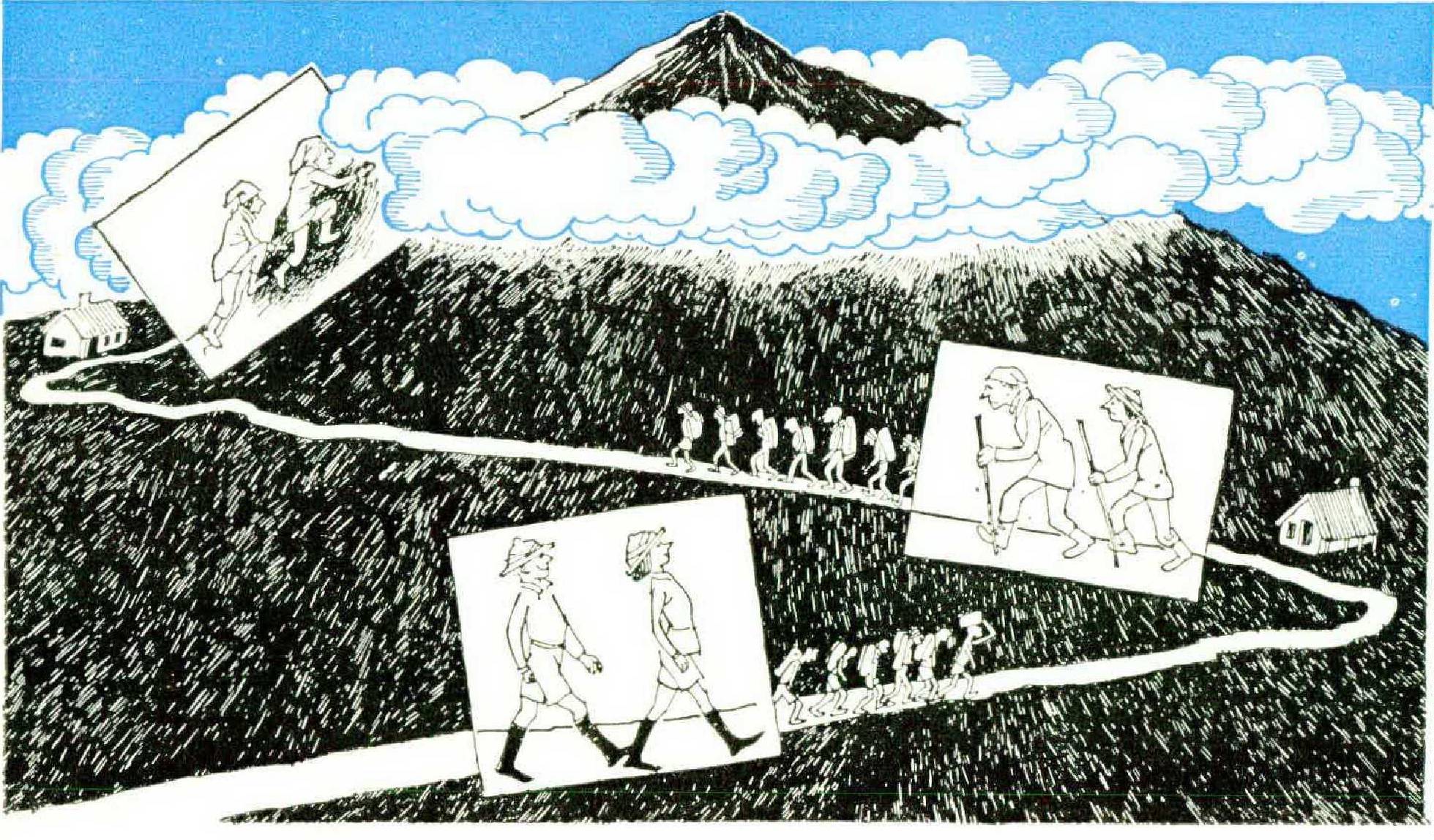
The sun was orange hot, steaming the jungle. A cooling breeze blew. We stood at the base in front of the Marangu Hotel, searching the skies once more for rock. “Where is the mountain?” we asked. The hotel proprietress, a healthy German lady who had climbed the mountain several times in her youth, extended an arm. “Just over there, behind those clouds.” I looked again and saw nothing of it. The mountain in a sly tactical maneuver was keeping itself hidden. I imagined that under its puffed blanket it was enjoying a tremendous joke on us. Was it not its rumbling laughter that made the clouds heave so?
In the hotel office on the following morning we studied a map. The proprietress traced with a baby finger the path we would follow to the top. She spoke with tender authority. We listened respectfully.
In a chilling mist we began our walk up, slowly, evenly, waving over our shoulders to the proprietress, who, with a faint smile, watched us depart. Our porters, barefoot, had taken off ahead at a light trot, carrying great bulky things on their heads which looked to have squeezed their chins to their chests. Our cook, Joseph, walked not far in front of us. He was the only African I had ever met who had a mustache that was successful; it pranced above his lips in irresistible crinkles and balanced the morning dew like diamonds on its crests.
Kumatari, our guide, paced behind us with lumbering steps. He was an elderly African, making his two hundred and forty-eighth climb. Tall and magnificent in his age, he had that awesome, irrevocable steadfastness that belongs to natural wonders of the world. He went well with the mountain.
I took a deep breath, blowing it out heavily in exultation. Moe, to my left, mistook this for a sign of exhaustion and began to advise me, as husbands like best to do. He stated with exuberant gruffness that we had hardly begun and was I going to turn patsy on him before we had encountered the real hardships? This was just a walk.
I was not complaining. Indeed, it was a walk, a pleasant and peaceful walk, on a clay road that cut through a foliage matted with jungle and orderly rows of banana trees. The Wachega tribe, whose gray huts clumped in shadows deep within, were coffee growers. They nurtured their delicate bushes on the mountain hills under banana tree fans. Above these struggled the wilderness, jagged branches, coiling parasites, leaves snarled like rats’ nests. And then rose the great green pines, dwarfing the life at their feet and in turn dwarfed by the peaks Kibo and Mawenzi, which capped the mountain . . . Kilimanjaro. We saw them now but briefly between passing clouds, solemn and majestic, remote. From where we viewed we understood suddenly why men of old worshiped the sun, the river Nile, the mountain. It is no waste of devotion to place one’s faith in such solidities. They are worthy of a man’s faith. Kilimanjaro commanded a man’s faith.
At noon we stopped for lunch, boiled-egg sandwiches and cheese. Kumatari, squatting on the ground between his bony knees, munched an apple. As we ate, we heard from ahead the thuds of approaching feet. Five or six climbers, tired, dirty, and uncaringly cheerful, appeared from around the bend, on the last stretch home. They did not stop to chat, so entrenched were they in their pace, as though they had descended all the way from the top with this same loping step; but they called out as they passed around us — for Moe and I had jumped up to greet them, making obstacles of ourselves in the middle of the road — that, yes, they had made it to the top. You bet. And how far was it to the hotel? Seven miles — oh, glory. And then they were around another bend, and we stood listening to the thuds of their steps grow faint. Now the porters heaved their loads aloft. At this signal we arranged ourselves and began to walk. Joseph had tied Kumatari’s jacket around his waist, as the guide had found himself warm. We did the same with our sweaters.
The road was becoming less pronounced. The banana trees had faded into jungle growth. Africans along the way, who saluted us sportingly as though we were the first to make the climb, became fewer and fewer. Finally we were alone, together in our file, the porters, Joseph, Moe and I, and at the last, Kumatari; yet we were each in our own world, removed from the others by the soothing vastness that lies between separately struggling minds.
And now I can say honestly, while we were strolling through an emerald jungle, engaged in a walk to a mountain peak which would assuredly be reached — and yes, at that time I knew with untested confidence that it would be reached — that after the first two hours the romance of it was gone. I state this as a remembered fact, yet I now feel nothing of the actual dreariness that was there. For after one experiences a great moment, all else is colored by it. But I am bound to say, though I do not believe it, that the rich landscape had become monotonous; that the walk was dulling, and being so far from the top, unchallenging. My thigh muscles hurt. The baby toe on my right foot was throbbing. And I had not the physical exhaustion which would have given me that satisfaction a person feels in exerting himself beyond his usual limits. I was glad when in late afternoon we arrived at Bismarck Hut on top of a knoll engulfed by mist. It was cold; the fireplace was clogged. We slept the night in a cloud of smoke, and awoke to find it was raining. Joseph, his mustache dripping with a seemingly self-perpetuated precipitation, presented us cheerily with fruit juice, cereal, eggs and bacon, and coffee. This did not seem to be consistent with the primitive ruggedness of a mountain climb. I started our walk frowning.
Now we were on a rolling plateau, sparsely covered with greenish-gray flora and the dull yellows and pinks of everlasting flowers. The rain had returned to mist, softly smoking the terrain. We walked up a hill, down a hill. Up a hill, down a hill; across a rocky brook. Up a hill. Down a hill. I hated coining down, feeling I had just made a wasted effort in going up, knowing I would have to make the same wasted effort again when we had finished going down. Once we met two German boys on their way back who asked us the time. We halted on the narrow path to let them by. We did not look behind to see their figures disappear in the mist.
We hurried our pace, following closely behind the porters. When Joseph found us for lunch, resting in a stone gully, he said we were walking too fast. “Poli Poli,” he advised, and with gestures he demonstrated the effects of altitude. We were at 11,000 feet.
That evening we came to Peter’s Hut, at an elevation of 12,200 feet. (Both Peter’s Hut and Bismarck Hut have been given African names since we made the climb.) We washed ourselves in a stream so cold that it stung our skin. A bird, one of the few that could survive at this height, sang echoing notes. Once again we encountered people who had come down from the top; they were spending the night in the hut. We clustered around the small tin stove in the cabin. Moe and I listened to their tales of the climb with an uncomfortable sense of frustration and foreboding. They joked seriously that the last part was begun at two o’clock in the morning because at that early hour you couldn’t see what you were climbing. If you could you’d never make it to the top. “Yes, but how was it? Really.” “You’ll sec.” From their descriptions, we gathered that the trip across the Saddle, the expanse of land which sweeps down between Mawenzi and Kibo, was exhaustingly unendurable, that the last five hundred feet up were excruciatingly unendurable, and that, as a group, they were very happy the whole business was over and they could sleep the night untroubled. I spent the night deeply troubled by altitude sickness, which kept me awake far into the night.
We were up early, and for ten unbelievable, beautiful moments, caught Kibo, the peak we would climb, in the uncluttered sunlight. We had not seen it since that glimpse on the first day out. Then it had been serenely majestic, unreal. Now it was immense and overpowering, alive, violent. It erupted. It soared. The sun banded it in gold phosphorescence, made its gray rock glisten, polished its icy dome. We watched it, breathless, and when a cloud passed over it we watched it still, studying its image that remained in our eyes with the illusive post-brilliance of an explosion.
Joseph approached, and detecting a haggardness about my eyes, withdrew immediately to make for both Moe and me an extra portion of porridge. A few moments later Kumatari emerged in a stocking cap pulled snugly over his ears. In the sun it was too warm for jackets, but our ears and noses, extending unprotected, were like ice. We breathed in air and blew out steam.
On that morning we walked again, but now over rocky hills. Forty-five minutes out from Peter’s Hut we came to the last water hole. The porters filled kerosene tins to the brim, and with these on their shoulders, left us behind to drink. They were still barefoot, though the night before I had seen them in shoes when they strolled about outside the cabin.
Two hours later we reached the Saddle. We came upon it from over a ridge. It dipped down coarsely from where we stood and swept across in a dull roll. On our right rose Mawenzi, a jagged finger of brown granite, veined with snow. Five miles distant, at the other side, stood Kibo, a peak that had had its top chopped off, strangely incomplete, encrusted with a circle of ice that remained the year round, though the mountain rested just off the equator. Cascading down 1600 feet from its barrel top was the scree. We could barely make out the path engraved upon it by the innumerable climbers before us. Another 1600 feet below the scree a spark glimmered as though someone were signaling us with a mirror. Joseph said this was a reflection off Kibo Hut, the tin shack we would spend that night in. It did not look far away, but we would not reach it for another three hours.
After lunch we lowered ourselves slowly onto the Saddle floor. The sun stayed behind in the world of man. We entered a thin gray atmosphere that drew our energy from us. The land was silent, brown, blotted with ugly boulders. Our path led on, marked with the footprints of former climbers. We read these as signs of an extinct civilization. In the distance we could see black specks that were men. For an hour we walked toward each other. Gradually their figures grew. At a mile apart we could see them distinctly, but we did not meet for another fifteen minutes. And when we did come upon each other in the flesh, it was with the impact of a collision, startling, catching us unprepared, for we had been tricked into viewing these distantly approaching figures as permanent parts of the landscape. We breathed slight greetings and within two steps were separated by soundless space, as though the meeting had never taken place, a disturbing, ungraspable encounter with a mirage.
The altitude began to play with us. Though we were walking up a gentle slope that in fact looked very flat, we had to stop frequently for breath. There were lead weights on my feet, which were becoming increasingly difficult to lift; my chest pushed painfully against an unyielding strip of rubber. For each step forward that I took, the tin hut, in reality only a mile away, withdrew ten giant steps backward. We dragged on, pacing ourselves off in whispers; after every sixty feet we stopped, our bodies heaving, without even the energy to laugh at the ridiculousness of working so hard to accomplish so little. What was this anyway? Pure silliness. Certainly no mountain expedition. Moe, who had not shaved for three days, looked ragged. I was trying with some difficulty to overcome an urge to cry. Had we not been closer to the end than to the beginning, I would not have gone on. Inwardly I was already back at the Marangu Hotel, wrapped in six blankets, soaking my feet in hot water, describing in vivid detail to a rapt audience the experience of climbing a mountain. “But how was it? Really.” “You’ll see.” At that point it was not necessary for me to reach the top to know what it would be like in those final moments of the climb. I knew already, I thought.
Kibo Hut approached us, or so it now seemed, for assuredly in our feeble efforts we were making no headway toward it. Then we reached it, and once inside, we
crawled under blankets that the porters had laid out for us. It was unbearably cold. We chattered as we spoke; when we did not speak, our mouths moved anyway. Joseph came in later with hot soup. Ah, Joseph. He now acquired the aspect of saintliness. Could anything else at that moment have been better? As the weird twilight became night, we curled ourselves into stiff balls under the blankets and tried to sleep.
A speck of yellow entered the room. It was Joseph with a candle and more hot soup and an encouraging cheerfulness that made us grumpy. “Now you climb to top,” he said. We struggled from under the blankets and began to pull on our boots, our sweat shirts, our jackets. Moe jerked a tassled ski hat over his head. I fiddled into three pairs of gloves. Outside we met Kumatari, who had donned a woolen army uniform and hiking boots, clothes that were old and venerable, having served him many times before in his climbs. His reason for being had arrived. He would lead us to the top. Joseph and the others would remain behind.
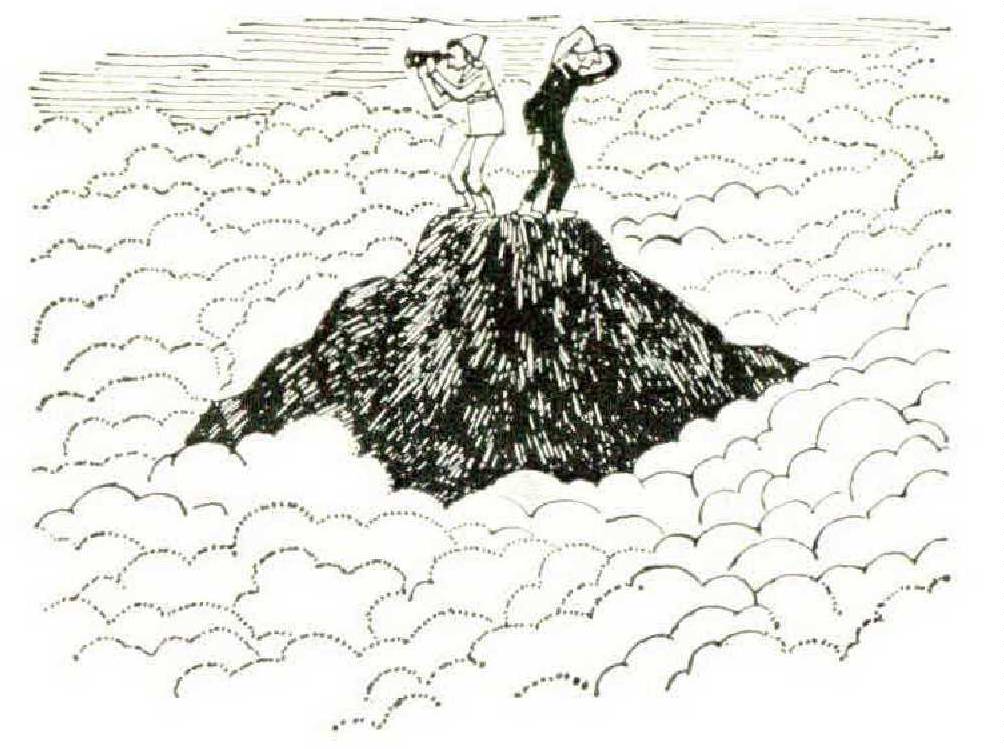
At 4 A.M. after we had clumped up still more hills, rock hills that angled at an acute degree, we hit the scree, and for two more hours made our way up it crosswise, little mice scurrying futilely up a sand heap. We came to snow sixty feet from the top. Over our shoulders we saw the red glow of dawn, lifting above the clouds like rose petals. Below us, to an endless depth, sank the mountainside. For another hour we slipped and clawed. The air, empty air, froze expressions of frowning agony on our faces. My body ached with a dulling consistency, a numb vehicle at odds with my spirit. Inexorably we were being whittled to nature’s size. Ten feet. Slip, claw. Rest. Touch the top now almost with an extended arm — no, too far. Out of reach. Slip. “One step forward . . .” Claw. “Two steps back; that’s the line of our attack.” Rest. There, the summit. Five paces. Just up there. How far! Oh, almost. One last effort. No. A final effort, the very last. No. I can’t. Will it never end? Slip and claw. Rest. Now . . . now. Make it in a dash. No. I can’t move. I cannot move. Kumatari. Slip. Two hundred and . . . forty-eight times. Claw. I can’t breathe. Can’t breathe. Rest. What could possess . . . the man. Lord of Heaven. Mountain. You cursed rock. I hate you. I HATE YOU. Slip. Claw. One step. Yes. Two steps. Oh, yes. Oh, Oh, Ohhh. Moe. We’re on the top. Moe, WE’RE ON THE TOP. WE DID IT. MOE. KUMATARI. WE DID IT.
We did it. And then we came down. How was the view? people asked us when we returned. What view? We had not seen the world that lay at our feet 18,700 feet below. The peaks Kibo and, across the way, Mawenzi had rested on a layer of clouds, like iced rock piles on a pink cotton-padded barge. But I do not think, now, that people climb mountains for the view.