The Book Fair
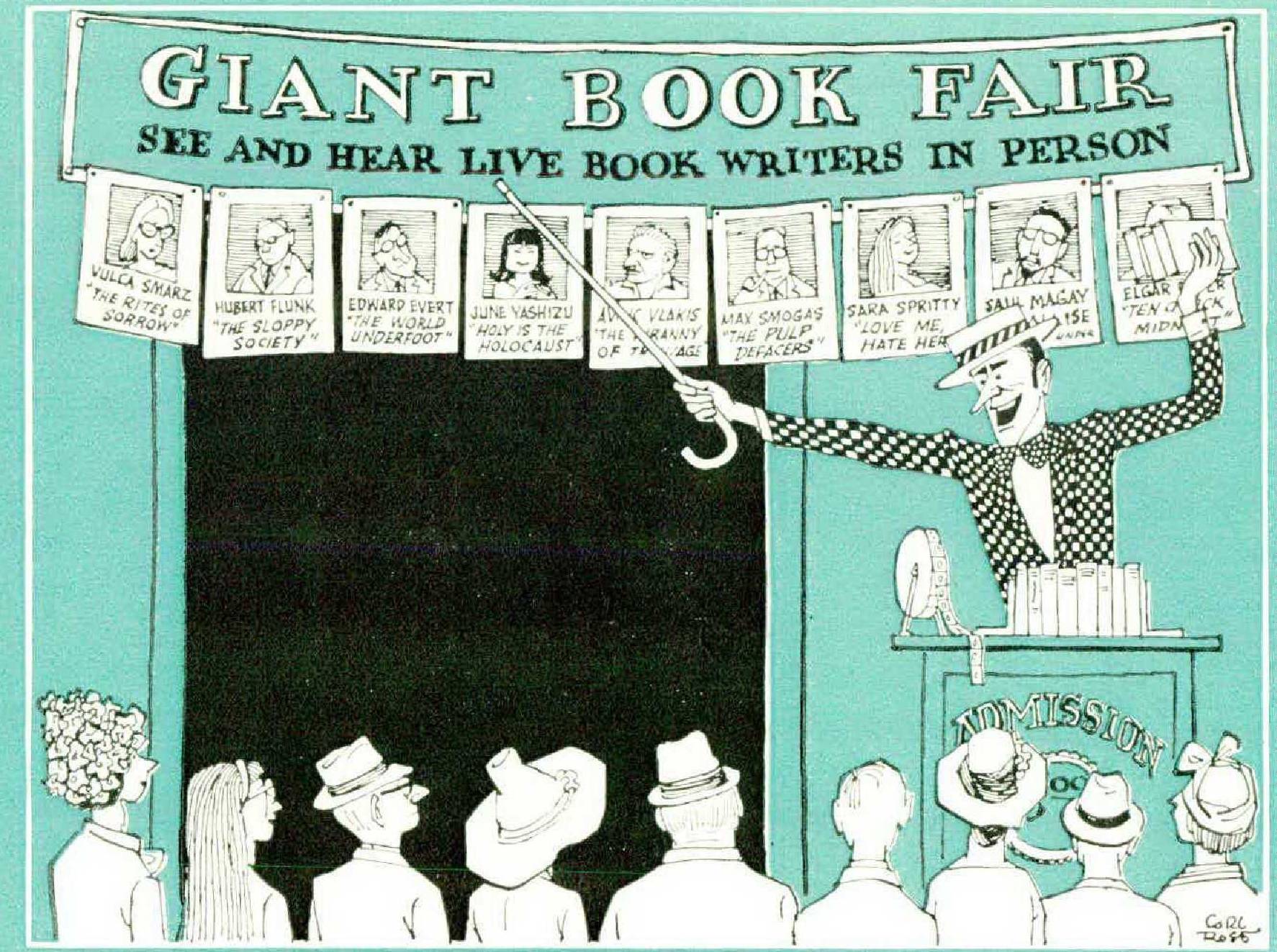
Book fairs, those curious public entertainments where a handful of writers may talk on the congenial subject of themselves to as large an audience as will pay to hear them, continue to exist and continue, moreover, to be popular. People go to them; they seem to like them; they come away satisfied and even happy. This is strange to me, for I have been to three book fairs in my life, and each one was, in its own way, a disaster.
The first of these was held in Boston during the final days of World War II. It was sponsored by a newspaper which had a tradition of supporting culture as long as it didn’t cost anything. In that year the excess profits tax was still in effect; the choice was either to pony up for literature or give it all to the government. Once again the lesser of two evils won; there was a book fair.
The setting was Symphony Hall. On the night I went, the hall was packed, the stage bulged with writers, and the master of ceremonies was a well-known publisher who seemed overjoyed about the whole thing until he discovered that the public-address system had broken down and could not — or at least would not — be repaired. At this point he pushed the useless microphone to one side and announced in a forlorn voice barely audible beyond the lip of the stage that the program would go on as scheduled, but that he would have to beg our indulgence. He was interrupted in this statement by a peremptory, cavernous voice from the balcony.
“I cannot hear you!” it bellowed. “Kindly speak into your machine!”
The master of ceremonies went into a rather pathetic pantomime, intended to indicate the nature of the problem; hurriedly, he introduced the first writer. The writer spoke, but not a word was heard; once more the bellow came from the balcony.
“WOULD YOU HAVE THE GOODNESS TO SPEAK INTO YOUR MACHINE? THEN PERHAPS THOSE OF US WHO HAVE PAID TO HEAR YOU MAY DO SO!”
The master of ceremonies rushed back to the center of the stage again and repeated his explanatory pantomime; it did no good. The book fair continued, a dismal dumb show broken only by the fierce patrician shouts from the upper air which kept on — or so it seemed to me — until the very end.
Years passed. I wrote my first book; I was invited to speak at a book fair in Providence. I shared the platform with three others; my immediate companion was Miss Jessica Dragonette, author of the recently published autobiography Faith Is a Song. She was not, however, the star of the day. That role went to a monsignor, a literary monsignor, a smooth and handsome man who wrote a syndicated column for diocesan newspapers in which he regularly rebuked the leading writers of the day. On his face there was a smile of gentle pain: it was obvious that, for this day only, the monsignor was playing the small time.
An announcement was made that each speaker would be allowed eight minutes, no more. I spoke, Jessica Dragonette spoke, another writer spoke. Then the monsignor spoke. He was easy, he was polished; he was interminable. The minutes passed; the audience began to grow restless. At the end of thirty minutes the restlessness amounted almost to revolt; the monsignor’s smile of pain became more pronounced, and suddenly he said, “Ladies, there is no cause for alarm: I shall be finished when my eight minutes are up!” And he talked for ten minutes more.
After the speaking, we dismounted from the dais and mingled with the crowd. To my astonishment I was immediately surrounded by a great number of women. I had expected nothing like this; was I, now, meeting my readers? Had I fans? No. Without exception, they all wanted to know how I had enjoyed talking to Jessica Dragonette.
My third book fair took place some years later in the ballroom of a New York hotel. Fro n one point of view it must have been an immensely successful affair, for it was crowded. I had never seen so many women gathered in one place (the comedian Fred Allen, reflecting upon his experience at this book fair the previous year, said, “It looked as though someone had overturned a Y.W.”). I was the last speaker on this occasion, being preceded by two others. The first of these was a European woman who had undergone great hardship during the war in a succession of forced labor camps. Her trials must in fact have been ghastly, but for this audience she had evidently decided to transform them into something comic. “Ho, ho, ho,” she said, and talked of running, lightly clad, through the snow in sub-zero temperatures, of having boisterous snowball fights in the prison yard. It all seemed rather jolly, but the reality beneath somehow came through, and I saw the women in the audience looking at each other. They were becoming uneasy.
The second speaker was a doctor who had written a book on cancer. His opening sentence was arresting. “One year from now,” he told the ladies, “twenty-five percent of you will not be here!” Uneasiness gave way to frank alarm, but the doctor had just begun. Grimly he went on, drawing from a depthless mine of grisly statistics; in a matter of two minutes he had his audience shaking and ready to run. By way of conclusion he reminded them that the time they spent in their baths was perhaps the most important time in their lives. “For it is here,” he said, “that you may examine yourselves for suspicious lumps!”
It was against this backdrop that I spoke. From the first word I knew that nobody was listening; my audience was lost before I began. I was conscious only of what appeared to be a universal rustling, of movement, all the time I spoke. It was the audience, surreptitiously beginning their search for suspicious lumps.
I have not since been to any book fairs.
Charles W. Morton is ill but is expected back in his accustomed place soon. His guest contributor is the author ofTHE LAST HURRAH, THE EDGE OF SADNESS,and an important new novel,ALL IN THE FAMILY,to be published in September.