Prestige
R. P. LISTER, who lives in London, is widely known for his light verse, hut he sends us an occasional bit of prose which we are pleased to share with ATLANTICreaders.
Prestige — call it status if you like — is in great demand these days. It is nice stuff to have, too, but it is not everything. It is like money, or sex: it is only important when you don’t have enough of it. The moment you have enough of it, you take it for granted.
I speak as an authority, since prestige has always come easy to me. Of sex I will not speak, except to say that I find it a dingdong battle, as do most single men I suppose; mostly it works out well enough, though a disproportionate amount of time and effort has to be expended to keep it that way. With money, though, I am always on the losing side. I have never had nearly enough of it, and the result is I think about it constantly. I never think about prestige at all, but it homes on me, like taxis. I never take taxis, but wherever I go they crowd around me in herds, like curious cows. I suppose they catch the rich whiff of prestige, and fail to realize that there is no money to go with it.
I was in a pub not long ago, and a man asked me if I had been to Norway. I replied, without thinking, “Two or three times, but never south of the Arctic Circle.” I could see he hated me immediately. He had been about to make an OK remark himself, and mine killed it stone dead. If I had thought of it in time, I should have made some noncommittal remark implying that I had once spent three days in Oslo. Then he would have bought me a pint of bitter and told me about his travels in Scandinavia. Instead of that, he went off to the Queen’s Head by himself, looking rather depressed.
I was with a bunch of poets once in an attic in Wigmore Street. One of them said that he had just bought the Dorothy L. Sayers translation of Dante’s Inferno and did not think much of it. Leaping to the defense of a respected craftsman, I said I thought it excellent. The poet asked me, with some condescension — since he knew I was a scientist, and virtually illiterate — what other translations I had read. Possessed, as usual, by a devotion to the simple truth, and a ludicrous lack of restraint in uttering it, I replied, “Previously, I’d only read it in Italian.” I never dared to go there again, which was a pity, since the poets, though disorderly, were occasionally amusing.
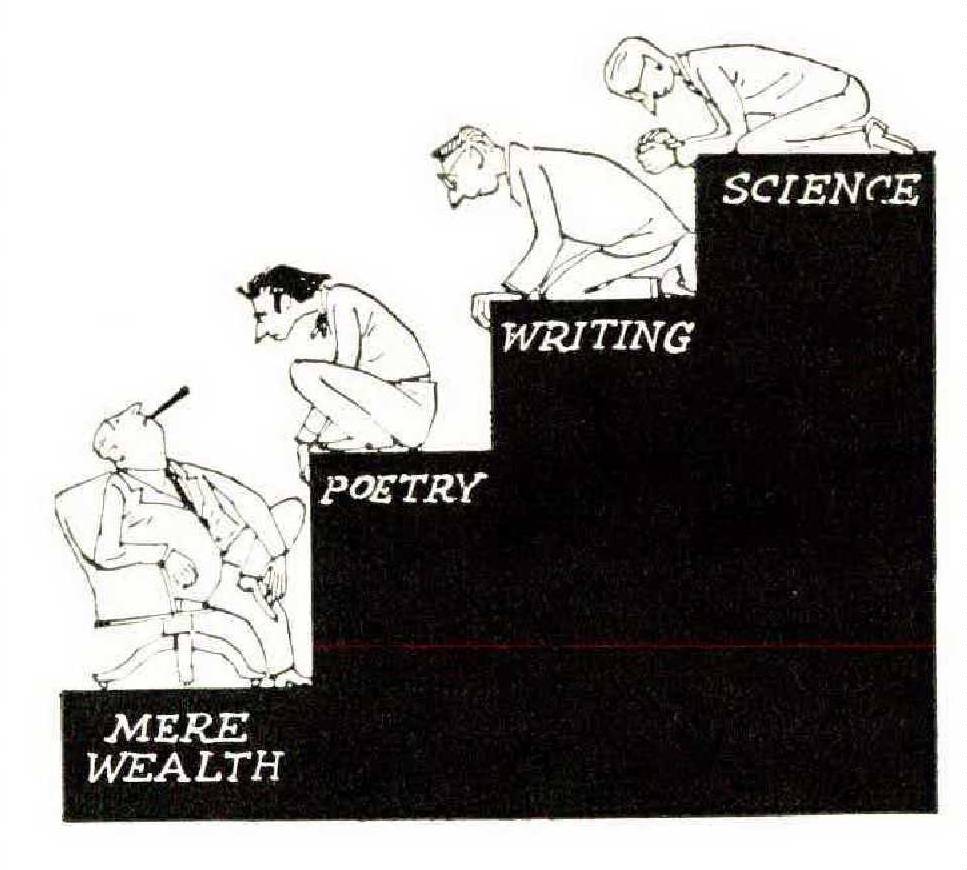
All this excessive, and unmerited, prestige comes partly from being a writer. As a scientist, though I was more useful to society, I had little prestige. When I became a writer I discovered that it was inherently an OK thing to be. People at parties ask me, languidly, “What do you do?” I say I write. Immediately they gush like uncontrolled oil wells. They say, “How interesting!”, and ask me to come to cocktails on Tuesday. This is one of the few solid benefits of prestige, that it brings in its train a lot of free alcohol.
In fact, writers are not necessarily at all interesting. They may be interesting or they may not, just the same as architects, engineers, or advertising men. They are rarer, that is all, so that people have less chance to find out how deadly dull they can be.
When I was in America, this form of prestige came even more easily, because I was an English writer. The Americans are remarkably nice to foreign visitors anyway, and although they can be quite rude about the English sometimes, nationally speaking, I found no trace of this understandable though regrettable attitude in personal contacts. On the contrary, to be English appeared to be a positive social asset. This was astonishing, and even touching. English people are deeply suspicious of other English people — and of anybody else, for that matter — so that the Englishman in England is accustomed to being received, if at all, with chilly reserve. In America it is not so. As an English writer, I was asked everywhere and had a wonderful time.
Travel is another of the things that bring prestige, though on the whole, people who have traveled a lot are much more boring than people who have never been anywhere. I was in China a couple of years ago, in the capacity of a journalist, though I was disguised as a tourist. This is not really at all interesting in itself, but I fully expected that after my return this visit would confer some additional status whenever I could drag it into the conversation, since it is rarity that appeals, and not so many people have been to China lately. What I did not expect was that prestige would dog my footsteps in China itself. I had not been long in Peking when Mr. Li asked me what I did for a living back in the corrupt West. I was a writer, I told him. When he asked me what I wrote, I confessed that I was to some extent a professional poet. I made this deplorable avowal with my usual apologetic mien, conscious that I was revealing myself in a bad light. To my astonishment the attitude of Mr. Li, and his colleague Mr. Chao, immediately became almost deferential. Poets, it seems, have prestige in China, though they have negative prestige everywhere else.
It was a refreshing change to be highly regarded merely for being a practicing poet, but this was not all. I was hobnobbing with some openhearth men at the Wuhan Iron and Steel Works when it occurred to me to mention, in order to establish some common ground, that I had once worked in a steelworks myself. The effect was remarkable. In England, if I ever mention that I once worked in that noble industry, the announcement is greeted with a mixture of amused incredulity — since all the English know that steelworkers are huge hairy men who keep whippets and mostly speak only Welsh — and nervousness that I should be so indecorous as to confess it.
In China it was far otherwise. To be a poet was a big deal, but to be a poet who had once been a steelworker exposed me at once to the full floodlight of Chinese esteem. From then on I could do no wrong. Even when I ventured to suggest that the proportion of the American people who, starved into subjection by a tyrannical oligarchy, were eagerly awaiting the opportunity to overthrow the United States government was, according to my own observations, appreciably less than their own estimate of 90 percent, my hosts merely smiled indulgently, as at an innocent but lovable dupe of Western propaganda.
Prestige comes at me from all angles, not only from literary ones. A few years ago, as an unusually clumsy beginner at skiing, I was on my way up the Kriegerhorn with a friend when we simultaneously fell off the drag. Our class went on without us. Rather than go down to the foot of the drag and fall off it once again on the way up, we plodded up to the final chair lift on foot.
Arriving at the summit, we found that the class had gone on ahead, expecting to find us waiting at the bottom. The mountain was deserted. After sitting in the sun for a time, in a state of terror and despair, we decided to ski down. Our descent of the Kriegerhorn was the most ludicrous exhibition ever staged since the first Lapp tied a pair of planks to his feet. We fell at every turn; between turns we dived off both sides of the piste into drifts, head first. I left my woolly hat in one drift and my broken sunglasses in another; my companion tore the seat of her pants, so that a square foot of scarlet underpants showed through.
We found our class eating lunch on the terrace and rejoined them with shame, but the shame was brief, turning at once to glory. It appeared that for beginners to descend the Kriegerhorn unaided was a feat of rare daring. From then on we were pointed out in every beer cellar in this section of the Arlberg as incipient tigers, a prophecy which has since proved wholly incorrect.
It was gratifying. Prestige is pleasant, as I remarked earlier; but it is not everything. I would trade some of mine any day for solid cash, if I could do so. Equipped with more cash and less prestige, I might go skiing more often. As it is, equipped with limitless prestige and a marked inability to descend the Kriegerhorn without falling down, I am more likely to end up back at the old steelworks, breeding whippets.