Artists as Ambassadors
Recently, three distinguished American poets, Robert Lowell, Stanley Kunitz, and William Jay Smith, gathered with one of the brilliant young Russian poets to discuss their art and its role in human understanding. The discussion, with Andrei Voznesensky was televised over WNDT/Channel 13. Here is their conversation.
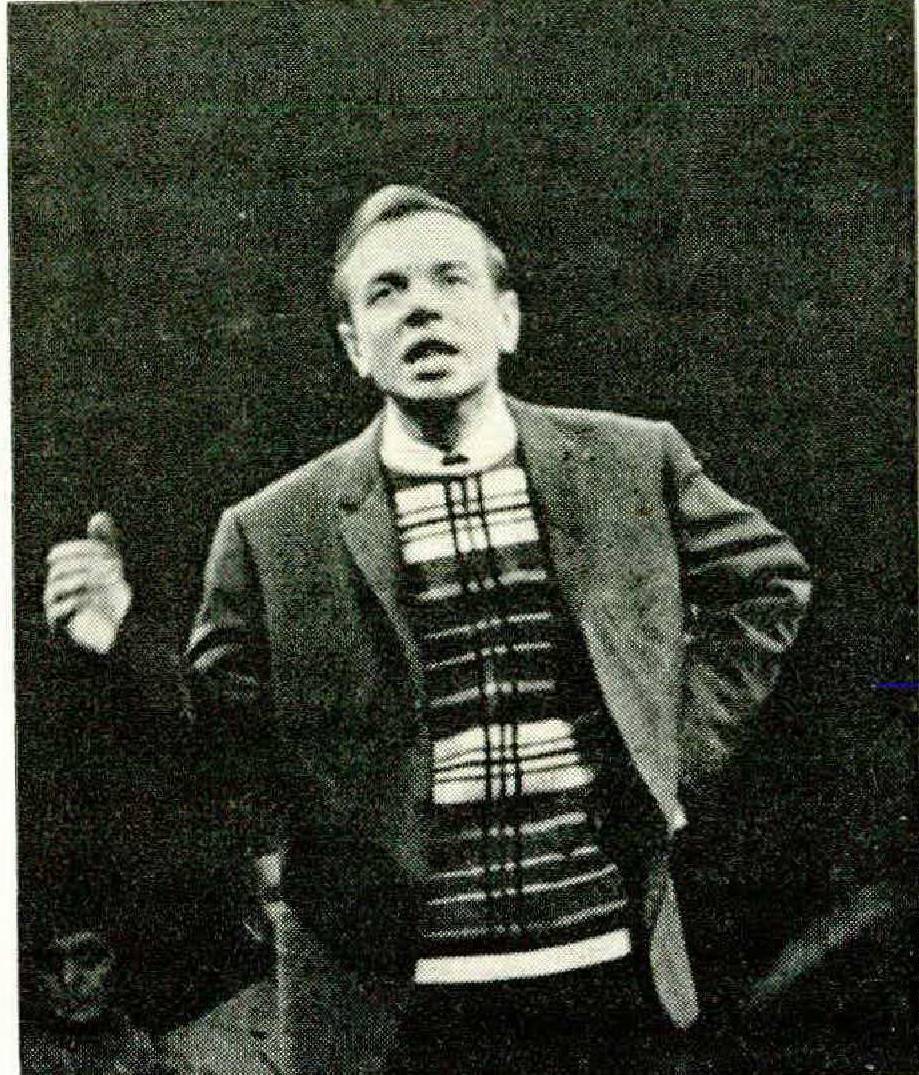
A Talk with ANDRE I VOZNESENSKY
KUNITZ: Andrei, may I ask you to tell us something about your beginnings as a poet, how you became a poet, who influenced you, and perhaps, what it means to be a poet in Russia?
VOZNESENSKY: [in English] Before I became a poet I was a student at the Moscow Architectural Institute. I wanted to be an architect, of course, and I painted a bit too. Then I sent my first poems to Pasternak, and we became friends. I think this was the beginning of my literary life. But there’s nothing more to say about me, because my life story is my poems. As for your question about Russia and the poet, I think it would be better if I spoke in Russian. . . .
I would say that in Russia the national art is poetry — just as in France the national art is painting. Therefore the place of the poet is somewhat different in Russia than in other countries. I know it may look a bit cheap and spectacular — the business of editions of poetry of 100,000 copies, the thousands, even the millions, of poetry lovers — and yet there’s nothing sensational about it. It’s merely part of the natural life ot poetry in Russia.
I suppose it has something to do with what you would call the enigmatic Slavic soul. Actually, poets in Russia have always had a special place, from Pushkin through Blok and Pasternak; they were not only poets but prophets as well. And therefore our poets bear a great responsibility. I’m happy I was born in that country.
You were asking about influences on me. I think that if there were any, I was influenced more by philosophy than by poetry. The only poet who influenced me was Pasternak, who was my god, my father, and for a long time, my university. And my literary institute too, although, unfortunately, I never finished the course. LOWELL: I’m fascinated by your connection with Pasternak. When I was a young man I became friends with several older poets, Allen Tate and John Crowe Ransom, and I found it hard to learn what they had to teach, and harder still to unlearn it. I was wondering whether you found Pasternak — your poetry seems to me like his and yet very different — whether you found him an engulfing as well as a stimulating influence and friendship. VOZNESENSKY: At first I felt that it was overwhelming. I’d like to tell you about something that happened to me which almost put an end to my literary career. We were very close, Pasternak and I, but in the summer I would go off someplace on vacation, and once I came back to see him, with a notebook full of new poems. He listened to them, then went upstairs and came back with some poems of his own, among them the poem “Autumn.” And the extraordinary thing was that some parts of it were exactly like what I had written.
Poetry now seemed to me like a chess game when, knowing the previous moves, you can anticipate the next. I was very depressed and went home. I was happy in a way about the resemblance, of course, but I was discouraged. For two years I stopped writing poetry. Then I did some painting, and later when I began to write again, I felt that nothing of Pasternak remained in me.
It’s difficult, of course, to say what influences you — it could be just the weather.
LOWELL: I just want to ask one more question about Pasternak. I’ve translated him, but I don’t read him in Russian. He seems certainly one of the very few great poets of this century in any language. There’s a power of variety in his verse, and nobility of character. I wonder how you’d place him in Russian poetry and how you’d describe his greatness.
VOZNESENSKY: You said that you don’t know Russian. I’d like to tell you something Pasternak said about translation, at which he was very good. He had translated Shakespeare, and he was accused of inaccuracy. People said he had used the word shoes instead of boots — or maybe it was monkeys instead of shoes, I don’t know — but in any case, he was accused of mistranslating. He said to me: “Of course, there are differences between me and Shakespeare, but what really matters is that Shakespeare was a genius and I am a genius.”
So I think that when good poets translate good poets, the essence comes through, whatever the form of words. I know that Pasternak corresponded with you and that he respected your work very much. As for his position in Russian poetry, I just don’t know. He is my favorite poet. Mayakovsky said he was a genius, and he certainly was. In any case, after the Revolution there were two poets of genius, Mayakovsky and Pasternak. As to who is the greatest — that’s a matter of taste.
Pasternak is a poet’s poet. In poetry he is an engineer, an inventor. And if you were to name any one person who had the greatest influence on the greatest number of modern poets in Russia, it would, of course, be Pasternak.
SMITH: May I ask, Andrei, what other poets outside Russia you had read when you began to write? In your new long poem, “Oza,” there’s a marvelous parody of Edgar Allan Poe’s “The Raven” which I’m very fond of. Did you know other American or foreign poets when you began to write? VOZNESENSKY: Yes, I was very deeply influenced, and for a long time, by Lorca. And when I first heard Dylan Thomas on a phonograph record, I was utterly mesmerized. Among the French, I like St. John Perse very much.
As regards contemporary American poetry, first I’d like to say that I am particularly happy about the evening at Hunter College [where Voznesensky read his poetry, on March 24, followed by translations of his work by W. H. Auden, Jean Garrigue, Stanley Kunitz, Stanley Moss, William Jay Smith, and Richard Wilbur]. I felt that evening that I had somehow been joined together with what is best in American poetry at present. I’ve never done any translation myself — or almost never — but now when I get home I’d like to do some. It’s important that this good American poetry should ring out, not only in English but in other languages as well. In the English-speaking world, American poetry is my favorite. But I want my love for American poetry to be less platonic, and more intimate.
KUNITZ: Andrei, at one stage in your career, you were criticized, I recall, as being a “formalist,”a word that has no meaning in American or English poetry. And I remember that you replied in one of your poems to your critics by saying that they “stank of formalin.” You also referred to yourself as being “among avalanches, like the abominable snowman, absolutely elusive.” LOWELL: Have you had any wonderful critics who were instructive to you and told you things? VOZNESENSKY: Yes, of course. There are all kinds. But it seems to me that first of all you have to believe in yourself.
SMITH: May I go back to your training as an architect? I’d like to ask you about your background in painting, because it seems to me that your visual imagination is so strong in your poems — and your use of the eye. Do you still paint, and are you still interested in painting?
VOZNESENSKY: I’ve been painting right up until very recently — painting quite a bit. It seems to me that an artist shouldn’t confine himself to a single art. Just as in sports, for example, athletes take part in all kinds of competitions, and do other sports for training. I’d like to be able to project the things I’ve learned in architecture and painting into poetry. Because just living in your own literary confines is like falling in love with your own relatives.
LOWELL: You’re never going to draw plans for buildings again, though?
SMITH: Well, in your poem “Florentine Torches” you mention the fact that there’s a sort of ghost that follows you and reproaches you for not having kept on with your architecture.
VOZNESENSKY: Perhaps someday architecture will have its revenge, and I’ll be killed by a falling brick.
SMITH: You’ve recently been involved in the theater, I understand, with writing for opera. Would you say something about that?
VOZNESENSKY: Yes, we have an experimental theater in Moscow called the Taganka Theater, which mainly produces works of poetry for the stage. For instance, they put on my Antiworlds, and now I am collaborating on an opera for them.
Why do I love the theater? For one thing, it’s because I think there must be a limit to the poet’s public appearances. Actors should read poetry, and not always the poet himself. KUNITZ: I’ve been interested in some of the technical aspects of your poems. Particularly the strong use you make of auditory patterns, the relationships of sound within the poem, the echoes, the assonances and consonances. And then the freefloating rhyme pattern, the use of the conversational idiom. And this, of course, is what makes your work particularly difficult to translate. VOZNESENSKY: Our time is a time of contrast, and there has to be some kind of music of the higher spheres, like an organ in church. Poetry is assuming some of the functions of religious art. At the same time the most way-out slang acts like the ground for an aerial. Poetry has to be grounded. There’s beauty in the heavens, and there’s the dirt of the earth.
KUNITZ: I read an article, I remember, that said that your Goya poem was untranslatable, because of the sound play going on in it, those hard G sounds, and all those assonances. And that, of course, was such a challenge that I thought, I’ve got to try it.
VOZNESENSKY: It seems to me that you’ve done a good Job. I don’t think it’s true that poetry is untranslatable. The only element which is untranslatable is the music, but — SMITH: But we are all here to testify that we have tried, at least.
VOZNESENSKY: There’s a certain tragic essence of a poem — the figures, the images — that can be translated. If it’s real poetry, it can be translated. LOWELL: There’s an essence, at least, that’s suggestible.
VOZNESENSKY: And in a translation you can see whether it’s real poetry or not, because the chaff is winnowed out in the translation, and only what is really valuable remains.
KUNITZ: And poets are always attempting the impossible, anyhow.
LOWELL: I was interested that you spoke of poetry as the Russian national art, and painting as the French. Of course, what strikes us in English is the Russian novel — I mean, it translates more easily; but it’s something more than that, I think. One feels the Russians almost invented the novel, Gogol through Tolstoy. It’s very different from our nineteenth-century literature, where the novel wasn’t an American specialty and our works tend to be allegorical. I’ve wondered what it feels like to have that enormous prose tradition behind you, and I think of Tolstoy particularly, who described War and Peace as being like the Iliad, which it seems to us.
VOZNESENSKY: Of course, at the end of the nineteenth century, prose was very strong, very highly developed. But somewhere around the turn of the century the balance shifted toward poetry. LOWELL: Yes, that’s what one feels. These things run out. You have Italian Renaissance painting, then it stops. Art doesn’t advance, but it has these marvelous runs. Then it turns somewhere else. VOZNESENSKY: Here I’m something of a nationalist — that is, a patriot of poetry. I like to think that poetry is all-important. Actually, the essential difference between poetry and prose is less in the form than in the various roles assumed by the poet and the prose writer in Russia and in other countries. As I was saying before, Russian poets have traditionally been prophets — and so have prose writers. Tolstoy was a prophet. Most of our writers have had a Messianic or missionary approach to literature.
SMITH: You’ve said that poetry is the national art of Russia. Do you think that this is because the oral tradition has been kept alive more in Russia than in Western Europe or America? — that is, poetry being recited by the people? Of course, this is the tradition which has been so alive in Ireland and Wales right up until the present day. But in the present century, poetry has perhaps been written more for the eye than for the ear. That’s less true in Russia, isn’t it? VOZNESENSKY: The tradition of reciting poetry is not only alive, but it’s growing all the time. Pasternak, Blok, Akhmatova, Esenin always made public appearances before large crowds. But things are on an even greater scale now. Poets read to 14,000 people in sports stadiums. So this tradition is spreading. My friends and I in Russia have to some extent widened the scope of poetry in this way. But I would like to say — and here my opinion is different from that of my colleagues — that now our task is to narrow it down and make it more profound.
LOWELL: Make it more difficult, and for smaller
audiences?
VOZNESENSKY: Yes.
KUNITZ: Andrei, the great Goethe said that the poet is like an eagle who flies at such a height that he does not even know when he crosses a frontier. Your work and your presence here remind me that the poet, no matter how deeply rooted he may be in his national heritage, belongs to the fraternity of the arts, a true fellowship that ignores frontiers.