A Painter's Search for Meaning
In 1964 the Philadelphia Museum of Art gave Franklin Watkins a retrospective exhibition which showed his versatility and the wide range of his subjects. In. this article the director of the H. F. Du Pont Winterthur Museum talks with the painter about the way he reaches his decisions and the methods he prefers.
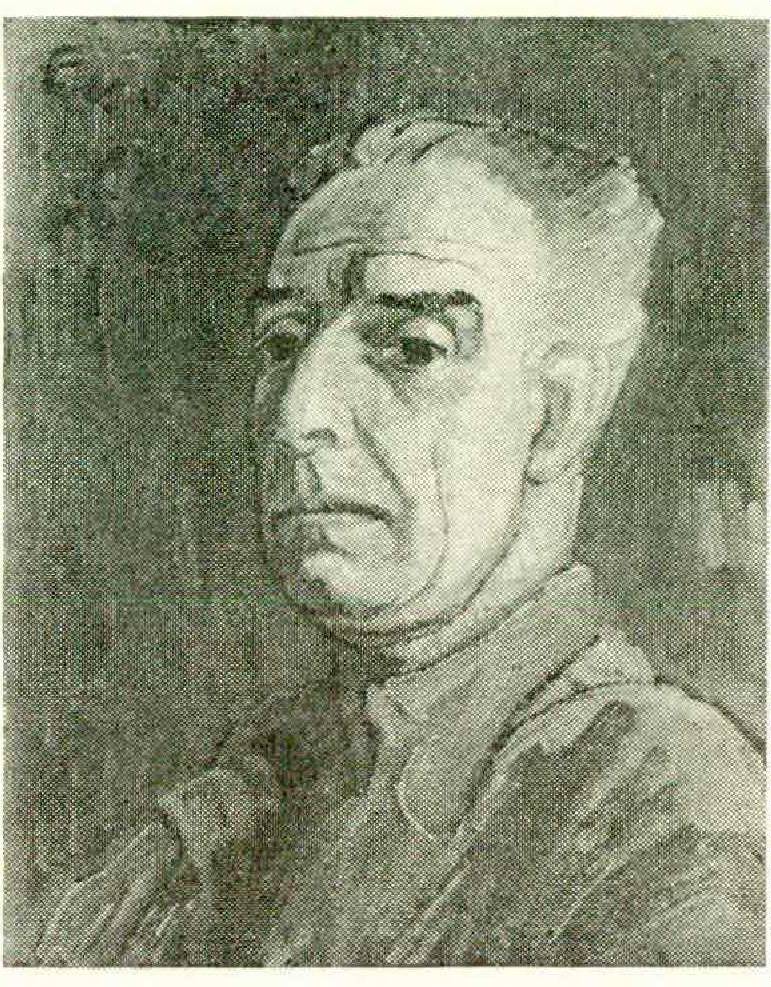
E. P. Richardson on FRANKLIN WATKINS
FOR twenty years Franklin Watkins has interested me as a stylist and also as a humanist. He is a rarity among American painters in that he works in the full historic range of painting, imaginative subjects, religious compositions, portraits, landscapes, still lifes. His record of twentieth-century Philadelphians is interesting, and a hundred years from now it will be an absorbing game for someone to reconstruct the Philadelphia of our time on the basis of his portraits.
Watkins is an urbane, civilized man and delightful company. But he is an elusive personality, and when you ask him a question, he laughs and in five cases out of ten parries with ease and wit. There is an aloofness about his work in spite of its positive character, something light, impalpable as sunlight, yet vital and vivid.
Since he outgrew his art-student days, Watkins has never belonged to any movement but his own. He has had a name since the Gold Medal of the Carnegie International Exhibition was given in 1931 to his painting called Suicide in Costume. At that time he was a complete unknown. “Never heard of him. He’ll be a flash in the pan” was the reaction of the critics. The jury of award that year was composed of solid, rather conservative painters — Henri Le Sidaner of France, Paul Nash of London, Cipriano Efisio Oppo of Italy, Randall Davey, Jonas Lie, and Eugene Speicher from the United States, and Homer St. Gaudens, chairman — but its choice was criticized as rash and capricious.
When the Philadelphia Museum of Art gave Watkins a retrospective exhibit in 1964 to mark his approaching seventieth birthday, I asked what the exhibition had done for him. He thought for a moment. ”I had always gone along believing I had very few friends. When I won the Carnegie prize, there was a ballot for the popularity prize, and I got only fourteen votes out of more than 5000 cast. One thing the exhibition did for me, Ted. When all those people came to the opening, I had for the first time a feeling that I had lots of friends, a real audience.”
Watkins divides his life between a studio on the New Jersey shore and a house in Philadelphia. When he is concentrating upon a picture, the studio at the shore gives him the needed isolation; and his wife, Ida, loves surf-fishing. Until the past year they had a house in Avalon. The town authorities announced that the tidal marsh upon which they looked, a solitude of marsh grass sweeping off to a line of pines where the ospreys found their last nesting place on that part of the coast, was to be rezoned for building lots. They sold their property and moved to a beach at Loveladies, near Barnegat Light.
Once every week Watkins returns to Philadelphia to criticize the life class at the Pennsylvania Academy of the Fine Arts. The method of teaching at the Academy is still in essence that brought back by Thomas Eakins from Paris a century ago: first drawing from casts of the antique to train the hand and eye in exact control, then painting from the human figure. The school occupies the ground floor of the massive building designed by Frank Furness and opened to celebrate the Philadelphia Centennial of 1876. Once a week a working painter comes in to criticize the students’ work: Watkins today, as Eakins did a century ago. Generations of painters have taught, and learned, their art in this way, which combines discipline, the placing of responsibility for his progress upon the student himself, and contact with an active practitioner of the art. It is the method invented by painters when they first freed themselves from the medieval guild system of apprenticeship. Today it is perhaps the oldest living tradition of their art; and the artists who teach at the Pennsylvania Academy of the Fine Arts, the first American school of art, believe in it and are proud of it. “When people ask me why I am so fond of the Academy,” Watkins explains, “I say I have no alma mater but that.”
In town the Watkinses live in what may well be one of the last undisturbed blocks of brownstone houses in existence. The house has had interesting inhabitants. Phillips Brooks wrote “O Little Town of Bethlehem” there. Another owner, a Roosevelt, added to the library upstairs wood panels from an ancestral home in Holland, and a great Dutch kas. Watkins has filled the house with paintings and put in an elevator. Riding in this is the great joy of their Italian poodle, Assuntina.
The studio is on the top floor. “Some of my sitters are apt to be rather elderly and important, you know. I can’t very well ask them to climb five flights of stairs,” he said once. It is a rather bare room, with plain gray walls and a surprising number of chairs of differing shapes and upholstery (leather, brocade, armed, armless) to suit the client. A north light has been built into the ceiling. The front windows look out into the tops of sycamores and the windows of the house across the street.
“A beautiful light,” I said.
“Yes, it is. It always leaks, though,” he said, looking upward. “I’ve had any number of roofers and repairmen here, and they say, ‘This time we found the trouble.’ But when the rain strikes it a certain way, it comes through.
When you are doing something that has been done before, you are wallowing in the big stream. You are not stepping off into an area of individualism. So there is a chance that you can come up with your own findings.
The great, sad, enigmatic Crucifixion, which closed the survey of his work in the retrospective exhibition of 1964, now hangs on one wall in the library, it is not an easy picture or an ordinary Crucifixion. On one side of the cross is a violent, roaring warrior, bellowing at the unseen world outside the frame. On the other side a hooded, brooding figure sits with one eye glowering at the observer, as if to say, “This is a hell of a way to run a world.” The Corpus is like a huge painted wooden doll carved by a primitive and not very skillful carver. The nails have been drawn and lie on a white paper below; therefore the body has been taken down, once. An open book and a chalice and paten speak of the passage of time and the history of the Church for two thousand years. Yet the desiccated body is once again standing on its cross, fresh blood showing in its wounds. In the foreground, a green branch and blooming flowers speak of the loveliness of life ever renewing itself. I thought of Phillips Brooks, and of that stormy and unecclesiastical picture.
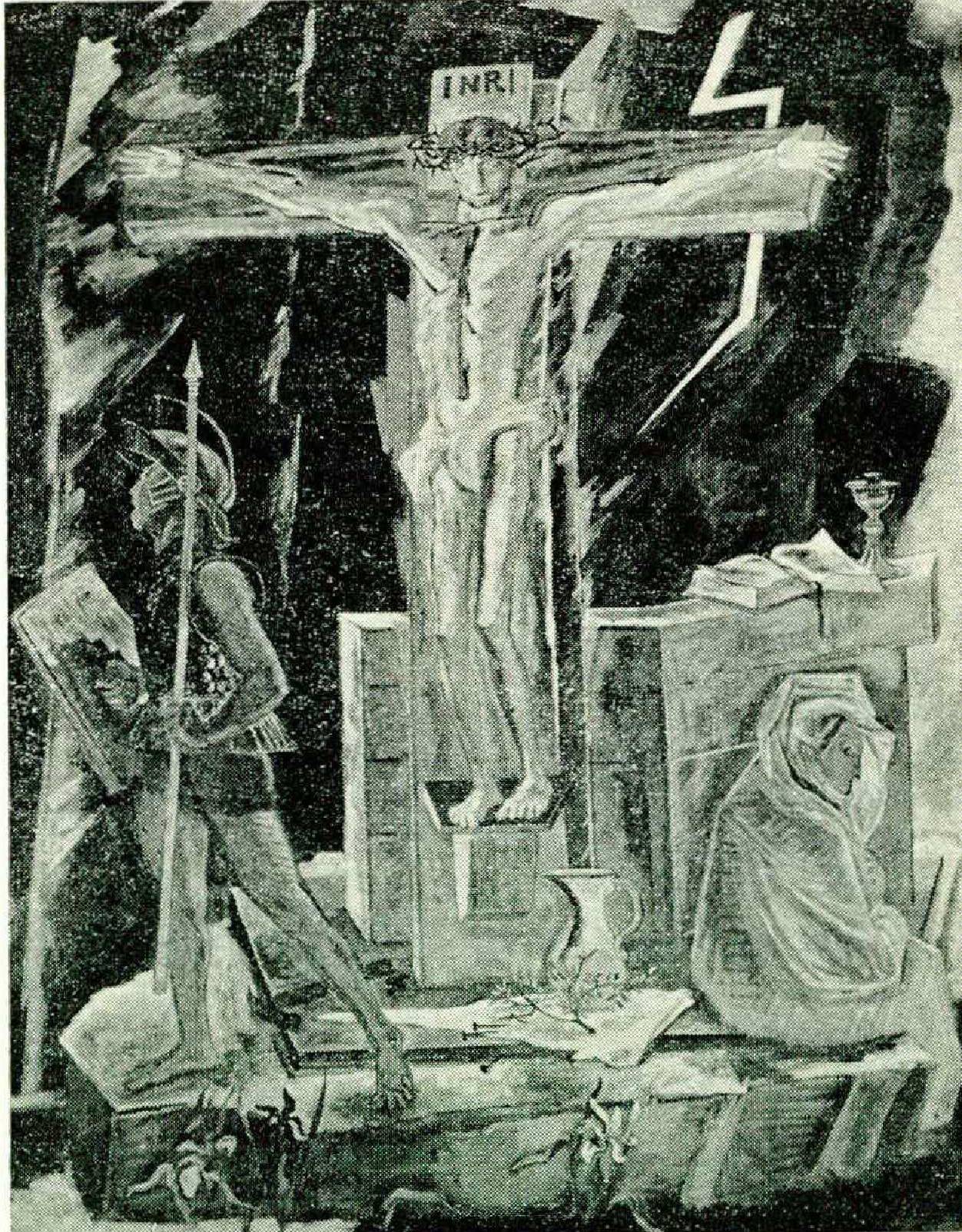
“Why do you like to paint religious subjects?”
I asked.
He looked surprised, as if the question had never occurred to him. “I don’t know. I’m not a church man at all. I suspect,” he went on, after a pause, “that religious subjects are so generalized that you can use them as a conveyance. When you are doing something that has been done before, you are wallowing in the big stream. You are not stepping off into an area of individualism. So there is a chance that you can come up with your own findings, express what you have.”
“But when you paint a portrait,” I said, “you are interested in the individual, aren’t you?”
“Yes, I am. Yet you can’t do that without referring to generalities at the same time. You are referring to some kind of a norm from which this man deviates. In portraits, without exactly being aware of it, subconsciously I think, I am very well aware that individual things are differences from some generality, some average. I am trying to see what is peculiar to the man but not so peculiar that it is not related to some point of reference.”
I like to do people.
Portraits play a very important part in his work; some think the most important. Watkins has a gift for seeing the basic trait of character in a man or woman. His portraits have added interest because they are the work of a man who paints all kinds of pictures, real and imaginative, large and small, and who thus speaks a richer pictorial language than that of the portrait specialist. Their most striking feature, to my eye, is that each figure is in movement. The whole person is a single gesture, and this gesture is intensely and sometimes uncannily expressive. The gesture may be dramatic or quiet, but it says always, This is what I am. It may only be the way Mr. J. Stogdell Stokes, a conservative, liberal, thoughtful Quaker, leans back in his chair, observing the world with kindly shrewdness. It may be the way Dr. George Kamperman sits with clasped hands, his big frame resting, tired by the outflow of the massive, silent kindness which warmed his patients back to life.
“Why do you like to paint portraits?” I asked him, thinking how seldom it happens that a painter today of imagination and originality is interested in painting human character.
He simply said, “I like to do people. I don’t know why. I suppose there’s a certain autobiography in it, though I’m not sure. When I do imaginary things, I am necessarily expressing emotions that are in a sense autobiographic. When I paint portraits, too, I think it’s impossible not to screen the findings through myself. I believe, though, that painting people, studying them, making the effort to understand them, screening the findings through myself, I have really increased my scope, added to my own stature.
“Children — you can’t paint them from a child’s point of view but as you look at them, you paint your reactions to them — their fine hair, the delicate shape of their little cheeks. When they prance out of the room, it’s like watching a ballet. We look at this from outside, but in our imagination we participate; like watching a bird in flight, there’s a certain autobiography in it.”
The portrait of the De Schauensee twins is one of his best-known portraits of children. “Their father called me up one day. He said, ‘Watty, I’ve two little daughters, twins. To me, just at this moment, they have a wonderful flavor, a quality that I know won’t last very long. I don’t want a portrait. But could you do something that will have that flavor? Would you come out to the house and look at them?’ So I said I’d be delighted to
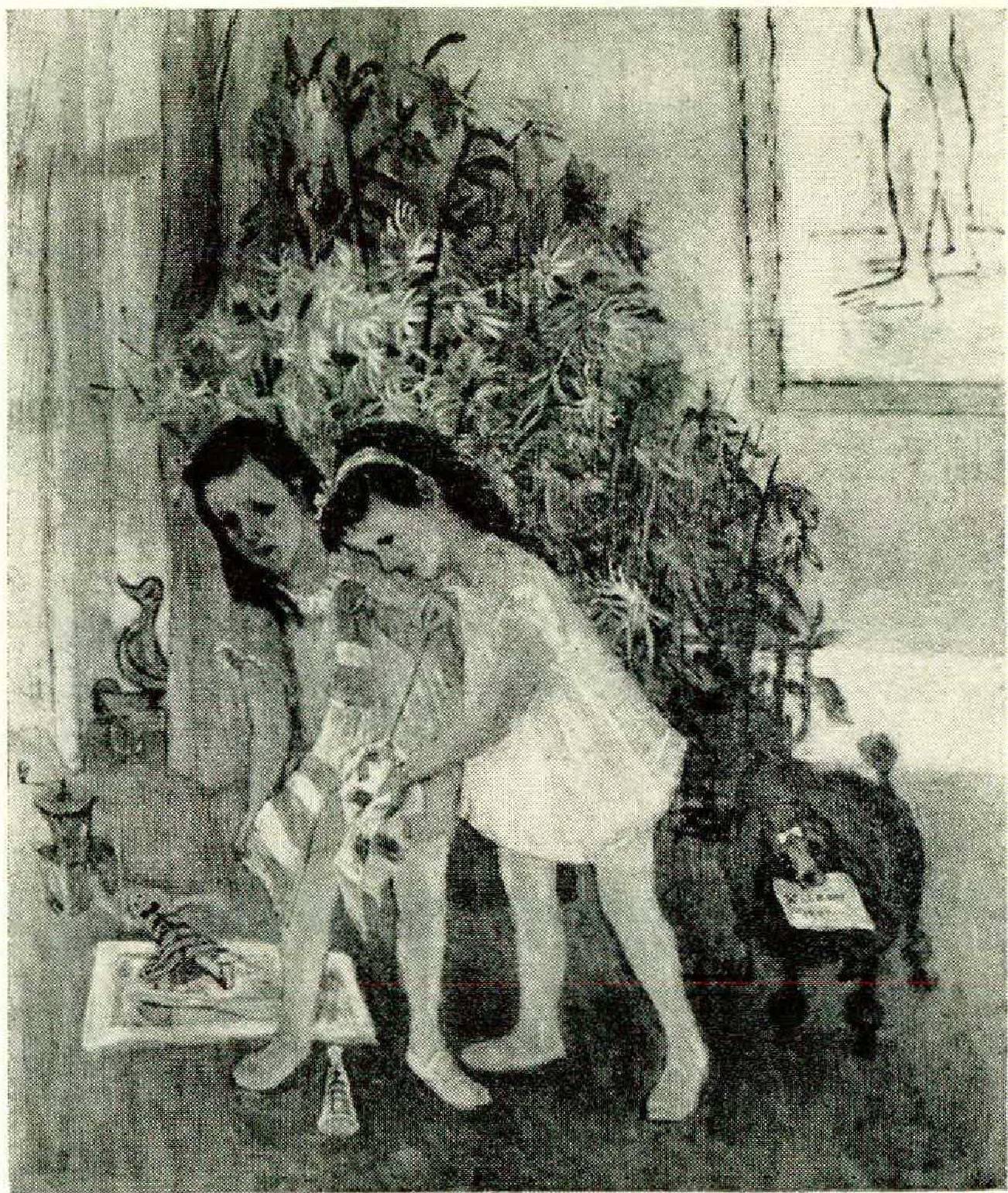
try. At that time they had a governess and a French maid to take care of them, and they’d come down all brushed and combed, just precious little things. The first thing that happened: they had black shoes, the kind with a strap across the instep, very cute, but I could see that the black would make the picture too heavy at the bottom. So I asked their mother, could they have white shoes. She said of course. That made me a hit with the children: I was the one that got them their new shoes.
“Children can’t pose, you know. The only thing you can do is to make that part of the house seem one you’re enjoying very much and rather want to be alone in: then they’ll drop in on you once in a while. One day I came in and found them to my horror with their mouths just dripping with delight. They had my brushes and colors and were painting on my canvas. Fortunately, it was up rather high, so that they could only get at the lower part. So I left what they had done; it didn’t do any harm, and it’s kind of nice.”
I feel there are some types of flattery that are definitely disrespectful.
“Why do people call you sardonic and satirical in your portraits sometimes?” I asked Watkins.
“I don’t know. I wish I did. I’ve had people say to me, ‘Watty, you’re a devil’—sometimes about portraits of people I have a deep admiration for and such sympathy for that I daren’t tell them in words. You can say these things in paint but not in words. But they expect some kind of trite flattery. I’ve had portraits I’ve done for banks or insurance companies rejected because sympathy crept in. When you feel sympathy with somebody, it leads you to see something other than the mask. I painted the person rather than the authority; but in their book, that downgraded the guy.
“I’ve painted television personalities. They have learned certain expressions that go over with the public, and they put them on for me. But after the first day they forget; and when they forget, sometimes their faces become perfectly beautiful. I’m not willing to forgo that and to give people the mask they are accustomed to.
“People hated my portrait of Joe Clark [the present senator from Pennsylvania], though I notice that of late they seem to have accepted it. Well, I hate that smile that politicians have to wear. One time, when he was posing, he asked me if I’d mind if he brought his secretary. I told him to go ahead. So he sat there dictating an article — for the Ladies Home Journal, I think it was — and I saw his face while he was thinking. That was a hell of a different thing. It was what I wanted — but people wanted his smile. I feel there are some types of flattery that are definitely disrespectful — and they don’t understand that.”
At this point his wife, Ida, came in, looking beautiful and mildly distrait, as she always does. “Ida, is Watty cruel in his portraits?” I asked her.
“He doesn’t mean to be. But he may admire a certain aspect of them that other people don’t admire. He gets his portraits pretty strong; so strong that people find them hard to take — their families, anyway.”
The pull away from reality
But there is also in his painting what Watkins refers to as the pull away from reality. “I used to love Greco,” he said. “With all his extraordinary and wild distortion you always feel the ghost of the real figure from which he pulled away. You are aware of the point of reference; that’s what creates the tension, pulling away from it. Look at a man’s leg in a Greco: it’s enough like a real leg so that you know what the real leg looked like, and you’re aware of his pull away from the real leg. You are aware of his emotional obsessions by what he does in his distortions. Unless you give some kind of fair representation of the object before you, distortions have no meaning; they’re just going from mush to mush. It is the point of reference in the back of your mind that gives you a measure of the artist’s emotionality.”
“How far can you pull away from the real?”
“That’s the difficult question, how far you can pull away. I don’t know. It’s like some kind of wonderful netting; you pull it and pull it — then it will pull you back. There is a limit, but I don’t know how far you can go away, I really don’t. But I’m absolutely unable to accept the premise that art can exist without a concept of reality.”
His eye fell on the portrait on the easel. “When I paint a portrait, I really am painting almost entirely out of my own head, and that offers a great deal of difficulty. I know,” he said, eyeing the canvas thoughtfully, “that I’ll have to work on this one. I’ll want to strengthen it. But almost every device I’ll be using will carry it away from the way he looked when he sat there. It looks very like him now. What I do from now on will, I am afraid, make it look less like him, less desirable from the point of view of his friends. But I’d like to get a nice thing out of it,” he said rather wistfully. “He’s a nice man. I’d like to get a nice thing.”
The paint we use today is ground too fine.
“How do you start a portrait?” I asked. “Do you make drawings first, or a small study in oil, such as a few of yours I’ve seen?”
“I don’t have any precise method. I didn’t make any drawings for this. I knew the man. You have to do a portrait rapidly it you are going to do it from life. I painted this one straight on, worked right smack on the canvas. You see, he was going away. I’ve had it happen” — he smiled wryly — “they’ll go away to Nassau and come back a completely different color. They think they look better.
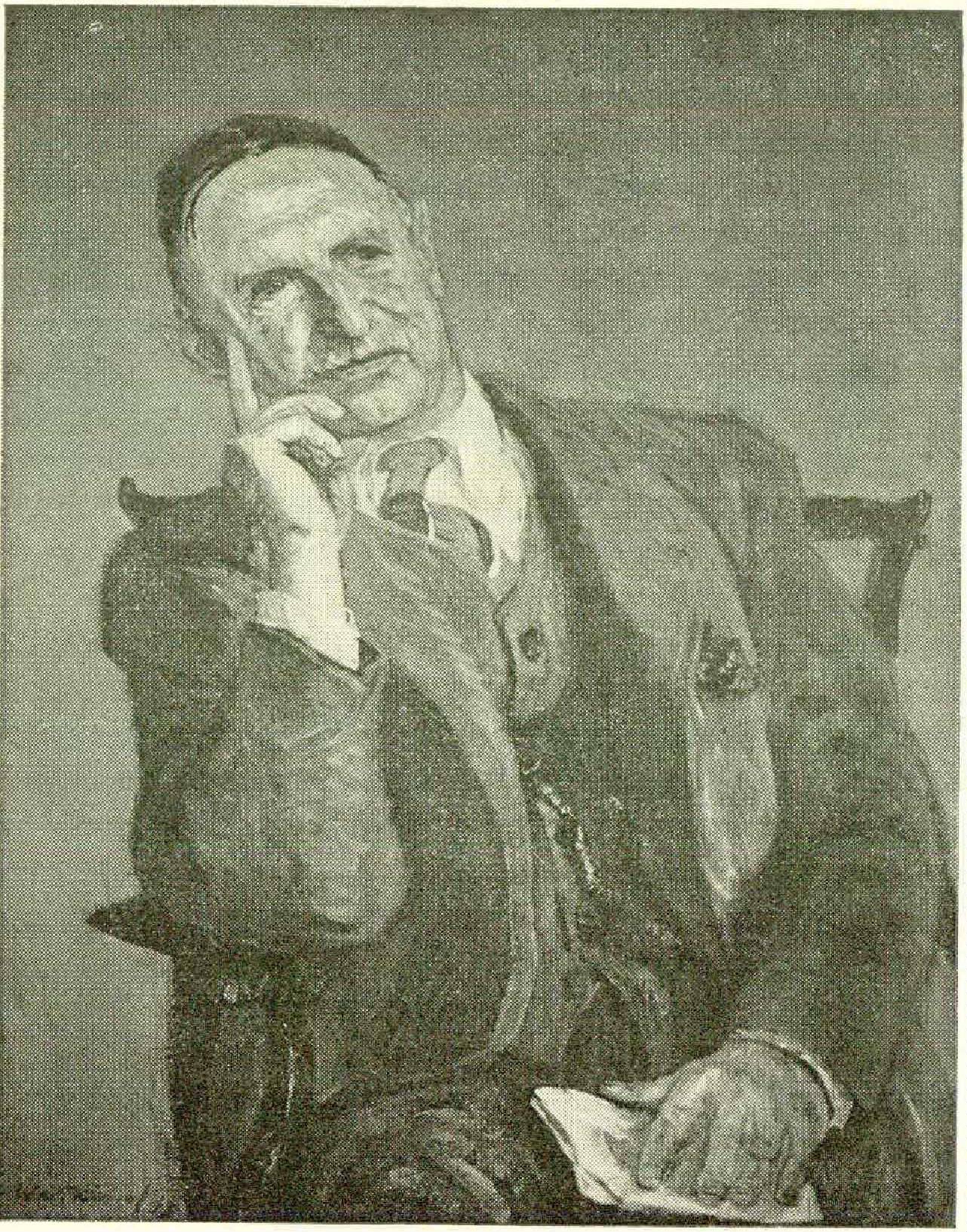
Don’t realize it means you have to do the whole thing over. And of course that isn’t the way they are at all. Something like that” — gesturing toward a still life of flowers — “I’ll fool with a long time. But for this portrait, I’ve had seven sittings of an hour and a half each, and I’ll have to work on it one more time. There’s so much junk in a face,” he said ruefully; “you have to get it out. That’s what interests me in Greco and Tintoretto, what they leave out. It takes so much knowledge to leave all that out.
“As far as methods are concerned, I don’t think I have any. I used to underpaint in tempera a lot. I haven’t been doing it lately. Just impatience, I think. I started underpainting through a puzzlement as to how certain painters got a kind of granular, lean paint. The paint we use today is ground too fine. They didn’t grind it so fine in those days, and the larger particles actually refract the light differently. I used to grind my own colors. You get an idea of what a color really is when you grind it yourself. What puffy, blow-all-over-the-place stuff ivory black is, for instance.”
I asked him what he thought to gain by underpainting in tempera.
“Underpainting and overglaze give certain qualities that are absolutely impossible to get in direct painting. I don’t mean to say that wonderful things can’t be done by direct painting. But I felt that underpainting with white over a red or dark ground fought back against the darkening of time.” He was referring to the fact that oil paint darkens in time, but it also grows more translucent. If there is a white ground under the paint to reflect the light, the increasing translucence balances the darkening of the paint. “If you use mediums in your first painting that don’t mix with oils and varnishes, they’ll sort of stand clear and do their own work. I like to have white underneath. It’s like the light at the bottom of a diamond. It will shine up from underneath and give a kind of translucency.”
A wonderful faculty of implying
The interest in luminosity has grown steadily stronger in Watkins’ recent work. It was stimulated, I believe, by the years he spent at the American Academy in Rome in the early fifties. The deep, warm tonality of his early work has grown steadily cooler and lighter, as if he were pursuing in oil paint the qualities of Italian fresco. Piero della Francesca seems to have played the role in his subsequent development that Greco, Tintoretto, and Manet did before those I talian years. In the Annual Meeting of the Budd Company, a picture which I find as interesting as Eakins’ groups of Philadelphia doctors, Watkins shows the clear sinewy contours, the cool even tones of a painter who would be drawn toward Italian fresco painting.
Talking once about the painters he admires and who have influenced him, Watkins spoke of Piero. “I find in him,” he said, “a wonderful faculty of implying; of making you do the work. He doesn’t do it for you. In the Flagellation no blow is being struck. There are three large figures just looking off into space. Nothing is being done, yet a terrific thing is implied. He never gives you an action — his horses are not prancing, they are frozen — but that stillness is terrific. There is a figure of a woman at the bottom of one of his frescoes that is a permanent shriek. She is frozen; yet there never was a sound shriek that was more impressive than that.”
Some of the most remarkable of such effects of implying, in Watkins’ own work, are to be found in his still lifes. He has, I daresay, painted some of the most original and imaginative examples of still life in our time. The first picture he ever sold, in 1923, was a still life. He came back to still life in the late thirties and early forties, painting pictures which are a shimmering, glowing parade of flowers and fruits from one side of a long canvas to the other, as if he could not have enough of their poetry and fragrance. But his most original work is, I believe, in the narrative still life, a form invented in the seventeenth century in the Low Countries, which reappeared among the Philadelphia still-life painters in the nineteenth century, then was killed by imitation of the French studio-tabletop picture, but reasserted with new power by Watkins in the nineteen fifties.
A still life does not necessarily consist of random objects on a kitchen table: it may have movement, mood, poetry, mystery, or satire. In Watkins’ Bird Cage, a caged bird is singing its heart out beside a sculptured wooden head that hears nothing. Make the Monkey Jump was painted after the Russians had put the first Sputnik in the sky. “We were trying to get a missile in the air. The Russians had already done so, but we were shooting things up that fizzled and fell into the sea. It was a very frustrating, humiliating period — and here was this damn monkey — ” he said. That impish monkey, which pointedly ignores the hoop held up by a wild and nervous girl, is one of a series of animals — monkeys, cats, baboons — which are perverse and demonic actors in his still lifes.
“My complication is that I get off from such nonvisual starts,” he once said. “I am not a clean painter. I don’t pick up my ideas necessarily through something seen. What is the look of a cat going pssst? How do you paint a thing like that?”
“How did you come to paint that cat?” I asked.
“In some strange way that cat making a noise is infinitely important to me. I like the differences in things; big and little, heavy and delicate, wild and quiet. The first cat I painted was in Rome. Those Roman cats are wonderful wild things living in the ruins, where people go to feed them. They’ve lived there since the Renaissance. Sometimes they don’t even look like cats, they are so strange. I painted a picture of some ruins, a warrior’s helmet, and a cat sort of crawling along, living there in all that antiquity. Then I did this one. I’ve never
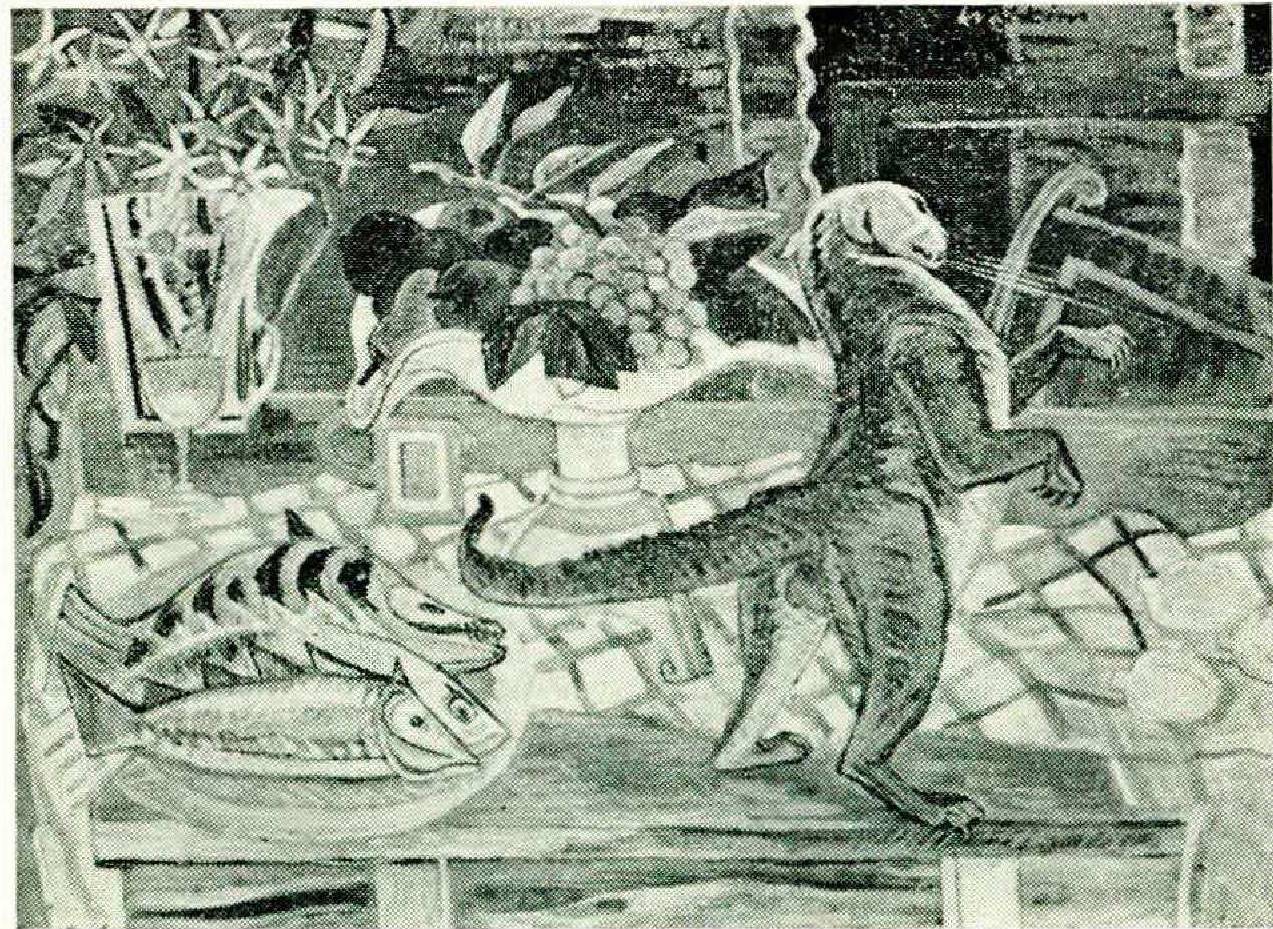
done any nice quiet cats just lying in a corner.
I suppose the symbolism associated with cats and monkeys is perfectly valid: you can say things with a cat that you can’t say yourself.”
I like decisions, and then the delivery of those decisions in the paint itself.
One time in the galleries of the Pennsylvania Academy we were talking of one of the pioneers of American twentieth-century painting, and I had objected to the monotony of the man’s work, which is really a single picture painted in variations over and over again all his life long. Watkins agreed that he was monotonous. “But this one the Academy bought is a beauty. Some of the decisions he made — You know how hard it is to paint the receding edge of the hairline on a forehead. Some of the decisions he made along that hairline are so beautiful — !”
Decisions. A most revealing word for the art of our century. Not only the decisions which a man must make in the long road of a life but the decisions forced upon an artist by the diversity of our times. The decision made at the beginning of this century by those who were then the pioneers of painting, to break with the past of art and with the appearance of nature, shattered the traditional language of vision and style. That decision has forced on each painter of our time a constant testing of his aesthetic ideas, or at least of their expression. Each artist has had to force his own path through the forest of conflicting dogmas that characterize painting in our century to find what he is to say and how he is to say it.
One of the decisions made by all the artists of Watkins’ generation — which contains artists as diverse as Picasso, Pollock, Watkins, and Shahn — was to explore the resources of their medium. Pigment itself, the stroke of the brush, and the gesture of the hand are immensely important to them. The development of a canvas is a process beginning with a study of reality, moving by stages of enrichment to something no longer natural but a poetic, statement about the natural. The steps and decisions by which Watkins arrives at his result, which speaks convincingly about his subject and yet is a quite arbitrary synthesis of shapes and colors, are most difficult to describe.
“Paint gives you a lot of pleasure, doesn’t it?” I asked him.
“Yes, it does, it does.”
“Brushstroke, too,” I said.
“I love it, I really love it, sometimes I think too much. I don’t like picky paint; I want real paint.”
“What do you mean, real paint?”
“I like decisions, and then the delivery of those decisions in the paint itself. There’s so much nonpaint, nonsculpture today, I get so damned tired I just can’t stand it. I like decisions. I don’t mean a phony facility. You don’t have to worry about a certain amount of decent fumbling. Good painters know it isn’t easy. But they smell out the phony. I remember Ben Shahn telling of a writing lesson he had seen in a Japanese school. Those little Japanese kids are taught to use their brush with a weight strapped on their wrist until they have developed their muscles and can control them. When they have learned fluency, they take the weight off. That’s what I mean: decisions as to where turns are made, what one thing is going to do to something else, and why things look the way they do. It’s true that painters invent their own language. But if you are going to speak a new tongue, you must look, and after you have looked, you must clarify, so that the terms come out clean.”
Decisions are what make art what it is. The decisions which have been the basis of most painting in our century were made sixty years ago. They were decisions to break with the European past, to break with the appearance of nature, to employ color and shape in rhythms for their own sake. Watkins has felt strongly the pull away from reality, and the appeal of color and shape for their own sake, but he has also made other decisions: to think of his art as belonging to the great stream of artistic thought in which Greco, Tintoretto, Manet, Piero della Francesca worked; the decision not to break with nature: the decision to paint portraits and subjects that have been done before. He has conveyed those decisions in paint with a passion and subtlety which prove that the will to spiritualize the real exists in our art side by side with the will toward abstraction, and is no less potent.
But such decisions confront a twentieth-century artist with problems whose solution may require a lifetime of labor. “Paint, paint, paint,” he once exclaimed. “We learn too slowly in America — if we could only learn more quickly.”
“But the things you do are not easy things,” I replied.
“I know, I know. You have to find what it is you want to do and why you want to do it. I’m afraid our time is a great time of wallowing around.”
My mind went back to his Crucifixion: why, I asked, had he wished to paint that. “I just don’t know what it is that made me want to do that. It’s just sort of comfortable to do something that’s been done before. I’m not an innovator.” So he thinks of himself. But although his art ranges over themes and feels interests which other painters have felt in centuries past, his findings are different. And who shall say that the innovations which are unconscious, unsought, coming as results of a search for meaning, may not be the ones that endure.