The Silk of Thailand
pleasures and places
Among the sights listed in the tour folders of Bangkok, along with such oriental splendors as the Grand Palace, the Floating Market, and the Temple of Dawn, one finds the unexpectedly Yankee-sounding name “Jim Thompson’s House.” Tourists who have done their homework on Thailand usually mark Jim Thompson’s House as a must-see: a superb example of Thai architecture and a treasure trove of oriental art.
Jim (or James H. W.) Thompson, who lives in the house and opens it twice a week for the benefit of the Bangkok School for the Blind, is the American who made Thai silk famous. The silk company of which he is founder and managing director has brought Thailand millions of dollars, while the goodwill that he has created toward his own country is beyond the realm of dollars and cents. He gives the lie to the Quiet American, the Ugly American, the American who is urged to Go Home.
At a parly in Bangkok not long ago, the wife of a Thai diplomat told me, “Of all the Americans I’ve met, Jim Thompson is most like a Thai.” I knew that she was paying him her ultimate compliment. Yet he has in no sense “gone native.” An amiable, good-looking, relaxed man, who is sometimes mistaken by tourists in his shop for another tourist, he drives around town in a Chevy II and hobnobs as much with the American community as with the Thai and European. His success as a businessman in Thailand results from the fact that he is a peaceable man, neither bossy nor aggressive. “Keep a cool heart” is a favorite maxim among the Thai. “Never mind” is a phrase heard almost as frequently as “OK” is heard in America; to make a fuss is simply frightfully bad form.
The Thai also pride themselves on taking from the West whatever they choose, and, cool-heartedly, throwing the rest away. The king plays jazz and has jam sessions at the palace, but the servant who brings him his clarinet crawls across the floor like an eel — the traditional approach to Thai royalty. Jim Thompson has had the good sense never to irritate the Thai with Western customs; he never claps them on the back, which they find hateful, and never causes anyone to “lose face.” Friends and advisers often warn him about the slippery ways of Orientals and beg him to watch his step. But Thompson points out gently that while other foreign-owned businesses have come and gone, he is still in business and very profitably so. Other silk companies have sprung up, and there have been attempted raids on his weaving staff; but the weavers, by and large, have stayed faithful, and the Thai Silk Company has dominated the production of silk fabrics in Thailand.
Thompson first arrived in Bangkok in 1945, two days after V-J Day, in the capacity of a captain in the OSS. He had been scheduled to arrive there by parachuting into the jungle, but in view of the circumstances, he stayed in his plane and landed at Bangkok Airport. Until his assignment to this mission, he had never given much thought to Thailand, but a couple of factors in his family background predisposed him to like it. In 1893, his great-grandfather, General James Harrison Wilson, had represented President Cleveland at the wedding of the future George V and Mary of Teck, and there he had struck up a friendship with Vajiravudh, Crown Prince of Siam, who was representing his father, King Chulalongkorn. The crown prince, who was studying at Cambridge, invited the general’s daughter Nell to May Week. A couple of years later, when he made an official tour of the United States, he requested that General Wilson act as guide. In the course of the trip, the prince and his delegation attended a garden party given for them at the Thompsons’ country house near Greenville, Delaware, where snapshots were taken of His Highness, in cutaway and high silk hat, perched high in the air on the Thompson children’s seesaw. Thompson recalls that these snapshots (made before he was born) were one of the pleasures of his childhood; he loved looking through the family album and finding an oriental potentate right there on his very own seesaw.
Thompson liked Thailand so much that after leaving the army he returned to Bangkok and took up a job as political adviser to the American minister. As a hobby, he spent his spare time browsing in the shops of Sampeng Lane, the textile street of Bangkok, and began to collect pieces of silk, attracted by the vivid and inventive plaids in which it was often woven and by its rough, lustrous appearance. He was beginning to wonder what to do with it all when the embassy commercial attaché, Mr. James Scott, suggested one evening at dinner that Thompson ought to go into the silk business. Scott had been in Syria and knew that the Syrians had been successful in acquiring American dollars through the export of silk brocade. After that, Thompson began to think of his silk collection with more respect. One day he came across a heavy silk pakama (a kind of sarong, worn by Thai women) in a highly original plaid of shocking pink, emerald green, and purple. The shopkeeper told him that it had been woven in Bangkok, and a little investigation led him to the door of the weaver.
Bangkok is a queerly organized town, being really a group of centuries-old villages overtaken by streets and buildings that are mostly quite new. Before the turn of the century, there were not more than two or three streets; the rest of the town was a tropical Venice, the canals called klongs and the gondolas called sampans. Thompson found his silk weaver in a part of town known as Bang Krua, or Silkweavers’ Village. Here, Thompson discovered, every house has a loom in it, and virtually every member of the hundred or so families knows how to weave silk or to dye, card, or wind it. These families are Muslims — unusual in Bangkok, where 95 percent of the people are Buddhists. Set apart by their religion, they have kept to themselves, intermarried, and passed the art of silk weaving from generation to generation. In 1946, when Thompson discovered them, they had fallen on evil times. Cheap European and Japanese dry goods had killed their markets. There were more looms than weavers, many of the villagers having been forced to learn a new trade. The creator of the plaid pakama that Thompson had bought in Sampeng Lane was working part-time as a plumber. He readily agreed to take time off from plumbing and weave a dozen or so hftecn-yard pieces for Thompson.
With these in a suitcase and about $700 in cash, Thompson took his first step in the silk business. He went to Washington and resigned his government job. Then he went to New York, and with no idea where to begin, went to see Frank Crowninshield, whom he had known around New York during the thirties and who was the only acquaintance he could think of who had anything to do with the fashion business. Crowninshield sent him around to Vogue, where he was permitted to open his satchel of silks on the desk of Edna Woolman Chase.
“She took one look,” Thompson recalls, “stepped back dramatically, and issued a command that nobody was to leave the office without seeing them.” She asked Thompson to leave the silks with her for a couple of weeks, and the result was that the dress designer Valentina bought a length of pale mauve, four-thread silk, and made herself a dress in which she was photographed for Vogue. This led to sales that enabled Thompson to buy a ticket back to Bangkok, where he told the weavers to get out of the plumbing business and start up their looms.
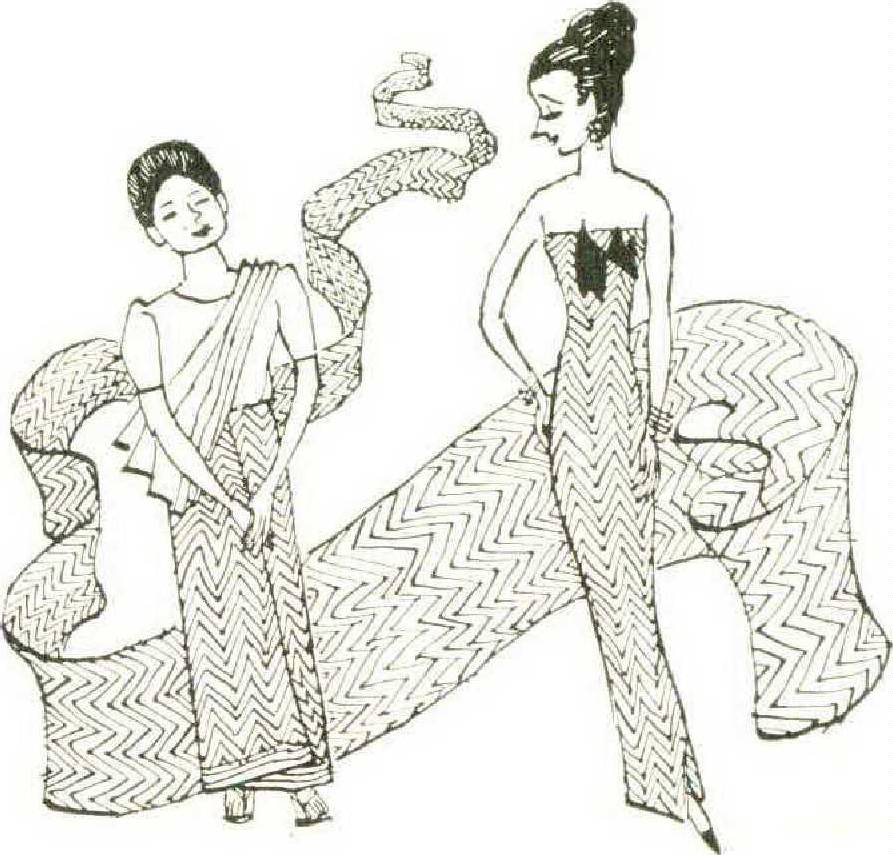
It was essential to order the best dyes from Switzerland and teach the workers to use them. Until then, the people who wore silk pakamas did not mind the fact that the color came out in the rinse water; or, if they did, they simply never washed the silk, but laid it away in sandalwood chests, scented with sweet herbs, and brought it out only for special occasions. The more expensive silks, woven with gold, were often kept for several generations, and when they were finally considered worn out, they were burned and the gold in them sold or rewoven. A really sumptuous pakama contains enough gold to make a fourteen-karat ashtray.
In an effort to stay in business, Thompson took to strolling about the lobby of the Oriental Hotel with Thai silk casually draped over his arm. Sooner or later, a tourist would ask him what he had there, and he would then confide that it was Thai silk and purchasable at a shop called La One, on Rama IV Road. A Chinese friend of Thompson’s ran the shop.
The first really big order came from Irene Sharaff, the costume designer, who was doing the costumes for Michael Todd’s Peep Show. Todd, having learned that the young King of Thailand, then still at school in Switzerland, wanted to be a jazz composer, took what for Todd was the next logical step: he invited the King to write music for one of the scenes in Peep Show. The name of the royal composition was “Blue Moon,” and the scene was the only one in Peep Show in which the girls wore clothes; they wore green and blue pakamas. Irene Sharaff admired Thai silk and this particular color combination so much that she used many hundreds of yards of it for the next show she costumed, The King and I.
After Jim Thompson’s hobby of silk collecting had become a business, he started collecting Thai paintings and sculpture; and then, needing a place in which to keep them, he collected pieces of old Thai houses and made them into one large, remarkable house for himself. Traditional Thai houses were built of teak, the joints dovetailed together rather than nailed, because in the Thai climate nails rust away rapidly. During the 1950s, some of the weavers of Bang Krua became so rich that they chose to give up their rather rattletrap old houses and build new ones of pink or mauve stucco. Thompson bought several discarded walls of their old houses. Another weaver had an aunt, up the river, who owned four houses, was in her eighties, and was 30,000 bahts in debt from gambling. Thompson paid the debts in return for three of the houses, pieces of which he had floated down the river in a barge. He bought a couple of acres of land across a klong from his weavers’ village, and drew up plans. The abbot of a nearby Buddhist temple, who was also an astrologer, then set the suitable time to begin building: September 15, 1957, at 8:40 A.M. A Brahmin priest, father-in-law of one of the carpenters, blessed the northeast post of the living room — the house rests on forty-seven teak posts, standing nine feet above the ground — and the carpenters raised it.
When the house was nearing completion, the abbot came to Thompson and warned him that it would be sheer madness to move in on any other day but April 3. There was still no water in the house and no electricity, but the weavers strung a line across the klong and put water in the baths, and Thompson slept in his house on April 3. Twenty-nine carpenters were still at work. The two best craftsmen had stopped work on the house in order to build a spirit house. Every Thai has a spirit house in his garden and hopes that only the best spirits will move in. Spirits, judging by the size of the houses, are about as big as parrots. When Thompson’s spirit house was ready, the Brahmin priest came back and blessed it. A generous meal was placed before the spirit door, and an empty chair, with a black umbrella tied over it, was placed invitingly before the meal.
One morning while I was in Bangkok, I went to call on Mr. Thompson in his famous house. It is only a short distance from a highly congested business street, but as soon as I entered the compound, I felt as if I were in the country. A small courtyard before the house is planted with rain trees, frangipani, orchids, palms, and jasmine, and game Bantams were wandering in and out of a hen house back of the garage. Thompson came to the door to meet me with a large white cockatoo perched on his shoulder. The cockatoo ruffled its crest at sight of me, revealing apricot feathers under the white ones.
“Cocky isn’t feeling very well this morning,” Thompson said, gently removing the bird’s left claw from his shirt collar. “I took him out to dinner last night, and somebody slipped him a martini.”
The first thing I noticed as I stepped into Thompson’s front hall was that this house seemed cool. In Thailand it is very difficult to achieve a sense of coolness. It may not have been cooler here than in other houses, but it seemed that way, which is surely important. The hall, which has a black and white marble floor, opens onto a covered terrace, where among leaves and flowers a stone Buddha stands. Other Buddhas occupy niches in the interior walls, which are teak, and a teak staircase ascends to the second floor. “One of the few Western influences here,” Thompson said to me, “is this enclosed stair hall. Thais don’t mind if the stairs lead straight into their sleeping quarters, but I’ll have to admit I do.”
Upstairs, a high-ceilinged drawing room opens to a view of garden and klong. Like most Thai houses, this one has no glass windows. Closing the windows is a matter of closing the shutters, and these are only closed at night or in case of heavy rain. Thus, one side of Thompson’s drawing room is entirely open most of the time and leads onto a terrace. The other three sides of the room are teak, and were once the exterior walls of an old house. Thompson turned them the other way around, the outside being the handsomer. Some of the windows, filled in, have become niches for stone and bronze images. “By the way,” he said to me, “do you notice that the walls seem to be leaning inward? Well, they are. That’s the way they like them here. Just slightly oblique, instead of perpendicular. Makes it hell for hanging pictures. The parallel sides of the wall panels, you’ll notice, aren’t really parallel. Eventually, somewhere up in the air, those two sides would meet.” He paused. “I’ve gotten so that right-angled walls seem boring.”
Thompson asked me if I would sign his guest book, and after I had done so, I asked if he would mind if I leafed through it. It contained a veritable galaxy of guests, and he said that that’s what happens when you live in an out-of-the-way place: everybody comes to see you. “If I lived in New York, for instance,” he said, “I’d never meet anybody.” Thompson’s shop in Bangkok, I learned later, has had an even more striking list of visitors: among them, Princess Alexandra, for whom a carpet of red silk was thrown down from door to curb, Mrs. Roosevelt, Mrs. Lyndon Johnson, Princess Beatrix, Queen Astrid, and Queen Frederika and her daughter, Princess Sophia. (When Their Majesties of Thailand made an official visit to London, Queen Sirikit’s gift to Queen Elizabeth was several bolts of the Thai Silk Company’s most magnificent gold-woven silk.)
A servant came padding in on bare feet, bringing coffee. He put the coffee tray down and removed the cockatoo, which was muttering grouchily. A passing boatman, catching sight of Thompson, raised a shout, stood up in his boat, and rocking it wildly, made several bows, with his hands joined together before his chin. Thompson joined his hands and bowed in return.
“Who is he?” I asked.
“Well, I’m not sure. But they’re all nice,” he said.
I asked him, while we drank our coffee, what had first attracted him about Thailand. He look at least a minute to consider this, and then replied thoughtfully, “Well, probably you might say it reminds me of Delaware.”
I said that I would have thought that few places in the world were less like Delaware, but he assured me that I was wrong. “I’ll admit that Bangkok and Wilmington don’t have much in common,” he said, “but when you get out in the country, particularly in parts where there are hills and rambling woods, and you can just walk and walk on dirt roads or across people’s farms — why, it’s just like Delaware was when I was a boy. Of course, up-country you can run into people wearing loincloths, or find a cave full of tenth-century Buddhas. I never saw that in Delaware. But I always had the feeling, when I was a boy in the country, that the world around me was full of surprises, and that’s the way I feel about Thailand. For instance” — he smiled, remembering — “one time, when I was flying back from the Laotian border, a Thai friend who was piloting the plane — it was a 1936 one-engine L-5 — flew over a town called Khon Kaen and suddenly happened to remember that he had an uncle being cremated there that day. He asked me if I’d mind if we stopped off so that he could pay his respects. Well, the airstrip turned out to be full of holes, and although we landed all right, my friend wouldn’t take off unless the holes were filled in. The reason for the holes was that some delicious lizards lived in the airstrip and people used to come out and dig them up. While the holes were being filled in, we went to the cremation. A Thai cremation, you know, is held about six months after the person has departed, so it’s not a particularly sad occasion. By this time, everybody has got used to the person being dead. In this case, the uncle’s family were well off, and so they were having a big feast and they’d hired an orchestra and they were showing movies on the outside wall of the temple. The movie was an old Laurel and Hardy, and the interesting thing about it was that it was being shown backward. Now, where else could you see an old Laurel and Hardy backward on the wall of a temple during a cremation? We decided to stay for the party, and 1 won a bottle of rice wine, for dancing the ramwong.”
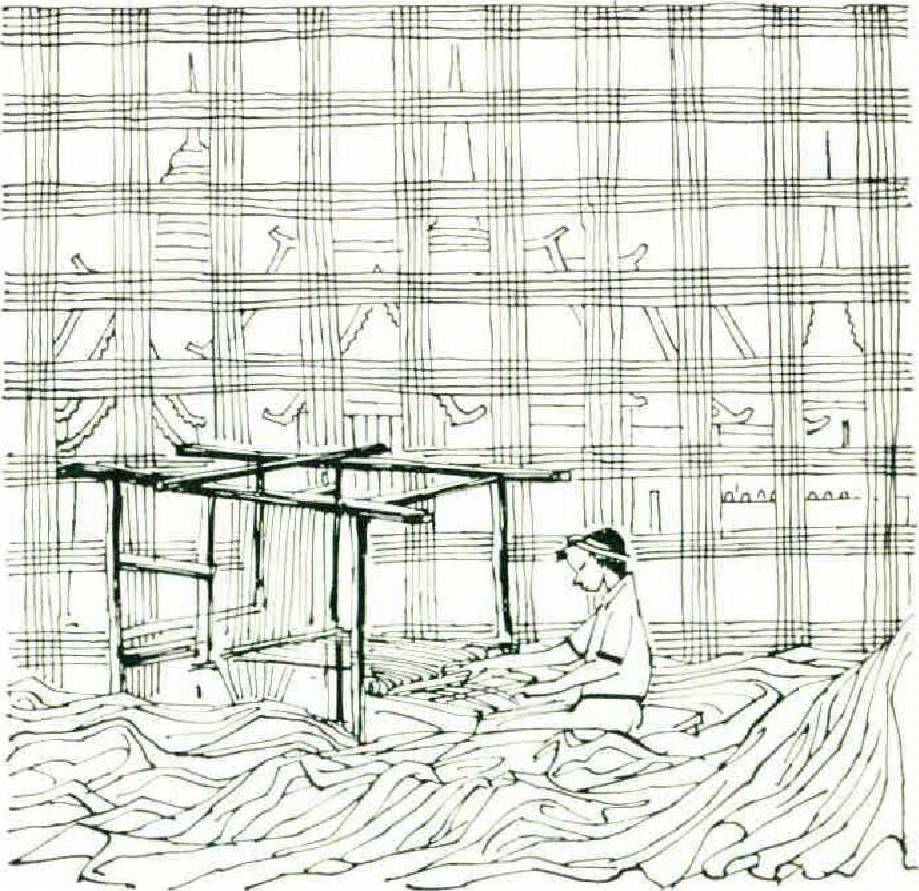
Just then, we were joined by one of Thompson’s company assistants. “Time to call on the weavers,” Thompson said to me. “You’ll come, won’t you?”
We crossed the klong in a sampan propelled by a small boy. Disembarking at a rickety pier, we proceeded along narrow boards, little more than catwalks, that wound in and out between houses. Several feet below this walk we could see the muddy, littered klong bank, which, Thompson told me, is under water most of the year. From March to June, the tail end of the dry season, the klongs grow steadily lower and more smelly. There is garbage collection in Bangkok, but the traditional disposal is the klong. Between the casually laid boards of the catwalks, I could see bits of eggshell and melon rind lying on the mud below, presumably awaiting the rainy season. As a startling contrast, on the opposite bank of the klong Thompson’s house in its leafy garden looked like a setting for an oriental fairy tale.
I asked my host whether the success of the Thai silk business had brought about any profound changes in the weavers’ way of life. He told me that the changes were many, but he didn’t know how profound they were. Some families, like the first one we visited, had made no visible changes at all: the first floor of their house was given over to two large looms and some very primitive cooking arrangements. The second floor, which we did not see, Thompson told me was one large room, bare except at night, when sleeping mats were unrolled. The klong served as a bathroom. “This family saved up enough money to send the eldest son to study in Paris. He came back with a French wife. She’d been warned, I think, that Bang Krua wouldn’t be Paris, and she did manage to last six months. In the end, it was the lack of privacy that drove her out. Finally the son left too, and that was really a profound change, because in Thailand young couples are expected to live with their inlaws. Fin glad to say, they have a fiat of their own now.”
At the next house we went to, apparently all the profits had gone into luxurious living. The house was a brand-new pale-pink affair, made of poured concrete, with a mauve tile terrace. In the living room was an icebox, a television set, and some highly varnished furniture, upholstered in lavender plastic. A glass cabinet contained a variety of vases and unidentifiable ornaments made of glucd-together shells. A new toilet gleamed brightly from a closet that opened into the room.
We took off our shoes, as we did at each house we visited, and sat around the shiny table, while the assistant talked in Thai to the owner, an elderly man, and his wife.
“These are our oldest and best and most nervous weavers,” Thompson said.
“Why are they nervous?” I asked.
“They don’t like trying something new. We just got an order from California for two hundred pakamas, larger than ever before, and it means some tricky adjustments of the looms. We’re trying to break it to the weavers gently — they’re all a little tired now. They just finished a rush order for five hundred yards of upholstery silk for a Hong Kong hotel.”
It seemed to me that the weavers were taking the news calmly, but Thompson cautioned me against going by appearances in Thailand. “They will nearly always seem calm. It’s not good form to seem otherwise,” he said. “If you don’t get any results, you’ll know they weren’t calm.”
Presently, the wife went and fetched a large box that contained a great many varicolored spindles of silk. Thompson took the box on his knee and began picking up first one and then another spindle. “We keep thinking up new color combinations,” he said. “We’ve got a hundred dyes and over a thousand shades. Each pakama is woven of three colors over one or two others. Sometimes you’d never guess how they will turn out. These three pinks, for instance, over red and turquoise will get you a pink and purple pakama.” He turned the spindles over lovingly and sorted out several. “This might be wild—let’s try it,” he said. “Bright pink and purple, and throw in a little acid green.”
One of the weavers brought over a pile of finished silks for his inspection. He held up one of violent pink and magenta, and began to laugh. “England,” he said. “That’s the place for this. We export to twentytwo countries, you know, and each one has its preferences. England has been blindingly bright lately.”
“What about that silk they have at Windsor Castle?” put in the assistant.
“Oh, that’s yellow. A quiet, pale yellow.” Thompson turned to me. “Liberty’s cabled us one day a few years ago for a large order of this particular yellow. ‘Not permitted to reveal name of customer,’ they said.
I figured that must mean somebody pretty exalted, and sure enough —that silk went on all the furniture in the Canaletto Room at Windsor Castle.”
“What’s the largest order you’ve ever filled?” I asked.
“Gosh, I don’t know,” he said, and thought it over. “The Reynolds Metal Company in Richmond, maybe. They did all their executive suites in Thai silk, specially woven with aluminum thread. The weavers were very nervous. Then, there I were the costumes for Ben Hur — a lot of silk there, because sometimes they’d have scenes where the people would start off clean and wind up dirty, and they’d reshoot the scene about nine times and need new costumes every time. Then, we did the hundred-dollar-a-day suites and the ballroom at the Hong Kong Hilton. And the General Motors buildings in Detroit—oh, I don’t know. I’d have to look it up. I’ll have to admit, none of that interests me as much as just the silk itself.” He took a length of brilliant apricot silk and held it up so that it shimmered in the light. “Look at that now,” he said, almost as if it were new to him. “Isn’t that really something?”