The Sixth Sense of Alan Jay Lerner
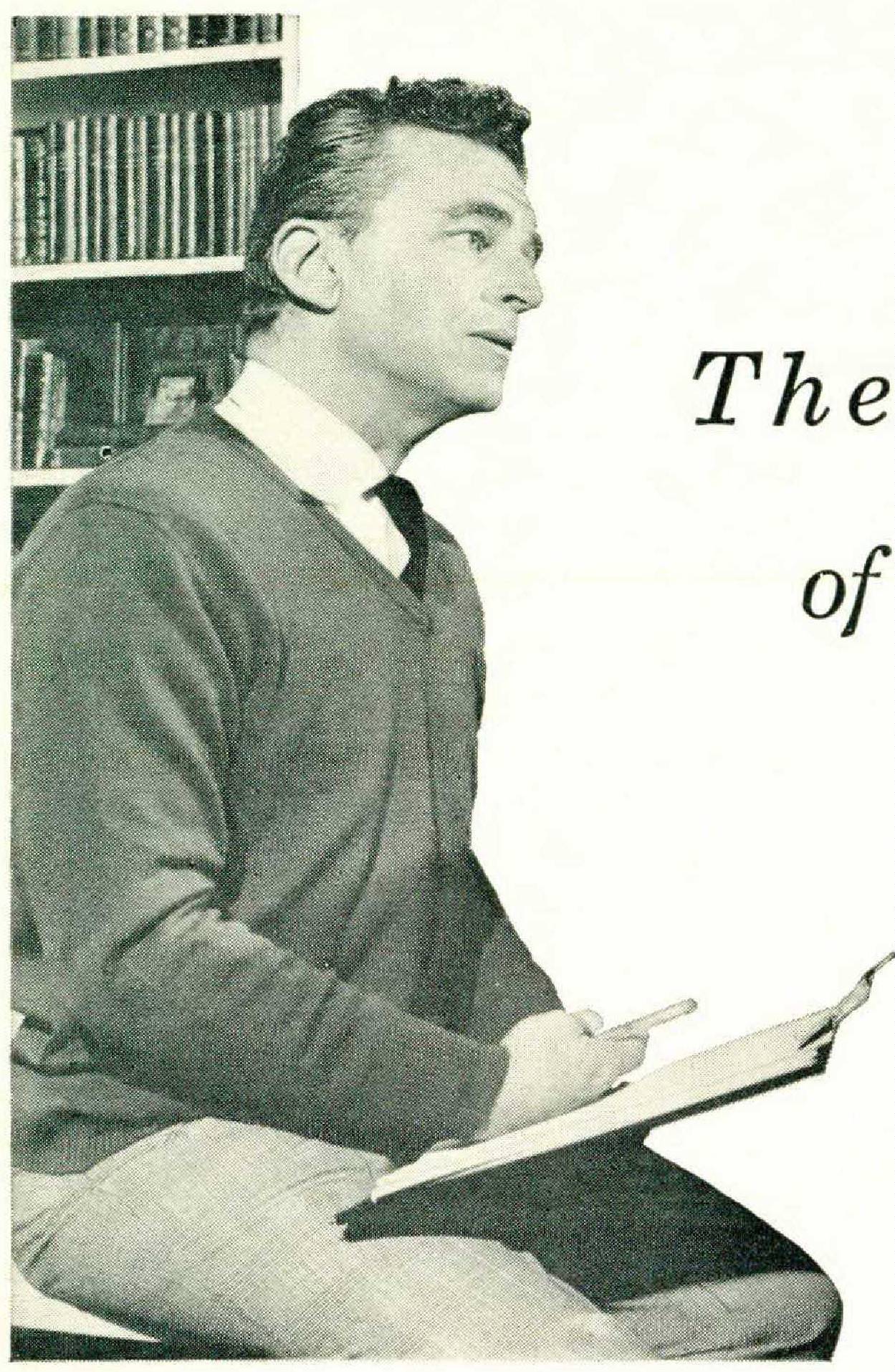
Having turned the phonetics of Professor Henry Higgins into the walloping success of MY FAIR LADY, Alan Jay Lerner now explores the world of extrasensory perception for his latest Broadway musical, ON A CLEAR DAY YOU CAN SEE FOREVER. In a conversation with ATLANTIC editor R. S. Stewart, Lerner talks about his notions of ESP, reincarnation, parapsychology, and, of course, the state of today's theater.
Now it happens to be a fact that you or anybody else can make flowers grow faster if you talk to them for a couple of minutes a day. It sounds absurd, doesn’t it? There’s a flower stand on Lexington Avenue where they will tell you about it and explain it to you. I’ve even done it myself. If you want, you can try it yourself: just go into your room and put one flowerpot in the window and put one flowerpot in the next room — then talk to one of them every morning for a couple of minutes if you can do so without blushing or without feeling like you ought to be arrested, and it will grow a little faster. What do you think of that?”
Lerner went on before I could answer: “It’s the connection that’s provided. There’s some relationship that’s created. There was the test that Dr. Rhine did down at Duke University. He took two pieces of identical ground — ten square yards each — with the same soil composition, the same seeds, and the same flower. Then he got two farmers to come out every day and do exactly the same things — the same amount of water at the very same time, and so on. Now the only difference was that Rhine knew that one of the farmers adored flowers and the other one didn’t care for them much at all. The one who loved flowers — his flowers grew twenty percent faster.
“Daisy, the girl in On a Clear Day You Can See Forever, has this ability to make flowers grow by talking to them. That’s what she does in the first scene, and if you are going to write a play about a girl with this kind of extrasensory gift, then it should be demonstrated in terms of music. So the first song, I decided, is what she says to the flowers. It’s a song called ‘Hurry Up It’s Lovely Up Here.’ Whatever is the most important aspect of a character is what should be in the lyric. Actually, a lyric should make a play shorter, not longer. It should say and it should accomplish what it would take you ten pages to do in the script. That was how we did it in My Fair Lady. The two most outstanding features of Henry Higgins were his passion for the English language, which is the reason why he sang ‘Why Can’t the English?’, and his misogyny, which is the reason for ‘I’m an Ordinary Man.’ Those are the pillars of his character.
“The only surprising thing about On a Clear Day You Can See Forever is that I haven’t written it before. Extrasensory perception has been my hobby all my life, and why it never occurred to me to write about it before, I just simply don’t understand — but it never has. I’ve been fascinated by ESP for years. I’ve read about it continually, and on one or two occasions have had the opportunity to chat with people who are really in it. I haven’t gone to séances or anything like that; it’s just a hobby as one might have bridge as a hobby. I know, of course, that only twenty-two percent of our brain is in practical use. The rest of it must be doing something up there besides filling out the hat. I’ve never had any extrasensory experiences myself except for one minor one when I was writing Brigadoon.
“The first act of Brigadoon ended with a wedding which had to take place outside the church. I tried to figure out why in seventeenthand eighteenth-century Scotland anyone would be married outside a church, and if they were, what the ceremony would be. So I figured something out and wrote it down. Several years later I was in London, and I was walking along the Strand, and I came to Foyle’s old bookshop. I stumbled upon a book called Everyday Life in Old Scotland, and there was my wedding ceremony — word for word! It’s my only claim to having an extrasensory experience. Anyway, one day when I was searching for a play to write, I suddenly began to look through my library, and I thought, ‘My God, why have I never written about this,’ and I started to frame a story on extrasensory perception.”
I ASKED him how he actually defined extrasensory perception. “It’s very simple,” he said. “There’s a very simple explanation for extrasensory perception. It’s the one I give in the play — we have five senses, and anything that happens that cannot be explained by one of them is extra sensory. It’s as simple as that. If somebody claims to be clairvoyant and we have no ordinary explanation for it, then that’s extrasensory. We don’t understand how bats avoid walls and don’t run into anything — to us that’s extrasensory. We don’t understand how homing pigeons get home — that to us is extrasensory. We don’t understand mental telepathy — that’s extrasensory. We don’t understand so-called poltergeists, if there are such things, and ghosts, if there are such things. And to the Oriental civilization, at least, there is reincarnation, which would fall under the general heading of parapsychology. Somebody asked me if I thought On a Clear Day You Can See Forever was a fantasy because it touched on the possibility of reincarnation, and I said, ‘Well, no, not to five hundred million Indians it isn’t.’ And this is precisely the question in the play: Is this a case of reincarnation, or is this a case of a girl having a fantasy?
“When I began to think seriously about why I wanted to write a musical about this, I realized that in recent months I had become increasingly outraged at all the pat explanations psychoanalysis was throwing up to explain human behavior. I was becoming more and more disgusted by the morality of psychoanalysis — that we are living in a world where there is no more character and where everything is behavior; that there is no more good, it is all adjustment; that there is no more evil, it is all maladjustment. Psychoanalysis has turned into a totally unsatisfactory religion which gives no life hereafter and no divine morality to live by. And so I began to think, ‘Well, yes, this might be a good thing to write about.’ I would find a way of saying that I don’t think that we are all that explainable, that much of us is still unknown, that there are vast worlds within us, and that it’s a thrilling possibility to contemplate. So then I went on to find a story that would dramatize all this.
“The story I found, of course, is of a character who is extrasensory. I decided arbitrarily to use a situation that occurs hundreds and hundreds of times a year — of putting this extrasensory girl under hypnosis to see if she can recall any previous existence, like the Bridie Murphy case, for example. Then it just happens automatically. First the story, as I’ve said. You have to trust your educated instinct that the subject you have fallen in love with is possible musical material. If you fall in love with the wrong subject, you are as doomed as if you fall in love with the wrong woman. It just never works out. The next step is a complete outline, then the total development of the characters, and then the use of music to advance the story and advance the development of the characters, so that, hopefully, the attempt will be realized, which is to create an organic whole.
“I work in every possible way — sometimes the lyrics come first, sometimes the music. I worked for eighteen years with Fritz Loewe, and we sensed instinctively and both went for the same thing. We’d discuss what shade or nuance of the character was to be revealed or what point in the story was to be made and what would be the most theatrical and precise way of doing it. I’ve worked with Burton Lane on this one, and with much more freedom and variety than I did with Fritz. On one or two occasions Burton’s even given me a melody which he thought would be right for a particular character. Of course each way of doing it has its limitations and has its advantages. If you do write the lyrics first, then you have an idea of the melody in your own head, which is nothing the way it eventually comes out. Sometimes you can actually control the music by the meter of the verse and the lines. For example, in On aClear Day You Can See Forever there’s a song called ‘Come Back to Me,’ and in order to create urgency in the writing of it, I wrote it in three-syllable sentences — da da dum, da da dum, da da dum, da da dum. Well, it had to be set to music that went da da dum, da da dum.
“When you write the lyrics before you have the music, you approach it very much the same as you would a poem. You try to find a meter and decide on the length of the line that will best emotionalize what you’re trying to say. Take ‘Wouldn’t It Be Loverly?’, which is a reasonably good example. Fritz and I were in London; we were wandering around the flower market early one morning, and it was bloody cold, as they say. I saw some people warming themselves over a smudge-pot fire, and it seems I began to realize what really they cried for were the creature comforts, and that’s what you felt so keenly the lack of. And I mentioned that to Fritz, and so when we went home, we decided to write a very pastoral and contented melody. Fritz then wrote a sort of nice cold, in a sense white, melody, which was very precise. Then I wrote a lyric about the creature comforts to it, knowing full well that was what I intended to say. In that case, I had the melody first.
I TAKE exception to the words ‘musical comedy.’ There are three very distinct kinds of musical efforts. One is operetta; another is musical comedy; the other is musical play. And what I think I’m trying to do is in the musical-play field, more than, let’s say, either musical comedy or operetta, although there are elements of all of them that are the same. I tried to write Camelot as if I had found a classical play and then musicalized it. That’s the reason I had soliloquies. In On a Clear Day I’ve gone much more into the play as a play than in anything else I’ve done, including Fair Lady. I think the need for the musical theater and for the musical-play form is so acute and is so intense that it partially explains its universal acceptance in this country. We have no romantic theater of our own; we have no classical theater — and so that’s the function that the musical theater is now performing.
“It’s the only place you can go where things like the ‘hero gets the heroine’ happen and where the good guys win and the bad guys lose and there is some reasonable normalcy — whatever that word means — in the development of character, where there’s some attention paid to the fact that we may have a positive side to our natures, that we may aspire a bit at the same time, that we’re not always lonely butchers on the cellar stair, you know, and I hope that’s the direction the musical theater is going to continue in. I know that every time there is a musical that realizes itself, it’s an enormous success.
“After all, it’s our natural expression. There isn’t anything that’s happened in the legitimate theater that did not come from Europe. Of course you can say the musical theater came from Offenbach, which it did in a sense, but the musical-comedy invention — and the musical play — is a purely American conception. It’s an American expression, and it’s indigenous to us and hasn’t been equaled by anybody else. I think it came primarily from the music. Operettas would have stayed operettas if jazz hadn’t come along, and jazz came along from America. It was a fusion. What we need now in the musical theater is for some dramatists to come into it. It will take on a life of its own when it begins to express somebody and not just the composer and the lyricist through an adaptation.
“The serious dramatists, however, are more interested in things that are a tangent of our life and that represent perhaps ten percent of the audience. Ninety percent of the audience isn’t involved at all with them. Perhaps it’s the pressure of television more than anything else that makes them feel the need to find some kind of unique voice for themselves in the theater. But I frankly never sat home or paced the streets wondering if a bunch of boys would castrate me, you know; it’s not been a problem that’s been acute to my life. So I think the success of the musical theater indicates that there still is a great public who love the theater and want to come to the theater, but they don’t want to come in as foreigners, you see. There’s nothing wrong with A Man for All Seasons — that had no problem finding an audience. Beckett had no problem. Every time anything comes along which isn’t just a tiny little soul crying out in the dark or whatever it is they are doing at the Actors’ Studio then something happens, and the theater comes alive again and takes on size. The Actors’ Studio is probably killing the American theater.
“What we need is somebody to teach people how to act — that’s also what we need in this country. We need to be taught how to speak, how to walk, how to open a door. You can’t find an actor today who knows how to take out a cigarette case and put it down on a table. They’re not taught it because it isn’t important. They’re taught what to do when ‘Mother’ dies, and they’re taught what to do when they take drugs, but they’re not taught anything that has to do with life. So we need better schools. The Actors’ Studio has done us a great disservice.
“It’s a disservice to all fields of the theater. When I was president of the Dramatists’ Guild, which I was for about four years until last year, why, I used to get agitated every time I heard about young dramatists going over to the Actors’ Studio and having a scene from their new play acted out so that they could become familiar with the actor’s problem. I said, ‘For God’s sake, tell them to come over and get familiar with your problem.’ I can’t think of anything less consequential than an actor’s problem. Even Stanislavski and the other great Russians of that time felt strongly that there was no such thing as a bad song, but only a bad singer — that there was no such thing as a bad line, but only a bad actor. I mean the author’s problem is what counts; he has the chance for immortality. The actor’s a temporal thing. That sounds very snobbish, but I don’t mean it to be. Nevertheless, in the broad scheme of things, it is true.
IT’S amazing: the problems I had when I started writing this play. I went around to several doctors who were in hypnotic therapy and psychoanalysis to get various attitudes, and every time I asked about the possibility of extrasensory perception — one doctor in particular, a very well known doctor connected with one of our leading universities, threw his hands up in front of his face and said, ‘Don’t talk to me about that; I don’t want to hear about that.’ I said, ‘Doctor, doctor, please, fine, I won’t talk about it.’ And then he said, ‘It’s too mysterious for me; I don’t know anything about extrasensory perception, and I don’t want to!’ Of course if you have that idea, it’s not exactly going to stimulate knowledge, you know. Things will become too ironclad. We’ll become a nation of young fogies.
“That’s the reason the doctor who puts Daisy under hypnosis in the play comes from a family of seven psychiatrists who have been psychiatrists since Freud — three generations of them. The orthodox standard psychiatric position about ESP, as I just demonstrated, is that it doesn’t exist. So in this way I can pit the two forces against each other.
“Actually, more and more people are beginning to believe in extrasensory perception. Anybody who denies it is simply closing his eyes to the facts. There are more and more departments of parapsychology being started in various schools all over the country. We’re way behind Europe, of course. In Russia they have a school where they find people with mental telepathy who are compatible, and they’re already training them for messages and so on.
“There’s no question either that people will become more aware of ESP after they see On a Clear Day. If they do, they’ll increase their enjoyment of life because anything that’s mysterious is marvelous. But even if they just have a nice evening in the theater, I’ll be satisfied. There will be some, I know, who will prefer not to think about it. More often, though, I’ve noticed that every time the subject of extrasensory perception comes up people start off by ridiculing it but end up by saying, ‘You know, I had a funny experience.’ Women, of course, are much more interested in it than men. First of all, they’re more subjective. Men dream in different ways. Woman dreams very practically. After all, she creates. We have to prove ourselves; the whole sex has to prove itself all the time. That’s the reason we’re the artists and have been, up until recently anyhow. Women have never had to. So throughout the ages most of the clairvoyants and the extrasensory people have been women. Maybe it indicates their disappointment in us men because every time I see a woman going to a fortune-teller, I know she’s got an unhappy something in her life, and she wants to see a sign that it is going to get better.”