Beleaguered Professors
Never before in history has the American college professor had so many opportunities to enjoy power, celebrity, and direct participation in the affairs of the nation. The conflicting claims upon his time, and energies, hare inevitably warped his passion for leaching and reshaped the academic environment. The impact of these distractions is assessed by Irving Howe, author of POLITICS AND THE NOVEL, editor of DISSENT, and professor of English at Hunter College.
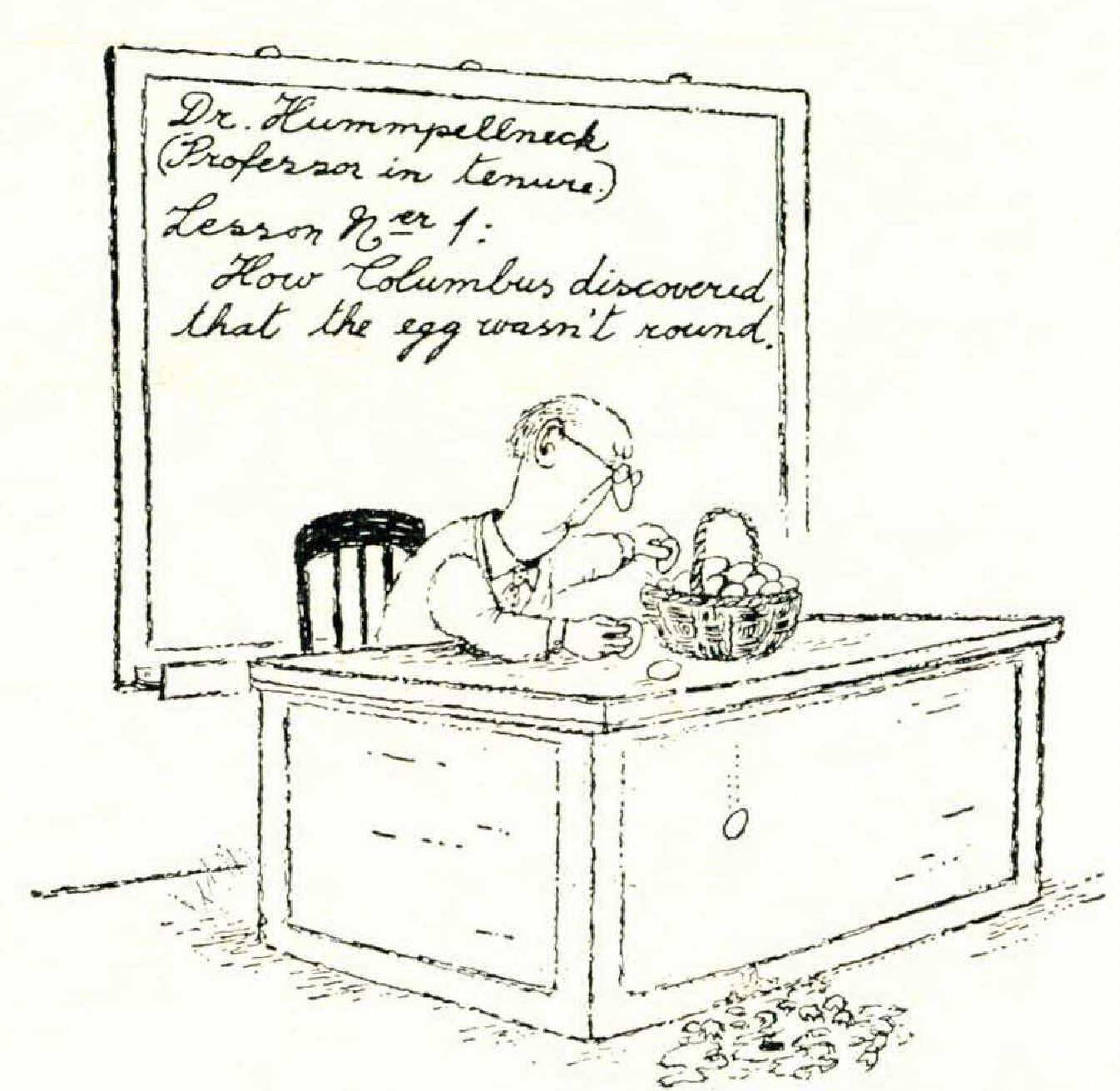
IN ONE of Thomas Hardy’s novels there is a rustic who, whenever he drinks a bit too much, suffers from a curious affliction called “the multiplying eye.” American professors, though usually more sober than Hardy’s character, have in the last few decades been troubled by a similar complaint. They have been uncertain about their true ends in work and life; they have become cross-eyed from trying to keep in view a treacherous dazzle of purposes. It’s enough to make anyone’s eye multiply: this having to confront at one and the same time the glare of political power, the neon flashes of affluence, and the still beckoning lights of scholarship.
It was not always so. There was a time (we need not idealize it) when the American professor knew exactly who he was. Until, say, twenty-five or thirty years ago, our universities drew their students mainly from the upper and upper-middle classes. Regarding himself as a spokesman for cultivation in the raging desert of American philistinism, the professor lived a life of containment, performing his work well or poorly, but usually in quiet. He transmitted the fixed content of his discipline to students who rarely disturbed him by an unseemly eagerness for knowledge or controversy. He conducted research of his own that was meant largely for the inspection of his peers. A “celibacy of intellect” was Alfred North Whitehead’s somewhat caustic description of this life, but it should be remembered that if celibacy points to a sterile disengagement, it can also suggest purity of spirit.
For the American people at large, the professor raised few problems. In the profoundly anti-intellectual tradition dominating American culture from the 1830s through the 1920s, the professor usually figured as a stereotype, a butt of ridicule. He was impractical (never met a payroll). He was absentminded (because his mind was stocked with thought or was ignorant of harsh realities?). He was not to be trusted with the abrasive tools of power, which had best be left to businessmen, lawyers, and other agents of American realism, whose vitality had not been sapped by visions or ideas.
If, however, the average professor was a sort of amiable bumbler, how could he be entrusted with the education of the young men who would soon be running our government, managing our corporations, and providing moral guidance for our families? The answer, which seems to me of great importance for a grasp of American history, is that until recently it was assumed that between life and learning, reality and thought, there was only the loosest connection.
What happened in college, like what happened during the European tours to which prosperous Americans once treated their young, was mostly decoration, a bit of stylistic polish, at best a sign that we too could hold our culture. Seldom was it supposed to have much to do with the way men earned their living, structured their society, and clawed their way to preferment; almost never was it regarded as a prerequisite for a decent job. Once, however, it came to be assumed that there were close vocational, social, and psychic links between higher education and economic mobility, the life of the American professor started radically to change.
Two further turning points should be noted: first, the advent of the New Deal, which brought professors to Washington; and second, the outbreak of the cold war, which meant that vast sums of government money would be poured into scientific-military research, and the country as a whole would begin its semiconscious experiment in “mass education.”
Behind Franklin Roosevelt’s New Deal there was the central assumption that the traditional sources of social power and intelligence had proved inadequate to the national crisis. Paralyzed by the Depression, businessmen, lawyers, and engineers no longer knew what to do. Some theoretical grasp was now needed in regard to what had happened to Western capitalism in the twentieth century, some knowledge of economics beyond the banalities of “free enterprise,” some idea of the way industrial society had deviated from the simpleminded fiction that the United States remained a nation of small, free, and self-sufficient entrepreneurs.
Ideas came into fashion. The country called upon the intellectuals for help. Professors sniffed the aromas of influence, approached the excitements of political battle. The world, for a few of them, would never be quite the same again, and many of those who remained on the campus, meeting their classes and scraping through blue books, were infected with the hope that new possibilities had opened to their profession.
Which possibilities? In the most exalted terms, a union of intellect and power, a re-establishment of the honored role which men of ideas had enjoyed at the founding of the nation. In the most vulgar terms, fame, influence, mobility, and perhaps some power.
THE New Deal years proved to be a portent of what was to happen during the cold war years. General Eisenhower may have had little use for eggheads, but the Pentagon and its attendant agencies needed them in quantity. A few professors were now men of power, or at least could minister to the power of those who really held it. Scientists could work up formulas by which statesmen might blow up the world. Economists could work up different kinds of formulas by which recessions might be eased. Psychologists could advise on brainwashing and space perception. Sociologists could make a pass at explaining the mysteries of juvenile delinquency, the heartbreak of urban renewal.
But more. Not only did the government pour millions into scientific research, a modest fraction of which would be carved away by “social scientists" ready to demonstrate that they too could contribute toward apocalypse, or at least toward charting its “dysfunctional correlates.” Not only did Sputnik spike the country into a crude hysteria about the need to “catch up” in education (though no one quite knew what we had to catch up with, or why). And not only did professors now find themselves courted by publishers, interviewed on television, gladdened by foundations, and allowed to ghostwrite speeches and justify invasions for politicians. Within the universities themselves, the professors also had to face an unprecedented overflow of students, many of them students only in name, yet all prepared to grind away for that diploma. The college degree became the great American tattoo, and “excellence" the first drip of honey from the lips of college presidents keen to the approach of endowments.
Only a handful of reactionaries, nostalgic for an aristocracy they never had, are opposed in principle to “mass education.”The rest of us, whether happily or not, believe that mass education is here to stay, as irreversible as industrialism. By “mass education” we mean a situation in which it is commonly agreed that all members of society have a right to attend schools and colleges as long as they wish, are able, or can bear to. We may also be pointing to the fearful problems that follow upon this assumption. For the campus now becomes a place of much business and great busy-ness; it resembles a modern corporation at least as much as an old-fashioned university; it becomes efficient, impersonal, “functionally rationalized.” In the memorable if unhappy words of Clark Kerr, president of the University of California, it becomes “the multiversity,” a “prime instrument of national purpose,” home of “the knowledge industry,” and center of “the knowledge process.” The very language is revealing: the language of a bureaucrat grown deaf to English.
In this world of processed education, the professor is besieged by problems of heartbreaking difficulty. He is, we shall assume, a young man starting his career. He has finished his degree, gotten his first job, and now, walking to the classroom and wondering how he can possibly fill up those fifty minutes, he remembers the words of his graduate teachers about the sanctity of scholarship and the dignity of learning. These words are precious to him; but the extent to which he should allow them to shape his career is another question. He is a human being, with the needs, anxieties, and weaknesses of a human being. He has been married, his wife has supported him through the pennypinching ordeal of graduate school, and a baby now crawls through their economy apartment. With a gasp of relief to be free from the benevolent dictatorship of his professors and some burgeoning appetites for decent living, he must take stock of his situation. He must try to cope with the pervasive competitiveness and anxiety which fog the American campus. He must think of tenure, he must begin to publish, he must try to please senior colleagues — and meanwhile, teach.
Our young professor knows that if he bears down hard on his teaching, he will have almost no time for anything else during his first few years. He also knows that he will be judged mainly for his “production” — that is, for his scholarly writing and research.
Now this problem of “teaching versus research" is a very complex one, and if college administrators are often crassly stupid when they insist that a certain number of articles or books should be the major criterion for tenure or promotion, so are many outside critics who talk as if research were merely time and energy stolen from the students. In our better universities, the professor who keeps his mind sharp by doing work of his own will almost always become a better teacher, while the lazy or incompetent man who assuages himself with the rationale that he is “devoted to teaching" usually hasn’t got much to teach. But only as a general principle is this true. Because of the feverishly competitive atmosphere that has overtaken more and more universities and the mania for “quantification” that has seized the administrators, there often is a conflict between teaching and research. More important, there is also a conflict between honest intellectual effort, which cannot be rationed in either time or quantity, and the busy-work to which harassed professors are sometimes driven.
Have you any idea what it means to prepare three new courses the first time (or any other time) one has to teach? Can you imagine how nerveracking it is to stand there in front of fifty young people who are skeptical, eager, critical, and quite delighted to compare you, a trembling rookie, with the DiMaggios of the profession? Anyone who takes college teaching seriously finds himself working sixty hours a week just to stay ahead of his classes — or to be honest, that is what he does in his first few years. If he keeps doing it, he may not have a very successful career in the academy, for he will not be able to display much “production,” nor will he get offers from the preferred schools.
THE choices our young professor makes will depend partly on the presence of certain kinds of colleagues, men of intellectual devotion and stamina. A few can be found on almost every campus, and we know their names as if they were figures in legend. But candor also requires one to admit that the strongest academic tendency, especially in the more ambitious universities, has been toward new types, far more snappy, aggressive, and up to date than the traditional scholar or intellectual. Here are a few of these types, drawn in the inks of caricature, but caricatures, I think, of the truth:
The Research Magnate. Usually a scientist, sometimes a sociologist, rarely a humanist, he spends as much time in Washington as on his campus. Supervising enormous projects and teaching less and less, he does the work of the world, not the work of the mind. He is a brilliant man. He has done remarkable things and may do them again. But right now it is not clear to his colleagues, or even to himself, whether the projects he is directing are scientifically inviting or militarily scheduled, whether he does such research because his mind cannot leave it alone or because there are strong institutional pressures and worldly inducements for him to do it.
If he is a physicist, he remembers the Bomb. He submits himself to occasional moments of moral agonizing, and worries about the social responsibilities of the scientist. But since he is also a “realist,” he continues to accept government contracts and, as penance of sorts, subscribes to and writes for the Bulletin of the Atomic Scientists, a thoughtful journal dealing with the issues that give scientists bad nights.
What really tempts such men is not money but the idea of power, with all its possibilities for personal expression and moral coloring. Professors whose political experience had been limited to jockeying for the chairmanship of a university department now find themselves close to the centers of national authority — it can make heads reel. Worldly power is a lure both strong and insidious, even among those who regard themselves as principled critics of the society. I recall a friend, famous at his death as a radical sociologist, telling me that for a lecture he had given at the War College, the Army had furnished a special plane: just for him. He was an opponent of militarism and a severe critic of U.S. foreign policy, yet he told me this story in a tone of awe and glee. Repeating it here, I mean not to disparage a gifted man but to suggest something about our common condition, Emma Bovary, c’est moi.
Prosperous, honored, indulged, and burdened with terrifying responsibilities, our research magnate is a very troubled man.
The Academic Entrepreneur. On a lower plane of intellectual distinction and academic status than the research magnate, he is the all-round grubber of university life. He is marvelously busy. He arranges conferences for colleagues and attends conferences arranged by colleagues. He consults in behalf of the Rand Corporation, also for a local research institute which has federal money to study “the changing character-structure in urban society"; he organizes “teams” of researchers, keen to the fact that foundations like to sip broths made by an excess of cooks. His textbook is now in its seventh edition: wily students must not fall back on used copies. He writes humdrum articles for the learned journals, sometimes “helped” by his graduate students. He also writes for the New York Times magazine, fearlessly advocating a balance between freedom and authority. But his greatest talent is at composing applications for foundation support: he is the Max Weber of “grant expediters.”
The Campus Org-Man. Antedating campus corporatism but flourishing since its arrival, this poor devil is also very busy. Provide a chore, and he will do it. Not much of a researcher, too little known to be an entrepreneur, he makes himself indispensable at home. He serves on twenty-seven committees, “advises” students endlessly, keeps in close touch with alumni. He is the delight of chairmen, the joy of deans (soon he too may become —). Every institution needs him, and he makes life a little easier for all of us; but as far as learning, writing, or even teaching is concerned, he simply fills a slot.
The kind of education that follows from all this is often bleak but not always hopeless. Nagging away through the routine of classes, coffee-break chatter, and examination-grading, the academic conscience survives. It survives, above all, through the example set by certain professors, men who embody the ideals by which the rest of us would live. Whoever has listened to the lectures and conversation of Meyer Schapiro, professor of art history at Columbia but actually the mentor of a whole generation of intellectuals, knows how intense and exhilarating the life of the mind can be. Or I think of a very different kind of teacher, Yvor Winters at Stanford, a literary scholar who sets for his students — and even for those of his colleagues who sharply disagree with him — a lasting model of seriousness.
Conscience survives among other professors, less brilliant and distinguished, but equally devoted. There are thousands of men and women teaching in the American universities who care more about the quality of their work than the standard of their living. They are neither geniuses nor saints, their contributions to scholarship may prove to be modest, and many of them publish little or nothing. But they care about intellect, they nurture the minds of their students, and some of them are passionately caught up with the state of the world. On certain campuses they tend to be overshadowed by the small minority of research magnates and slightly larger minority of academic entrepreneurs; somehow, they do not sufficiently establish themselves as a force for standards in most universities; but they are serious men, much to be respected, who can transform the life and values of their students.
An especially severe responsibility falls upon the growing number of intellectuals who have recently found shelter in American universities. They have become professors at precisely the time students are experiencing a profound sense of doubt regarding the relevance of intellectual concerns. Every agency of our society keeps hammering at the young to tell them what they already know: that there is practical advantage in getting a degree. But the more our students become convinced of the utility of a college education, the more problematic does its content seem to them.
Not many old-line scholars and no new-style academic entrepreneurs can demonstrate to these students, with a burning and indisputable urgency, the values of disinterested thought and critical reflection. To validate the kind of contemplative life which, upon need, also becomes a passionately committed life; to show how the motives behind pure scholarship can also lead us to organize teachins on foreign policy; to uphold the complex ideal of a balance between detachment and involvement — this is the special task of the intellectuals now doubling as teachers. Whether it can be done I do not know; but it must be tried.