The Path to Promotion
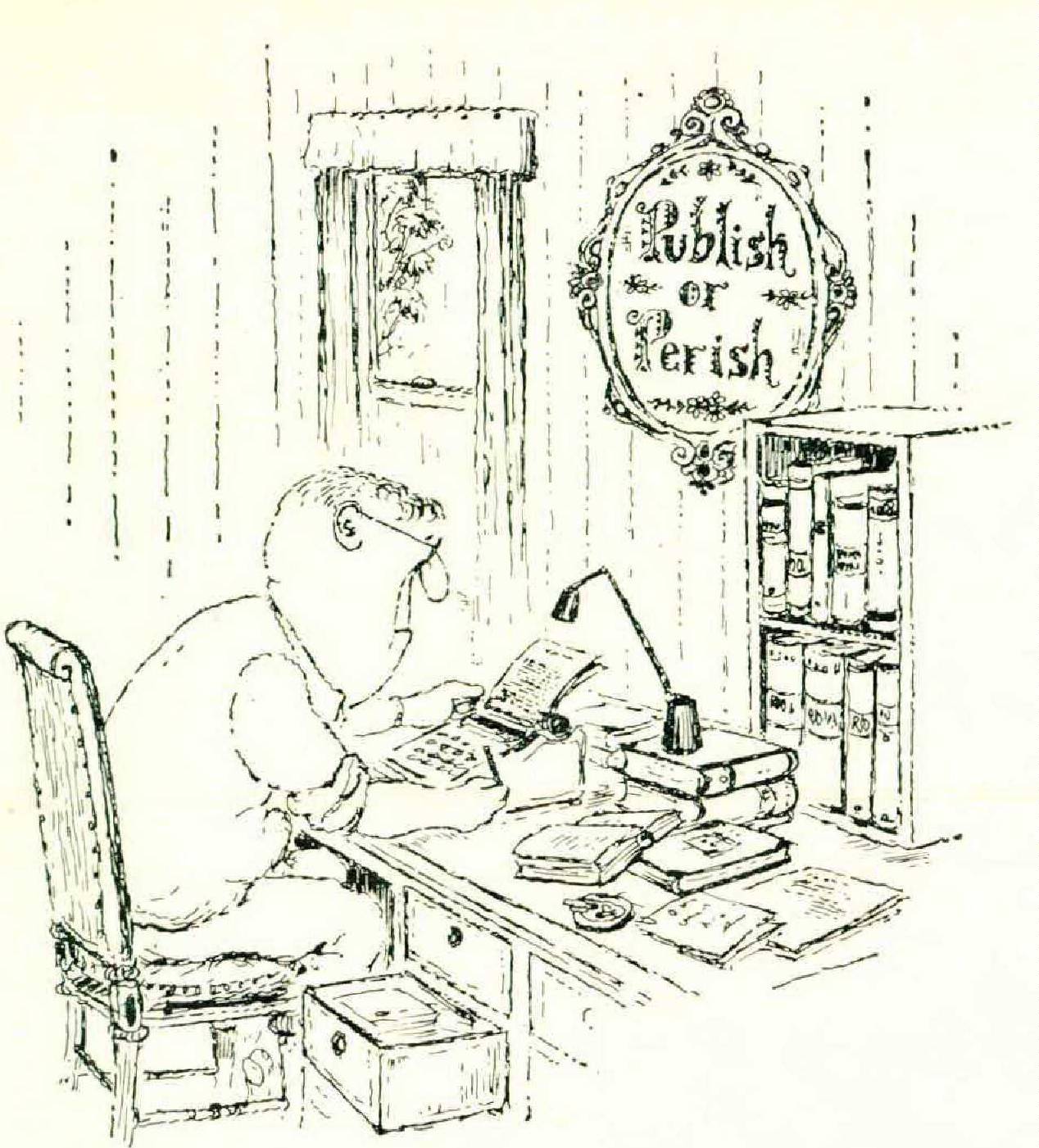
“The idea that universities select their faculties on some mindless principle of publish or perish is so ludicrously childish that it ought not to take in even a foolish undergraduate.” So says Arthur Mizener, biographer of F. Scott Fitzgerald and professor of English at Cornell University, who explores in detail the hiring and firing of university professors.
ARTHUR MIZENER
THE impassioned cry that the referee ought to be shot sent up by students at Yale last spring is only the noisiest illustration of an attitude that is endemic among American undergraduates. Heaven knows it has its occasions. Like all institutions, universities have never been perfect; at the moment they are a good deal less perfect than usual, because they are faced with a nearly impossible situation, an unprecedented increase in enrollment and an unprecedented shortage of experienced or even competent teachers.
The difficulties of the situation are being considerably increased by the unlucky fact that the fashionable posture among students seriously interested in reform is an assertion of their “alienation” from society accompanied by an idea that the way to make a “community,” to enforce human warmth and intimacy, is to form a committee and to agitate. Like the Trotskyism of the 1930s this posture has the advantage of allowing its possessor to scorn anyone responsible for the actual operation of a human institution (a man already committed to an absurdly pointless world and therefore evidently a fool) and thus to free himself for the most seductive of all intellectual self-indulgences, the invention of utopias.
This is in itself a harmless and even stimulating activity. But when the utopian dreams of students are acted on, they involve a serious, sometimes even a disastrous waste of the students’ time and, insofar as they have any political effect on the university, an increase in the difficulty of solving the very problems the students are attacking. The pity of all this is that for the first time in decades at least a few American students are interested enough in education to want to do something about it, and they are well on their way to wasting their efforts on ridiculous schemes based on false conceptions of the problems. Perhaps all this waste and confusion is inevitable; if it is, then so are the well-meant efforts of aging rebels of the last generation to prevent its happening once more.
The present agitation over the system of promotion in our universities is a good illustration of what is happening among these contemporary rebels. It is based on a misconception of the actual situation so extravagant that had they not made it as plain as the Madison Avenue art of placards can, it would not have seemed possible among intelligent young people who have been observing a university from inside for three or four years.
Perhaps university faculties are to blame for this situation. It is certainly true that the better they are, the more intensely they are preoccupied with their scholarship and their teaching and the less patience they have for the purely political aspects of the internal life of their universities. If this were not so, they might well have seen dangerous signs that many undergraduates have little idea of the actual nature of a university in the persistent tendency of students to make superficial courses remarkably popular, to trail about after the showmen of the faculty rather than the teachers, to seek, rather pathetically, dogmas rather than occasions for understanding. These signs, it is now easy to see, ought perhaps to have warned us that many students have a conception of a faculty’s uses that is neither possible nor, if it were possible, desirable.
THERE are three easily distinguishable kinds of professors in universities, none of whom performs the functions allotted to him with the utopian perfection that idealistic undergraduates expect. The first kind is the man who provides what everyone in the university, faculty and students alike, depends on. He is the man who has read, in an intellectually tough and disciplined way, all there is to know about his subject and has accomplished, in at least an adequate way, the supremely difficult intellectual task of organizing this body of knowledge in a communicable form. That form does not, theoretically, have to be the written word, but anyone who has ever performed even the most insignificant intellectual task knows that when he tries to write down what he knows and thinks, he discovers the many gaps of knowledge and reason in his understanding of a subject he quite honestly believed he had perfectly under command. There are rare people who can discover these gaps without the discipline of writing, but they are so rare that they are, for all practical purposes, nonexistent.
The men who perform the task I have been describing are the scholars, the real scholars. They may not always be eloquent public speakers, moving preachers, or sympathetic confessors. Thorstein Veblen, for example, was famous for his classroom habit of putting his hand before his mouth and mumbling in a way that made it difficult to hear him at all. One of the distinguished Elizabethan scholars of the last generation, Thomas Marc Parrott of Princeton, always lectured with his eyes closed and with a faraway expression on his face that strongly suggested a considerable lack of personal interest in the students before him. He was in fact a gregarious and genial man among his friends, but I believe he found it absurd — as indeed it is — for a man to pretend that every student who turns up in his classes is a personal friend.
The fact remains that the whole educational process depends on men like these, because the universities are not just trying to teach students; they are trying to teach students the slowly accumulated knowledge and understanding of a great culture. Their fundamental justification for existence is that they are committed to striving for exact knowledge and just understanding. The tendency of idealistic students to overlook the supreme importance of the scholar’s function seems to rest on their flattering but absurd conviction that everyone who is a professor automatically is a learned man and that all anyone needs to worry about is whether he is an interesting teacher.
The second kind of professor is the man who becomes, at any cost, the interesting teacher. He has developed talents as an actor or an orator or a preacher. Consciously or not, he is much more interested in finding an aspect of his subject that will allow him to give an appealing lecture than he is in providing a well-ordered conspectus of it. As a young instructor, I once innocently said to a popular older colleague that I was killing myself trying to reread in too short a time The Portrait of a Lady because I was about to teach it. “That’s silly,” he said. “What you should do is to read it only until you come to some interesting point, one you are prepared to say a good deal about and that you know will remind your students of experiences of their own; then you build your lecture around that. The important thing is to be sure the lecture is interesting.”
Not all teachers primarily concerned to fascinate students go that far, but this is the principle on which they select what they will teach, and with beginning students, it may not be a wholly bad one. A real education consists almost entirely in what an individual learns for himself by studying; the function of a formal educational system is somehow or other to get him to do that studying, and certainly one of the ways of persuading beginning students to do it is to make them feel that the personal problems with which they are so deeply preoccupied are reflected in the books they are asked to study — though in fact they never are, at least not in the primitive forms in which they exist in the minds of such students. There is, therefore, an inevitable element of tergiversation in teaching of this kind; but it is difficult not to sympathize with the people for whom education is so important that any method of inducing students to study, however dubious in itself, is justified.
What is more, though it is irrelevant to education, the discussion of the personal problems of young people under the guise of teaching a novel or a period of history or whatnot may well be the best moral and civil training young people get in our society.
To be sure, it can also be made, usually for the most high-minded reasons, destructive of the students’ sense of reality. I once knew an eloquent and personable young teacher who was an earnest Zen Buddhist. No matter what subject he was asked to teach, his course always ended up as a series of sermons in Zen. A certain number of students found that young man all too fascinating; he was a successful teacher in the sense that he interested these students. But he did not at all interest them in the subject he was supposedly teaching; he simply did not teach it. And however much may be said for everyone’s understanding Zen Buddhism, it is doubtful that it provides a satisfactory faith for anyone but the odd eccentric in our society, even if one should grant that the function of the university teacher is to inculcate a religion.
The third kind of professor in our universities is the man who has done a good deal of moderately serious reading and thinking, or, alternatively, a small amount of severely disciplined reading. Such men are the useful men of the profession. They know from experience what knowledge and understanding are; they can use the work of real scholars responsibly. They are, in short, the teachers who, though they usually have not studied systematically the subject they are teaching, can work out at second hand an undistorted and lucid view of it. They are usually men with the natural equipment to become scholars who have been diverted partway through their careers, by their personal popularity or perhaps the accidental success of a book, into devoting most of their time to teaching, and at worst, “administration” — the name universities give to the endless hours that someone must spend over the humanly fascinating trivialities that preoccupy students not much interested in learning and faculty members too much interested in the internal politics of the university. Such men sometimes even end up in business or government service, where their careers are sighed over by their erstwhile colleagues, with the comic myopia of all professions, as further instances of promising scholars lost to the profession.
But when such men stay in the university they constitute the backbone of the faculty. It is this kind of man that universities are trying to identify among the young teachers whom they are more often than not forced by circumstances either to promote to tenure or to fire before enough evidence has accumulated to allow even the wisest judge to guess what kind of professors they are going to make. Even under ideal circumstances, the decision about promotion would be pretty much of a gamble, since human beings are too unpredictable for anyone to guess what they may become during the thirty-odd years they will be tenure members of a faculty. In actual practice the guessing is done according to a few not very obscure and not very reliable rules of thumb that most sensible people can probably imagine for themselves.
The young man who spends long, long hours in his office discussing with students, not their work, but their personal problems is often a gentle and kindly person; sometimes, too, he enjoys playing the sage, a great temptation for teachers that few are wholly immune to. Either way, he is all too likely to find less time for the study of his subject than he needs to understand it, however popular his activities may make him with certain students. The young man who falls in love with pedagogy itself and assures himself enthusiastically that he has found, in some special method of teaching, a way to revolutionize education is likely insensibly to come to care less for what he is teaching than for the amount of responsive enthusiasm he can generate in his students. The young man who thinks that in some quasi-analytical, quasi-religious, or political theory about his subject he has found an important secret long concealed from the world can quite easily become a popular teacher by his advocacy of this revelation and is often a facile writer who awes people unacquainted with his subject by the sheer bulk of his publication. The young man who has fallen deeply in love with his subject and is easily excited over the minute particulars of it is also often a great publisher, usually of articles that give every promise of his turning into a hopelessly narrow pedant. Such young men may be kind and considerate human beings; they are often much loved by the students who have come to know them intimately. But they raise serious doubts about their capacities to become or to remain good teachers in the full sense of the term.
PROFESSORS, unbelievable as it apparently is to reforming undergraduates, are merely men; very few of them are filled with motiveless malignity or straw, but they are, like most men, frequently willful, jealous, vain. Perhaps they are a little less so than most groups of men, because though devotion to learning does not influence their characters as much as naive people expect it to, it does influence them a little. Devotion to learning is an impersonal love, and insofar as it exists in a man, he will rise above merely selfish feelings. Nevertheless, professors make plenty of mistakes in deciding about promotions, both theoretically avoidable and unavoidable ones. The only practical question which that fact raises is whether any other system of making these decisions would ensure fewer mistakes.
It is all too natural that young people, facing in classrooms the human evidence of the mistakes that have been made in the past about promotions, should be tempted to believe in the superiority of their own judgments, and that some undergraduates (and all instructors) go about suffering from the frustrated conviction that they could choose a faculty far more skillfully than the tired old crocks who actually have the responsibility of doing so. Even if this were true, there would be no way of discovering what the students’ judgment really is, since no student can know what he thinks about all the teachers from whom those to be promoted must be chosen; at best he will have studied with one or two of them. The vociferous minorities that march about with placards are even less useful, generous though the impulse to march about in support of some young teacher may in itself be.
But even if the difficulties in the way of discovering an informed student opinion could somehow be eliminated, the judgment of students would not be adequate to the occasion; they are wholly unequipped to judge a teacher’s knowledge of his subject, and they have a perfectly natural but distorting vested interest in his talents for keeping them interested in the classroom. It would be too much to ask of human nature to expect students to recognize that, as a great professor once said, it is the duty of every teacher to bore his students at regular intervals, since there are necessary aspects of every subject that are not in the least interesting.
This is not intended to suggest that a teacher’s senior colleagues are able to judge his worth very precisely either. The longer and the more effectively a man has taught, the more highly developed his own personal method of teaching will have become and the less free he will be to judge someone else’s. Moreover, there are irritatingly unavoidable practical difficulties in the way of finding out how a man does teach. Let another teacher — especially an older one — visit a class, and both the teacher and the students freeze up in a way that makes the occasion hopelessly unrepresentative.
It is perfectly possible to make reliable gross distinctions about teachers, of course. When a man is ignorant or incoherent, it will become evident to students and colleagues alike; the same thing is true of the informed and lucid teacher. But it would make the whole discussion of how to select teachers for promotion a good deal more useful if everyone would honestly admit that no one has yet discovered a way to make fine distinctions in this area, even if everyone could agree about the criteria to be used in making them.
Moreover, it seems not to have been considered by those who are overwrought about the universities’ inability to make their methods of promotion infallible that this may actually be an advantage to American higher education as a whole. When Harvard or Yale makes the mistake of failing to promote a potentially fine teacher, the man does not stop teaching; he goes to another university or college, where he teaches students every bit as deserving as those at the institution he has left. American education as a whole is no worse off for that. In fact, it may be a good deal better off, since the mistakes of Harvard and Yale send to less famous institutions teachers they might not otherwise be able to get.
Furthermore, the men themselves are often better off for having been driven out of institutions to which they have frequently become attached in detrimental ways. A surprisingly large number of the most successful teachers began their careers by being fired from the institution at which they started. With rare exceptions they themselves will bear unembittered and convincing testimony that it was the best thing that ever happened to them. On the other hand, every famous university will have on its faculty a certain number of people who were reluctantly promoted when they were young because they were popular with the students and emotionally committed to the university; they are the embarrassing tenure members of the university for whom some administrative make-work or some insignificant teaching has to be invented.
None of this is intended to suggest that the present system of selecting teachers for promotion is faultless, or even very successful if measured against the ideal system we can all so easily imagine. It is intended only to suggest that the reforms so far proposed have little bearing on the actual situation, and that if they were put into practice, they would make the selections worse rather than better.
If it is not impertinent of a professor to say so, I believe that there would be much to be gained if students were to direct their attention to the factors in our situation that are really frightening — the shortage of scholarly teachers and the crude massproduction methods that are being suggested to increase the supply. These things are lowering the quality of both the scholarship and the teaching in our universities right now and show every sign of doing so even more in the near future. They are also setting up a competition for teachers among leading universities that is wasteful in itself and conducive to the spread of all sorts of shoddy tricks, like the bait of no-teaching programs offered by universities anxious to buy distinguished men.
The idea that there is something patently vicious and easily curable about the process by which men are chosen for promotion in our universities is, however, an illusion, and the idea that universities select their faculties on some mindless principle of publish or perish is so ludicrously childish that it ought not to take in even a foolish undergraduate.