The Bso Plays Lohengrin
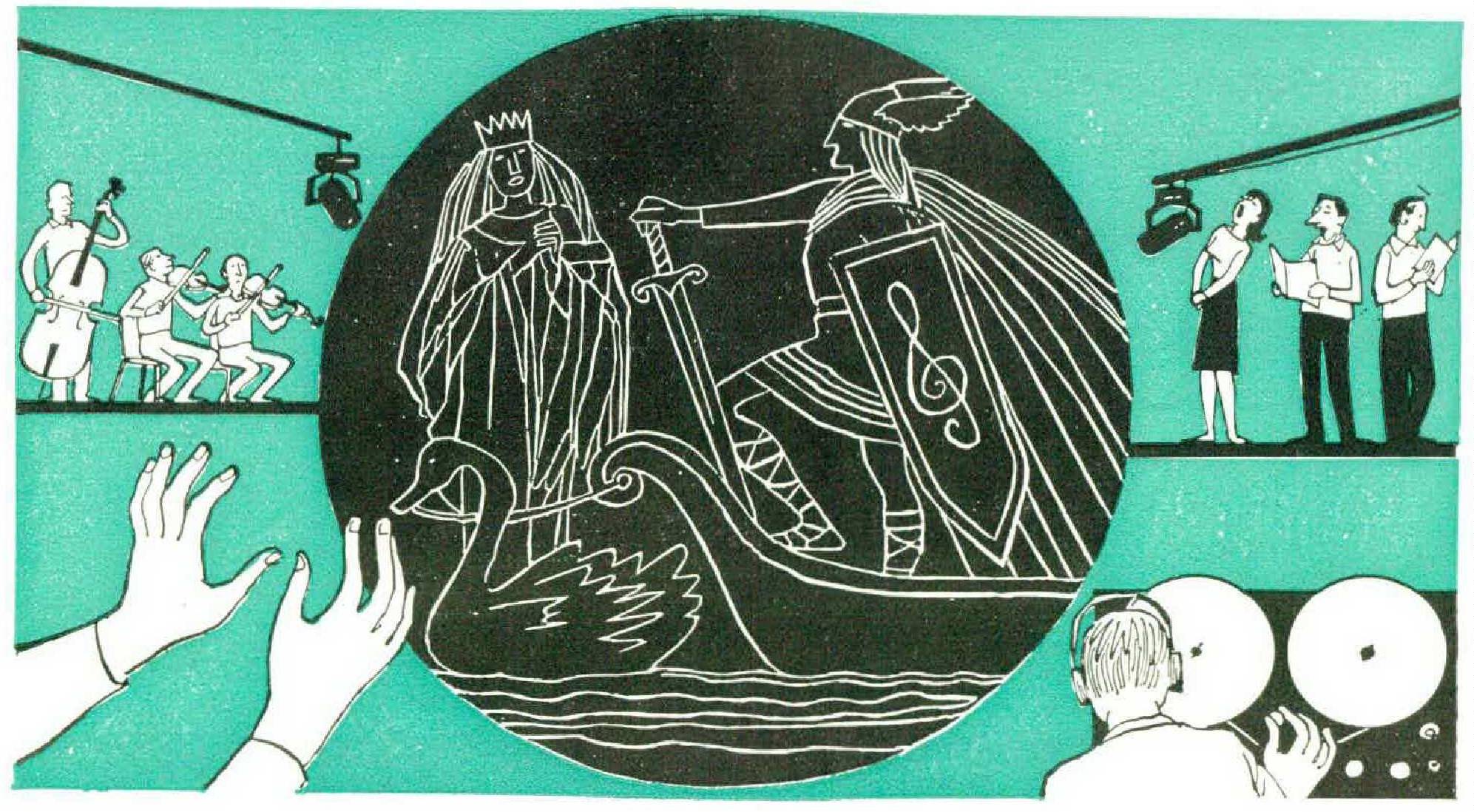
Some time next fall RCA Victor will send forth into a curious and possibly skeptical music world a new recording of Wagner’s opera Lohengrin. It will be a Lohengrin like none other, with a passage in it that even Wagner never heard, with a leading soprano completely new to her role, with an oversized chorus of 169, and with the Boston Symphony Orchestra, which has never before been involved in a complete opera recording.
Even now, with the actual recording sessions over, no one is quite sure of who thought of having the Boston do Lohengrin in the first place. George R. Marek, general manager of the RCA Victor Record Division, says that the Boston Symphony wanted to do it, and adds: “We seldom argue.” Erich Leinsdorf, the Boston’s conductor, remembers the original suggestion as coming from another RCA Victor executive, although he himself, he says, eagerly accepted the idea.
Whoever originated the project, it quickly ran into complications. The first, and perhaps most serious, occurred when Leontyne Price, after being announced to star in the role of Elsa, withdrew for reasons which were never specified. “First she said she would, then she said she wouldn’t,” explains Mr. Marek, in as succinct a summation as has ever been uttered of the vagaries of sopranos and the frustrations of recording executives.
Lucine Amara, another Metropolitan Opera soprano, was quickly engaged to replace Miss Price. Miss Amara had never sung the part of Elsa on the stage (neither had Miss Price, for that matter), and although she is a soprano held in wide respect, she is not known as one whose name “sells” operatic recordings. Nevertheless, her rather distinctive vocal quality of pristine innocence was deemed just right for Wagner’s aloof and maidenly heroine. Besides, the main sales push is expected to come from the presence of the Boston and Mr. Leinsdorf, who was renowned as a Wagnerian conductor in his years at the Metropolitan Opera. “We’re thinking of calling it ‘The Boston Symphony Plays Lohengrin' or something like that,” says one RCA Victor executive, only half jokingly.
With its personnel problems settled, the Victor Lohengrin then proceeded to cast a long Wagnerian shadow over the Berkshire Music Festival. Usually the Boston Symphony’s summers in the Tanglewood shed are devoted to symphonic music. This year, however, the final weekend in late August was given over to a concert version of Lohengrin in what was obviously a preliminary, not to say a rehearsal, for the recording sessions just ahead. Furthermore, instead of presenting the opera intact, the Tanglewood authorities put on one act a night, a procedure which led to the suggestion that the successive presentations be called “Low,” “Hen,” and “Grin.” With a $6.50 nightly top, the cost of attending the complete opera came to $19.50, making it one of the most expensive Lohengrins on record. Attendance, not surprisingly, was noticeably below normal for Tanglewood’s final weekend of the summer.
Nevertheless, when Mr. Leinsdorf and his performers, along with a large delegation of RCA engineers and executives, gathered the next day in Symphony Hall, Boston, all was serenity and confidence. In fact, it seemed almost as natural for the Boston to be recording Lohengrin in Symphony Hall as for the swan boats to be gliding across the lake in the not-too-distant Public Gardens. Mr. Leinsdorf, nattily clad in dark trousers and a white longsleeved polo shirt, began the first of what was to prove a solid week of sessions by thanking the orchestra for its work at Tanglewood. “By your great skill and flexibility you liberated me to concentrate on the people who really needed me,” he said, in an allusion to the singers and choristers especially imported for the production.
Symphony Hall had undergone changes for the recording session that made it almost unrecognizable. The front half of the orchestra floor had been cleared by ripping out the seats from rows A to W. Rows X to SS were left in place, but a giant curtain had been draped across the hall in front of them. Other drapes and wood panels had been arranged along the sides of the hall in patterns determined by the sound engineers. Temporary air-conditioning units had been installed, and their ducts protruded from the balconies. An array of microphones hung over the performers from booms that resembled gigantic fishing-yacht poles.
The Boston Symphony was on the cleared orchestra floor, seated in rising semicircular tiers around Mr. Leinsdorf, who stood on an elevated platform. On the stage at the orchestra’s rear were the solo singers and the huge Chorus Pro Musica. The chorus plays a more vital role in Lohengrin than in most of Wagner’s operas, and Mr. Marek wanted its impact to be even greater than in a live performance. The orchestra, too, was at more than full strength, for to the normal complement of 104 had been added 25 supplementary players, most of them to participate in the offstage fanfares and other special effects in which Lohengrin abounds.
His introductory speech over, Mr. Leinsdorf called out in a businesslike voice: “We begin Act Two, Scene One.” A voice from the control booth echoed from a loudspeaker: “Opening of Act Two. Stand by. Take number one”; the tape machines began to turn, and the sessions were officially under way. It is almost axiomatic that operatic recordings nowadays are never made straight through, beginning with the overture and ending with the finale. Instead, the sessions are planned to conform to singers’ schedules and engineering requirements.
Sandor Konya, the Hungarian tenor who sings the title role in the recording, was nowhere on the scene when the sessions began. His turn would come later in the week, and an unprecedented turn it would be, for no Lohengrin before has ever been recorded completely uncut. Among the passages restored are a fifty-six bar addition to Lohengrin’s narrative, “In fernem Land,” which Wagner, in a rare burst of self-discipline, permitted to be excised to shorten the first production in 1850.
Without Konya, the stage was left to Miss Amara as Elsa, and the two villains of the piece, Ortrud, sung by the Belgian mezzo Rita Gorr, and Frederick of Telramund, sung by the young American baritone William Dooley. It seemed a long way from Symphony Hall, Boston, with its battery of electronic equipment and its casually clad singers and musicians, to the citadel of Antwerp, with its armored knights and regally garbed ladies, but Wagner’s orchestral colors and motives gradually began to work the transformation. The voices of Ortrud amd Telramund blended in their sinister duet of intrigue, vengefulness, and evil.
Mr. Leinsdorf played the scene almost to the end, but there were a few interruptions. Once he had to stop when the power momentarily failed; another time it was decided to defer temporarily a passage Miss Gorr was having trouble with. But a good twenty minutes of the act had been consigned to tape when the conductor announced a half-hour intermission. With Mr. Marek, the solo singers, and recording director Richard Mohr, he went upstairs to hear a playback on tape equipment which had been set up, of all places, in Symphony Hall’s Ancient Instruments Room. All listened, following the score as intently as if they had never seen it before. When it was over, Mr. Marek was asked how much of the “take” he expected to use in the final recording. “None of it,” he replied. “Not a bar.”
“Why not?” the startled questioner asked.
“Because it’s no good,” said Mr. Marek firmly. “It’s not a performance. There’s no menace, no emotion, no contrast, no pronouncing of the text. They’re not performing it.”
Not everybody had repaired to the playback room. During the recess a pinochle game — a musicians’ specialty — quickly started backstage. Several orchestra members began planning a golfing weekend after the recording sessions. Others wandered about, instruments in hand. Joseph Silverstein, who became concertmaster of the Boston three years ago, soon after Leinsdorf succeeded Charles Munch as conductor, was encountered in a corridor. He was wearing a horizontally striped sport shirt and was playing violin figurations. He stopped to talk about Lohengrin and the problems of recording it.
“We’ll develop drive and excitement as we get going,” he said. “A recording is always harder to play than an actual concert. The singers are a distance from the conductor; there’s also a space between the orchestra and the conductor. It takes time to get acclimated; you find the balances as you go along. There’s a kind of antiseptic atmosphere at a recording, with less excitement and less emotional involvement. Leinsdorf is very good at maintaining concert-hall tension. That’s why he tries to record in long segments. Otherwise you record a lab specimen, not a performance.”
The problem of distance was demonstrated as soon as the chorus joined in the recording session. Seated on the stage, perhaps seventy-five feet from the conductor and with the full orchestra interposed between them, the choristers kept lagging behind Leinsdorf’s beat. Rather, they were following the sound of the orchestra as it reached their ears. Leinsdorf kept chiding them with growing impatience. Finally he put aside his baton and said sharply, “Light is faster than sound. Sound gets delayed. Watch me, please, for the beat, ladies and gentlemen. Don’t believe your ear, believe your eye.”
There were other increasingly testy exchanges as the day wore on and the afternoon proceedings gave way to a night session. The control room reported that the F-sharp on the kettledrums at the start of the scene was coming through as “a low rumble,” and adjustments were made. “Drums, make the diminuendo longer,” said Leinsdorf, calling out a moment afterward: “Horns, take more time for the grace notes.” Later on, after slight lapses of intonation in the orchestra had occasioned several repetitions, Leinsdorf told his men: “With singers you can’t repeat it five times because of these little inattentions. Now, this time is for keeps.”
And so the music-making grew serious and the interruptions fewer. Scenes began to build, personalities to emerge, and the musical contours of the opera to take shape. However it had sounded in Tanglewood the day before, however it might sound in the finished recording a year hence, in Symphony Hall that day Lohengrin seemed to fill the empty auditorium with lyric radiance, making the early difficulties, the casting crisis, the Tanglewood controversy all seem remote and unimportant.
“Now that you’re really under way, is there anything you would like to say?” Mr. Leinsdorf was asked.
“Well, yes,” he said. “Listen to it.” It seemed a reasonable request.
Record Reviews
Dvořák: Serenade for Strings in E, Opus 22; Mozart: Divertimento in D, K.136
Nicholas Harsanyi conducting Princeton Chamber Orchestra; Decca DL-710109 (stereo) and DL-10109
Dvořák’s Serenade for Strings is a distillation of bittersweet romanticism, and Mozart’s Divertimento an expression of sheer musical joy. And yet it is possible to pass a concertgoing lifetime without encountering either one. On this recording they make an admirable pair, especially in the clean, precise, and sunny performances by the Princeton Chamber Orchestra, a new organization that makes a fine first impression. Doubtless there are recordings of more important works to be heard, but few that are such delight to listen to or that linger as agreeably in the memory.
Esplá: Don Quixote velando las armas; Albßniz-Halffter: Rapsodia Españ;ola
Rafael Frühbeck de Burgos conducting Orquesta Nacional España, with Gonzalo Soriano, pianist; London CS-6423 (stereo) and CM-9423
Oscar Esplá is a Spanish composer born in 1886, the first president of the Junta Nacional de Música under the Spanish republic, the former director of the Madrid Conservatory, and the writer of operas, ballets, and orchestral works, several of the latter being staples of the symphonic repertory in Spain. Don Quixote Watching Over His Arms was written in 1926; it is a poetic and evocative piece, with a Spanish folk spirit pervading its musical atmosphere. The reminiscences of other composers are mostly a matter of the rhythms and flourishes common to almost all Spanish orchestral music; there is individuality of approach as well as deftness of instrumentation in Esplá’s portrayal of the “meditations and hopes of Don Quixote on the vigil of his armour during the night,” to quote the description written by the composer on the cover of the score. The work on the reverse of the record is an arrangement for piano and orchestra by Cristóbal Halffter of an early piano rhapsody by Albéniz. It makes a fine effect in the elegant performance by Gonzalo Soriano, the pianist, and the National Orchestra of Spain led by Rafael Frühbeck de Burgos, who at twenty-seven is becoming one of his country’s most active and incisive conductors.
Ives: Symphony No. 4
Leopold Stokowski conducting American Symphony Orchestra and Schola Cantorum of New York, with David Katz and José Serebrier, associate conductors; Columbia MS-6775 (stereo) and ML6175
Charles Ives, the Connecticut insurance executive and spare-time composer, once said, “It is my impression that there is more open-mindedness and willingness to examine carefully the premises underlying a new or unfamiliar thing, before condemning it, in the world of business than in the world of music.” Ives’s compositions, spectacularly difficult and “different” as they were, certainly went ignored by large sections of the music world during his lifetime. But the situation has changed dramatically since his death in 1954 at the age of eighty. Today the work of discovering Ives goes on, with listeners becoming increasingly convinced that he was probably the greatest, and certainly the most original, of all American composers. A case in point is Ives’s Fourth Symphony, a work so immense that it requires two auxiliary conductors to control the enormous performing forces, which include, in addition to an augmented symphony orchestra, a small chamber ensemble, a chorus, and an organ. The Symphony No. 4, completed in 1916 and unplayed for nearly fifty years, bears many of the characteristic elements of the Ives style (a style, incidentally, which no one has yet come close to emulating) — the clashing rhythms, clangorous harmonies, asymmetrical melodies, polytonalities, dissonances, and sudden startling snatches of patriotic airs and hymn tunes. It is music in which the unexpected always happens, and seems inevitably right. A distant chorus sings “Watchman, Tell Us of the Night.” The strains of “Columbia, the Gem of the Ocean” burst from the brasses. At the climax of the second movement all hell breaks loose in a concatenation of what sounds like five firemen’s carnivals, three village parades, and general orchestral madness. It is quickly followed by a movement of noble serenity, with brasses and strings turning New England hymns into a majestic instrumental chorale worthy of Bach himself. This is music that must be heard to be believed, and music that bears countless repetitions.
Nicolai Ghiaurov in French and Russian Arias
Nicolai Ghiaurov, bass, with London Symphony Orchestra and Chorus conducted by Edward Downes; London OS-25911 (stereo) and 5911
Unless the present evidence is wholly misleading, and there is no reason to suspect that it is, both the voice and the name of Nicolai Ghiaurov will be heard with increasing frequency in the years ahead. Ghiaurov is a Bulgarian without the gravelly quality common to so many Slavic bassos. Instead, his voice has a nap to it, and is capable of smooth, sustained lyricism as well as brute power. The results are particularly notable in the French repertoire on this record, including Mephistopheles’ two arias from Gounod’s Faust, “Epouse quelque brave fille" from Massenet’s Manon, “Piff! Paff!“ from Meyerbeer’s Les Huguenots, and the Toreador Song from Carmen. This repertoire has not been recorded so well in years, and some of it has hardly been recorded at all.
Ernest Hemingway Reading(The Nobel Prize Acceptance Speech; Second Poem to Mary; In Harry's Bar in Venice; The Fifth Column; Work in Progress; Saturday Night at the Whorehouse in Billings, Montana)
Caedmon TC-1185 (monaural only)
“A writer should write what he has to say, and not speak it,” said Ernest Hemingway in his Nobel Prize acceptance speech. But even he occasionally succumbed to the home recorder, and the few tape and wire recordings he made during his years in Cuba have been brought together here. Despite the primitiveness of the equipment, his words are clear and distinct and his voice surprisingly youthful. Not all the readings are of equal interest; the Nobel speech (read at a date well after the actual ceremony) is a bit perfunctory, and a section of an unfinished short story is not always easy to follow. But most of the record gives a remarkably close-up view of both the man and the writer. In his discussion of his play, The Fifth Column, he enumerates the “good places for working” — that is, writing — Madrid, Paris, Key West (“in the cool months”), Kansas City, Chicago, Toronto, Havana. Then he adds wryly, “Some other places were not so good, but maybe we were not so good when we were in them.” The most moving, personal, and perhaps enduring work on the record is the “Second Poem to Mary,” the text of which ran in the August Atlantic. And the concluding Father Christmas portion of the poem, an ironic carol, is actually sung by Hemingway!