Chabert of Tain l'Hermitage
My first encounter with Chabert, or more exactly, Madame Chabert, produced one of the most embarrassing moments of my life. It was a hot August night, and though the windows were open and the three fans were whirring in the long mustard-colored dining room, there was no escape from the sultry Provençal heat which had dogged me relentlessly up Route Nationale 7, the Lyons-Marseilles highway, which is with little doubt the most unpleasant and lethal in all of France. Letting my tired eyes skim down the menu handed me by Madame Chabert, an imperious hawk-nosed lady with a dowagerial mole on her left cheek, I came upon an entry for orange sherbet, which I decided was the end of the menu. Just above was a dish temptingly advertised as “Filet SaintPierre.”There was a solid ring to the name, with a robust promise of good red meat, which struck me as ideally suited to restore my frazzled nerves. I ordered the filet and with it a bottle of red Hermitage, the local wine to whose noble name the little town of Tain has been immemorially wedded. The look on Madame Chabert’s face was something to behold. “Comment, Monsieur, du vin rouge avec du poisson?” The sherbet which I had taken for a dessert was, in fact, a mere entr’acte or culinary hyphen between the fish course and the meat, the filet Saint-Pierre being not of beef but of John Dory, a small golden-scaled fish much prized by the fishermen of Honfleur and other Channel ports.
The practice of serving sherbet in the middle of a meal has disappeared from most French restaurants, though it was once an integral part of la grande cuisine. A hundred years ago, when the French ate more copiously than they do today and when a respectable girth was measured in meters rather than in centimeters, sherbets used to be served not once, but twice and even three times during a meal — between the fish and the entrée, between the entree and the roast, between the roast and the game. No chef’s cookbook, even today, is complete without a section devoted to the granités or granolates, which include spooms as well as sorbets. By definition, they must not contain milk, cream, or eggs; they are water ices and are meant to settle the stomach, which is to say, prepare it to absorb another gargantuan portion. Chabert’s orange sorbet is made of tangerine syrup flavored with a touch of kirsch. It is a great stomach settler, allowing one to move with a minimum of abdominal exertion from an écrevisse (crayfish) flambée au Noilly-Prat or a truite a Vesiragon avec riz de pilaf to a noble cut of Charollais beef or that Chabert specialty, a pintadeau (small chicken) served in a cream sauce with a roast banana.
Toward the end of the meal the patron himself is wont to sally forth from his kitchen — a small balding figure whose arms hang limply from his shoulders like a Watteau clown’s and whose eyebrows, implausibly brown in contrast to the gray-white hair, seem stuck on above the sparklingly brown eyes and traditional red cheeks, like a Fifth Avenue Santa Claus’s. This habit of mingling with the diners, as though they were guests even more than clients, has always struck me as one of France’s great gifts to civilization. Like a triumphant general, the chef can at this point leave the routine moppingup operations to the lieutenants of his brigade, as his kitchen team is called, and go out to receive the compliments or complaints of those who have been busy savoring the fruits of victory. But it is more than a mere chef who makes the rounds; it is a sage, a homespun philosopher, ready at the drop of a toque to offer a philosophical commentary on the state of the world or to share out a few gems from the treasure chest of a lifetime’s exposure to the great.
Chabert’s impressive fund of stories begins, appropriately enough, with one about how he came to be a chef in the first place. “It was all a dreadful accident,” he likes to recall, his rosy face lighting up in a smile. “I was brought up in Marseilles at a time when there was no nonsense about excess education. When I was twelve years old my father called me in one day and said, ‘Alexandre, mon petit, the time has come for you to make a decision. Your school days are over. You are not a rich man’s son. You cannot loaf through life. Il faut choisir un métier. Now, what do you want to be, butcher, baker, carpenter, charcutier, mechanic?’ To his surprise I answered ‘cook.’ The day before, I happened to be walking up a back street, and I’d seen a number of kitchen apprentices sitting out on the back steps in their white aprons and toques laughing their heads off. They seemed to be having a great time. ‘Very well,’ my father said. ‘If you want to be a cook, a cook you’ll become.’ I was hired out as an apprentice, made to get up at five every morning, and had to work like a Turk. A dog’s life. A week later I was already regretting my choice, but it was too late.”
From then on it was a slow but inexorable progression. Born in 1900, Chabert was too young to serve in the First World War, just as he was too old to serve in the Second. Or, rather, he served in the kitchen instead of the trenches. One of his more vivid memories is of the year 1917, when he put in a stint at the Metropole in Dieppe, which a Lady MacLean had converted into a convalescent home for wounded officers. “There were more than two hundred of them. Service grand luxe. Eighteen ouvriers ("workmen,”which is to say, cooks, as opposed to apprentices). My job was to get the breakfast ready. Twelve hundred eggs each morning, along with kippers, grilled tomatoes, and a caldron full of porridge. No bugles, but you had to be up by four.”
The year 1918 saw him in Paris, where he worked for Noël Peters at Le Passage des Princes, before moving on to Ciro’s, which in those days ranked with the Café de Paris and Larue as one of the three great restaurants of the capital. At Ciro’s there were thirty-two ouvriers for ninety clients, or roughly, one cook for every three clients.
In 1925 he was appointed chef at the Palace Hotel in Monte Carlo. It was quite a place. One of its most picturesque clients was a nephew of King Fuad, a learned gentleman with the appetite of an ogre. He took all his meals in his room, where he always kept a case or two of champagne to kill the recurrent thirst. Each morning he would call Chabert up to his room and order two kilos of lamb, a pound or two of potatoes, enough haricots verts for a family of eight, and would polish them off at a single sitting. But his great passion was garlic, which he simply ate, like onions, by the head. “Put two heads of garlic in that ailolée sauce,” he would command the startled chef. One day the hotel manager asked him why he entertained such a fancy for garlic. “It’s like this,” Fuad’s nephew explained. “When I go to the Casino, which I do almost every day, I always find the game tables crowded with old Englishwomen who waste their time playing fiveand ten-franc chips. All I have to do is walk up to one of those tables, and avec l’atmosphère que je dégage, I can clear the place in a minute and have it all to myself.”
Chabert has preserved a photograph from these well-heeled days which shows him, proudly surrounded by his brigade of twenty cooks with white tunics and hats, sporting a flamboyant Alexandre Dumas mustache. ”Il fallait vieillir,“ he explains with a disarming twinkle of the eye. He was only twenty-five, rather young to be a full-fledged chef, even for one who began at twelve. Today, having reached the venerable age of sixty-four, he has removed the deceitful bush, and his baroque contours of yesterday have given way to a trim, almost ascetic silhouette.
In 1931, after marrying the daughter of the local (Tain) pharmacist — the same Madame Chabert who so impressively advises clients on what they should order and keeps ignoramuses from mixing red wine with fish — he moved to Tain l’Hermitage, 250 miles from the Côte d’Azur, 50 miles south of Lyons, and 350 miles from Paris. The traffic in those days was more leisurely than at present; it was only an occasional truck which shattered the stillness of the night as it growled through the town’s main street, where Chabert’s “hôtel de négotiants” still advertises its blue awnings and buff shields. The six bedrooms which constitute the hotel are still there, right above the mustard-colored dining rooms with the fans and the green saucer-shaped glass lamps, along with a sign at the foot of the stairs informing the weary that only those who eat at Chabert’s may bed there; but, in fact, the rooms are now almost never occupied, and Chabert prefers to send all prospective lodgers to the Hôtel des Deux Côteaux. There the ceaseless roar of truck traffic is replaced by the stillness of the quietly flowing Rhône and a view across the river to the linden trees and Castle of Tournon, which in the summer months is floodlit every night.
It is strange that this part of the Rhône valley should never have achieved a fame remotely comparable to that of the Rhine’s scenic stretch between Koblenz and Mainz. For from Givors south to Valence, where the ruined tower of the Château de Crussol looks southward like a sentinel toward the misty amethyst horizons, the sandy escarpments, and the silver-gray olive trees of Corot’s Provence, the hills are dotted with ruined battlements and jagged walls. The same robber barons built the same castles here with the same fixed intent of milking the river traffic; the only difference is that the Rhone is a more unpredictable river, given to extreme low ebbs and sudden floods which impede and sometimes imperil navigation.
The river barons, like their cousins along the Rhine, eventually found vine-tending as profitable as plundering transient traders. One of them, a certain Gaspard de Sterimberg, is even credited with having given Tain l’Hermitage its name, the story being that on his disillusioned return from the Crusades and the Albigensian wars, he got the permission of Queen Blanche of Castille to set himself up as a hermit on one of the river’s western slopes. From his sojourn in the Holy Land he brought back a grape known as sirrah, the ancestor of the species which today provides the noble vintages of Hermitage, Côte-Rotie (the Roasted Hillside), Saint-Joseph, and what may well be the loveliest name in all French vineyardry, ChanteAlouctte (Sing Skylark). All this, I have been assured on good authority, is legend, fabricated a century or two ago by a family which wanted to prove that its patents of nobility went back to the Crusades — the sine qua non criterion of acceptability for any French aristocratic lineage worth a brace or two of quarters. The sober truth of the matter is that the grape has been cultivated on the hillsides of the Rhône ever since the Greeks founded Marseilles (the Massilia of the ancients) five centuries before the birth of Christ.
The wine-growing barons, of course, have long since been replaced by vine-tending commoners, some of whom now sport the trappings of nobility in their turn. Their leading representative today is a Monsieur Chapoutier, who is to be seen in the autumn — the best time of year for visiting Tain — striding around like a country squire in corduroy britches, knee-high woolen socks, and an Austrian hunting cap. The Chapoutiers, father and son, are far and away the biggest wine dealers in the region, and three quarters of the Chôteauneuf-du-Pape and the Tavel rosé consumed at American dinner tables is fermented and processed, prior to being bottled for export, in their huge vats and deep, dank cellars at Tain.
Max Chapoutier, the thirty-yearold heir, even told me that “it’s America which keeps us alive.” After a morning spent clambering around the terraced vineyard slopes, which are as steep here as they are in Switzerland, he invited me into his office and thrust a brandy glass full of liquid gold into my hand. “What do you think of it?” I took a sip and felt a warm Provençal glow light up within me, a feeling as smooth and velvety as gently warmed honey. I was ready to sing like a thirteenthcentury troubadour, but it would have been off-key and an insult to the superlative nectar I had before me. It was a fifteen-year-old marc, distilled from grape-skin residue, a drink which in most French cafés or bistros has the raw taste of firewater laced with kerosene. Chapoutier refuses to sell his marc until it has aged for at least fifteen years, which is one reason it can stand comparison with the finest cognacs.
The Chapoutier vineyards also offer a splendid view of the steep hills which converge on the Rhône to form a kind of natural gateway at Tain, which is appropriately linked with its twin town, Tournon, across the river by the oldest suspension bridge in France (built in 1825). The eastern bank of the Rhône, being less exposed to the sun, is given over to peach and apricot growing and pastures as green as those in Normandy. This is the department of the Ardèche, itself part of the mountainous Auvergne, probably the most backward and for that reason the most unspoiled region in all of France.
The department of the Drôme, on the western bank, has remained almost as unspoiled, and its numerous streams are a treat for trout fishermen. Half a dozen miles south of Tain, the beautiful Isère River joins the Rhône, turning its meandering pebble-girded channel into a mighty flood. I know of no more breathtaking landscape in France than that offered by a drive up the Isère. The mistral, the fierce north wind which periodically blusters down the Rhône valley, here blows the poplars into shapes as twisted as gnarled old vines, and in the autumn, when they turn a brilliant yellow, they look like fiery torches, with the flames blowing south. The golden sycamores and lindens, alternating with the rust red and faded crimson of the apricot and peach leaves wilting on the trees, stand out against the gentle green of the pastures, dotted with the square-towered campaniles of the villages, which fade away and merge into the deep blue-green haze of the pine-covered mountains. Village follows shuttered village, each more ocher-hued than the next; the stained old walls drop straight into the Isère, in whose green waters the red-stone cliffs and balconied facades form a shimmering spectrum of iridescent bands.
Yes, Alexandre Chabert certainly knew what he was doing when he set himself up here in 1931 in what was then a humble restaurant de paysans. To be sure, he failed to anticipate what the truck traffic along Route Nationale 7 would do to Tain’s main street, on which his hostelry is located; or perhaps one should say that he was simply twenty-five years ahead of events; for the new LyonsValence turnpike, cutting through the hills behind Vienne and Tain, diverts all truck traffic from this stretch of the Rhône, permitting it to revert to its predestined condition, one of the loveliest touristic promenades that France has to offer.
The turnpike, even so, has come a dozen years too late. For in the early nineteen fifties, the department of the Dr7#244;me bought up the eighteenth-century château, belonging to the de Sizeranne family, which once stood at the northern entrance to the town. The château was torn down so that Route Nationale 7 could be broadened — a shortsighted piece of vandalism which Chabert has not ceased to regret. One day he asked one of the de Sizeranne heirs how much they had sold their château for. “Seven million” (about fourteen thousand dollars), he answered. “Heavens,”said Chabert, “if I’d known you were letting it go for that I’d have scraped up the money and bought it myself. Just think of the hôtel premiere classe I could have made of it — something to rival Poing’s place up the road at Vienne” (a reference to the famous Hôtel des Pyramides, the only three-star eating place on the Lyons-Marseilles road). ”Mais que voulez-vous? C’est le destin.”
Chabert’s own destiny, as far as he is concerned, is to rest content with a single star. Not because Michelin willed it, but because that is the way he wants it. “You know,” he said, “one evening a few years ago a young man came in here and asked if he could still get something to eat. It was already pretty late, but I told him that if he didn’t mind sitting in the bar and taking potluck, I’d see what I could do for him. ‘I’ve got a banquet next door for sixty people, but there should be a few scraps left in the kitchen.’ ‘I’ll take whatever you have,’ he told me. The waiters were so busy with the crowd next door that I had to take the dishes out to him myself, though I’m no maitre d’hôtel. 'Entre nous,’ I said to him, ‘I think you’re better off here in the bar than in the dining room with that mob. If I’d put you in there, you’d have found yourself in pretty bad company, and it might have put you off your meal.’ ‘Why bad company?’ he asked. ‘Because it’s a dîner de représentation in there,’ I said, ‘you know, financial officialdom, fiscal experts, tax collectors, that kind of thing.’ ‘God forbid,’ he said. ‘I’ll stay here.’
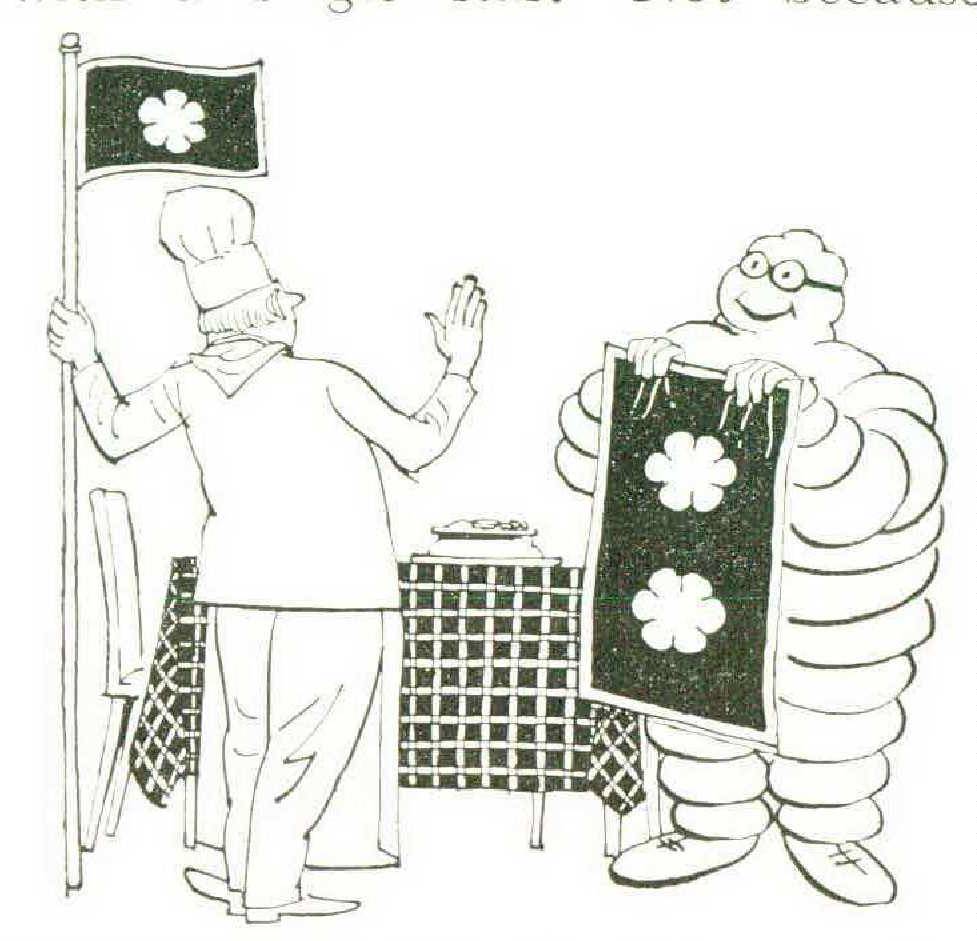
“Later he ordered some coffee and a glass of my best brandy and then asked me to sit down. ‘I’m a Michelin inspector,’ he said, pulling out a card. ‘I stopped by here because so many people have written in to say you deserve two stars. They’re quite right. We want to give you two stars.’ ‘You can keep them,'" said Chabert. “You see, Monsieur,” he explained to me, “if you move from the firstto the second-star category, all you do is bring a heap of worries down on your head. You have to lay on more staff, spruce the place up, go in for all sorts of chichi.” He waved his soft, steam-reddened hand around at the walls, decorated with a few framed adages like “On naît gourmand, on devient gourmet,” “On voit plus de vieux gourmets que de vieux médecins,” “Le soleil à Tain donne son Hermitage; l’Hermitage à l’homme donne son teint.”“And then, instead of the old clients — people who want good honest food without the artificial trimmings — you attract all the enmerdeurs in the business — traveling salesmen in a rush, pampered film stars, Teddy boys in Jaguars, and millionaires in Cadillacs who’re never satisfied and who start pounding the table if they’re not served in five minutes and can’t bolt the meal in half an hour. God bless them! They can exercise their haste on others. I’ll stick with my old clients.”
At that moment the door opened, and one of the old clients walked in. He was not smoking a cigar, he was too old to be a Teddy boy, his shabby tweed jacket and dustcolored cardigan were not those of a millionaire, but he could do Brigitte Bardot one better. For his initials turned out to be B.B.B., Baron Borel du Bcz. “The Baron can tell you a lot about Tain,” said the imperious Madame Chabert, quietly fingering her necklace beads. He did. He showed me the eighteenth-century house where Lieutenant Napoleon Bonaparte once spent a night, the house with the bright red window flowers where Châteaubriand wrote a great page on the French Revolution for his Mémoires d’Outre-Tombe, even a windowed arch spanning a tiny dark street which he humorously dubbed “Tain’s Bridge of Sighs.” It was a brisk October night, full of stars and flurries of wind, and our voices in the narrow street aroused a neighbor, who opened her door and told us that “that obstruction” had to go. “Why?" I asked the Baron as we walked away. “For the same reason they tore down that Sizeranne mansion,” he replied. “You see, the man who lives next door has just acquired a Citroën DS. He wants the house opposite torn down so that he can maneuver it into his garage.”