The Next Step Forward Is Back
A regular contributor to PUNCH of light articles and literary criticism, R. G. G. PRICElives in Sussex and writes for the ATLANTIC on a variety of subjects.
BY R. G. G. PRICE
The London Times Literary Supplement is a noble but worried paper. It broods about getting left behind by rapid changes in fashion. It knows its readers revere it for the soundness of its attitude to new manuscripts of Chaucer, but it sometimes fears they may think it a bit old-fashioned when it comes to what’s new. This gnawing terror has driven it into producing two plump special numbers devoted to reporting on the avant-garde. They are packed with manifestos from alleged avant-gardists, and action typography, and poems consisting of casually assembled syllables that form poetry because the poet says they do.
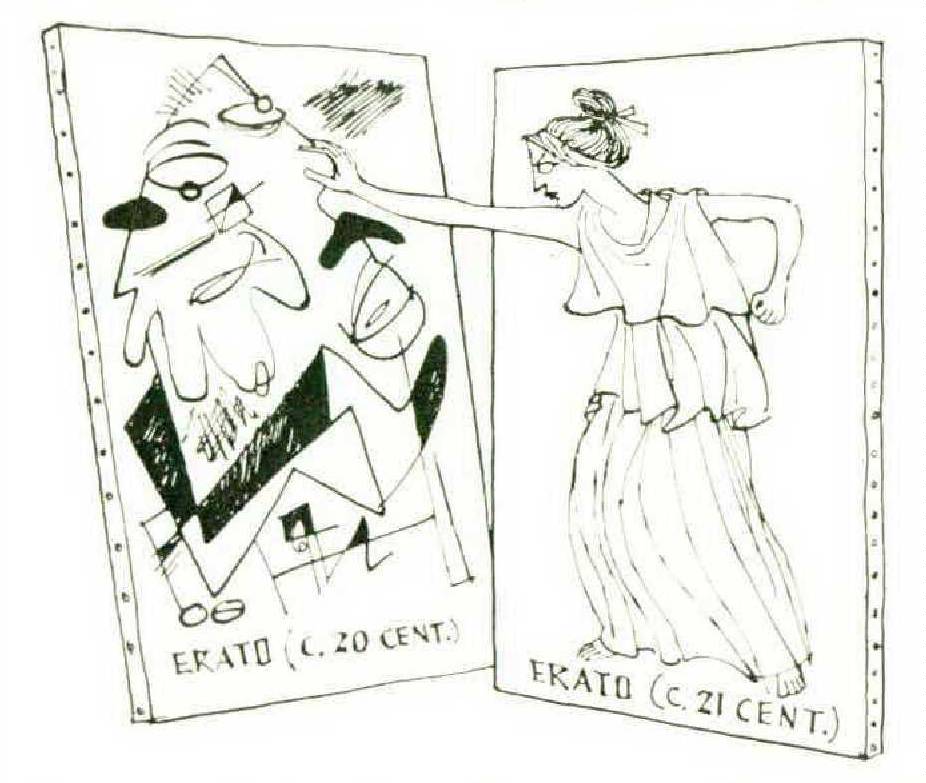
These are illustrations of current practice; but I get the feeling that the Supplement thinks it is telling its readers about trends and helping them to hold their own in conversations about Whither Verse? and The Novel — What Now? But the assumption that advance continues in the same direction is quite unhistorical. The next stage in literature won’t be like the present avantgarde only more so. My guess is we are going to see a return to the simple, the comfortable, the middlebrow; and the leaders of ultra-experimental writing will howl their heads off saying it isn’t literature at all.
When Wordsworth caused violently raised eyebrows with Lyrical Ballads, his mild ditties were not attacked (or going right over the edge of comprehensibility, for pushing the heroic couplet way out beyond decent limits. They struck contemporaries as feebleminded. The biggest new development in poetry for over a century was dismissed as smug, incompetent, and childish. It was yawned at.
But where else can modern writing go except back? Detailed descriptions of ever less widely shared perversions with alternate words printed upside down? Poems in algebraic symbols? Drama with the dialogue electronically randomized? Novels with blank spaces for the reader to fill in with any word that occurs to him, preferably dirty? Once you have broken down sense into jumbled type there is nothing left to do except give up attempting to communicate at all. The only thing to do in a cul-de-sac is turn around and go back the way you came till you come to another road forward. The new middlebrow experimenters would find life hard. They would be confused with the poor souls who have never stopped copying the writers their grandfathers loved; but any real critic ought to be able to distinguish between writers who have passed through current fashions and emerged with something quite new and poor dumb creatures who have never noticed anything happening at all.
The trouble with stunts and gimmicks and shocks is that they have to be exceptions in a humdrum world to produce any profitable response. De Quincey made a good thing out of being an opium eater because the average writer was respectable and would never have dreamed of eating opium, even on anniversaries. Now that writers, and painters, fill up with drugs before working, drugging has become an orthodoxy. Well, it always takes toughness and patience to be a heretic, and the abstemious will just have to persevere until the arts belong to them once more. They will go underground, feeling persecuted but in the right, and refuse to take the easy way and join the older generation in dope, debt, and dissociated prose.
I see these sober heralds of the new dawn turning their backs on the traditional hangouts of the progressive, like Paris, San Francisco, Ischia, and Mexico. Harold Ross said the New Yorker wasn’t written for the old lady in Dubuque. Well, Dubuque sounds like just the kind
of town for the real, not the phony, innovators to settle in. They will merge into their community, and their meetings with one another will be formal. Dining together, writers will look a bit like a whiskey ad. After the meal there will be a pause for the relaxed digestion of good wine and food — but not for snob wine-and-food talk — and then plans will be discussed for publishing a new magazine, something quite new, with the lines starting top left and finishing bottom right and never being interrupted with pictures of human eyes, technical formulas, or outbursts of obscenity. There will be a good deal of courteous, coherent, and well-reasoned argument about its title: A Treasury of Prose and Verse? The Dubuque Monthly Record of Literature? Mens Sana? When it finally appears, many readers who have been used to a hotter,
The editors are saddened to report to ATLANTIC readers the death of Robert Fontaine, a frequent and valued contributor to these pages.
spiced diet will find it tame and unreadable. But sooner or later the young will be attracted by its novelty, and one of the most savage critical battles in history will begin.
In the mid-sixties artists have been having it even better than writers. Editors don’t pay as much for a poem consisting of forty-five “I’s” followed by an equation as dealers do for canvasses with one half left bare and the other painted a single color. The heretics will begin by starving because they are meticulously representational, ostentatiously skillful, and visibly industrious. Buyers will feel they are getting their money’s worth in hours of work, even if the result is a bit short on surprise. Sculptors will stop fusing heaps of nails into a rough-and-ready unity or giving slapdash impressions of the effects of erosion and try to find somewhere to look that their predecessors have missed, perhaps even nature.
Delivering commissions on time, being moderate with stimulants, fitting in with everyone, the new wave is going to seem pretty gray to the jaded appetites of the middle-aged. But what the over-thirties think doesn’t much matter. The young will respond to something that is fresh, and what is fresh in 1965 is anything that isn’t avant-garde.