Contrasts in Europe
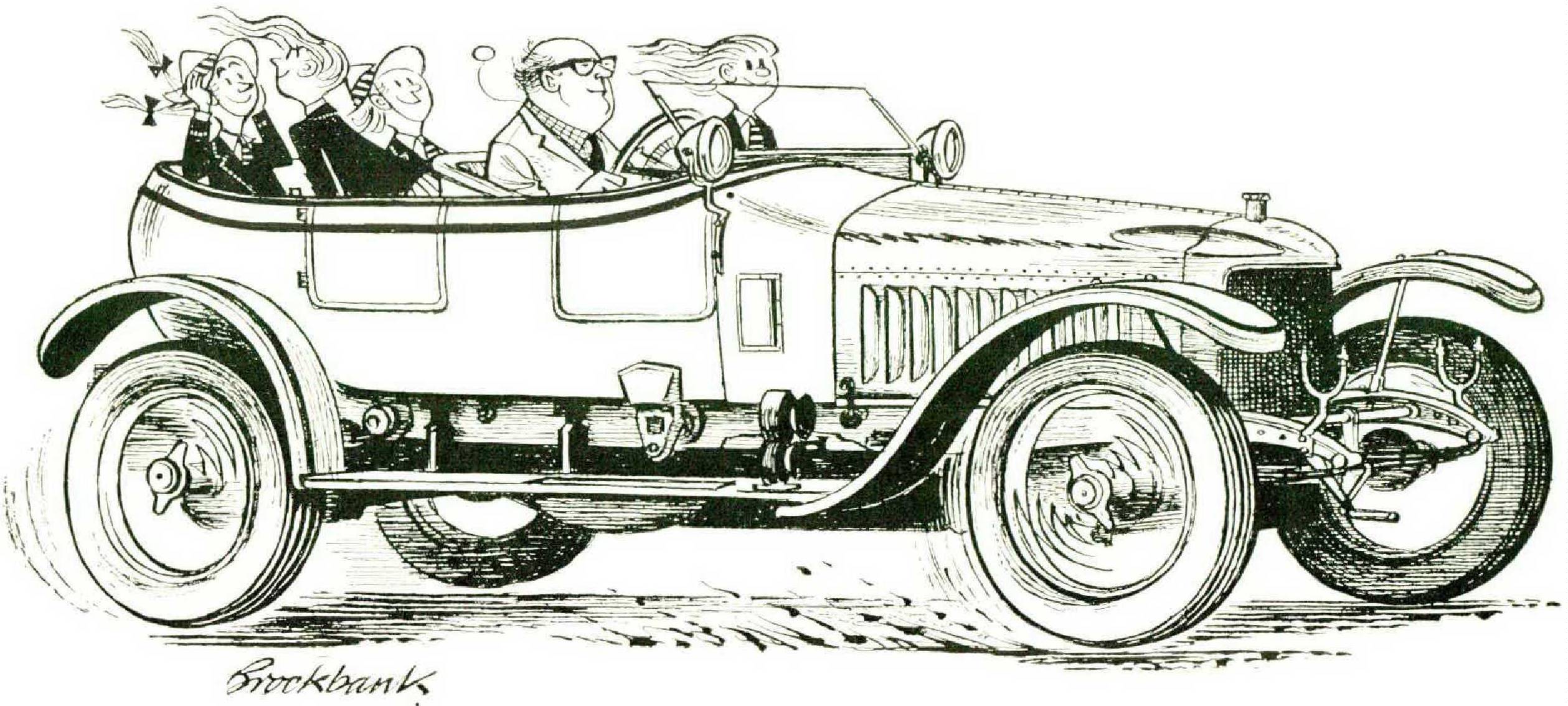
Laurence Pomeroy has spent most of his life in road testing and enjoying virtually every make of automobile. Russell Brockbank, who illustrates this article, shows him giving some friends a ride in his 1914 Prince Henry Vauxhall, which is still to be seen on British streets after fifty years of use.
THERE are considerably more than twice as many cars in the United States as there are in Europe (72,000,000 against 31,000,000). There are indeed as many Fords and Chevrolets running in the States as there are cars of every make and kind in all Europe, and if all of them were exported to the world outside Europe, this would raise the ratio of cars to population by more than three times.
Nevertheless, the current annual production of Detroit no longer dominates the scene as it did ten years ago, and in the world at large the American car is rarely encountered. Indeed, the ratio of European-made cars to American outside the United States is of the same order as the ratio of domestic to imported models within the North American continent. Broadly speaking, present output is equal on both sides of the Atlantic, but whereas the United States exports under 5 percent of its total production, mainly to nearby countries, Europe sells some 40 percent all over the world, so that most non-car-producing areas are receiving nine new European (including English) cars for every one taken from the States.
To the European observer, the most obvious characteristic of the American motoring scene is not the traffic density, which in the New York area, for example, is little different from what it is in and around London or Paris, but the fact that the average American car is at least one third longer and 50 percent heavier than the corresponding European type, is between three and four times more powerful, and costs twice as much at par values. It is equipped with an automatic transmission in three cases out of four, and six out of ten American cars have a v -8 engine. None of these features exists on popular European cars, few of them on any car.
Less obvious to a passenger is the fact that the average of all models offered has an engine with a capacity of 310 cubic inches giving over 230 brake horsepower, whereas the typical European vehicle has an engine one fifth of this size with no more than one fourth of the power output.
Similarity comes as a second surprise. For example, almost all American cars can today exceed 100 miles per hour, and all are legally restricted to around 75. In England, however, a man may buy fifteen models which will comfortably exceed 2 miles a minute, and there is no country in Europe which imposes a speed limit on the open road. On the other hand, there are a score of models which can barely look a true 80 mph in the face. In weight, size, and carrying capacity only the rearengined Chevrolet makes a marked break in an overall pattern of cars which are 230 inches long, 75 inches wide, and weigh 4000 pounds; and the price ratio on the order of five to one is reflected more in differences of equipment and furnishings than it is in the scale and structure of the car itself.
The traveled reader may well exclaim at this point that utilitarianism is as basic to European motoring as it is to American; that the differences between normal production cars on one side of the Atlantic and those on the other are determined by differences in roads and economic conditions; and that so far as variety and the spice of life is concerned, it is the large-scale American producers who offer their customers considerably more than their counterparts do in France, Italy, or Germany.
It can be agreed that operating conditions are very different in the United States from what they are in Europe. Daily distances of 500 miles on freeways at controlled speeds are common in the United States, whereas a daily mileage in excess of 350 miles is rare in Europe, and ten times this distance would exhaust the mileage of what the American recognizes as a road suitable for driving. In Europe fuel is taxed, so that gasoline costs the equivalent of 80 cents per U.S. gallon; service stations are rare, and almost all are closed between 6 P.M. and 9 A.M.; winding roads, and in some cases severe gradients, make demands on transmissions, cornering power, and steering response which are unknown in the United States. But it is true that just as the models from Chrysler, Ford, and GM account for 80 percent of American sales, so in England a similar percentage is accounted for by the lower-priced models of the British Motor Corporation and Ford of Dagenham; and in Europe by Fiat in Italy, Renault and CitrÖen in France, and Opel and Volkswagen in Germany.
But that there is congruence in the one group and contrast in the other is sustained by simple facts. AH the U.S. cars in this class are similar in specification; in Europe specifications embrace such diverse factors as front engines with front drive, rear engines with rear drive, engines of two, three, and four cylinders (in some cases air-cooled and others liquid-cooled), traditional rear axles and all-independent suspension, springs made with torsion bars, coils, and rubber. In fact, the only features common to all cars are four-speed manual transmission and restriction to four passengers. The three reasons for this engineering state of affairs are geography, economics, and society.
ALTHOUGH the major European motor manufacturing companies export 40 percent of their output, they do so at less profitable prices than they can obtain in their metropolitan markets. With only brief exceptions during the whole post-war period, production has lagged behind demand, and therefore the physical needs of the home markets have dominated the designers’ concept of the car.
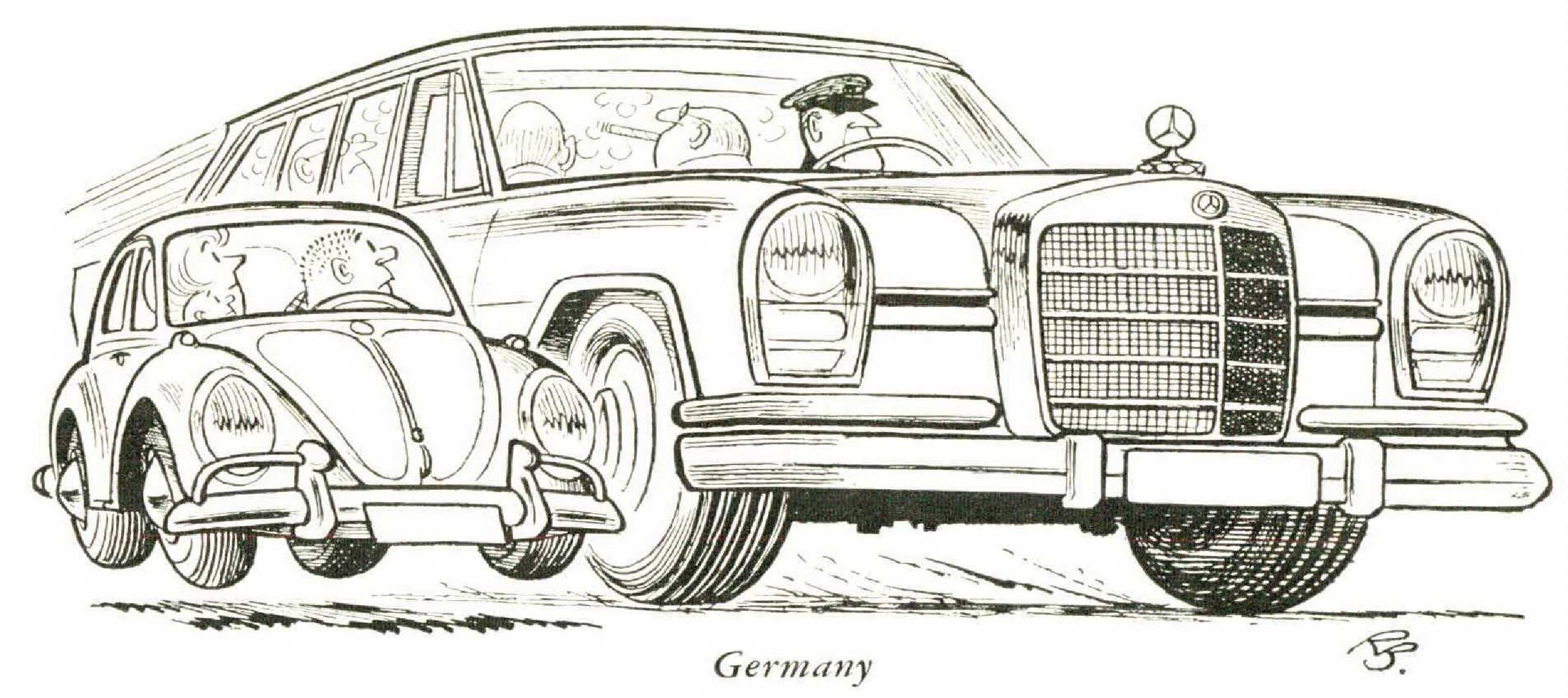
For example, in Germany severe winters make air-cooling desirable, since inherently such a system cannot freeze; the network of autobahns encourages low engine speed in top gear and hence poor high gear acceleration; rough roads elsewhere have led to the use of independent suspension for all four wheels; and frozen slippery roads throughout severe winters give a premium to carrying weight over the rear-driven wheels, which is a natural consequence of rear-engine mounting.
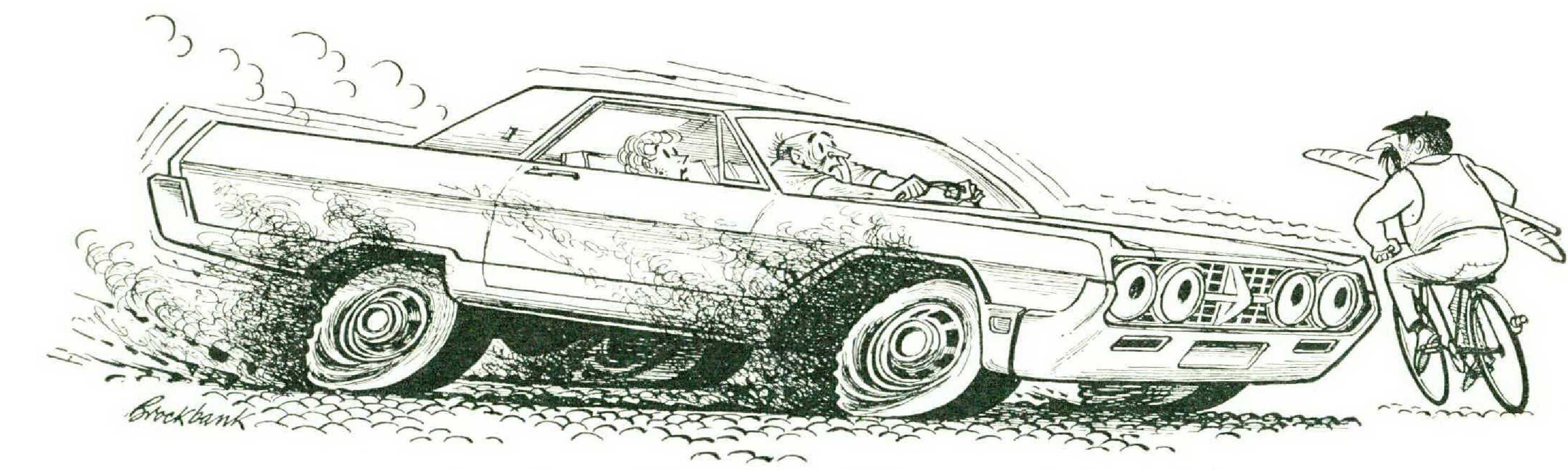
in France, also, long straight roads encourage low engine speeds at the expense of acceleration, and the cut and thrust driving tactics of the French driver demand a quickly responsive steering system and a high degree of stability. This situation is the same in Italy, and in both countries, as in Germany, poor road surfaces have led to the general use of independent rear suspension.
Geographically, Britain presents a different picture. Very smooth roads have discouraged “advanced” suspensions, and the relative rarity of a straight road leads to high-speed engines in which acceleration and hill-climbing in high are obtained at the risk of a short life if the car is driven hard in other circumstances. Additionally, very steep hills, which are infrequently snowbound, encourage gear ratios which enable restarts to be made in circumstances which European drivers would think impossible, and the attitude of live and let live between drivers makes quiet running and comfortable suspension more important to most than the ultimate in response in cornering power, although there is one exception here which tests the rule.

In all the large cities of Europe parking is an even greater problem than it is in the United States as it is less well organized, and for this reason owners of small cars have a big advantage in urban use.
The small car is also in demand for economic reasons. Gasoline is far more expensive in Europe than it is in the United States, and wage rates and salaries are far lower, so that more hours have to be worked in Europe to buy a $1500 car than would be needed in the United States to buy a $3000 model. Furthermore, Europeans have traditional priorities in their income which are at least equal with motoring.
As the first cost of a mass-produced car is determined by the weight of metal in it, and its running costs are influenced by the number of square feet which have to be driven down the road and the amount of material which has to be accelerated in traffic, four out of five European cars have an engine of less than 90 cubic inches capacity, giving under 60 horsepower, and they weigh less than 1600 pounds.
It has been said that the great engineer must combine technical know-how with social know-why, and to provide adequate performance and comfort for four persons within a shell less than 150 inches long and 55 inches wide taxes the ability of any engineer and results in diverse solutions to the basic problems. For example, although the engine in the back saves money, produces the best traction in difficult circumstances, assists in quiet running, and reduces air resistance, it also in one stroke eliminates the rear luggage locker, promotes skidding if a corner is taken too fast, and leads to disagreeable swerving on the road when there are crosswinds.
In the past two or three years, the opposing concept of driving the front wheels from a front engine (in the most successful case, from a transversely mounted front engine) confers stability on corners or when the car is subject to crosswinds, and provides 80 percent of the overall length for the carriage of passengers and their effects. On the other hand, this layout is difficult to silence, in critical conditions it may fail with wheelspin, and because of costly joints in the drive shafts, it is more expensive than either the conventional or rear-engined car.
Scaled-down versions of the conventional car, as it is understood in the United States, continue to sell in Europe, but there is a general feeling that without the particular advantages in flow from front drive or rear-engine mounting, it is a compromise which is behind the times and it should at least offer independent suspension.
THE social reasons why European cars differ from one another so much can be divided into national outlook and class consciousness. The Germans and the Swedes have a passion for high quality, solidity, and mechanical perfection which is less evident in Italy, where acceptable shape and style can make a crucial difference to public acceptance. In France, cost of running is of major interest since the car has a low priority in the budget and indirect taxation makes ownership a utilitarian matter coupled with very close calculation. Hence in France the car deluxe does not figure in any manufacturer’s program, and the motoring world of France is a classless affair. In Germany and Italy this is not so, but in Germany it is only Mercedes-Benz which implies affluence, and until last year there was no German car corresponding in size, performance, or prestige to Lincoln, Imperial, and Cadillac.
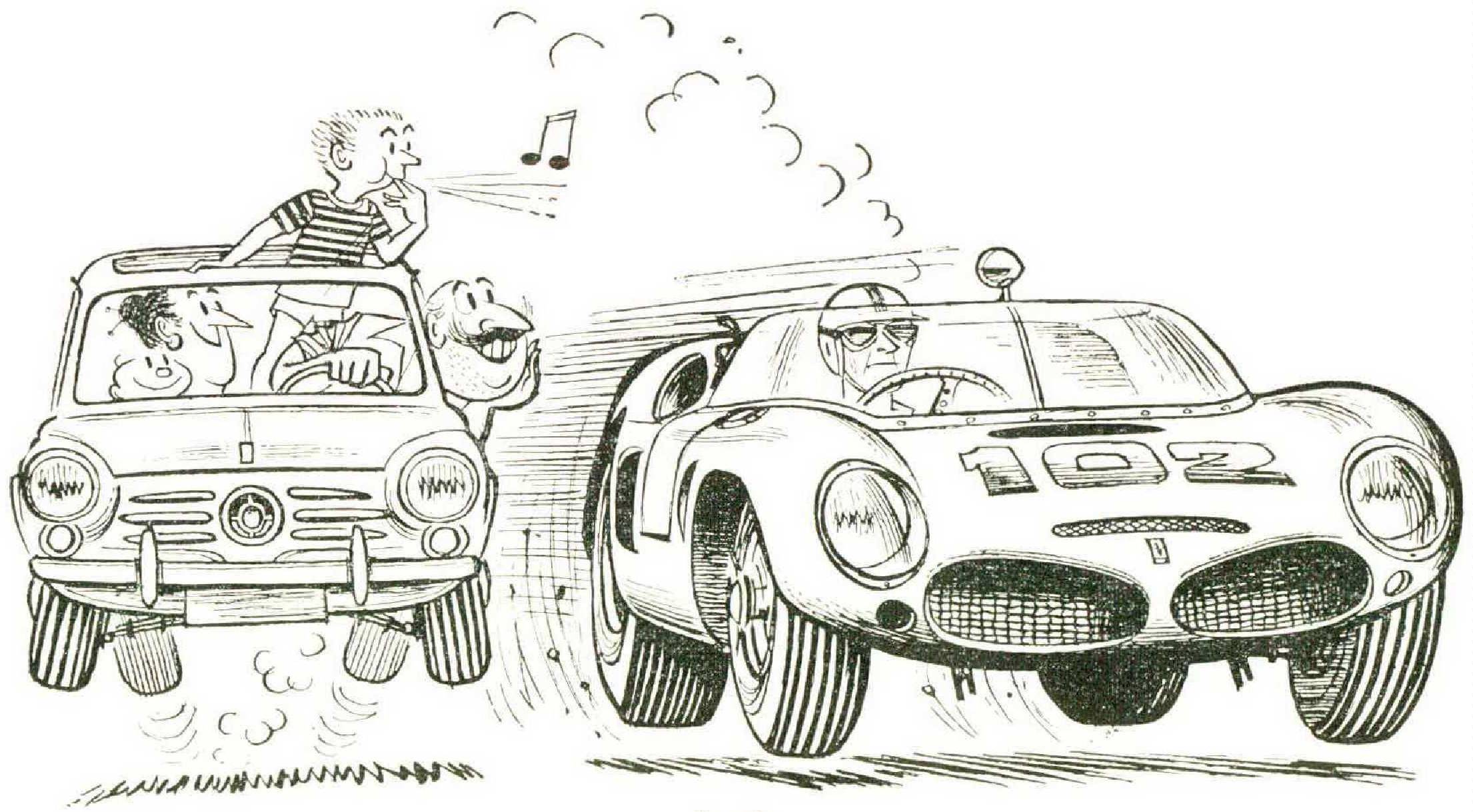
In Italy, where cutting a good figure is of prime importance, there is a limited production of choice chassis with bodies which blend artistic design and mechanical excellence. In superlative degree Ferrari stands at the top, and has the smallest output; Maserati is slightly below; Alfa Romeo and Lancia are building bigger numbers of specialized cars with engines of less than 150 cubic inches capacity and with road speeds which do not normally exceed 110 mph — a mere loiter for the Ferrari or Maserati drivers, as I was once told by the great Bertochi, the head tester for Maserati. As we sped through the traffic between Modena and Bologna at a steady 2 miles a minute, he said, “Mr. Pomeroy, it is not too fast, but then this is not a sports car; this is a touring car.”
Motoring in Britain presents a variegated, not to say kaleidoscopic, picture which I will try to make a moving picture by describing my experiences with some of the dozen or so cars it has been my fortune to drive in the past six months. They represent a range of fifty years in dates of construction, of ten to one in price, including a 25 percent purchase tax, of six to one in engine size, and of one and a half to one in maximum road speed.
The most elderly, in many ways the most attractive, and certainly not the least comfortable is my 1914 Vauxhall, in which I had the honor of touring the New England states in 1957 in the
Anglo-American Vintage Rally, which included a sprint across Times Square at over 50 mph in the very late evening! Here is a car which sustains its original maximum speed of some 75 mph, with an engine running at a little over 1700 rpm at a cruising speed of a mile a minute, and which can, as a demonstration, be started from rest in the same gear. It has deep and comfortable buttoned leather upholstery, and the passenger’s height when seated in the car is about the same as when he is standing on the ground, so that he retains a natural sense of perspective and has a splendid view over a rolling countryside.
With no brakes on the front axle, and very small ones on the rear axle, it is technically possible to combine comfortable springing with superb stability; and although the absence of weather protection, apart from a windshield, makes one think twice before undertaking a journey on a rainy day, this car, unlike most old cars in the United States, is used for ordinary daily journeys. That is to say, in London I use it for shopping and visiting friends; collecting my daughter from boarding school and taking out her friends, who are delighted with the cheers, bows, and raising of hats with which the progress of the car is attended; and in the summer, for business journeys. Also, of course, for picnics, when the wide running boards can be used either as seats or as tables.
As my father designed this model, and as my early youth was spent in corresponding vehicles, I am prejudiced in its favor and am proud of the fact that it runs speedily, economically, and reliably after fifty years on the road on its 34-inchdiameter tires.
Thirteen years younger, and possibly having covered only a fifth of the distance, is a supercharged Bugatti belonging to a friend of mine which provided an exhilarating day just before Christmas. Bugatti was a major artist with a natural endowment of engineering skill, and in his drawing office his freehand sketches were converted into conventional elevations by a very skillful team. This particular car is related closely to his racing models of a period when, in his mid-forties, he was at a peak of his powers and his cars were at the summit of success in competition.
The engine starts after a clang from the pinion, the echoes of which are submerged by a cascade of sound from twenty-four valves, eight pistons, eighteen ball or roller bearings, the gear wheels driving the OHC, and the supercharger. One moves away from a haze of sweet-smelling Castrol R through a shriek of gears, to settle down at a steady 80 to 85 mph in the knowledge that there is at least another 30 mph in reserve. The springs are ironhard but are not too unbearable on British roads, and there is no roll as one corners at nearly breakaway speed with a steering layout having one and a half turns from lock to lock and so accurate that one could deflect three feet either way if challenged to run over a matchbox casually thrown down. Shifting gears is like inserting a hypodermic charge; resolve and rapidity are all, and the whole outfit completely sustains ray definition of a sports car as one which gives adequate reward for the exercise of superior skill.
KEEPING a car of this kind involves a high degree of mechanical skill and plenty of spare time from the owner, or else a sympathetic understanding with the bank manager; and to a lesser degree this comment is true also for the highly tuned production car, of which the outstanding examples in England are the Lotus version of the Ford and the Cooper kind of B.M.C. Mini. I had the opportunity of savoring one of the latter in its highest “stage,” sitting low to the ground in 1300 pounds of metal shell at around 110 mph: a sobering experience which would be frightening if the steering and stability were not so outstanding.
These qualities were proved in the Monte Carlo Rally which this model won, and flow from the fact that Designer Alec Issigonis has a background of competition driving in his younger years and is still able to test his cars up to the very limit when he cares to do so. The small size enables one to slip through unscathed in a situation where overoptimism might lead to disaster with a larger machine, and the wide track and disc brakes make what seem to be impossible maneuvers not only safe but also physically comfortable for passengers, once assured that they are in the presence of something unique. The Cooper Mini, originally designed as a “people’s” car, has turned out to be a “brilliant horse.”
The Renault R 8 and the Vauxhall Viva cars have attractive qualities of their own. The rearengined Renault has the most comfortable seats I have come across in any normal car; it is particularly quiet running, and with all-independent suspension is comfortable over really rough surfaces. The General Motors-owned Vauxhall reminds one of a baby Buick, with almost unnervingly light steering, good brakes, and power steering despite the light weight of the car, and the kind of interior finish that photographs better than it really looks and feels, a state of affairs which seems unique to the large American producer. That it is noisy above the average is something which may be cured with development (it has been on the market only a relatively short time); that it will reach current standards of comfort and control with a rigid rear axle may perhaps be doubted.
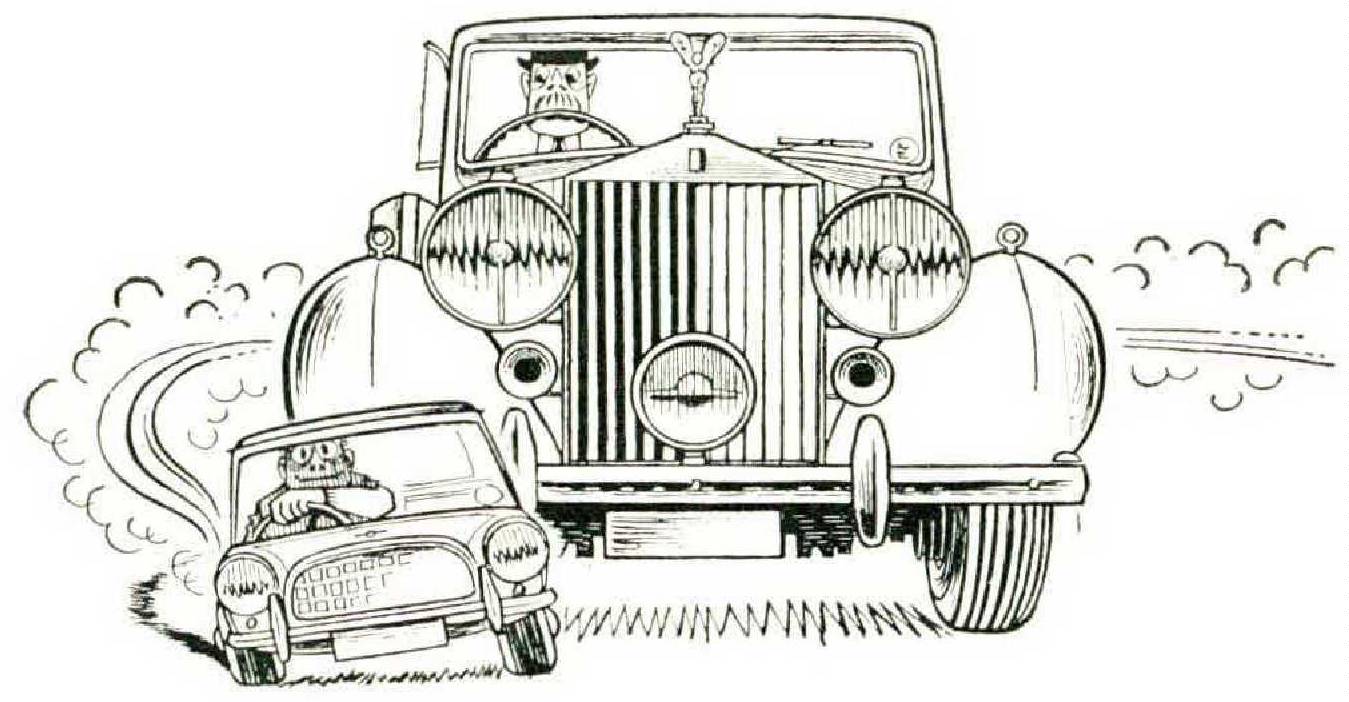
I have chosen these cars in particular to stress that although in their standard forms they compete in price, size, and performance, they represent such widely diverging technical concepts as front engine and front drive, front engine and rear drive, and rear engine and rear drive. With rubber springs, coil springs, and leaf springs as suspension media, they share in common four-cylinder liquidcooled engines, rack and pinion steering gear, combined body and chassis, and four-speed transmissions. In appearance they are quite unlike, and whereas one, in London and Paris at least, supplies status, two of them have made no impact upon the social scene.
Even the long-standing claim of Rolls Royce that they make “the best car in the world” has never unanimously been accepted. Fifty years ago they were challenged by Mercedes, Napier, and Daimler; in the twenties by Hispano Suiza, Bentley, and Lincoln, and in the thirties by Cadillac, Daimler, and Mercedes. But with four exceptions these rivals have fallen by the wayside, and by general consent the Royce claim has been justified.
The particular merits of a Royce are seen plainly in my own personal car, now in its eleventh year. After 115,000 miles it has an almost inaudible engine, which consumes oil at the rate of 1000 miles per quart, a gearbox that makes merely a murmur, an unheard rear axle, and no lost motion in any of the controls or the steering. The seats have not sagged and are covered in leather that looks like new; the immaculate woodwork includes picnic tables of adequate area to support lunch and a drink, which in conjunction with the car gives, in Jorrock’s words, “a werry gentlemanly feeling.”
The car has enough space in the back to allow the tallest man to stretch out his legs.
This is one of those rare cars in which it is pleasurable to drive and to be driven, but with a weight of 5000 pounds, a frontal area of over 30 very square feet, and an engine giving no more than 150 brake horsepower, performance on the open road is well below today’s standards; so one must keep a stiff upper lip at a cruising speed of 70 mph, or maximum of 80 mph, as the lesser breeds fly past.
These qualities have real and not sentimental value, as is shown by the fact that the market price of this car is about one fifth that of a present-day Rolls Royce, which at the cost of a severe cut in interior space, a more aerodynamic if less impressive shape, and a slight increase in noise level is more than 30 mph faster and has such acceleration that few cars can stay with it. Only the height of the floor betrays the fact that the car was designed a dozen years ago, and except for the replacement of the six-cylinder in-line engine by a V-8 four years ago, it has remained almost unchanged during this time.
The earlier type, introduced to the public in 1955, earned some fame in America by an advertisement headed “at 60 m.p.h. the noisiest thing in the car is the clock,” which, in The Confessions of an Advertising Man, David Ogilvy said was the best headline he has ever written. It is not far removed from my words in the Motor of February, 1958: “The legend that at 60 m.p.h. the noisiest thing on the car is the clock is in this instance substantiated.” I used the word “legend” deliberately as the phrase had originated in a 1908 copy of the Autocar dealing with the Silver Ghost model!