Sailing With Uncle Charlie
The late Charles Francis Adams was in his maturity Boston’s leading citizen and Secretary of the Navy in President Hoover’s Cabinet. He was also for fifty years the best helmsman on the Eastern seaboard. This racy memoir by his nephew George Homans, professor of sociology at Harvard, was first presented to the Massachusetts Historical Society, and we print it with pleasure.
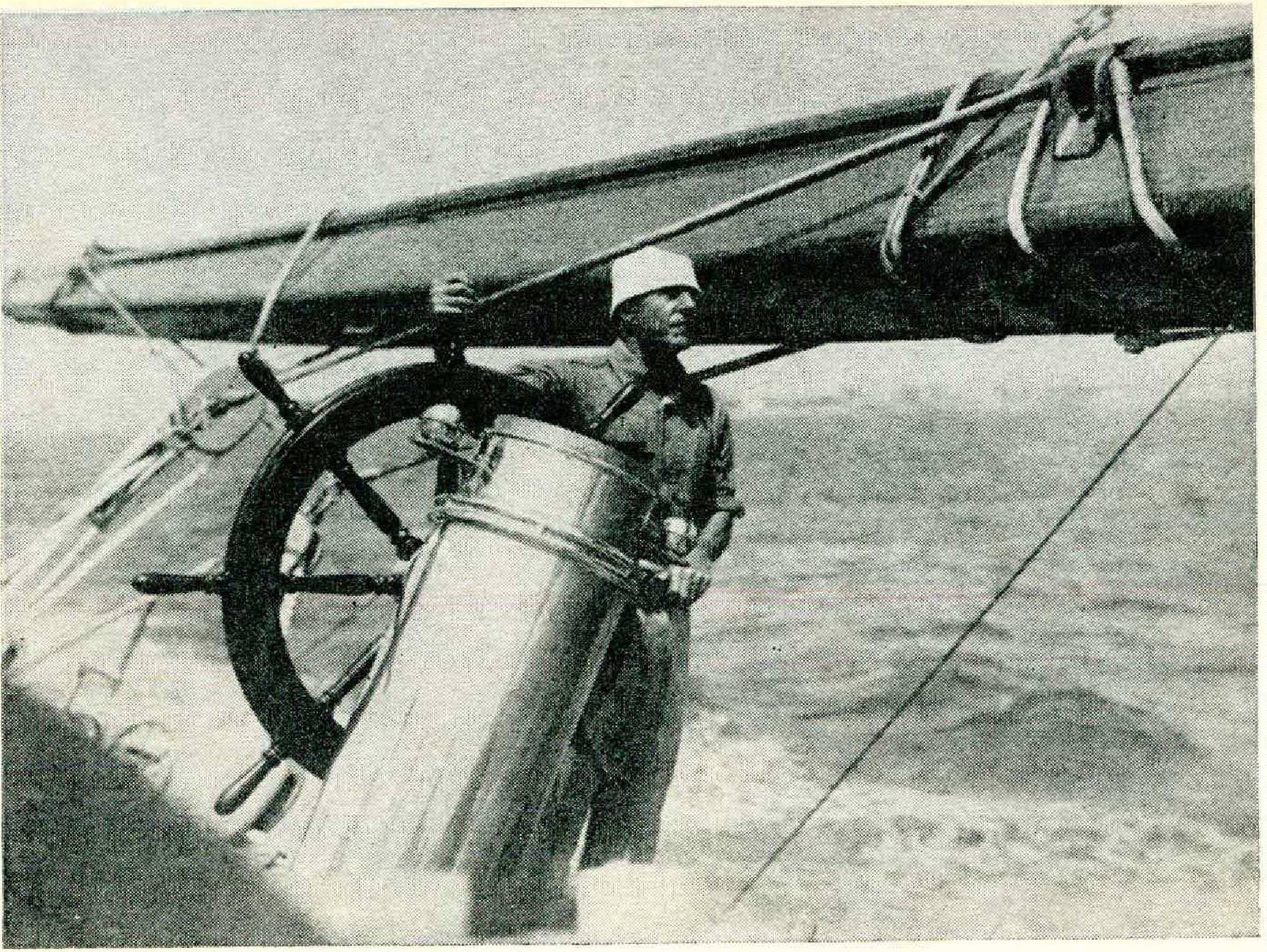
By GEORGE C. HOMANS
THE historians spend their time talking about every great Adams except the one I knew, my mother’s brother, Charles Francis Adams, the third of the name. I cannot speak of his career as treasurer of Harvard College, as Secretary of the Navy in the Hoover Administration, as the leading citizen of Boston in his day. I can only try to describe what it was to serve as one of the crew of his yachts. My excuse is that his career as a racing skipper was the greatest of his careers, the only one in which he reached supremacy. For some fifty years he was acknowledged to be the ablest helmsman in Massachusetts Bay, and if the ablest there, the ablest on the East Coast — though Long Island Sound may have had its reservations — and if the ablest on the East Coast, then also in the world.
He was, moreover, supreme in every kind of boat, from the little Herreshoff S-class to the cup defenders: in 1920 he had, in Resolute, successfully defended the America’s Cup. Here was a new kind of excellence for an Adams, since to the earlier members of the family, competitive sport may well have seemed frivolous, even British. But if new, still excellent. Let those who do not know what it is to be a seaman argue that in Uncle Charlie his tribe had lost its bite.
I never sailed with Uncle Charlie on the big boats, but I did sail with him as one of his crew most summers from 1923 through 1940: in the R-class sloops, designed by W. Starling Burgess, Lightning, Dandelion, and, greatest of them all, Gossoon; in the Q-class Bat; and, finally, in the 8-meter Thisbe. All of them, I suppose, were between 30 and 45 feet long overall. Almost every year we were champion in our class at Marblehead, our most dangerous opponent being frank C. Paine in Gypsy of his own design. In the smaller boats, those of the R-class, two of us went as crew, myself and Uncle Charlie’s son, Charles Francis (“Chas”) Adams, now president of the Raytheon Corporation. In the larger boats we added a third, usually my other cousin, Thomas Boylston Adams, president of the Massachusetts Historical Society. In short, we were all Adamses, crew and skipper. As the smallest and lightest hand I was ordinarily assigned the work with jib and spinnaker, requiring less muscle but, by that token, more brains.
For many summers Uncle Charlie had lived — if it can be called living — in a wooden barracks, hugger-mugger with Perkinses, Hunnewells, Lees, Thorndikes, and other Adamses, forming a sort of advanced communist experiment like Brook Farm, only more successful, called the Glades Club. The “Glades” may suggest something lush; it is in fact a bleak promontory jutting out from the South, or proletarian, Shore of Massachusetts Bay inside Minot’s Ledge Light and outside Cohasset Harbor. Uncle Charlie kept his boats moored behind the Glades in a hole affording slightly greater depth of water than elsewhere over the sandy bottom.
The Glades is some eighteen miles across the bay from Marblehead, where we raced. Every Saturday Uncle Charlie sailed his boat over to Marblehead in time for the race in the early afternoon and then back again afterward. Note: he sailed her. He could well have afforded a motorboat to tow him, but he sailed. No other boat in our classes sailed from anywhere: they stayed in Marblehead; and I suspect that no other skipper would have been prepared to sail our distance. The result was that we got more experience in handling ship and sails than did the others, who only went out for the afternoon to race, and far more experience in keeping her going in light airs. We had to keep her going if we were to get to Marblehead in time to eat and back to the Glades in time to sleep. But we got something more than experience: to the imagination of at least one boy, we were, compared with our opponents, the hardy, the bold, the true mariners. It was we, not they, who followed the sea and carried on the traditions of sail.
LOOKED at objectively, the task of getting a racing yacht back and forth across the bay under sail in summer was by no means arduous. In all my years with Uncle Charlie we always reached Marblehead in time for the race, and almost always in time for lunch before it; and as for getting home, I spent only one full night aboard, when fog, blowing in before an easterly, surprised us halfway across and made it doubtful that we should find the entrance through the Cohasset ledges. We ran in under old Boston Light and then anchored in Hull Gut till morning, when the weather cleared. It is fair to admit that if the weather was bad enough, we did not try to sail over, partly, I think, because Uncle Charlie’s boats were not at their best in a blow. For the record, our fastest run across the bay was made in Bat from Marblehead in one hour and three quarters under trysail and small jib before a fresh northwester. Our average run was, I suppose, somewhere between four and five hours.
The weather on the less typical passages included northwesters in the early fall, when the bay was, in Uncle Charlie’s words, feather-white and the salt dried and crusted on our faces in the sun as we beat up to Marblehead, reefed; and rainy northeasters — again a head wind — when we had the choice of getting soaked on deck or sick below. More characteristically the winds were gentle, southeast by day, westerly by night.
We met at the Glades float a little after seven in the morning and rowed out in the dinghy, our oars puddling and breaking the rafts of eelgrass combed out by the ebb tide. Looking overboard one could sometimes catch a white Hash against the bottom where a flounder shifted berth and showed his underside. To the west against the coffee-colored Cohasset rocks the water was pale blue, but to the cast and seaward, golden and hazy under the sun. Still heavy with sleep, we set the working sails and ran out with the last of the night breeze. Then while some of us slobs were likely to go back to sleep on deck, Uncle Charlie puttered.
But it was puttering with malice in it. When people tried to explain Uncle Charlie’s racing record, they spoke of his touch at the helm. That was what they could see; what they could not see was his tireless obsession with anything that would help the float sail faster — not just the big things, like the slow agonies of breaking in a new mainsail or statesmanlike conferences with the yardmen about the state of the underbody, but also all the little things most yachtsmen did not bother about. He spent some time on his boat every day in summer, rowing off to her after he got back to the Glades from a long day in State Street, righting crimes against speed.
His method was characteristically elimination rather than addition. He was, above all, death on superfluous weights. When he bought a boat secondhand he went over her with a screwdriver taking off useless gadgets and dumping them unceremoniously overboard. A whole stove once went overboard in this fashion — and with it any suggestion of hot coffee. All cushions and mattresses went the same way: should anyone want to lie down, there were always the sail bags, which were in fact much more comfortable. He would have been glad to get rid of the heads, and the boats he had built for himself never had one. Even for crowded waters, a canvas bucket was just as good. In brief, he was, in his care for speed, the supreme rationalist, the supreme functionalist.
He was indeed a bit of a puritan. Anything that did not directly contribute to our salvation, even if innocent in itself, was suspect. No one cared less for the elegancies of yachting. He never shined brass. He seldom coiled a line. When we hoisted the mainsail below deck, we let the halyard lie where it dropped. If it came in all right, he argued, it would, left undisturbed, run out all right again. Our furls had only to be good enough to let the sail cover be put on. Nor did Uncle Charlie insist, as Admiral Morison does, that the stops be tied in neat bows on top of the sail. He did not care for fancy work like a golden groove along the sheer strake. The appearance of the vessel was nothing to him so long as the paint in contact with the water was smooth. We were a working ship; the others could go in for the beautiful.
In the same way, telltales were a superstition and contributed, however little, to friction. At night we ran, quite illegally, without lights, for lights prevented the helmsman’s seeing what he ought to see. In the days of prohibition this suspicious feature of our behavior led Coast Guard cutters to overhaul and hail us, until, I suspect, they got used to our presence in the bay on Saturday nights. Finally, Uncle Charlie never insured his boats, and never lost one, though the moorings off the Glades were pretty well exposed to northeasters. The loss of a vessel would, in his mind, have paid him off fairly for being a damned fool.
Nor long after we cleared the land, the offshore westerly would die. Then we slatted gently over the smooth sea, waiting for the standard summer southeaster to make. We would first see its scattered cat’s-paws to windward; then they were all around us, bringing freshness to the golden summer. The water would begin to whisper under the bow. With luck we could set the spinnaker and count on reaching Marblehead with time to spare. To starboard we left the red lump of the Boston lightship; to port, our halfway mark, the gray pillar of the Graves lighthouse, crossing the tracks of the ships bound in and out of Boston. In the early days these sometimes included a coasting schooner. Later the wooden draggers from the Georges Bank were more prominent, trailing stinking clouds of diesel smoke, and mackerel fishermen towing seine boats almost as long as themselves.
At Marblehead we came to our moorings, took off the working sails, put on the racing sails — we were always heaving sails up on deck — and went ashore for lunch at the Eastern Yacht Club. Uncle Charlie’s approach to the clubhouse was in some ways his finest moment, and the only one when I ever suspected him of self-consciously acting the reverse of self-consciousness. An old navy seaman’s duck cap, its brim reversed, might be pulled down over his noble beak; then came a pullover sweater, and finally a pair of knickerbockers, left unbuckled perhaps and drooping below the knees, held up by a sail stop instead of a belt, a stop passed not through the belt straps but below them so as to hitch the knickerbockers up. The effect was as little nautical as possible, and put Uncle Charlie at once one up on the gentlemen in white flannels and yachting caps on the piazza.
How shall I reproduce the smells of an old-time yacht club before it became just another country club: smells of tarred marline, manila rope, and new cotton duck, of large, dark high-studded rooms fitted with varnished woodwork and straw matting, of the sea breeze blowing through open transoms and slatted doors, of clam chowder and blueberry pie?
After lunch we dumped our spare sails into the dinghy and went to the starting line off Marblehead Rock. If there was one department of yacht racing in which Uncle Charlie fell short of excellence, it was in starting. He was never very bold or skillful at getting the best berth at the windward end of the line. Indeed, I never felt he liked, as so many racing skippers do, maneuvering at close quarters. He would get into a luffing match if one were forced upon him, but his heart was never in it. I suspect he felt it was irrational, bringing in factors outside the sheer speed of the boat. In starting, at any rate, Uncle Charlie seemed to be content if at the gun he was somewhere near the line with his wind clear.
Since the commonest wind at Marblehead in summer is south to southeasterly, the first leg of a race is usually to windward. This is the point of sailing that brings out the greatest differences in ships and helmsmen, and in this point lay Uncle Charlie’s skill. He counted on getting ahead on the windward leg and holding his lead on the run or reach that followed. He did not expect, except by sheer luck, to pass another boat off the wind, though he was certainly afraid of being overhauled himself. Nor was he at his best in strong breezes, which demanded crude methods. His supreme expertise lay in coaxing a ship to windward in light airs — and at Marblehead in summer the winds are light; the place fitted the man. Like all great magicians he was credited with powers he did not possess. People thought he had the gift of finding the strongest breezes, but in this he was no better than other skippers. Indeed, there were no special tricks of wind or current at Marblehead that gave an advantage to local knowledge. Uncle Charlie never sailed any extreme course on the mere gamble of picking up a favorable slant. Even when he was, for once, behind, he seldom went off wind-hunting. I do not mean he did not care about finding the breeze: he certainly did. All I mean is that he was, above all, a rational sailor. Since he ought to be able to beat any boat sailing under the same conditions as his was, the best strategy was to stay with the rest of the fleet, and especially his chief rivals, rather than leave them and look for a breeze. To the usual maxim “Stay between the leading boat and the mark,” he added the rule “Stay with a boat you’re beating.”
And he did beat them. Besides what I have called his rationality, his only gift was a superb sensitivity to the helm and the trim of the sails, as if he were a delicate machine that could register to ten decimal places when the ship was doing her best. Characteristically he sat to leeward watching the jib, the tiller over his shoulder, holding it, as he could in these beautifully balanced yachts, between thumb and forefinger, as if to pick up and read its least vibration. Occasionally he would say in a low voice: “Ease the jib a hair,” or something of the sort. And however bad our start — and it was seldom really good — we found ourselves before long well up in the fleet or leading it.
During a race there was little conversation. Unlike some skippers, Uncle Charlie did not seek his crew’s advice unless things were going very badly. For our part we volunteered no suggestions, but simply reported the movements of our competitors and the sighting of the windward mark. Our efforts in the matter of strength and skill were not always distinguished. In the early days I myself weighed less than a hundred pounds and added little pull when getting in the mainsheet. But we were always willing, proud of our boat and our record. Uncle Charlie, moreover, assumed we would do our best. He found it embarrassing to praise us, as to express most other sentiments, and seldom did so except for some truly outstanding feat, when I think he praised us out of duty, not desire. I once got a “good work!” for setting the spinnaker without a hitch in a northeast blow when the ship was putting her nose down under the seas. But neither, since being inarticulate works both ways, did he blame us, not even when I managed to fall overboard from the forecastle at the start of a race in a nearly flat calm.
In demeanor Uncle Charlie was normally the calmest of men. In his younger days he acquired a reputation for hard swearing when his blood was up, and I was often asked whether he swore at us. He did not: perhaps he felt that his son and nephew were sitting ducks for abuse. But there were times when he got, shall I say, excited and behaved rather unlike the cool skipper that the code of the sea demands. There are, in my experience, such times for every skipper. For him they were likely to come when we had rounded the weather mark for the run to the finish, and another boat was close astern. As one of us went forward to struggle with the spinnaker, he would appear to jump up and down in the cockpit, not shouting so much as passionately exclaiming: “Hurry, boys! Hurry up! Oh, hurry!” These vivid comments did nothing to speed the setting of the spinnaker. They were irritating distractions in a ticklish job. Nor did Uncle Charlie nourish any intellectual doubts that we were doing our best. It was just that for once the tension got too much for him.
For Uncle Charlie wanted above all things to win. Beneath the calm exterior, surely at times of a type that justified an Englishman in claiming the Yankees to be the coldest of men, lay a passion for victory, at least in racing. Much trusted and respected though he was as a financier, I doubt that in this field he felt the same passion. Like his father, he must often have felt that he did not want to be bothered. Racing was different. He enjoyed sailing for itself, but there was no nonsense that racing was a way of getting a pleasant afternoon sail. Once when one of our opponents withdrew from a race for reasons that seemed to us quixotic, and so allowed us to score a win, Uncle Charlie remarked quietly: “I like to win boat races.” (“Boat” was pronounced bot.) He was lucky in wanting to win what he was good at winning, and we were lucky, too. He set us an example of the passion for excellence that, in whatever unlikely places it may show itself, is still the thing in the world to be most cherished.
BACK to the weather mark. At Marblehead the last leg of a race is usually a run before a failing breeze. It is not the point of sailing that separates the men from the boys, in boats or skippers. Uncle Charlie harbored no illusions that he could, except by sheer luck, overhaul any boat on the run to the finish, and lie went over, so to speak, to the defensive. His preoccupation was not to pass but to avoid being passed. He would sight astern, holding at arm’s length his thumb erect, with his index finger against it, to measure the angle subtended by our nearest pursuer’s mainmast, and so determine, by comparing two successive observations, whether she was gaining. I never found out how he remembered where against his thumb his finger had stood on the previous occasion. Under these circumstances the finish line came as a blessed relief.
With the end of the race our opponents’ work was done. Ours had hardly begun: we had to work the ship back across the bay. We returned to Marblehead Harbor, bent on once more our working sails, and got under way again. By this time our late rivals were sitting on their piazzas, knocking back the first of many cocktails. Toward them our attitudes had all the ambivalence of working stiffs eyeing the fat cats of the bourgeoisie. No doubt they were to be envied their costly pleasures. On the other hand the moral superiority was unquestionably ours. Ours was
all that beauty
Born of a manly life and bitter duty.
Yet as we rounded Marblehead Rock, it was hard to sustain enthusiasm for the great tradition. Not only was the wind failing, but it was ahead. Much experience to the contrary, it did not seem possible that we should beat our way over to the South Shore. When we had made enough offing, we put the ship onto the port tack and started a long board over toward Nahant. At this point Uncle Charlie turned her over to the crew and went below to sleep. He threw himself flat on his back on the sail bags and at once began snoring, mouth open. He had the gift, shared, we are told, with other great men, of relaxing swiftly and completely when his responsibilities were at an end. He was, by the way, far ahead of the other great men of his time in his inability to refrain from going to sleep in the midst of public speeches. But even in sleep he retained his preternatural sensitivity. He would feel the ship check her way, and would wake up and call to the cockpit: “She’s all in the wind, George,” or, “You can bring her up a hair.” In the same way, he could sail her by the way she felt, even in black darkness and light airs.
By suppertime our prospects were usually cheerless enough. The onshore day breeze had died. The ship slouched over the seas, sails slatting in the gear, blocks banging, somewhere between Nahant and the Graves. The sun was sinking in smoke over Boston, and the sea resuming its eternal cold, eloquent of shipwreck in the North Atlantic. Having slept his fill, Uncle Charlie would stick his head out of the cabin, make a tour of the horizon, sniff, and announce by way of encouragement, “Fair wind on t’other tack, by’ n by.”
Then we piped — if that is the word — to supper. This usually consisted of club sandwiches, sardines, and invariably bananas, the brown parts of which Uncle Charlie would cast overboard, saying: “Why make a sewer of your stomach?” He ate with slightly exaggerated champings of his jaw and lips. Except sometimes for a thermosful of soup or cocoa
— never, I think, anything as stimulating as coffee
— it was a cold supper, and the only other liquor aboard was a bottle of Poland Springs Water, referred to by my cousin Tom as eau de pologne.
Uncle Charlie never touched alcohol. He once asked me how many members of my class at Harvard had been ruined by drink while still in college. As members of the prohibition generation, many of us drank hard, but “No,” I said, “none of us has been ruined by the stuff.” He implied that several of his class had been. His was the era at Harvard of the Gold Coast and the California millionaires. “Billy” Hearst, he said, always kept outside his door a bucket of whiskey, together with a tin dipper, to which anyone was free to help himself if so disposed. Uncle Charlie did not try to stop people’s drinking, nor did he fail in good fellowship while others drank, but no member of his crew would have considered bringing a bottle aboard: it would have been too uncomfortable.
IF Uncle Charlie ever became conversational it was at supper. He would ask us what we were doing; especially, as a former treasurer of Harvard, he was interested in what we were doing in the years we were attending the College. He liked to talk about the prospects of the football team and the crew. He even asked who the great professors were, once saying wistfully that it must be a great satisfaction to spend one’s life doing something one was really interested in. Would he have liked to spend his life boat racing? He had served on the Harvard Corporation under two presidents; both were able, though Lawrence Lowell in his youth had been conceited, but Eliot was one of the greatest men he had known. In what ways Eliot was great he did not undertake to explain.
Uncle Charlie, though a rationalist, was in no sense an intellectual. He had had two famous intellectual uncles, one of whom, Brooks, he certainly regarded as a crank; and two members of his crew were intellectuals in grain. These experiences had not led him to share the vulgar antiintellectualism of the common businessman. His was rather the healthy attitude of the nineteenth century, which did not regard intellectuals as a different breed of men. His view may have resembled that of his father, John Quincy Adams II. When my mother as a little girl asked him why her uncles, Henry and Brooks, spent their time writing, he answered simply and accurately, “I suppose it amuses them.” It was perfectly legitimate to amuse oneself.
So Uncle Charlie did not talk about books or ideas. Indeed, he was not a reader, though he liked to have his wife, my Aunt Fanny, read to him of an evening as he fell asleep. They seldom,
I think, read novels, certainly not the novels of my literary enthusiasms. I once urged him to read Moby Dick, but I am afraid he never even started it.
I doubt that he was much interested in the drama of human personality, which did not mean in the least that he ever failed in his devotion to his friends. He would talk about the abilities of his contemporaries and their qualities of judgment, but not about their souls. In following this rule, he began with himself; he did not talk about himself: gentlemen did not do so. Human beings were, no doubt, capable of anything. Why they should be so was their business, not his. One could but try to deal with them, and then only when it was absolutely necessary, and all one might use was honesty, courtesy, some good fellowship, and a great deal of silence. What intrigued him were not the human passions but the spectacular problems of coping with the physical environment. Politics had too much of the irrational about it, but he enjoyed reading, for instance, about Arctic exploration and naval warfare. He became an expert on the Battle of Jutland, and when he was Secretary of the Navy he liked to discuss the proper use of aircraft carriers in a potential war against Japan. On subjects like these he was exceedingly interesting and exceedingly acute. Not until his imagination was captured did his mind go to work.
His taste in the arts was that of the American people as a whole. He did not look like their epitome, but he was just that. He enjoyed musical comedies and almost any movie. When we stayed at the Eastern Yacht Club for Race Week, we would row across the harbor in the evening and walk to the local movie house to see anything that was showing. To only one of the finer arts did he respond: he liked to look at paintings, though he seldom in fact did so, and he had developed firm and unconventional tastes — unconventional at least for the thirties. While his crew submitted their orthodox, avant-garde enthusiasms for Rembrandt or El Greco, he maintained that Franz Hals was the greatest of painters. Franz Hals is a great painter, and Uncle Charlie was not being vulgar.
During his service as Secretary of the Navy under President Hoover, Uncle Charlie was often indiscreet with us, or perhaps he worried less about security than people do today. He once discussed the problem of bribing Japanese admirals, and told how he had detected a British ambassador lying twice in one morning. His statements were astonishingly matter of fact: it was not in moral outrage that he mentioned the ambassador but, if anything, in recognition of human foolishness. He was, in fact, opposed to the taking of moral stands that could not be made good by force. Accordingly, he deplored the refusal of his colleague, Secretary of State Stimson, to recognize the Japanese conquest of Manchuria, as well as Stimson’s refusal to use information gained through cryptography that had broken foreign codes. But this same high respect for physical realities and his lack of imagination about human passions led Uncle Charlie at the outbreak of World War II to believe that Britain was finished and that the United States should stay out of the war in Europe. Pearl Harbor ended all that. The Japanese war was the one he had been preparing for, with all too little in the way of funds, while he was Secretary of the Navy. So while we were slatting around off the Graves we were never, in those days, very far away from great affairs and the Adams tradition of statesmanship. But what we dramatized, I am sure Uncle Charlie did not. Self-dramatization was the last thing he was given to, except perhaps in making his entrance to the Eastern Yacht Club. He never saw himself, or wished to see himself, as a statesman.
He disliked the New Deal in almost all its forms. Indeed, he failed to understand what it was about. In the middle of the Depression he once remarked that he had driven a good deal around the Commonwealth of Massachusetts and that the workingmen appeared to him to be reasonably well clothed and housed. Yet he never expressed the fear and hatred of Franklin Roosevelt so current among businessmen of his class, never talked about “that man in the White House” or told any of the scabrous jokes — but then he never told jokes at all. Anyhow, Franklin Roosevelt was a Harvard man. Nor did he mouth the catchwords of “free enterprise.” I doubt if he was aware of economic doctrine, whether Adam Smith’s or Maynard Keynes’s, which did not mean that he was incapable of wisely investing his own and other people’s money: he certainly was not caught in the stock market crash. He believed that the country would get out of the Depression more quickly by saving than by spending, but he stated his views as a matter of good judgment, not good doctrine. No doubt Franklin Roosevelt was a demagogue; no doubt he was taking advantage of the Depression to get votes, but then it was the nature of politicians to try to get votes. No doubt he was bad for the country, but the country was, at bottom, wise and would with experience get over the New Deal. Above all, Uncle Charlie never expressed that most vulgar of sentiments, the complaint that he was being personally hurt by the New Deal or increased taxes. If he was a conservative, he was an aristocratic conservative, though no one was less likely than he to think of himself as an aristocrat. On the other hand, he rarely expressed criticism of businessmen, and certainly not of businessmen as a class. He could never have said, as my father did, “In bad times the country is ruined by the politicians; in good times by the bankers.”
Naturally Uncle Charlie spoke about seafaring. He had a long story that ended with the wise and rhythmic line: “If you ever gets ashore, and I guess you never will, don’t you never cuss no more about the weather.” And he described sailing out from the Glades in his youth to a Boston bark that had dragged anchors during a northeaster and slid up onto the West Shag ledges. The skipper was somewhat discouraged, not only by his immediate situation but by the circumstance that his wife had died off the West Coast of Africa and was now below, pickled in a barrel like Lord Nelson. You can see that Uncle Charlie’s view of seafaring was less than romantic. He was not given to scorn, but if anything could rouse his scorn it was hearing that someone “loved the sea.” No one but a damned fool could love the sea. He had once signed on with a friend of his to take a schooner down south in winter. They were dismasted in a gale and spent two days expecting the ship to go to the bottom at any moment. In itself, the sea was cold, fearful, and treacherous.
Though he had a sense of humor and could reach a kind of quiet gaiety, Uncle Charlie’s conversation was never consciously funny. Its quality was quite different. Whatever our actual ages, he always took for granted that we were his equals; indeed, that we were just like him, sharing his sense of what constituted good judgment. This was flattering and good for us but sometimes hard to live up to, as two of the crew were in fact emotional romantics, closer to Shelley than to Uncle Charlie. Finally, since he was human, he could be fatuous, as in his great statement about a Boston businessman: “He’ll go far if he don’t bust.” But fatuous was the last thing Uncle Charlie usually was.
If supper did much to relieve our cheerlessness, the wind did more. Though we never believed in it ahead of time, we usually did get a fair wind on “t’other tack.” The night breeze, the offshore breeze, began to make, breathing of all the heavy, hot summer of North America. It blew high in the air and did not show on the surface of the water at all, which remained unbroken. As if at some secret pressure, the sails fell asleep, and we gathered way with a hiss like softly parting silk. We came about and began to move up under the South Shore, the lights and music of Paragon Park at Nantasket Beach coming to us with an incongruous suggestion of human frivolity.
Sometimes we had to anchor or lie to at the entrance of the Cohasset channels waiting for the flood tide to give us enough depth of water over the shoals. More often we picked up the ledges, lying black in the moon glade, and went right in. We shot up to our mooring buoy — Uncle Charlie was an effective though not an elegant buoy shooter —getting our sails down as we did so, for our racing yachts did not lie to a mooring well with sails hoisted. A quick furl and we were in the dinghy, rowing in to the Glades, phosphorescence dripping from our oars. If we were early enough, some of the natives were still sitting after dinner on the back piazza, swatting mosquitoes and arguing about whether they could see Thatcher’s Island lights, as they had done, by way of passing an amusing evening, for fifty summers gone.