Down With Michelin!
pleasuresandplaces
BY KEITH WILLIAMS
Who doesn’t know about Michelin guides? The basic one is about French hotels and restaurants, one thousand pages and two pounds of Red Guide, selling for about $2.00. Take Fleurance, a little market town we stayed in for a while last summer. The automobiliste heading toward it can find from the Michelin Red that it is in the department of Gers, has 4310 inhabitants, is 98 meters, or about 300 feet, above sea level, is 29 kilometers from Condom and 24 from Auch and 660 from Paris. The best place to stay is the Hôtel de France, 69 rue République, telephone 68, meal from 9 to 14 francs ($2.00 to $3.00), with a carafe of wine at 1.50 francs. It has 20 rooms costing about $2.00 to $2.50, with steam heat, bidet, bathtub, shower, garage, which the customer has to pay for, money changing, and no dogs allowed in the dining room. All this information about both town and hotel is conveyed by words and signs in two and a half lines.
The next listing, alphabetically, is Fleurines (where I’ve never been), which happens to have a one-star restaurant. You get all this if you know how to read the guide:
In the Oise Department, 671 inhabitants, 98 meters altitude, 51 kilometers from Paris.
Nearby Halatte Forest is a onestar attraction.
The Vieux Logis with its star belongs to a fellow named Le Hir, who closes it down from August 16 to September 15 and every Thursday. It is at 2 Paris Street, and its telephone is 13. The meal costs 12 francs, or about $2.30, and the wine in carafe 4 francs. Specialties are Sole au Champagne, Poularde aux morilles a la crême, Vacherin glacê Chantilly (the last two items: fattened pullet with morel mushrooms and cream; meringue with whipped cream). Le Hir offers five rooms to transients, for $2.30 to $6.50, and he has steam heat, bidet, bath, and free parking. He does not accept radios in the dining room, although dogs are not excluded. All this is boiled down to four lines in the Michelin Red. A second, humbler restaurant in little Fleurines is also described, in less than a line and a half. The thirty-four-page Paris part of the guide gives the same kind of details about more than 500 hotels and restaurants.
Michelin stars are extremely important to establishments which earn them. On page 32 of the current Red is an explanation of the star system:
“Almost everywhere in France hotels and restaurants serve good meals and good wine. Nevertheless, some merit being brought to your attention by one, two, or three stars.
“3 Stars, 11 in ail France— One of the best tables in France, worth a special journey. The food is always very good, sometimes wonderful. . . .
“2 Stars, 61 in all France — Excellent cuisine, worth a detour. . . .
“1 Star, 555 in all France — A good restaurant for its class ... a good place for the passing motorist to break his journey. . .”
If money is an object, Michelin goes on to explain, in three-star restaurants “price has no meaning.” Among the two-stars, “do not expect meals of this quality to be cheap.” Pages 28 through 31 show about 200 places where you can have “good meals for less than 12 francs.” All this wine and food precision is accompanied by maps of every town of 5000 inhabitants or more. A Michelin Red in your hand means that you can know nearly everything about France — everything if you buy the supplementary Green guides to attractions and sites. Of these last there are seventeen in all, ranging from Brittany to the Côte d’Azur and the Vosges to the Pyrenees. Red guides now exist for Germany, Benelux, Italy, and Spain, in addition to France, and Green guides to Austria and Switzerland as well. The guides to Morocco and Algeria have long been out of print and are now collectors’ items.
What criticisms can possibly be made of such exemplarily erudite and concise guidebooks? Why is it that I now take their recommendations with a grain of salt and a good half of the hotelkeepers and restaurateurs of France earnestly desire their disappearance?
To speak for myself first: When I was very young I held jobs in Syria and Lebanon and for four years explored the whole Middle East, checking into overpriced bad hotels and underpriced good ones and running along carefree over pistes non aulomobilisables. The chickpeas and yogurt and local stews pleased and filled me.
When my wife and I moved closer to Europe and started driving around that continent during annual vacations, the guides snared me and I soon became an addict, although I vaguely sensed that they deflowered the countries for me. I remember Assisi, for example, the first week of our Michelin honeymoon — how the little hired car made undeviatingly for the best hotel for the money, how we already knew that it had fifty-five rooms and several baths and a good restaurant and would not completely break us. The next morning, Italic Green in hand, we spent all the time in the Lower Basilica over the two threestar and the five two-star attractions, aware that the Upper Basilica had only two three-star attractions and the Cimabue frescoes were “unfortunately ruined.”
Passing thus smoothly through Italy, never once checking into a crummy hotel or eating in a low dive, we felt grateful to Michelin. My wife did complain that she had sat all that time in the front seat reading about the next town, and navigating me through it by the map when we got there, with no time to look out and see anything, but this was only wry tribute to the quality of the guides. When we stopped, it was for a three-star attraction or maybe a church with only two-star windows, but a week for 500 miles did not allow enough time for the one-star things. Or, I now see, for discovery.
In France, Italy behind us, this early Michelinisme of ours reached its apogee. That first night in Nice we poured some pastis down the children to make them sleepy, bribed the chambermaid to look in on them once in a while, and set out, Red in hand, to Restaurant A, with its two stars, “worth a detour.” It was crowded with Anglo-Saxons bearing Red guides, and very expensive, so I determined that we should go on to Restaurant B, “good meals for less than 850 francs” (old francs, of course), to get a glimpse of the real France. In front of B the mother of my children clapped her hands and said, “Oh, sweet! Just like those Skid Row missions where they serve free breakfasts.” Restaurant C then, with its one star, a good mile away over cobbled streets, was closed because it was Tuesday.
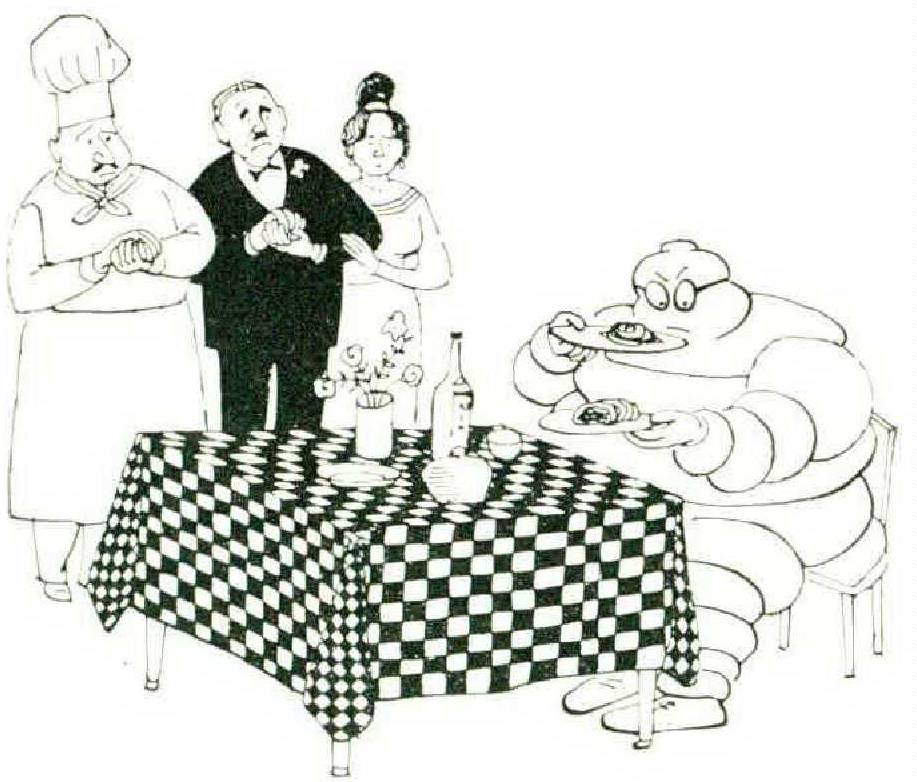
Restaurant D posted a menu touristique which looked reasonable, and it did have two crossed spoons (out of a possible five; the crossed spoons relate only to the comfort and service of the restaurant, not its cuisine). After four acceptable courses and a liter of some of the fairest old agedin-the-aluminum Algerian wine ever to be mixed with a drop or two of Bordeaux and sold for two dollars, I paid the bill — to which, since this was France, about 60 percent had been added in service, taxes, couvert, and deposit on the wine bottle — and we walked back to our threetower (out of a possible five) hotel clutching our guide and our gorges, which were already rising. This was seven or eight years ago, but even today the gluttony inherent in all but the meanest French menus plays havoc with the outlanders digestion.
This has not, of course, been a serious criticism, but a left-handed expression of what is good about the Red and how useful it is to the innocent traveler, especially if he remembers to bring his Turns along. Stick with Michelin and you go only to the best hotels in each category and eat only in restaurants where the cooking is at least competent and often magnificent. In addition to the starred places, Michelin lists other restaurants which are working toward a star, knowing how much it means in dollars and francs and Deutsche marks and shillings; Michelin makes travel safe. Anyone with $25 or more to spend per day per person (half price for children) is silly to deprive himself, in a Michelin country, of the services of the guides.
This is not the whole story, though, even in France — especially in France, perhaps, which remains a country of many independent, often surly, always fat, quasi-Poujadiste individualists in hôtellerie and restauration. This sort of entrepreneur often displeases Michelin, and Michelin certainly displeases him. Take M. Dupont, proprietor of the Hôtel du Château in Aix-du-Béarn (Aix is pronounced “x” to preserve anonymity; I don’t want to get him in any more trouble with Michelin than he is because someday he might want to make peace). “Why am I not in Michelin?” said M. Dupont, pouring a round of Izarras and taking one himself. “Why? Have you seen that barracks down the street they list first? You see, it was about ten years ago, when my father was still in charge. An instituteur [elementary school teacher] didn’t like the way we hosed down the terrace or something and wrote to the Boulevard de Pereire to denounce us. We lost our Michelin listing. When my father became old I took over and resolved to get us back in Michelin. Dozens of contented guests wrote to say how good we are. Don’t think it didn’t cost me a fortune in free drinks, this Operation Michelin. Michelin never answered. One contented guest, my sister-in-law in point of fact, the one who lives in Lausanne, wrote and asked for an immediate answer. Why had Michelin not responded to her demand that they re-evaluate the Hôtel du Château? The salauds still didn’t deign to answer.”
The Hôtel du Château is an eighteenth-century château built within the walls of a ninthto eleventh-century castle (the walls are still largely intact). The view is magnificent over the cold little river 400 feet below and the rolling hills to the highest peaks of the Pyrenees; and the trout, foie gras, preserved goose, and Béarnais specialties are as good as in all but the multiplestarred Paris restaurants.
The twenty-odd rooms of the Hôtel du Château are large and clean and comfortable. Officially it is ranked as a one-star hotel by the tourist department. If I had followed (Michelin, I wouldn’t have stayed there but at a mean and deserted smaller place down the street, with no view and no history, or at a decent but bleak hostellerie two miles out of town on a blank prairie, with no view and no strolls.
M. Dupont is clearly sour, but his place is by all odds the best in Aix. It is notorious that to get a Michelin star you should sport on your menu a quenelles or fish-dumpling dish, preferably with a red fish sauce. One Paris restaurant owes its star to putting such a sauce, with two little crayfish, alongside its half poularde, the whole thing being served with rice, in the style of an American hostess throwing a buffet supper. Hardly Brillat-Savarin. Once you get into the French countryside you find that the places Michelin favors are, quite naturally, inundated with English, German, and American tourists; expensive, if only relatively; clean, even if humble; mean, with strictly one-person portions served; overwhelmingly if chastely feminine, from the melancholy female who receives you and watches you fill out the hotel fiche or takes the dining room order, to the frail little maids who carry in all the heavy bags if you let them, to the starched, perfunctory twe1ve-hour-a-day maid-waitresses who so crisply serve the food. When I first came to France I liked these efficient women-run places, but now I am a slob and enjoy discussing with the patron what we are going to cat and drink.
No Chinese restaurant in Paris or anywhere else has a star or even three crossed spoons, no matter how white its napery or obsequious its personnel; and the food in some, usually more Vietnamese than Americans are used to, is superb (to try are beignets de crevettes, or shrimp doughnuts, and nem saigonnais, like egg rolls but better).
Although Michelin shows absolutely nothing between Arcachon and Biarritz on the Atlantic coast, you can for a dollar, in a poor people’s plage called Biscarrosse, have a degustation of “sea fruit,” including oysters, clams, shrimps, clovisses, and various sea snails and crabs, with bread and wine thrown in. I ordered one such plate and two dozen oysters (at 50 cents a dozen), and it took five of us a half hour’s work to finish those raw things off before the cooked fish came. This was not so much a restaurant as a fish shop with some tables, hence much too humble for Michelin, but it is impossible to eat better or be better served than we were there.
Going abroad, in the deserts of non-France, Michelin becomes a disaster. Take Spain, for instance — not such a bad little country really. Leaf through the Espagne Red, and you find all the same signs and symbols as in the France Red, with one difference: there are no stars. No restaurant is good enough, even in Madrid. Most of the hotels (even the best one in a city of 50.000, Ecija) do not rate even one tower but bear the glass-and-fork symbol of the très simple. The text, too, tells the percipient reader that Spain is a pretty appalling country in which the fat coat-and-tie Frenchman slums at the cost of his comfort, as in Central Africa or the Midwest. Cheap, yes, but (it is implied) low tariffs are weak excuses for barbarity. The Spanish had several chances, the last one under Napoleon, but they failed to take them, and the sad truth is, they are not French.
If in a British publication we were to read that “the Spanish know nothing about the preparation of a proper cup of tea, their biscuits are saltless and treacly, and their lavatory paper, on the rare occasions it is to be found, is much too soft,” we should chortle and consider clipping the bit for “This England” in the New Statesman. But we only nod wisely when we read in Michelin:
Spanish cuisine is more complex than it is refined. Black pepper is hardly ever used, but to certain dishes pimentos bring their flaming note. Table wines are in general quite alcoholic (12 to 18 degrees) and very fruity. Dry or light vintages hardly exist. The most famous dessert wines, like those of Xeres (Jerez) are. . . appreciated in England. Andalucia produces “coñacs” as fruity as they are cheap, but their finesse is disputable.
A disputatious Spaniard might respond:
French cuisine is overrefined, although it lacks real complexity. Table wines are in general quite weak (10 to 12 degrees) and not sufficiently fruity. The most famous dessert wines (such as Castillo Yquem) are in short supply and hideously expensive — the French know nothing about fortifying a wine and serve their weak vidueños unimproved. Their “cognacs” are even more carameled and vanillaed than coñac, and not nearly as cheap. Pimentos are practically unknown, but in certain dishes black pepper contributes its flaming note.
Italy receives somewhat kinder treatment, with some restaurants actually meriting one star, even though Italians obviously don’t understand spaghetti, not cooking it sufficiently for a Frenchman’s taste.
I have not yet seen the new Deutschland, nor am I acquainted with the Benelux Red. So far England and Portugal remain guideless, and actually there are a lot of other places in the world where you don’t have to decide for or against Michelin, but will it last? When De Gaulle visits all Latin America and recognizes Communist China, can Michelin be far behind?