Counting Our Eagles
POLLY REDFORD, a well-trained observer of wildlife, is haunted by the thought that the bald eagle, our national emblem, is dying out. Next to Alaska, Florida is the state with the most bald eagles, and there, with the assistance of Dr. William B. Robertson, park biologist at the Everglades Park, and Alexander Sprunt IV, director of research for the National Audubon Society, she compiled this serious warning. Her text forms part of her new book, RACCOONS AND EAGLES, just published by Dutton.
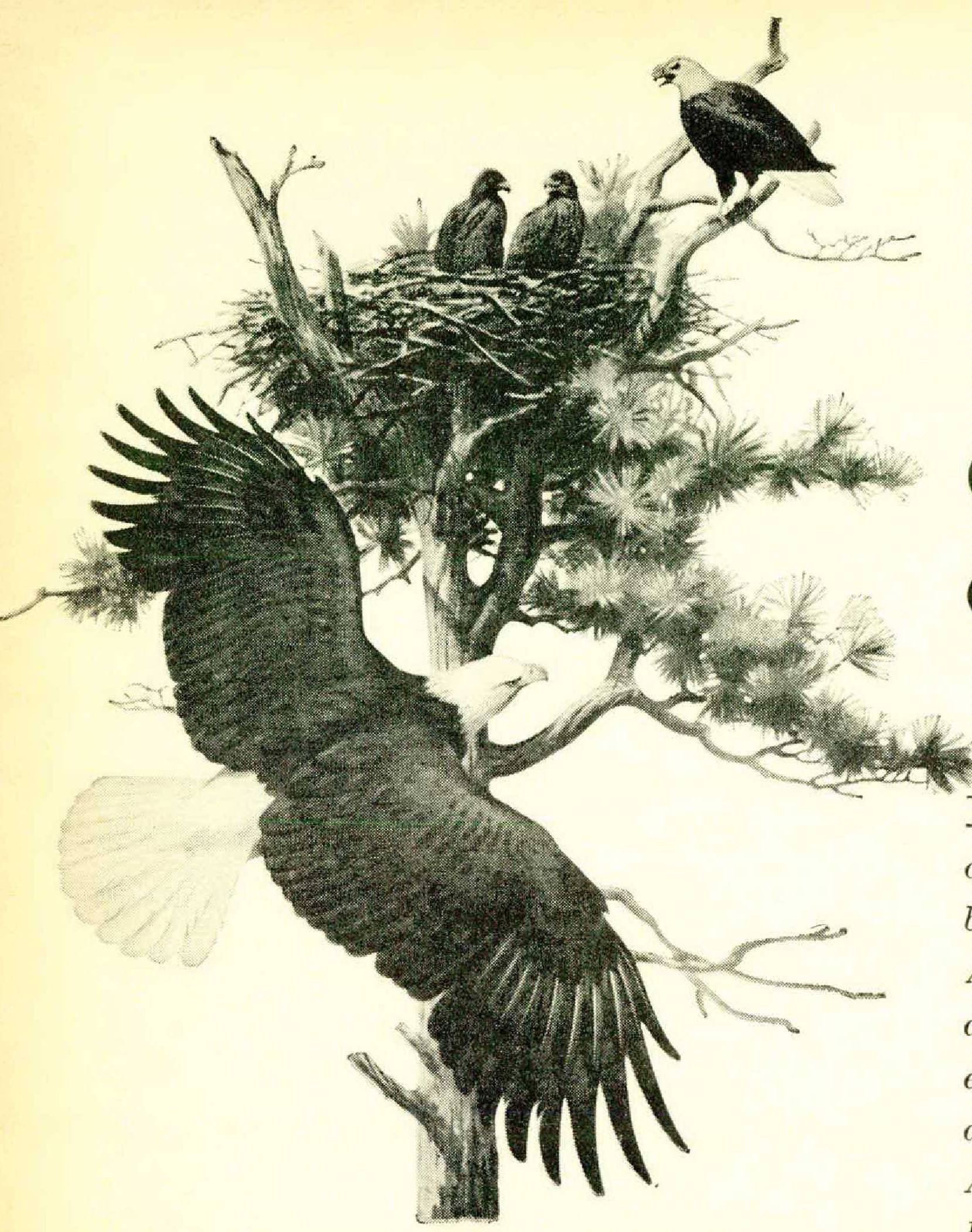
IN 1958, four years before Rachel Carson startled the nation with her book Silent Spring, an angry old man wrote to the editors of Audubon Magazine. He was Charles Broley, “the eagle man,” whose amazing record of banding bald eagles in Florida had made him an authority on the national bird. Though Broley was not a trained biologist, his records of eagle nests in the Tampa area ran back to 1939; they showed a sudden drop in the number of young birds produced every year since 1950. And when, in February of 1958, he drove a hundred miles and found only three eaglets in a territory where he had formerly banded 150, his patience ran out. He was seventy-seven years old, his birds were dying out; neither he nor the eagles could wait.
“/ am firmly convinced,” he wrote, “that about 80% of the Florida bald eagles are sterile.” He went on to say that the great birds had been sterilized by DDT which they had picked up from dead and dying fish.
The scandal caused by Broley’s announcement put biologists in a very uncomfortable position. They did not know enough about bald eagles or about pesticides to say whether the old man was right or wrong. Whatever the answer was, it would surely prove politically and professionally embarrassing, for battle lines were being drawn between outdoorsmen and chemical companies, between boards of conservation and departments of agriculture, between ornithologists and entomologists. And what if it turned out that federally sponsored spray programs, supervised by biologists, were really poisoning the national bird?
Preliminary studies undertaken by the Fish and Wildlife Service and various Audubon societies raised more problems than they solved. Though bald eagles seemed to be decreasing alarmingly all over the country, no one could explain exactly how or why, since many of the basic facts of eagles’ lives are not understood. How could one know how fast eagles were dying if one had no idea of how many eagles there were in the first place? One could not study their fertility, or lack of it, without knowing what their normal rate of reproduction was. Besides, half the time one could not be sure where eagles were or what they were doing: Florida birds vacationed in Canada and Canadian birds vacationed in Alabama. Meanwhile, time was passing. Someone estimated that the nation had less than 500 pairs of bald eagles left.
Finally, in the fall of 1960, the National Audubon Society, afraid that the bald eagle might die out completely before anyone started to help it, pledged a minimum of $50,000 for a live-year research program on its numbers, biology, and life history. This new Continental Bald Eagle Project was launched at the society’s national convention in November of 1960.
Thus the counting of eagles began not in the wilderness, but in a New York boardroom, where men and women pledged themselves to raise $50,000; it began in the hearts of anonymous donors, who gave $3000, and all over America at lodge meetings of the Fraternal Order of Eagles, where men who had adopted a symbolic eagle found themselves paying a good many thousands to keep real ones alive.
And now this survey continues throughout the nation: in national parks and wildlife refuges, where government biologists keep records of every eagle they see; in Florida, where eagle eggs are counted from the air and cattle ranchers post their land as eagle sanctuaries; at the U.S. Department of Agriculture Experimental Fur Station in Petersburg, Alaska, where feeding experiments test DDT poisoning; in midwinter South Dakota, where hardy souls brave the cold to go eagle-counting; at the Fish and Wildlife Service research laboratory in Patuxent, Maryland, where chemists check eagle carcasses and sterile eggs; along Chesapeake and Delaware bays, where army helicopter pilots on training missions keep an eye out for nesting eagles; on faraway lakes in Maine, where one reported nest turned out to be a metal washtub high in a pine tree; up and down the Mississippi and Missouri rivers, where a paint salesman and a tugboat captain, housewives and students maintain a watch for migrating birds.
THE leader and coordinator of this motley army of eagle-counters is a young man named Alexander Sprunt IV, who is director of research for the National Audubon Society. Sandy more or less grew up in the society; he comes from a family of distinguished ornithologists and cannot remember a time when he was not interested in birds. He could identify twenty different species before he turned three, and his three-year-old daughter can do the same right now. His home in the Florida Keys is only an hour’s ride from mine in Miami, and from time to time I drive down there to talk with him about eagles.
Sitting in his office among his maps, his files, his library of bird books and journals, Sandy explains some of the difficulties in a project of this size.
“I suppose the hardest thing was knowing where to begin. So little was really known about bald eagles on a continental scale that the first thing we had to do was find out how many we had and where they were. But luckily, when this bald eagle project started, we had just made a big study of wading birds, so we already had a good list of cooperators. These people were professional biologists, state fish and game wardens, men from the Fish and Wildlife Service, bird clubs and university people from all over the country.
“We ran announcements in the National Geographic and all the local bird journals, and other magazines like the Florida Stockman’s Journal and the Wildlife Society News. These brought lots of replies; we even got a letter from an inmate of the South Dakota State Penitentiary. Then we also uncovered a number of people who had been doing amateur research on their own. So to start with we had eleven or twelve hundred likely prospects.”
From these prospects came a nationwide network of census takers, for American eagles are now counted in the same way that Americans themselves are, by field workers armed with questionnaires. Census takers are paid, however, while eagle-counters do it for love; yet so strong is the interest in this bird that Sandy has always had hundreds of cooperators. Every year they receive questionnaires designed to find out as much as possible about nesting and wintering eagles, the two best indicators of population and fertility.
As completed questionnaires began coming back in 1961, a new picture of the bald eagle in America emerged. The first news was encouraging; there were more eagles left than anyone had realized. For three successive years, in January of 1961, 1962, and 1963, more than 3500 were seen in the forty-eight states; and though some of these were undoubtedly Canadian birds come south for the winter, the figure was an encouraging one. The count was made in January to coincide with the annual midwinter waterfowl inventory made by men of the Fish and Wildlife Service, who were asked to include eagles on their lists. Moreover, Illinois and Iowa bird clubs had already found considerable concentrations of bald eagles in the Mississippi Valley during the winter months. Thus, combining the work of amateur bird watchers with professionals, the midwinter census was much more complete than it could have been at any other time of year, when eagles are more scattered.
Since then, the number of birds seen has remained fairly constant, for in the dead of winter, northern eagles gather near patches of open water to feed upon the fish which also collect there, possibly because of a lack of oxygen beneath the ice. It is the fish and ice-free water below the dams at Keokuk and Davenport, Iowa, that make the Mississippi towns such popular winter resorts for the national bird. Midwestern eagle-watchers find most of their birds strung along the valleys of the Mississippi, the Missouri, the Illinois, the Wisconsin, and their tributaries — any place where the water is open and food can be found. Farther west, in the Great Plains states, eagles will move into waterfowl impoundments and national wildlife refuges, while in the east, Chesapeake Bay is a favorite wintering area.
But all eagles do not migrate. Adults whose nests lie near year-round food supplies can be seen in their home territory all year, though they are harder to find because they are less conspicuously active around the nest. Wanderlust seems to strike the unmated, immature birds — those that Broley banded and studied — rather than breeding pairs, who stay as close to home as they can and still find food. Again, the principle of least resistance seems to apply. In Far Northern winters, for example, some eagles can be found around deeryards feeding on frozen deer carcasses. As long as the food holds out they will not move; nor do the fortunate birds at the other end of the nation, that seldom leave the Everglades National Park.
The bald eagle’s comings and goings, formerly so mysterious, make more sense when seen as vacations rather than true migrations. This theory fits in with data on European eagles; it accounts for the larger number of eagles seen in cold winters than in mild ones (because heavy freezes in the Northern wilderness push more birds farther south into settled country), and explains why more of them are found in January than in any other month (January is usually the worst month, when any sensible bird would rather stay near a sure thing in Keokuk than move around, as it does in December and February, hoping for something better).
On the other hand, this explanation certainly does not tell us why so many of Broley’s Florida birds rushed off toward Canada the minute they learned to fly. Some kind of exploratory instinct might serve a biological purpose by scattering eagles over the widest possible area, but this is pure guesswork. Here it is better to admit you don’t know than to try to make everything look neat by filling in the blanks. Besides, many immature birds stay as close to home as adults do. In Florida, for instance, groups of thirty or forty have been found roosting amiably together in the height of the supposed migrating season, a piece of new information that nobody knows quite how to interpret.
Another big unknown, the Canadian eagle population, makes any complete explanation impossible at this stage. Canada’s wilderness lakes and forests probably support many bald eagles, most of them uncounted. How many eagles seen in the United States actually nest in Canada? In spite of these uncertainties, Sandy Sprunt’s eagle-counters have uncovered more about the national bird than was ever known before. Their nesting reports show that bald eagles are not evenly distributed all over the country but are concentrated into five major areas. Alaska still has the largest eagle population, from Puget Sound in the north and to the Aleutians in the west. Florida, with more than 200 active nests, has more eagles than any of the contiguous states. Almost as many can be found in the North woods-upper Mississippi area: Michigan, Wisconsin, Minnesota. Maine at last count had twenty-seven active nests, but of these, only five were producing young. A few eagles still nest: around Chesapeake and Delaware bays, but very few chicks are hatched.
EAGLES in Maine and the mid-Atlantic states are not reproducing themselves at a normal rate. This seems to confirm Broley’s pesticide theory, for we know that both areas are heavily sprayed, but prior to the Continental Bald Eagle Project it was impossible to say what a normal rate was. We now have nesting reports from most of the nation, and for the first time we have data on a stable, protected population, one that remains essentially undisturbed. This made-to-order control group lives in and around the Everglades Park. These birds, about seventy breeding pairs and another forty-five subadults, have been intensively studied by William B. Robertson, the park biologist.
Half of them nest in the Ten Thousand Islands, impossible, impassable mangrove keys with green walls ot interlocked roots and branches. In many places visibility is less than twenty feet. Somewhere in the branches above are eagles’ nests, but in this country only a bird’s-eye view can find them. So Bill Robertson watches over his eagles through the Plexiglas windows of the park plane, an amphibious horse-of-all-work used for searches and surveys, rescues, fire fighting, patrols, and wildlife census. Once a month during the nesting season it is available for eagle counts.
It was a promise of seeing Bill’s birds, the most select group of bald eagles in the country, that brought me to the landing strip near park headquarters one windy winter afternoon; I had been offered a back seat for the February nesting survey.
I almost changed my mind when I saw the plane.
It looked like a Volkswagen with wings, though the pilot assured me it was an LA-4, amphibious; nor was I reassured by the document I signed, absolving the federal government, the Department of the Interior, and the National Park Service of all responsibility for my demise or dismemberment during the flight. Truly, eagle research is not for the fainthearted. It’s one thing to sit at a desk reading neat nesting reports (“Year built? How many young produced? General habitat, check one: coast, lake, river, dense woods”), quite another to go hedgehopping over the mangroves counting eggs from an airplane.
I confess I was a bit nervous at first. A strong northwest wind was blowing, and when the pilot. Ranger Ralph Miele, took us down to 200 feet and circled above the nest trees, sudden gusts buffeted the plane until the stall indicator beeped as we seemed to hang motionless for a second. But I soon became so absorbed in the chase that we could have brushed the treetops and I wouldn’t have minded.
Starting at Cape Romano, some twenty miles north of the park’s western boundary, we worked our way southward over the Ten Thousand Islands, then over Whitewater Bay to the tourist center at Flamingo, where a pair of obliging eagles have built an eyrie for all America to see. (Just visible from the road, it is in plain sight of anyone in a skiff on Coot Bay, a short way from the marina.)
Bill keeps records of all reported nesting sites on a series of 5 by 8 cards filed in geographical order, one for each nest, on which he writes anything and everything seen there over the years. As we flew along, he would turn up a card and remind the pilot of the exact location of the nest; then we would crane our necks, hoping to spot it as we made our first pass low over the key. From the air, many nests are hard to see against the thick tangle of leaves and branches; they are often obscured by a spray of green leaves that arches over them, for in the hot Florida sun, eagles like to build under a bit of shade. Not knowing where to look, I would often miss them altogether, but Bill and the pilot had the advantage of long experience, and as the plane turned back in a tight banking circle over the nest, they would peer down over the wing tip and count the eggs.
Luckily, no nesting surveys depend on me. Though my glasses are not one bit thicker than Bill’s, I never could see those eggs against their gray background of moss and twigs. Privately, I blamed this on the fact that I had the back seat, but even my myopic eyes could not miss the young, or the adults, most of which seemed quite used to the plane, and by the end of the trip I had begun to tell the difference between an eagle’s nest and an osprey’s.
It took us nearly four hours to check the thirtyfive-odd active nests that lie between Cape Romano and Cape Sable. This meant checking everything in the area — empty nests, abandoned and ruined ones, ospreys’, and other false alarms. Such thorough coverage is possible only in this park, where a full-time biologist has a plane at his disposal.
Few people realize that our national parks are museums and laboratories rather than glorified playgrounds. Small wonder. For years their recreational aspects have been heavily advertised; and roads, campgrounds, parking lots, and picnic areas have multiplied until parts of them now resemble amusement parks — cheap places to try out new spinning tackle or cookouts with the kiddies. It is only recently that biologists, alarmed by profound changes in the natural environment, have emphasized the scientific importance of these unspoiled areas. Research on the bald eagle demonstrates this very clearly, for in all forty-eight contiguous states only the Everglades Park combines an environment relatively free from pesticides and a group of undisturbed birds available for yearround study.
Over 150 eagles live in the park. This seems to be a fairly stable figure (it does not include the annual crop of eaglets, some of which fly north), a figure which in itself proves the great biological wealth of this wilderness, since any territory that can support 150 top predators must hold a host of other creatures upon which they feed. Here adults are seen all year round, and it was here that Bill first discovered a stretch of pinewoods near the main road where as many as forty-five subadult birds are seen in the height of the nesting season.
But even the most idyllic life does not produce a great many eaglets. Bill’s records show that over the past six years, nesting success has remained close to 50 percent, with an average of one and a half young per successful nest. This means that for every forty pairs of eagles seen sitting on nests or otherwise acting like parents, thirty eaglets will fledge. Of these thirty, it is thought that half will die in their first year and perhaps six to eight survive to breeding age.
PROTECTED as we are from plagues, parasites, and sudden death, we tend to forget how wild life in the wild really is. Birds and animals maintain themselves only by producing a tremendous surplus of young. It is impossible to count eagles to the last decimal point, so these figures are approximate, but the 50 percent nesting success in the Everglades Park over the past six years (a level that maintained itself even in 1960, when 85 percent of the active nests were destroyed in Hurricane Donna) seems stable enough to form a basis of comparison.
Comparing the figures, then, with those of last year’s nesting survey in Maine, one does not have to be a senior mathematician to calculate that when twenty-two out of twenty-seven nests fail completely, the success ratio is only 18.5 percent.
What is going on in Maine? No population explosion or building boom; quite the contrary. But Maine is a lumbering state, and its forests have been sprayed with DDT since 1958 in an effort to control the spruce budworm. Last year, 70,000 acres in the northern half of the state were treated.
What is going on in the Chesapeake and Delaware bays, where in 1962 the nesting success fell to 8 percent? For years these waters have been polluted by industrial wastes poured into the Delaware and Susquehanna rivers, but now little creeks and streams carry a new kind of devastation — increasing loads of pesticides that run off the heavily sprayed orchards and truck farms of Virginia, Maryland, Pennsylvania, and New Jersey.
It is their cumulative effect that makes DDT, chlordane, endrin, and other chlorinated hydrocarbons and naphthalenes so dangerous. They do not break down, but become more and more concentrated as they travel through natural food chains, because living creatures filter them out of the environment and store them in their flesh. Rachel Carson explained this process to a Senate subcommittee investigating the problem a few months before she died:
At Big Bear Lake, for example, toxaphene, a chlorinated hydrocarbon, was applied at a dosage of only 0.2 parts per million. Later it was found that the minute plankton organisms in the lake had picked up this chemical and had concentrated it to a level of 73 ppm. The buildup continued through the food chain, with fish containing 200 ppm and a fish-eating bird (a pelican) containing 1700 ppm.
Eagles eat fish and fish-eating birds as well. As top predators, they are at the end of these food chains, and their slow rate of reproduction makes them especially susceptible.
Does this prove Broley’s theory once and for all? Not completely, for until longtime feeding studies with captive eagles show how much pesticide is transferred from female eagles to their eggs, and until we know how much of these poisons is necessary to sterilize bird eggs, the relationships between these chemicals and eagles remain officially unproved .
“ The number of immatures seems lower than it ought to be to maintain the species,” said Sandy Sprunt when I asked him to sum up what was happening to the eagle population as a whole. “But there has been no catastrophic drop here. The bald eagle is probably undergoing a slow decline. It’s a process of attrition, not a wholesale slaughter. We know that pesticides are contributing to it — we’ve picked up dead and dying eagles which gave every symptom of pesticide poisoning — but there are other factors, too. In spite of twenty-five years of protection, many bald eagles are still being shot, probably as immatures. Now, if we could stop the shooting, this might be a big enough factor to stop the present trend.”
I wondered if the old myths of eagles could ever be dispelled. Can any amount of sensible educational campaigns ever overcome those dark folktales of terrible birds that kill cattle and carry off babies? If they can, the bald eagle will have a chance of holding its own.
Yet in the long run, it will need more than this to survive, for an eagle cannot build its eyrie atop a television tower, or gather fish on beaches crowded with water-skiers. How long will we be able to afford open land? How much longer can we keep any woods uncut, any rivers unpolluted, any lakes unspoiled? The wealth of America, so long taken for granted, is no longer sure and simple. And like so many other things, preservation of the national bird is a question of cost. It has no economic value; it is a luxury. It is dear to us because of its history and symbolism, and because it is a glory to watch.
Long ago it was said that not even a sparrow was too small or too worthless to fall unnoticed. No living thing is worthless just because we happen to have no commercial use for it at the moment. Now an eagle is falling. And unlike those other symbols of dying wildlife—the condor, the ivory-billed woodpecker, the famous whooping crane — bald eagles are not specialized creatures of restricted range. They are (or were) strong, hardy birds that range throughout North America. When they die, it will be because this continent is no longer fit for a wild, free-moving thing to live. In this, our threatened eagle symbolizes America in a way it never has before. If we lose it, we shall have lost more than a bird.