The Magazine of the Year
The associate editor of the ATLANTIC, whose lead essay in our Accent on Living has prompted many a reader to turn first to that department, CHARLES W. MORTON here describes an innocent venture in magazine publishing.
CHARLES W. MORTON
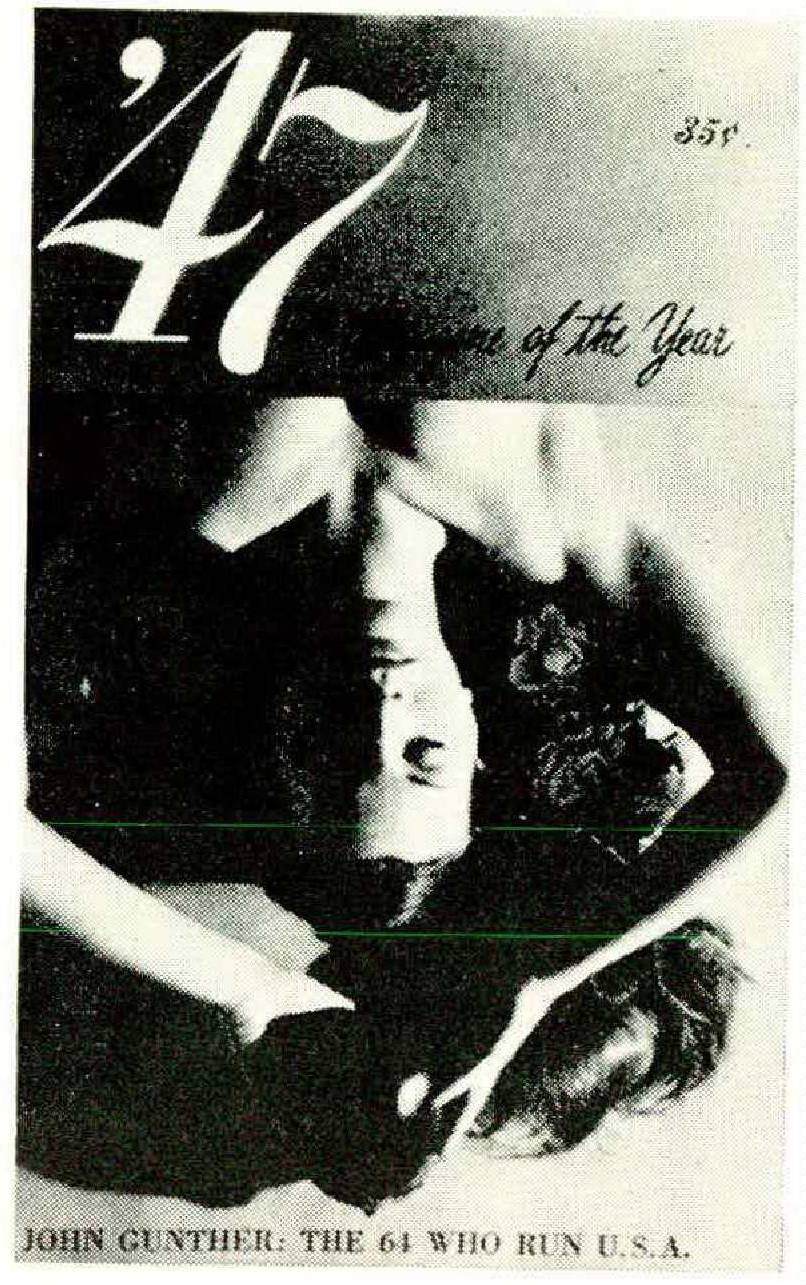
ONE of the oddest magazine ventures in recent memory was the monthly publication proclaimed as “The Magazine of the Year” and initially called ‘47, which was the year of its birth. The plan was to change its title with each successive year – ‘48,‘49, and so on – a stratagem designed to give it an up-to-date quality not possessed by its competitors.
Some three hundred well-known authors, journalists. and artists were the sponsors of ‘47, and their role was described not only as that of proprietors but also of contributors and editors. One heard that the group believed other publications were making a great deal of money and paying their contributors too small a share of it. and, among other things, ‘47 was to correct this imbalance. The prospectus, or prepublication offer, went on to make some other unusual assertions: “It‘s the first national magazine completely controlled by its contributors! Imagine an everymonth ‘all-star cast,‘ of the calibre of John Hersey, Walter Lippmann, Pearl S. Buck, John Dos Passos, Virgil Partch, Christopher Morley, Gjon Mili, Irving Stone, John Steinbeck, Morris Markey, Stuart Clocte, Taylor Caldwell, Raymond Swing, Mary Petty, Marquis Childs, Robert St. John, Adolf Dehn, Jay Franklin, Ilka Chase, Sigmund Spaeth, Elmer Davis, Yousuf Karsh, C. S. Forester, and 276 others equally regarded in literary, journalistic and art circles!”
There is enough in what I have already quoted to fill a sizable organization chart, but here is one more excerpt:
’47 Has No ‘Taboos’
Scintillating 160-page monthly issues (which do not contain advertising), bring you for the first time the stories, experiences and ideas these great writers have always yearned to tell you. In ‘47 contributors, editors and readers alike are free to speak their minds without the necessity of respecting anyone‘s taboos.
If I read the paragraph aright, it meant that all these sponsor-contributor-controller people had something incredibly hot up their sleeves, something that made them “yearn” but something which taboo-loving, nonscintillating editors of other magazines had kept them from publishing.
One could only imagine what bitter experiences the owner-contributors had undergone in the past: the editor who tabooed the comic drawing because he didn’t think it was funny; the review that turned down the article on the grounds that it had already scheduled a similar subject; the big magazine‘s bold refusal of a Jay Franklin manuscript; the rejection slip once suffered by Robert St. John. Well, there it is – a term which I had not intended to use in these speculations, a rejection slip. Could it have been that ’47 was planned as a vehicle for rejections? It seemed to me implicit in the prospectus; ‘47 would print what other magazines had tabooed, that is, rejected. But no, let us put away any such interpretation. Perhaps it was reasonable to expect to see Struthers Burt, Yousuf Karsh, Aaron Bohrod. Gjon Mili turning out writing of which no one would have believed them capable. There is no need to quibble over whether it was work which other magazines actually did reject. One could simply go along with the prospectus, believing that no other magazine would touch the stuff at any price. We could just take ‘47‘s word for it.
It was more difficult to get an altogether clear understanding of these “yearnings.” One could not tell, for instance, whether it was a singleor multiple-yearning situation. Might not the authors develop new yearnings after the old ones — the yearnings they’d “always” had — had been sated by publication? How would they feel? Would everything seem flat and insipid once the lifelong struggle had been won? It seemed quite likely that the subsequent yearnings of a really big-time novelist were likely to be small potatoes compared to the vast hankering he was first going to unload in one of the early issues of ‘47.
ALL those involved in the new venture were free to speak their minds without the necessity of respecting anyone‘s taboos, and I judged this to mean that ‘47 was not going to have an editor, or if it had one, that no one would pay the slightest attention to him. The same reasoning seemed to wash out the possibility of an editorial board. Thus freed from anyone’s taboos, Hersey, Lippmann, Buck, and Dos Passos were to operate – write, edit, and publish – harmoniously with Ilka Chase, Martha Gellhorn, Ellery Queen, and Virgil Partch.
There is no need to raise the question of rates paid to contributors in this case. The contributions from this all-star aggregation naturally had to be of identical quality. No author could say that he was fifty dollars better than any other author in the list. Hence, all must have been paid space rates, with the measurements made by precision instruments and computations carried out to the fifth decimal point. Of course, it wasn‘t the money but the final lineup for each issue that had us all wondering.
Suppose, for instance, that each of the authors yearned to write a humorous piece about the eccentricities of his grandfather and the trouble the family had with him. (These odd-character stories very often go in waves in the publishing field.) Their next biggest yearning might be to tell about the picturesque hired girl that used to work for them, or to write a piece about the inscrutability of cats. What if the artists kicked through at the same time with the same harem gag? Then they might all come up suddenly with a scheme to wipe out the national debt, if their yearnings were still in working order and happened to veer in that direction. The priorities in such cases could be settled only by having a schoolchild, blindfolded, pull numbered slips out of a goldfish bowl, and the losers would have to wait until the next month, or possibly ‘48 or ‘49.
The reach of the Magazine of the Year was not, unhappily, to extend to ‘49. Its first issue appeared, tensely, after one or two postponements, in March, ‘47. It proved to be a rather squarish, pocket-size affair, with several pages carrying illustrations in color; if the first issue was short of spectacular, there was enough hopeful sympathy for the undertaking to make it acceptable. Skepticism might have been traced to the editorial staffs of some of the older periodicals who spotted certain rejects in the contents of their new rival. But for the next few months it was hard to tell just what the magazine was trying to make of itself.
Eventually an editor was appointed, and it was announced that advertising would be permitted. By the middle of its second year, '48, as the new magazine was now called, went into bankruptcy and suspended publication. In its short span it had consumed close to one million dollars.