Ménage À Trois
BY R. G. G. PRICE
R. G. G. PRICE is the author of many light pieces which have appeared frequently on these pages.
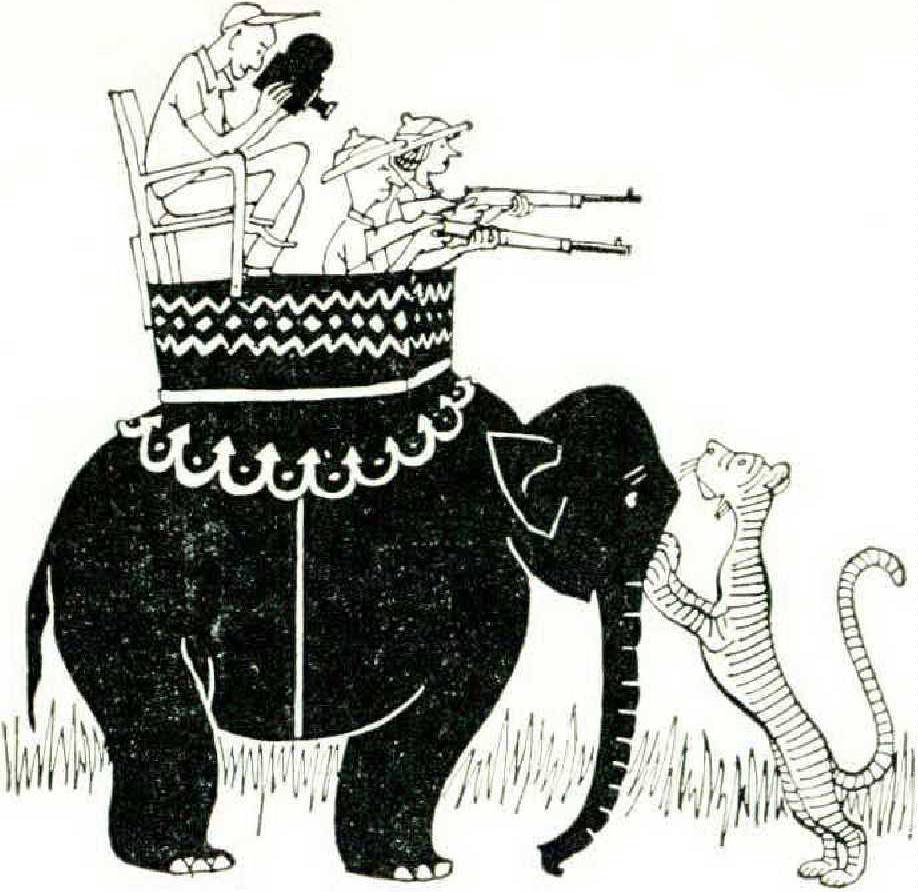
I have never been quite sure what an armchair traveler is, but I suppose I am being one as I sit in a light stupor in front of the television set watching explorers fiddle with carburetors, make friends with headmen, and stand up to charging rhino. I am as uncritical an audience as any station could wish to have. But when I am away from the screen, my analytical powers get to work on what I have just been seeing, and I remind myself that the adventurer must have had a shadow, a doppelgänger, right in there with him — the man who took the pictures.
Usually everyone agrees to ignore the photographer and his apparatus, though very occasionally he is given a bit part and you see him being driven across the veld in the expedition’s truck, presumably being filmed by an amateur hand. Sometimes there are even coy jokelets about how worried he gets when elephants kneel on his cans of film or how hard he is to rouse in the morning; but usually his presence is only an assumption, though he must make a difference on the spot to an explorer’s life.
In the formalized world of television travel, husband-and-wife teams enjoy each other’s company rather ostentatiously. A cameraman must be de trop, even if they take care to pick a technician who is so dedicated as to be sexless. Perhaps it is this dedication that explains the cameraman’s indifference about what happens to the boss when he is in danger of getting gored or trampled or chewed. Deep down in the Persian Gulf the explorer is rapt in the beauty of a sea fungus while a fish of prey steals up on him. Does the watcher with the lens stop filming to knife the menace? No, he hangs on hoping for a scoop. His attitude to the female adventurer is equally detached. However winsomely she dresses, however comradely her smile, however hard she tries to be the outdoor girl next door, she does not rate much footage unless she is fondling an iguana or dressing local sores. I remember one team which drove across Africa, the husband uxoriously tapping his wife’s shoulder to draw her attention to sights she could scarcely miss, say a lion chasing an impala immediately ahead. To get the shots, the cameraman must have been crouching on the boxes in the back of the truck. I suppose married adventurers get used to having cameramen around the same way queens get used to equerries.
Those scenes in marketplaces are puzzling, too. The expedition is taking time off between mountain peaks to study manners and customs. A seething mass of shoppers greets them with wonder and delight, though really all they have to offer their public is white skins, wristwatches, and an infectious belief in the entertainment value of their smiles. But, in fact, the center of interest would surely be the camera. The inhabitants would converge on it excitedly, leaving the stars in the company of villagers too old or crippled to join in the rush. This never seems to happen, so I suppose cameramen are specially trained in rebuffing curiosity without causing riots.
When one watches a man clinging to a sheer rock face, breathlessly testing his next hold, one is likely to forget that there must be a camera somewhere. In a helicopter? Miles away on the other side of the great valley, watching through enormously powerful telescopic lenses? My guess is that often the cameraman is just behind the climber, doing everything he does but without hands. A recent telecast of a balloon race over the Alps had a revealing moment. It suddenly seemed to strike the narrator that some explanation should be given of how the viewer came to be looking into the gondola far above the icy summit. Waving a casual hand, he said, “There’s an automatic camera out there.”
I suppose that the next step is the robot cameraman which will tag along giving animal-loving couples marital privacy and certainly being no less help in a crisis than its human ancestors. The difficulty will be to construct a robot that will run away from charging carnivores and save valuable apparatus but stay put when gentle vegetarians are sporting around. From the audience’s point of view the danger is that the robot will be given a name and worked into the act. A second robot will be needed to film it being served with beer, and baffling pygmies who try to fraternize with it. Sooner or later it will arouse the jealousy of the live performers. At least the present breed of cameraman is trained to be as unobtrusive as the traditional British butler.
I doubt whether explorers themselves will ever be replaced by robots. They could do many of the things the present generation of wellheeled nomads do. They could cock an intelligent car as interpreters pass on the conversations of chiefs. They could climb temple steps and pause at the top looking keenly to the right and then to the left. They could move slowly underwater emitting bubbles. They could dangle on the ends of ropes. They could smile into the camera. They could pass unnoticed by fauna at water holes. But that is the point at which they would be valueless. Apprehension at the possible destruction of a machine that cost a lot of money would never be as delicious as apprehension that the next minute a real live explorer is going to be eaten. A robot sniffed by a couple of hungry lions would be no more interesting than a robot matador or a robot heavyweight.
Sometimes when I am watching the slow inching up the north face or the cobra-catching or the rap on the shark’s nose, I do just wonder whether an element of contrivance, of fiction, hasn‘t already begun to invade the factual purity of the documentary film. My doubts were crystallized by a scene in which the explorer was sitting on a snowy mountaintop gazing out over a vast geological panorama. He was feeling, the sound track told us, as completely alone as the first man in the world.