Mexico's California
Publisher, writer, conservationist , PAUL BKOOKS spends most of his holidays camping with his wife in remote spots from Alaska to East Africa. His account of their adventures,many of which have been described in theATLANTIC, will be published this month by Alfred A. Knopf under the title ROADLESS AREA.
WHAT would we not give to see a bit of North America as it appeared to the first explorers? Only dimly from the printed page, from a journal entry or a hasty sketch, can we construct a picture of what it must have been like and share for a moment their sense of wonder and delight. Yet, just below the Mexican border lies a country where the experience of discovery is still within our grasp.
Baja (Lower) California, separated from the mainland of Mexico by the Gulf of California, or Sea of Cortés, stretches from the border a thousand miles south to the Tropic of Cancer: a rugged peninsula of bare volcanic mountains, cactus-strewn deserts, sandy beaches, rocky offshore islands, and deep blue bays. By modern standards it is largely a roadless area, though, paradoxically, containing part of the oldest road in America — El Camino Real, the King’s Highway, built by the Spanish padres to connect their chain of missions from La Paz, near the tip of the peninsula, northward to San Francisco. How did this untamed country look to Hernán Cortés when, having conquered Mexico, he set sail across the narrow sea that bears his name? How did California look to the Jesuits who, nearly two centuries after Cortés, finally gained a foothold for their propagation of the gospel? In Upper California the answer must be pieced together in libraries from the written records: to conjure up El Camino Real while whizzing down the Los Angeles Freeway would take a stronger jinn than most of us have in our bottles. The greater part of the lower peninsula, however, appears today as it did then.
It is said that those early missionaries to Baja occasionally ran into trouble when preaching eternal damnation during spells of cold weather. The shivering Indians in their roofless huts all demanded to go to hell. My wife and I were feeling no such compulsion as we flew south from Tucson, Arizona, on a warm day in mid-April of last year. We were in an eight-passenger plane, headed for Concepción Bay, two thirds of the way down the peninsula. Our journey — in the company of a group of distinguished naturalists under the aegis of the Belvedere Scientific Fund — had a long-range purpose. If the scenic and scientific values of this unique area were better understood, might not a bit of it be saved from exploitation while yet there is time?
To the visitor from above the border, an unspoiled body of water such as Concepción Bay seems like a gift from another age. Without a single human habitation on its shore, it extends southward for twenty-five miles from the old mission town of Mulegé at the mouth of the Mulegé River. Its purity is the result not of formal protection but simply of bad roads. Henry Thoreau, who went to jail in protest against the Mexican War, might have found comfort in the fact that a diplomatic blunder prevented President Polk from acquiring the peninsula for the United States. Had he succeeded, the freeways would already be there. As it is, Concepción Bay has been given some years of grace. The morning after our arrival, we set out to make its more intimate acquaintance.
TO REACH the boat landing we traversed a salt marsh which is a favorite feeding place for shore birds. Willet raised a piercing cry as they flew restlessly about, showing a bright wing pattern of black and white; several curlews, with their long down-curved bills, four magnificent red-brown marbled godwits, and a snowy egret had gathered at the edge of a tide pool. In slightly deeper water a Louisiana heron waded delicately along, leaning forward in readiness to strike its prey. Beyond the mud flats rose a rocky headland topped by a miniature boxlike lighthouse; on the sheer cliffs below, a few feet from the boat dock, perched a raven eating a large shrimp, his jet-black plumage as striking against the pinkish rock as it would have been against the manicured lawns of the Tower of London. And as the boat headed slowly down the bay, I saw my first Heermann’s gull, a handsome bird with slate-gray body and snow-white head, which we were later to encounter by the hundreds of thousands on its island breeding grounds out in the gulf.
The sinuous shoreline gave direct evidence that this rugged land is rising from the sea. One could make out the traces of earlier shorelines, as one can in parts of the Nevada desert, where the rim of an ancient lake is clearly discernible on the surrounding hills. The shallow caves high above the present beach, formed by wave action millions of years ago, reminded us of similar caverns we had seen on the slopes of Isle Royale in Lake Superior. An occasional patch of gleaming white sand had been molded by the wind into a ripple pattern of low dunes. Above each headland circled scores of frigate birds, their long, angled wings in black silhouette against a pale-blue sky, scissorlike tails opening and closing as they glided on the rising thermals. All wore males, which indicated that the females were on their nests somewhere nearby. Offshore a roiling in the water turned out to be a school of porpoises, their dorsal fins slicing the surface in a sequence of lazy arcs.
The edge between sea and land on a tropical desert coast is strangely sharp. In the north we are accustomed to a transition zone between the two elements: broad salt marshes reclaimed by the sea at every high tide, fingers of the ocean reaching rhythmically landward, rivers whose lower stretches respond to the sea’s pulse, their waters blending imperceptibly from fresh to salt. Sandbars come and go; fog drifts inland to modify the climate and the vegetation. But in Baja one wades ashore into a true desert.
Today the cove where we landed was bright with the yellow flowers of the paloverde, a delicate shrub whose green bark contrasted with the almost birchwhite palo blanco growing on the same slopes. The crescent beach of coarse shell sand — which blows about much less than the fine sand of our northern Atlantic beaches — was backed by an undercut cliff of volcanic rock, providing the only spot of shade. Here, among the flotsam, lay the carapace of a tortoise and the sunbaked remains of a large triggerfish with its surprisingly manlike teeth. Well above the water’s edge, supported by a cairn of loose rocks, rose a rough cross of weathered boards, the grave of a drowned fisherman. To the untrained observer it was the only reminder of human life. But a scientist in our party knew better. Within ten minutes he had discovered an ancient kitchen midden — a mound of broken clamshells into which he began to burrow happily, sieve in hand, in search of shards and traces of charcoal from campfires that had burned away before the dawn of history. Leaving him to his detective work, my wife and I turned inland to explore the cardon forest.
“Forest” requires a footnote. Get out of your head the idea of towering trunks and leafy canopies, of crowded vegetation and shelter from the sun. The cardon is a cactus, similar to the saguaro of our Southwest but with upraised rather than outstretched arms. “A gigantic plant,” writes the Jesuit missionary Clavigero. “Grooved, thorny, leafless, upright, and parallel branches . . . grow from its thick trunk. . . . They grow to the height of even forty feet, and are thick (in proportion) and uniform from the trunk to their tips. . . . The Indians use the spines of this plant as fishhooks. Combs are made from the burr-like fruit, and the seeds are ground into flour for making cakes.” Scattered over the desert, each of these “trees” needs plenty of lebensraum: not for sunlight, which is in oversupply, but for water, gathered from a wide area by the shallow roots and stored through months of drought in the leathery trunk. The struggle for life here is less obvious than in a Northern forest. There the competition is for the sunlight, and the losers, overtopped by their neighbors, may stand dead or dying for years before they eventually fall to the forest floor. Though desert plants are fiercely armed with spikes and sabers against their animal foes (to whom they are so openly exposed), the battle between plant and plant goes on largely underground. To visualize the plant life of a desert, turn the whole landscape upside down in your mind’s eye. The roots then become a tangled web of interlocking branches in a nightmare forest as luxuriant as the visible desert is sparse.
When so much is hidden, it is sometimes hard to believe that a desert shrub is alive. We wondered at the flaming flowers of the ocotillo, or desert candle, bursting improbably from dead-looking limbs. The desert, like the Arctic, represents a frontier in life’s ceaseless and infinitely ingenious campaign to colonize every available inch of the planet. Where nothing else grows you will find lichens, forerunners of higher plants, first link in an endless chain. The life cycle of the flowering plants in both the Arctic and the desert must be adjusted to a long period of dormancy followed by an explosive burst of speed: in the one case to take full advantage of the short summer, in the other to use to the utmost the unpredictable rain that may be followed by months or even years of drought. In terms of rainfall or snowfall, much of the Arctic is indeed a desert, but the comparatively light precipitation is preserved by the cool summers and storage of water above the permafrost. In the Southern desert it is more often a case of feast or famine. A cloudburst will deluge the hard-baked soil with more water than it can absorb and utilize: the runoff is not only useless to the plants but can cause vast damage, as we saw in the case of the town of Mulegé, ever subject to disastrous floods by the river that gives it life.
More than any other, a desert landscape changes form and color with the angle of the sun. By the time we had finished exploring and sketching in the cardon forest, shadows and highlights had recreated in bold relief weird shapes of rock and plant that had been flattened by the vertical glare of noon, while the mountain peaks on the horizon had become sharply articulated in glowing red. The bay itself was rich in color and contrast, showing that clear line between the green shallows and violet depths characteristic of tropic seas. The breeze dropped with the sun; frigate birds no longer circled the headlands. It had been a strange and haunting day, but stranger things were still to come.
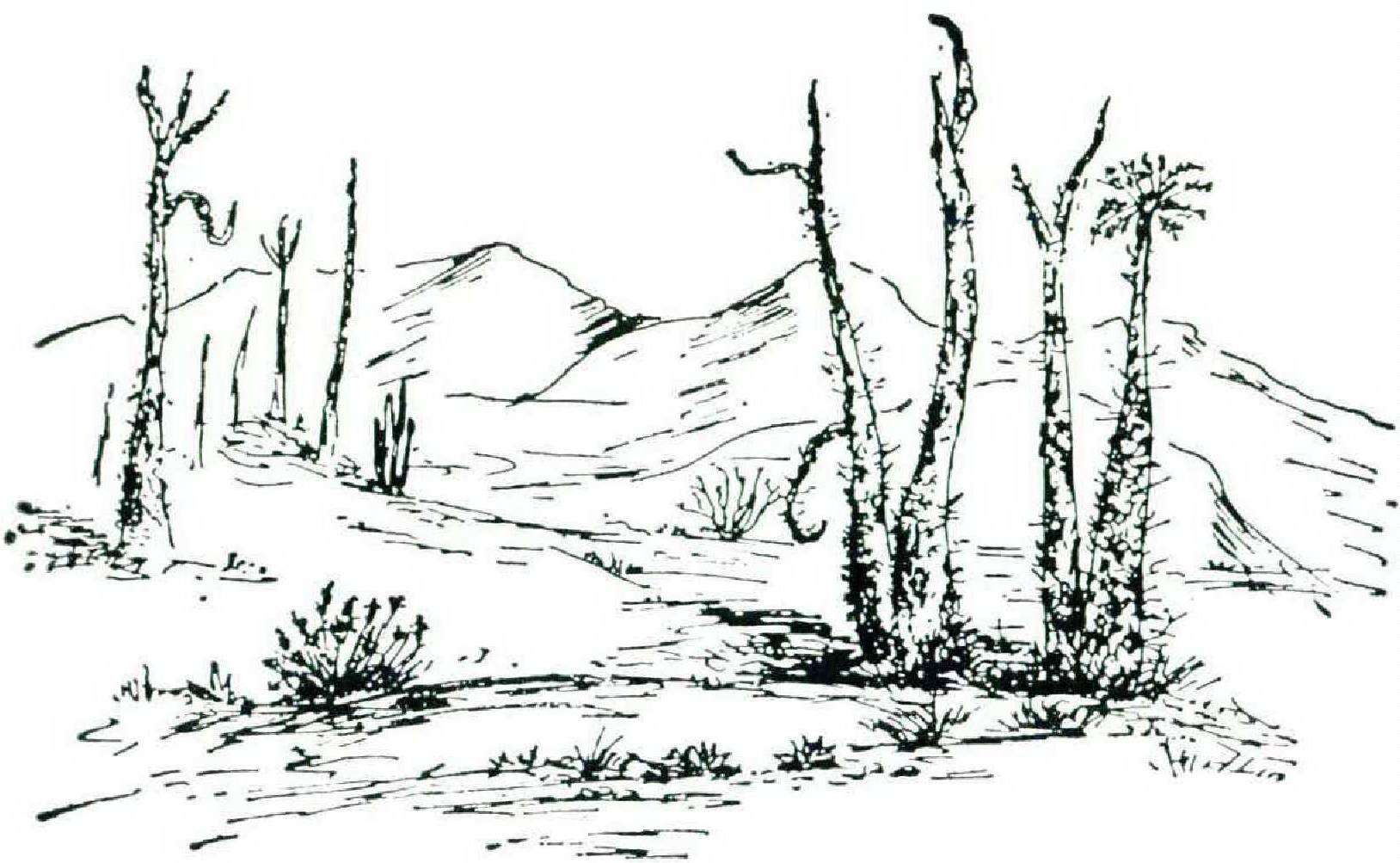
AMONG the many oddities of Baja California the oddest of all is the boojum tree, Idria columnaris. In The Forgotten Peninsula, Joseph Wood Krutch devotes an entire chapter to this unique aberration on the part of the Creator which (with the exception of one small spot on the mainland of Mexico) is confined to a narrow section of Baja. Next morning found us flying north in our amphibious plane, headed for Los Angeles Bay, whence an hour’s ride by truck would take us to the heart of a boojum forest. From the air the dark-blue bay looked like a model harbor, deep and curving and sheltered at its mouth by a scattering of small islands. Here lies a little fishing village whose principal industry is the harpooning and sale of giant sea turtles. The airstrip, running between a row of houses and the turtle shed, serves also as a sort of town plaza and playground: our plane had no sooner rolled to a stop than it was surrounded by a swarm of small boys, who shortly settled down to a game of marbles under the shadow of the wing. At the end of the plaza stood an exquisite little stone chapel faced with onyx. Flanking the doorway, like modern creations of abstract sculpture, lay two enormous whale vertebrae, bleached to a chalky white. White, too, was the cool interior, still decorated with white flowers from a wedding the previous day. We lingered there for a moment before starting on the next lap of the journey.
It was a rough lap. I had noticed heavy steel struts reinforcing the body of our truck, and I now understood why. This bit of El Camino Real climbs every hillock and plunges into every dry wash as it twists between outcroppings of red-brown rock. The desert floor itself is sandy and the vegetation full of variety: two species of ocotillo, distinguished from each other by the pattern of their branching; delicate smoke trees; dark-gray ironwood; cupals, or incense trees, whose twigs have a spicy fragrance when you break them between your fingers; squat, grotesque elephant trees, named for the heavy tapering branches which are supposed to suggest an elephant’s trunk, though to me their pattern seemed more like that of an octopus. Only more fantastic is the tree we had come especially to see.
One’s first sight of a boojum inevitably evokes what Joe Krutch calls “the rustic-seeing-his-firstgiraffe syndrome.” In fact, if you can imagine a giraffe’s neck projecting straight up out of the ground, you have a fair approximation of the simplest form of boojum, tapering skyward from a thick base, sometimes with a bunch of flowers bursting from its head. Other boojums are more complicated, sprouting arms and hooks like surrealist hat racks. When we brought the truck to a lurching halt in this nightmare forest and began to explore on foot, we had a startling experience. In this remote desert, miles from any habitation, we came upon a single neatly cut stump of a giant boojum. The botanist in the company did a double take; then suddenly he smiled in comprehension. Collected by an early scientific expedition, this particular tree now resides in the Smithsonian Institution, gaped at by the incredulous rustics of Washington, D.C.
Scientifically, the boojum is closely related to that wide-ranging species, the ocotillo: its flowers, though whitish rather than burning red, are similar in structure, and both plants have a curious way of producing thorns from the stalks of their fallen leaves. Why the range of the boojum should be so restricted is still a mystery. It seems to grow well enough in cultivation. When at last we had left our boojum forest and jounced back over that rollercoaster road to Los Angeles Bay, I took a last look at the little onyx chapel before getting into the plane. Where suburban North Americans would have used cedar or arborvitae for their base planting, the people of Baja had quite properly used young boojums.
FOR sheer dramatic impact, we found nothing in Baja to compare with the offshore islands where the seabirds nest. These islands have all the romance of unexplored mountain peaks — which is exactly what many of them are. The absence of vegetation emphasizes this mountain character: bare cliffs rise sheer from the water’s edge, perhaps cut in at the base where new caves are slowly being formed in the softer rock by the incessant action of the waves. Other caverns, dating from an earlier geological age and now high above sea level, may be occupied by colonies of blue-footed boobies, their powder-blue feet bright against the white line of the nest’s edge; a lower slope will be dotted with brooding pelicans, while ravens perch on the rocks above, waiting to pounce on an unprotected egg. An ordinary island when seen from the air will reveal at its center a perfect crater, the top of a dead volcano. On any one of them the naturalist may find a surprise such as the brown boobies, characteristic of the South Pacific, that we found resting among the expected blue-footed species. For these islands are uncut pages in the book; new types of plants, possibly even of animals, may be still awaiting discovery.
Of the islands that we visited the most exciting was neither particularly scenic nor unexplored. Too small to appear on most maps, Isla Raza lies approximately between Los Angeles Bay and that ancient pirate stronghold, the large island of Tiburón. To bird-lovers it is of supreme importance as the only known breeding ground of the “elegant tern,” Western counterpart of the handsome royal and Caspian terns known to Eastern birders. Our object was to check up on the present state of this unique colony. For here, on a wild spot far from any human dwelling, is a scene of incredible abundance. And here in brutal clarity lies the shadow of future extinction.
The shores of Raza consist of black volcanic rock, jagged and pockmarked like clinkers fresh from some gargantuan furnace, splashed everywhere with white bird droppings. In the absence of sandy beaches, our amphibious plane anchored well out in deep water, and we rowed ashore two by two in a rubber life raft to the sound of moaning seals on a nearby islet. Our arrival was not unobserved. Though supposedly Raza belonged only to the elegant terns and their natural rivals, the even more abundant Heermann’s gulls, we had just had an ominous warning that all was not well. From the air we had been startled to see several dories with outboard motors drawn up on the mud flats of a tidal lagoon. Now their owners, a wild and tattered but not unfriendly crew, stood looking down on us, some of them barefoot on the sharp rocks, one holding a long fish spear in his right hand and a still-flapping grouper in his left. Wading ashore, we picked our way among the slippery, kelp-covered boulders to the mud flat and the nearest dory. The owner stepped up and proudly lifted a cover of damp burlap sacking. The floor of the dory was already a foot deep in gull and tern eggs. We thought of Audubon’s Eggers of Labrador. We thought of the extinct great auk. But today we weren’t concerned with the dismal record of the past. Our job was to study the page that lay open before us.
Obviously the gulls and terns choose Raza because it is the one comparatively flat island among its larger and steeper companions, whose cliffs and elevated caves provide nesting sites for the pelicans and boobies. About twelve hundred feet wide, without shade or fresh water, it is built of three layers of volcanic rock which have become uptilted to produce three long ridges, between which lie the sandy flats where most of the birds nest. (“Nest” is a misleading term: eggs are laid in slight depressions in the sand, in the case of the gulls never less than two feet apart, but of the terns much closer.)
This year there were perhaps half a million birds on the island — four hundred thousand gulls and between fifty and a hundred thousand terns (including some royal terns among the elegants). As we stepped ashore, our noses were assaulted with the ammoniac smell of guano, which reminded us that the island had once been the scene of an illfated attempt to exploit this natural fertilizer; the business failed when a supply boat broke down and twelve men perished of thirst and starvation. The present incumbents, who numbered about twenty, were obviously not starving. Some were eating tortillas, and the litter around their camp indicated a varied menu, including three young ospreys.
Followed by several members of this ragged crew, to whom our motives were obscure and hence suspect, we climbed the nearest ridge. It formed a watershed, not of rivers, but of birds. The flat to our right was speckled with thousands of gulls; to our left lay a shimmering blanket of terns. The chorus of sound was sharply divided: into one car poured the gulls’ plaintive mewing, into the other the terns’ shrill cry. The birds ignored our presence; for a moment peace reigned. Then suddenly from behind us came a sort of rebel yell as the egg collectors charged down the slope, waving their arms and shouting into the midst of the nesting terns. The very ground seemed to rise as myriads of birds took to the air in wild alarm, shrieking and swirling about our heads in a blizzard of wings. Pails in hand, six or eight men fanned out over the flat to snatch every tern egg before the waiting gulls could swoop down to join in the plunder. It was a clean sweep: minutes later the pails were full and every nest was empty.
Such was the daily routine. The Heermann’s gulls, themselves predators on the terns, suffered the same fate. Though they nested everywhere on the rocky slopes as well as on the flats, we could find, on exploring the rest of the island, only a handful of eggs and — almost unbelievably not a single live chick. As we made our way back to the waiting plane, we wondered how any living creature, however abundant, could survive such exploitation.
A partial answer came two months later when a return expedition visited Raza on June 7 (about seven weeks after the eggers left) to check up on the results of the spring nesting season. For the Heermann’s gulls it had been a 99 percent failure. Though the island was covered with adult birds, still in pairs at their nest scoops, the few young were less than a week old. In other words, during the time the eggers were on the island the destruction had been complete, and the colonies had never recovered. The terns had fared much better. Apparently they had still been able to lay and to incubate normally after the eggers had departed; though their numbers were smaller than in years past, they had managed to survive another season.
Are they fighting a losing battle? To us the ominous note on Raza was not the men but the outboard motors. Egging has gone on in Baja California since time immemorial, as it has among the coastal Eskimos of Alaska; and the birds in each case have survived. When does legitimate harvest become exploitation? Modern weapons and modern machinery have forced the issue everywhere in the world, from the Arctic ice floes to the tropical deserts, from the sky above us to the ocean floor. Isla Raza is a tiny but significant case in point.
Owing largely to the efforts of the National Audubon Society and the Belvedere Scientific Fund, Isla Raza was declared a Federal Bird Refuge by the President of Mexico on May 14, 1964. Provision is being made for a resident warden to protect the birds during the nesting season. Thus, conservation has won another skirmish in the endless battle to save our natural heritage and to preserve for the Sea of Cortés a treasure as precious as its now vanished pearls.