Majoring in Resistance
H. F. ELLIS is widely known for his light prose and is a frequent contributor to the pages of the ATLANTIC.
Some time ago Oxford University discussed in convocation whether Latin should continue to be a compulsory subject for entrance to the university. The debate spread to the correspondence columns of most of the British newspapers, and its last faint rumblings can still be heard where educational theorists and old students of the ablative absolute gather. All the familiar views on this perennial topic were faithfully aired: in favor of Latin, that it is essential to a proper understanding of the English language, that it “teaches boys to think,” and that Western civilization owes an immeasurable debt to the legacy of Rome; against Latin, that it is a waste of time to learn a dead language, that very few boys get deep enough into the subject to touch even the fringes of Roman literature or history or law, and that it makes a mockery of education to force schoolmasters to teach a subject that most of their pupils will drop like a hot brick as soon as they have got safely into a university.
This amiable controversy started me brooding on the extraordinarily conservative, not to say blockheaded, way in which Latin is taught. In most schools, in Britain at any rate, it is still just a “subject,” something one “does” or “takes,” a strange and wearisome affair of declensions and conjugations. Labienus is still being wounded with a spear, and Caesar continues to throw bridges across rivers. Many children fail to see the point of it. They have my sympathy. It is no joke to have to plug away at a dead language, knowing that there is no hope or intention of getting anywhere with it, that a scratchy acquaintance with the elements of it is required for the apparently aimless purpose of an eventual examination, after which it will thankfully be discarded forever.
But suppose that Latin were taught not as a subject in itself but simply as a part of English, as a step toward acquiring the art of making oneself understood? Suppose the Latin words learned were, wherever possible, those that are still alive in our own language and were always accompanied in the textbooks by their English derivatives — yes, and perhaps also by their existing variants in French, Spanish, Italian? Suppose that those tiresome inflections and the structure of Latin sentences were taught pari passu with English grammar and composition? Would not the child then see the point of spending a little time on what is not a dead language but the key to the vocabulary of his own language and half a dozen European ones as well? I believe he would — always provided, of course, that someone had taken the trouble to point out to him the desirability of being able to express himself adequately, at least in his own tongue.
The ability to communicate one’s meaning and, of course, to comprehend that of one’s fellows, both in speech and writing, is a fundamental need of every man and woman, in business or profession, in politics, in love, in ordinary social life. The power to express oneself (even, since we think in words, to know what one wants to express) is not innate but acquired, and the tool for the job is the infinitely flexible, delicate, complex, and difficult English language. The present educational theory, in Britain at least, seems to be that mastery of this essential tool can be acquired in one’s spare time. Add an essay or two, a little Shakespeare reading, and perhaps a smattering of grammar, and so far as communication goes, the pupil is ready for his higher education. The advantage of this theory is that plenty of school time is left for the “really important” subjects. Its disadvantage is that precious few educated people are turned out who can adequately express meaning in their own language.
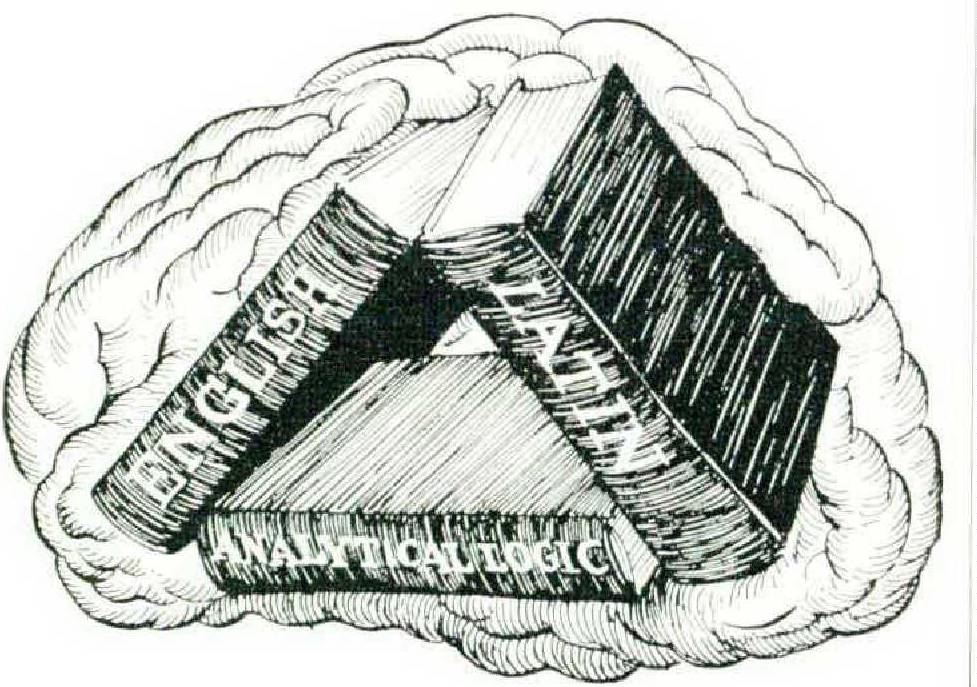
I do not, of course, believe that teaching alone, with or without Latin, will produce good writers, or that extreme clarity of thought and expression will necessarily result from a course of “English.” But I do believe that it is the first business of education to give every child a chance to master his own language, and I strongly believe that some proficiency in the art of communication should be insisted on by universities as a condition of entry.
There is another “subject” so important that I should like it, too, to be made compulsory for would-be undergraduates. It is in a way a branch or extension of the art of communication, and the best name I can find for it is logic. Not, God forbid, the logic of the schoolmen, nor the mathematical logic of Bertrand Russell, nor whatever the logic of the logical atomists is, but a little down-to-earth instruction in the principles of argument and reason. You cannot teach ready-made recipes for discovering truth to children in their teens, but you can, I think, help them to detect falsehood and to distinguish the meaningful from the meaningless.
The ancient Greeks had a passion for rhetoric, the art of persuasion. What we need now is something more like antirhetoric. A great deal of time, money, and ingenuity is spent on perfecting the techniques of persuasion in the modern world. Governments, politicians, newspapers, writers, advertisers, agitators, zealots of all kinds, and just plain talkers pour out a stream of advice, admonition, instruction, and propaganda, using all the known and some unheard-of tricks in their anxiety to tell us what to think, do, eat, wear, smoke, and believe. I have never yet heard of any concerted effort to provide young people with effective armor against this persistent attack. Yet resistance to it is vital. If a democracy is to function effectively, even to survive, its members must retain their power of individual judgment and must be protected against brainwashing from within as well as from without. I believe that a boy or girl ought to have acquired the first principles of self-defense before leaving school.
Nothing very profound is needed: some basic training in the nature of evidence; some instruction on the distinction between mere amplification and argument, between repetition and proof; a little practice in the recognition of some of the commoner and less reputable tricks. We don’t want to train a generation of cynics, but we do want young people who will wait until something has been said before applauding. I should like to think that when some politician declaims, let us say, that “the tide of feeling in favor of a sabbatical year for industry is sweeping across the country in full flood — and you can’t arrest a tide by Act of Parliament,” my ex-pupil will say to himself, or even to the politician, “Very nice; but you haven’t said anything yet.” I should like to feel that he had learned at school that a metaphor is not an argument, still less a proof; that a feeling in favor of this or that may have some of the attributes of a tide, but cannot have all; that a tide in any case does not sweep across country but goes up and down; that when it is in full flood it is just about to turn; and that you can arrest a tide by Act of Parliament if the act provides for the building of a suitable wall. In other words, I should like the growing generation to be provided with some sort of touchstone for the detection of blah, gup, wind, distortion, falsehood, and meaningless but tendentious utterances of all kinds — and equally, if possible, for the recognition of sane, careful, not necessarily correct but at least reasoned argument.
It is a lot to ask of schools. But it would be a great achievement if the first tottering steps could be taken there — to be lengthened into giant strides in the heady, controversial air of a university. It will be a happy day for us all when the first man majors in Resistance.