Why the Border Guards Defect
BY MICHAEL MARA More than one thousand East Berlin border guards have defected to the West since the Wall went up in August of 1961. One of them is the author of this article, MICHAEL MARA,a twenly-four-year-old Berliner who, on Christmas Eve of 1961, escaped to the West.
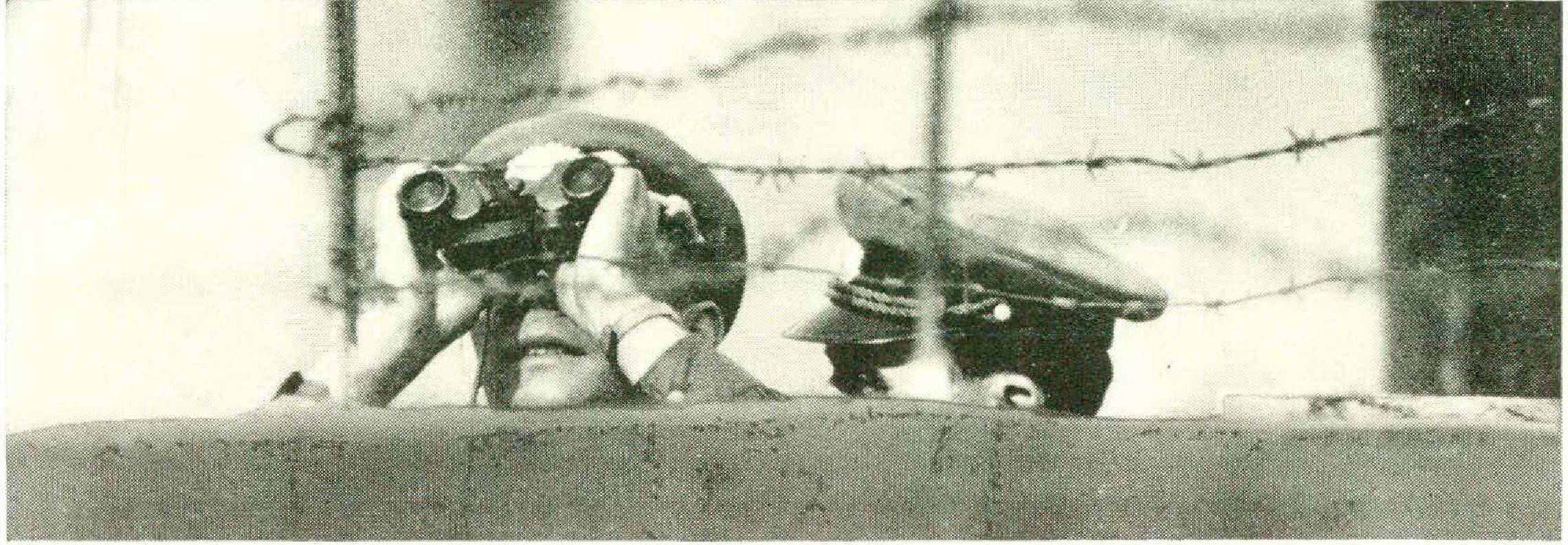
SHORTLY after our arrival at the Twelfth Border Company at Drewitz it was impressed upon us that we must expect to be the target of provocative acts from the West side. There would be Americans in Steinstücken who would throw stones at us to provoke us into shooting at them. We were warned that the West Berlin police in the Kohlhasenbrück area were controlled by an American spy ring and that they would try to bribe us with cigarettes and liquor.
My first impression of the border was the barbedwire barrier around Steinstücken, “Over there,” said my patrol leader, pointing to a bar, “that’s where we used to get Western cigarettes. That’s all finished now.” He was in a nasty mood. “Just had a letter from my girl,” he went on. “She’s running out on me. Her mother told her to find someone who isn’t on the border. The old cow ought to be in jail.”
It was a dark, peaceful morning, the air damp with rain. The strands of barbed wire looked unreal, like ornamental scrolls decorated with crystals, and the smoothly raked death strip reminded me of the cinder track in an athletic stadium. I just couldn’t grasp the truth of the situation — until I saw the first prisoners, those who had sought to cross the Wall. They were led away by Corporal Roselle and the other members of his patrol. They Were forced to line up against the barrack wall and put their hands behind their necks. A few days earlier I had seen a similar picture in Neues Deutschland: it was of partisans captured during the Second World War.
I stood on guard at the entrance to the enclave of Steinstücken. My orders were to take the names and addresses of all persons coming in and out and to pass this information on to my patrol leader, who stood next to me. The first car drove up — a small blue one. The driver held up his identity card against the window briefly and got ready to move on.
“Put your window down and give me your identity card,” i said.
The window was opened an inch or two. “It gets worse here every day,” said the man in the car. “I’ll put in a complaint to the allies. I don’t need to let my identity card out of my hand.”
“Complain as much as you like, it doesn’t worry me, but I still say you can’t drive on,” I answered. My patrol leader had stationed himself in front of the car, his submachine gun pointing at the hood.
Now the window was fully opened, and the identity card was thrust into my hand. I read “Professor Dr. Niemeyer,” and I saw a distinguished, intelligent face. I hastened to carry out the essential procedure, handed the identity card back, and said, “Thanks very much!” I thought to myself, maybe one day I can apologize to him.
A short time afterward I saw three Americans in uniform walking along the barbed-wire barrier. Later I learned that there are never more than four Americans in Steinstücken at one time. The Americans nodded to me, and one winked at me. I nodded back. My patrol leader poked his gun in my back and hissed, “Are you crazy? If you do that again, just once more, I’ll report you to the politnik! You mustn’t nod to those swine!” Up to this point I had got on quite well with the patrol leader, but the friendly gesture to the Americans opened a great gulf between us.
Next, I patrolled a section which included the Breitscheidestrasse. The broad high barbed-wire barrier stretched straight across the Villenstrasse, separating us from the West Berlin side. The people living in the comfortable houses on the West side, and those who were visiting there, often used to stand and look along the street into the East sector. Out of one of these houses came a man with two young and elegantly dressed ladies.
“Look, there are two of them,” said the girl who was wearing a fur coat. It was as though she had said, “Look, there are two rabbits.” My patrol leader and I stood touching the barbed wire, on the same sidewalk with the people who were looking at us. We remained motionless.
The man eyed us critically. He shouted across to us, “One of your gang shot another refugee trying to escape across the Spree!”
“That’s enough,” said the younger girl. Then the three of them got into a car, and before the younger girl disappeared inside, she waved to me. A pain shot through my heart. Did those people on the other side really know what their freedom meant?
I SPENT six weeks in Ulbricht’s Border Police at the Berlin Wall. It took six weeks to find a hole in the Wall, six weeks filled with fear and apprehension of being discovered.
During this period I lived through experiences which I shall never forget. I met soldiers who did not shoot at refugees or who deliberately took false aim. Many of them had to pay dearly for their staunchness of character. My first hours of duty at the Wall gave me a foretaste of the supervisory system of control exercised by the SED (the Communist Party) over the Border Police. It was the job of my patrol leader, a member of the SED, to keep strict watch on me. Everything depended on the thoroughness of my reports on those coming in and out of Steinstücken, and the accuracy of my inspection determined whether I should continue to be posted at the Wall. My patrol leader gave a written report on my behavior to the company commander. In those six weeks I learned enough about the political system of control exercised by the SED to last me a lifetime.
The “control activity” of the Party begins as soon as the young soldier joins the Army. Young men between the ages of eighteen and twentythree who are forced under the Free German Youth Order of August 17, 1961, to join “the armed organizations defending the Republic” have to fill out the same forms as the conscripts, and they also must sign the printed “Declaration of Loyalty” to the “First Workers’ and Farmers’ State.”
This form is an eight-page questionnaire about the “social-political” activity of the young man before his entry into the Army, and it covers every sort of function he may have carried out and special marks of favor he may have received.
Three pages of the document are concerned with “relations with the West.” The young soldier must answer such questions as: “Do any of your relations live in West Germany, West Berlin, or in capitalist countries abroad?” “If the answer is yes, how longhave your relations lived there?” “Have you yourself ever been to West Germany, West Berlin, or to a capitalist country abroad?” “If the answer is yes, when and for how long were you there?” “To date have you had any contact (by letter, and so forth) with West Germany, West Berlin, or capitalist countries abroad?”
Anyone who answers yes to these questions is rated as “unreliable,” and if he should be posted anywhere near the border he is closely watched by informers and officers. He is sent only to areas where any attempts at escape are almost certainly doomed to failure.
The same treatment is accorded soldiers who are classified as “politically weak” for other reasons. This classification includes those who during their political schooling speak out against certain measures of the regime, those who were not members of the FDJ (Free German Youth), and those who have relations who have fled to the West. Each “politically weak” soldier is generally paired off in duty at the Wall with a “politically sound comrade,” so that any chance he might have had of escaping is nipped in the bud.
The questionnaire follows the soldier during his entire term of service and is kept in a so-called progress book. This book, modeled on Russian lines, contains written entries detailing all items of military or political importance about the soldier: remarks he may have made during his political training; conversations, supplied by informers, which reveal opposition to the regime; reports on his conduct at the border; accounts of any refusal to carry out orders. Opinions expressed by the SED or FDJ leaders responsible for the “Training in Political Consciousness" of the boy before he joined the Army are also entered in this book.
Special entries are made for “good deeds,” such as the capture of “traitors to the fatherland” (in other words, refugees); commendations and prizes for “outstanding conduct at the border”; and promotions. The progress book is an important working document and “reference work” for SED officers and security officials — but, of course, the soldier himself is never allowed to see it.
Young soldiers who pledge their faith and loyalty to Communism, and who conduct themselves accordingly at the border, soon amass glowing reports in their progress book, and this leads to a rapid and dazzling career in the Army or, later, in civilian life. But for many others this book is a dangerous institution which makes it impossible for them to advance in their professions and which may eventually lead to the loss of civil liberties.
The SED controls a tightly woven network of informers who keep watch over the border soldiers. All members of the Party are bound to pass on information to the officers. This information includes the reporting of “service misdemeanors,” the faithful repetition of conversations and political statements by soldiers. Under regulations dated November, 1961, a member of the Party must sleep in each room of the barracks so that all conversations can be overheard and the “political consciousness” of the soldier can be suitably influenced.
Every platoon (twenty-five to thirty men) also contains at least one State Security Services informer, who collects details about a “problem” soldier. These informers usually wear the uniform of a private or a private first class, although they are in fact lieutenants or officers of low rank. Sooner or later they betray their true identity by some slip in their behavior.
A soldier never stands guard alone at the Wall. He must be in full view of another soldier. He is posted daily to a new position and has a new partner for each turn of guard duty. This is to ensure that no confidential exchange of views is possible, and to guard against escapes.
During the eight hours on duty, officers and noncommissioned officers make “check controls” at irregular intervals. They often creep up on a pair of guards at a post, hide behind some nearby obstacle, and watch the soldiers. Another test which the SED has devised is to send Communists in West Berlin up to the Wall, where they throw cigarettes to the guards and try to start conversations with them. Border soldiers who fall into this trap land in jail or in a hard-labor camp.
Here is an example of the kind of trick played on the soldiers under the system of political supervision. The day after two soldiers had fled to the West from a border company in the south of Berlin a radio was suddenly installed in the canteen. The officers were looking for young soldiers who had been in contact with the refugees, and they thought that these soldiers would rush to the radio and turn on RIAS or SFB (two West Berlin radio stations) to see if there was any news about the men who had fled. But nobody did so, because everybody could see that the radio was clearly connected to a wire leading into the room of the political officer. A few days later the radio was removed.
I have had many conversations with soldiers at the Wall since I fled from the East. These conversations showed over and over again that young East Germans loathe their service at the Wall, but because they have families dependent on them, they have no means of avoiding it.
A few weeks ago I was standing one evening somewhere near Checkpoint Charlie. On the other side of the Wall three soldiers were sitting on a block of concrete. They gestured to me to ask if I had a few cigarettes for them. I went to the nearest cigarette machine and bought some packs of Lifes, the favorite brand of border soldiers. I wrote a few words of greeting on a small piece of paper and threw it over with the cigarettes. The soldiers carefully scanned their surroundings before they picked up the cigarettes. A little later a note weighted down by a stone came flying over. It said, “Thanks a lot for the cigarettes. But we’re married, with children, and that’s why we can’t jump over — we’ve just got to put up with this humbug. There are many here who think as we do.”
The three of them shared the cigarettes and burned the packages. One of them kept constant watch on the area behind them.
I wrote another note, telling them that I had also been a border soldier and had fled to the West, and that I would like to come to the Wall another day and see them again. I threw this over the Wall with two more packs of Lifes.
They sent me a detailed answer: “Today is the last day of our sixteen days’ duty at the Wall. You know yourself what it’s like here. Tomorrow we’re going into intensive training. So that you’ll know the new guards are OK we’ll tell them to turn their caps around in their hands. We’ll be back here on the nineteenth or twentieth. Many of us here envy you for making it.”
From time to time I speak to these soldiers, in spite of the cleverly contrived control system. The urge toward freedom cannot be suppressed, and this fact gives us something to hope for.