The Cave
A Southern writer whose short stories first appeared in these pages and whose first novel, MOUNTAINS OF GILEAD, appeared under the Atlantic-Little, Brown imprint, JESSE HILL FORD makes his home in Humboldt. Tennessee. He is now at work on a second novel.
by Jesse Hill Ford
FROM the back seat of Uncle Creason’s car, riding behind my Grandfather Turner, I look at the trees and the red, gullied hills. This is what Uncle Creason, who is driving, calls the poorest land in North Alabama.
“Oh, they can’t let corn ripen on the cob around here before they’ve made it into whiskey,” says Uncle Creason, shaking his head. He drives too fast. Grandfather Turner keeps telling him to slow down. The clay road twists like a rope, on and on ahead of us, over one hill after another. There are only the pine trees to look at here. This is Grandfather Turner’s forest, and for my birthday present, because today I’m thirteen years old, they’ve let me come along with them.
Uncle Creason’s mind jumps back to the timber. “Let’s turn somebody loose in there and thin it out — sell off the thinnings for pulp and leave the rest to grow up to lumber size, like we talked about last year.”
Grandfather Turner nods. He and Uncle Creason are lean, sharp-nosed men with thick dark eyebrows. They sit bent forward in the front seat, looking at the thick piny woods on either side of the road.
“All right,” says Grandfather Turner, “let’s see the Murrays then.” He remembers me in the back seat. “Our cousins, George,” he says to me. “The Murrays?”
“Yes, sir,” I say. “I remember.” But the memory is very distant. I can barely remember Grandpa Murray, not my grandpa at all, but a distant cousin. And I can barely remember the Murray boys, wearing faded overalls, coming to see us in Royal, teasing me, calling me “little city dude.” But now they would be grown men, and it would make all this time that I had not seen them or Grandpa Murray, all those years, I think.
“He’ll have to show us that cave” says Uncle Creason, and I have a glimpse of his eyes. He’s looking at me in the rearview mirror.
Grandfather Turner turns from the timber for a second to look at Uncle Creason. “Well,”says my grandfather reluctantly. “After all, George is twelve — ”
“Thirteen, sir,” I correct him.
“Ah — oh, yes.” My grandfather turns his head to look at the timber again. But now the timber falls away to sour pastureland. We’re out of the forest. “Well, if we must, we must,” says my grandfather. Something bothers him. “And — ah — we must, I suppose,” he says.
“ They have a cave?” But nobody answers me.
“Slow down, Creason! Make a right turn just yonder at the top of that little rise,” says my grandfather. But Creason has already started slowing down. He makes the turn. We pass between gray weathered gateposts and stop in the front yard before a big unpainted two-story house.
It’s a December day, not raining, but damp all the same, and not really cold, but with a chill in the air so that I can see my breath when we get out of the car. The sun is behind a shelf of bright clouds. The yard is red sand and white pebbles. Chickens squawk and run under the porch when Uncle Creason reaches through the car window and mashes the horn a couple of times. “Hello!” calls my Grandfather Turner. He raps on one of the porch posts.
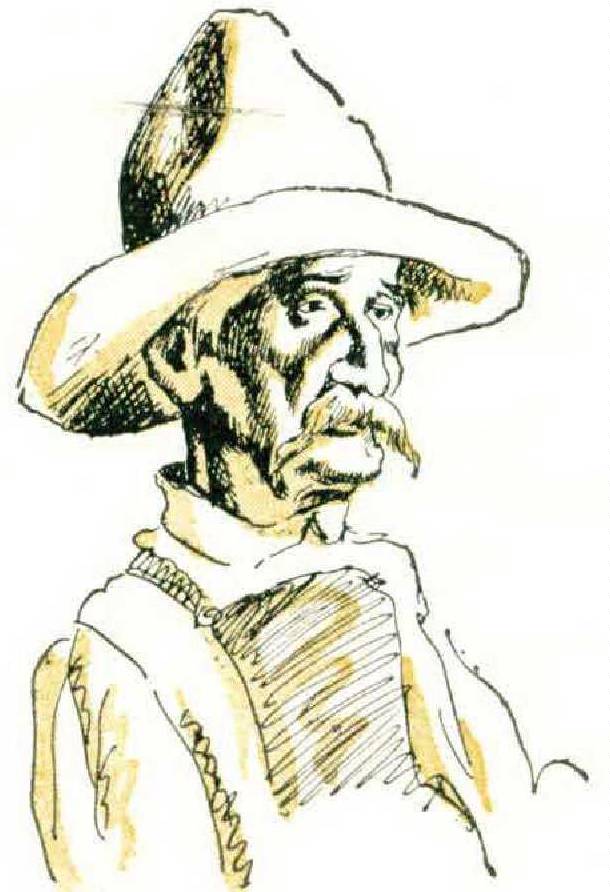
“Anybody’d live this far off the highway might as well live in trees,” says my Uncle Creason. Just then the front door swings open. Two red hounds come out first, shaking their ears and wagging their tails. After them comes Grandpa Murray, our cousin. He knows us right away. “Sah-sah-sah, come in the house!" he shouts. He is a tall old man who staggers when he walks. We go in and sit in cane-bottomed chairs around the warm bungalow stove. Grandpa Murray shivers even when he sits down. His white beard and mustache tremble. Before speaking he says. “Sah-sah-sah, like a cold Model T engine kicking over, cranking and trying to start. “Sah-sah-sah, that would be a matter for the boys,” he says. “Sah-sah-sah, thinning those woods, and the boys are not here! Sah-sah, we’ll go down to the cave and see the boys. Grandpa Murray stands up.
“I was afraid of that,” says my grandfather.
“Sah-sah, you’d have to see the cave anyhow!" says Grandpa Murray. “Sah-sah-sah, bring my hat! Sah-sah-sah, we’re going to the cave.”
His daughter, Cousin Emmy, brings his hat and his stick. She wants to take Grandpa Murray to Birmingham for a visit when she and her kids go back home next week. She says, “I think Papa would like to come to Birmingham for a while, don’t you, Cousin Will?” It’s strange hearing my grandfather called Cousin Will.
“Sah-sah-sah, damned if I’ll go!” shouts old Grandpa Murray. He hits the floor with his stick like someone scotching a snake. “Sah-sah-sah, a thousand years will pass before you’ll get me to Birmingham again!”
His yelling doesn’t bother Cousin Emmy. She seems not to notice it. She is like somebody talking about a bad child. “I just know Papa would like coming to see us once he got there. Talk him into it, Cousin Will. You’re the only one in the whole family he’ll listen to. It just don’t make sense for him to keep on hating Birmingham the way he does.”
My grandfather has gone pale around the mouth, the way he always does when something makes him uncomfortable. Still, he promises to talk to the old man. “Talk to him over at the cave. Cousin Will,” says Cousin Emmy, linking her arm with my grandfather’s, starting us to the front door. “Oh, me, if he don’t love that cave better than his own children!”
On the way to the car I ask Grandfather what it is Grandpa Murray has against Birmingham.
“He was in jail there one time,” my grandfather whispers.
“What did he do?”
“What he’s done all his life — made whiskey, sold whiskey. That’s what he’s doing right now. I just hate for you to have to see anything along this line, George.”
I lay my arm across my grandfather’s back and feel the thin bones. “I’m thirteen,” I whisper.
“Course you are,” he says aloud. “It’s foolish of me not to realize it — getting up a man now.” A little sadness creeps into his voice.
I GET in the back seat with Grandpa Murray, my grandfather gets in the front seat with Uncle Creason, and we’re pretty soon off on another winding road, rougher than the last one. “Not exactly the Bee Line Highway,” says Uncle Creason now and again when the ruts get hold of the car and sling it like a dog killing a snake.
Grandpa Murray points out the signs, red paint on white boards, nailed to pine trees at every bend of the road. “THE CAVE,” they all say, in letters so crooked and squiggly I know that nobody but Grandpa Murray himself can have painted them.
“Hate to be a goat trying to hunt up a meal around here.” says Uncle Creason, winking at me in the rearview mirror.
“Sah-sah-sah, follow the main road straight ahead ! Sah-sah-sah, all my life didn’t I dream about fixing up this place — oh, sah-sah, didn’t I?”
“STOP!” says a sign bigger than the others. “THE CAVE!”
“Sah-sah-sah, whoa!” Grandpa Murray roars. We hang on, Creason stomps down on the brakes, and we skitter sideways a few feet before we stop just past where the road ends in a parking lot graveled with burnt slate. Trucks and automobiles sit parked on it every which way. We get out, cross the lot between the cars, and begin climbing wooden steps that lead up to the cave entrance, a whitewashed plank door up on the hillside.
Squatting there on the top step is a man in a gray suit with orange stripes in it. The suit’s too little for him, his yellow shoes are muddy, and he’s wearing no socks. He’s drinking corn whiskey out of a Nehi bottle. The minute we touch the top step I smell it. Another Nehi bottle beside him on the log step has a red balloon stuck over the mouth ot it. Inside the bottle something is boiling and bubbling and blowing up the balloon. We stop and watch.
“Hello there, neighbors,” says the man. He holds a handful of sales-tax tokens. One by one he’s bending them double with his teeth and dropping them in an empty Nehi bottle. From another bottle he pours in a little water, and out of a lye can with a red devil on the label he shakes a little lye on top of the bent tokens. The stuff starts bubbling, and he caps this bottle with a green balloon and then pauses to sip from the bottle with his whiskey in it.
“Suh-sah-sah, remember which bottle is which!”
“Yeah,” says the man, not looking up at Grandpa Murray. “Here’s the only thing in the world tax tokens are good for.” He bends one and drops it in an empty bottle. He reminds me of a fisherman who loves to fish, the way he’s so wrapped up in what he’s doing.
“What do you do with the balloons?” I ask him.
“Just let ‘em go.” He points up. Sure enough, there’s a balloon high in the air over the cave, getting higher all the time.
“I thought they tied messages on them,” says Uncle Creason, still looking up. “Way I heard it, they had the Post Office Department worried about the competition.”
“Do you tie messages on them?” I ask the man.
“At times yes, at other times no. Ain’t thought of no messages today,” he says, bent down over his work now like a crawfish, tying off the full balloon with black sewing thread. He lets that one go, and we watch it sail up, higher than the pines, higher than the hill, on and on. Something about it makes me feel funny inside, seeing the balloon go up that way.
“Well, I’ll swear,” says Uncle Creason. “It’s good for you. isn’t it? Like giving your soul a Florida vacation. Yes sir, that sure reminds me of Daytona Beach.”
“You been there?” the man asks, minding his bottles like somebody weeding a garden, working faster now.
“More times than I could count,” says Uncle Creason, who likes to brag. “You can drive your car right down on the beach beside the sea. Never even have to get out of your car —just drive up and down beside the ocean all day long. Oh, sure, it’s a paradise.” Daytona is Uncle Creason’s idea of the perfect vacation.
“Never been there,” says the man, “but maybe one of these little old balloons will end up there. What I like, you just never know. Anyplace the wind blows at, one of these little dudes is liable to end up.”
Uncle Creason squats down for a close look at the fizzing tokens. “Chemical reaction,” he says.
“Yes, and I expect it’s against the law to dissolve tokens,” says my grandfather.
“Oh. I’ll spit and go blind it is!” says the man. “I’ll guarantee you — ” He caps off another balloon. “That’s half the fun, but I wish you’d look how this lye eats holes in a man’s shoes and britches.
I give a good price for this suit — and now, just look.”
“Sah-sah, the lye boils the tokens, and the hot air raises the balloon some way.”
“Must be hydrogen,” I say, stooping down the way Uncle Creason did.
“Never heard it called nothing but token gas,” says the man. “You gents from Birmingham?”
“Sah-sah-sah, not in a damn thousand years!”
The man looks up. “Well, kiss my mother! You come up in a Birmingham car.”
“Sah-sah-sah!”
“I quit,” says the man. “You win.”
“Doesn’t pay to say you-know-what around him,”says Uncle Creason, “the name of that place. He had a lamentable experience there.”
“Pardon my gopher dust,” says the man. “I never meant to give him no hernia of the brain. Takes all kinds though, don’t it?”
Grandpa Murray starts jabbing down his stick now. “He says ‘Birmingham’ again, I’ll strike him dead right where he squats!” The old man staggers away to the cave door, waving the stick and muttering.
WHEN the plank door slams behind us we’re in a big room barely lit with pink and red lights, quiet as a cotton warehouse, warm, and about like I always thought something under the ocean ought to look. Besides us, there isn’t another soul in the place. Just a bandstand and a bar that Grandpa Murray herds us over to. telling all the while how they found a regular Indian cemetery when they dug up the bottom of the cave to lay down the dance floor. All this time I’m wondering who the cars and trucks outside could belong to and where the Murray boys are, I’m also trying hard not to look at the calendars back of the bar, but of course my eyes keep going back to them like a couple of magnets. They are machine-tool and steel company calendars — naked women fussing at little dogs that have just jerked off their cheesecloth nightgowns, naked women talking on white telephones. It’s what I’ve seen at lumber sheds and in the back room of a filling station, but never this many. Calendars cover the entire back wall of the bar, years and years of them.
“Sah-sah-sah, we’ll have chicken fights here next spring.”
“The devil you will,” says Uncle Creason, trying, like me, to act like he’s not noticing the calendars.
I’m just taking a look at a calendar showing a tall woman holding a little towel and backed up to a pothellied stove when the back of the bar opens and out walks a pretty girl through a door not even the F.B.I. could of guessed was there.
“Hi!” she says, and comes around the bar.
“Hi yourself,” says Uncle Creason. Grandpa Murray is still rattling on like an old car about to fall to pieces on a rough road, behind the bar himself now, rummaging under it and paying the girl no more nevermind than if she was a vinegar gnat, and neither me nor Uncle Creason able to take our eyes off her she’s so pretty. “Sah-sah-sah, sold them all but just this here one,” Grandpa Murray’s saying. He comes up with a skull, bottom jaw gone, but still worth ten dollars, he says. He sets it on the bar, proud as punch.
Uncle Creason winks at the girl, lights a cigarette, and makes like he would slip it under the skull’s teeth.
“Lordy at that,” says the pretty girl, leaning over to look at the skull. “I’ve lost my date,” she says. “Ain’t anybody seen a stripy suit with a drunk guy down inside it, have you? Lordy, if that ain’t the awfullest thang I ever saw. It’s a fake, ain’t it?”
Nobody offers to tell her it’s real. She wears a tight black dress and light-blue shoes and carries a light-blue coat, same color as the shoes, over her arm.
“Well,” she says. When she straightens up she sees me. “Hi. honey. What’s your name?”
I feel my face heat up like a Warm Morning stove. I tell her, but it sounds more like I’m clearing my throat than saying my name.
“Well, cute,” she says.
“There was a stripy-suit man out yonder on the front steps as we came in.” says my grandfather, taking off his hat. “He was filling balloons with token gas.”
“Oh, I oughta guessed. Russell’s a regular nut on the balloon subject.” She looks at me. “If he was a little older, wouldn’t I make him mine? Hope to spit I would!” She giggles and looks at me like a chicken watching a grain of corn, and I have to look at her hands, at her bitten fingernails all painted red and uneven like a little girl’s. Then I look at her face again. The others know what s happening — that I’m standing there falling in love with this girl. Uncle Creason is grinning.
“Bye, honey,” she says again. Then she’s walking away.
“Bye,” I say, looking after her, and yet not wanting to watch her leave because I know the men are watching me. It’s a relief when Grandpa Murray hurries us in behind the bar, through the secret door, and down a short hall to the hidden gambling room. It’s protected by another door with a bright light that flashes on above it when Grandpa Murray knocks on it, like Moses striking the stone, I think, the old man hitting the door a crack and the light flashing and the door finally swinging open on a room full of laughing women and smoke and men all gathered around tables, shooting dice.
Here come our three cousins then, the Murray boys, dressed just alike in gray checked suits, hair slicked back, grown men now, sure enough, like preachers or undertakers — businessmen, I think. They have to feel my muscles. Cousin Roy, the oldest, is pushing us toward a booth in the corner when my grandfather says maybe I’d rather go outside and wait for them, if it’s all right. “Why, sure,” says Cousin Roy. “I never thought of that.” What Roy means is he’s never thought about me being a little young to be in the gambling room. You always have to like a cousin for speaking up that way. “Yes, George can wait outside,” says my grandfather. Cousin Roy gets me a Nehi and some peanuts first, and then back I go, down the secret hall to the big empty dance floor and back out the rough oak front door of the cave, sipping my Nehi, eating my peanuts.
I’M no sooner outside than I see the girl’s blue coat. She stands by the man in the striped suit. He’s holding a balloon. When she sees me she yells “Hi!” just the same friendly way she did the first time. “Come here!” she says. She’s laughing. It comes to me that she can’t be very old — not too much older than me, I’m thinking. “Gimme some peanuts,” she says. I hand her the package. “Hey, Russell, want some goobers?” He shakes his head no. “Here, Russell.” she says, “let’s see what you wrote.”
Russell has the note already tied to the balloon with sewing thread. She looks at the note and lets the balloon sail off with the note hanging under it.
“What did it say?” I ask her, thinking how she can’t be too much older than me, that thought running and running through my head. I’m feeling big and grown-up — big as anybody. I’m feeling good. “What was on the note?” I ask again.
“Why, nothing but Russell’s name and where he lives at and his phone number. He hopes some old whore will find it and phone him up. I don’t call that much of a message, do you?”
“No,” I say.
“OK,” Russell says, as busy as the first time I saw him.
“All right,” says the girl. She sits on the log step and takes a black address book out of her blue purse. “Come sit by me, hon,” she says, patting the place beside her, smiling at me. “I’m gonna write something real. Well, come on! I won’t bite you! Will I, Russell, will I bite him?”
“I wouldn’t be surprised at any damn thing you did.” Russell says pleasantly, very busy bending tokens in his big yellow teeth, dropping them in a bottle.
“Aw, hell with you,” she says. I sit down on the step beside her, so close I smell her perfume, and little fishhooks swim into my belly and into my blood too, swimming on and on into my arms and legs. I take a little drink and smell the orange smell of Nehi and then her perfume again. From her purse she brings out a stubby yellow pencil with teeth marks on it. She bites it. “Now, let’s see,” she says. She writes something and tears the little page out of the address book and hands it to me. “How’s that?”
“U R A Sun of a bich,” it says.
“It don’t mean you, hon. This is for Russell.” She takes the message and hands it to Russell. “Here, ape man,” she says.
Russell looks at it. “Hey,” he says. “Hey, I like that a hell of a lot.” He ties the note under a white balloon and lets it go. “No telling where the hell that note will come down,” he says. “That’s better than putting your name and address any day! That’s a real message. Wouldn’t I like to see somebody’s face when he finds that.”
“It was spelled wrong,” I say. I’ve said it, and I have to say it again. “Wasn’t spelled right,” I say.
“Well, I like that,” the girl says. She sticks out her bottom lip. “Who am I supposed to be — Mrs. Doctor I.Q. or somebody? Kiss my mother! What’s the damn difference to you, anyway, how it’s spelled?”
“Anybody can see you’re just an ignorant slut,” Russell says in that pleasant voice of his. “Even he can see that.”
It’s so quiet then I can hear the blood beating in my ears. She leans over, her face close to my cheek. “Am I, hon? Is that how I look to you?”
She turns my face with her hand. “Did I hurt your feelings, hon? Come on now — do I look like a dumb slut?”
“Got him between the rock and the hard place now,” Russell says. “It’s either tell a lie or give you the reds.”
I take a deep breath. “You — you’re the prettiest girl I ever saw.” I’ve said it, and it’s quiet again for a second. She lets go my face and turns away.
“So there, Russell,” she says. “I swear, this kid’s so nice I could eat him!”
“Well, first write me another message, and you can tattoo him for all I care,” says Russell. He’s got another balloon tied off. It’s long, like a sausage, and green, like new willow leaves.
She bites her pencil and then writes “JESUS SAVES.” She tears it out and hands it to Russell.
“Now, what kind of message is that?” Russell says. “There’s nothing new in that — hell, the whole world knows that. Why’d you have to go write that when the first one was so good?”
She gives me a look. “I can spell that,” she says. Russell ties on the note. The green balloon takes off with it, spiraling up like a screw.
“Let’s have something else,” Russell says. “Write something good for a change, will you? Try and let your mind outa church, OK?”
I try to see what it is, but she hides it under her left hand. Without letting me see it, she tears it out of the little book and passes it to Russell. He yells. “Hey! If this ain’t the best thing you ever did!” He laughs and stops and laughs again. “When I think about some dago over in Germany or one of those wops out in Turkey findin’ this!” he yells. He laughs and then coughs. His face goes dark as a plum. “Oh—oh, man alive!” he says when he can stop coughing.
“Can I see it?” I say.
“Ain’t you seen it? Sure.”
But she grabs it. “He can’t see it,” she says.
“What the hell?” says Russell. “You think he never saw that word before? Hell, it’s wrote on the wall of every public can in the world.” He takes the note back and ties it under the balloon. “Just think,” he says, “across over the ocean somewhere in Germany this dago sees this little red balloon floating down to him out of heaven. He runs after it! He runs a goddamn mile! Garlic falls out of his hairy ears!”
“Stop!” the girl yells. “I can’t stand it!” She’s holding her stomach. She’s laughing so hard her stomach hurts.
“Finally he reaches it! What will it say? He opens it up. He’s outa breath, and here’s this message straight from God, or maybe even the President of Oklahoma!” Russell laughs and his face goes ripe red again. He stands up straight and hands the balloon over to me. “Here, kid,” he says. “Read it and let it rip.”
I take it from him, but before 1 can get a look at the note the girl snatches the balloon away from me and lets it go herself, up and on up, with the note tied under it.
“Well, I quit,” Russell says. “This beats Birmingham.”
“Oh, I don’t mind,” I say. The girl looks at Russell. Her face is pale and cold as fresh corn. She turns to me.
“You understand, don’t you?”
“Oh, I don’t mind,” I say. What I feel inside is like a heavy wire. It bends me forward a little. I’m looking away from her at the torn red ground and the little busted bits of rock mixed up in it.
And she’s saying, “Look, I didn’t mean to hurt your feelings none. Hey, I’m gonna give you a little kiss. Hear that? A kiss. Will you let me? Hey — ”
I shake my head. I can’t look at her. I have to get away.
“Honey?” she calls after me. “Hon?”
“Can’t you let him alone?” says Russell. “Wanna kill him or something?”
“Hon?” But I’m walking fast, headed back to the cave. I want to be back inside where it’s quiet, back inside where I can be by myself. I don’t want to hear anything or know anything or see anybody.
Yet when I open the door the others are just coming—my grandfather and Grandpa Murray, my cousins and Uncle Creason. I hear my grandfather’s voice. “George’s birthday,” he’s saying. “Got to get home to eat birthday cake.”
“Birthday? Why didn’t somebody say so?” Cousin Roy brings out his wallet. I see it’s a fivedollar bill when he hands it to me.
“Your birthday from the Murrays, George,” Cousin Roy says. “From all the Murrays.”
“Sah-sah, wait a minute!” Grandpa Murray has caught on all of a sudden to what’s been said. He staggers back to the bar and comes out with something in a paper sack. He hands it to me. I feel it through the sack — the Indian skull. “Sah-sah-sah, and a thousand happy returns of the day,” says the old man. He hugs me in his cold shivering arms.
Then we leave. Me with the sack, holding the five-dollar bill and having to go back past her now, not wanting to do it. I put my grandfather between me and the girl, so at first she doesn’t see me.
When she does see me her mouth opens, but she closes it without speaking. She waves. I nod and look away. “Oh, me,” says a voice. It’s Russell.
We go down the steps. When we get to the parking lot Russell yells, “Montgomery! Albuquerque, Arizona! Hey, Birmingham!”
“Sah-sah-sah!”
The old man’s sons are there. They hold him. They’ve grabbed him, and now they’re dragging him back and he’s waving his stick. He’s like an old bug the ants have found, with ants holding and dragging him. “Sah-sah-sah!”
“Get him in the car,” says Cousin Roy. They open the car door and push the old man into the back seat. I jump in after him and sit down, still holding the sack and my five dollars. The door closes. Uncle Creason starts the car. My grandfather jumps in and shuts his door, and we start to move. “Sah-sah-sah!” Grandpa Murray beats the floorboards with his stick. “Sah-sah-sah, not in a damn thousand years!”
Going out of the parking lot, we haven’t picked up much speed. I want to look back. I want to because I’ll never see her again. 1 want to so bad I can’t stand it, but then, in the rearview mirror, I see Uncle Creason’s eyes watching me. Even then I think, yes, I will look back anyway, but those eyes of his, blue and hard as stone, hold me from it. Instead I look to the roadside and hunch down in the seat so Uncle Creason can’t see my face. I look at the pines sprocketing by on my side of the road. I think about sadness and love and then try not to think about anything but the trees, putting my mind on how they seem to march on and on, how they seem to straggle over hill after hill after hill, forever and ever.