Conversation at the Styx
by DUDLEY FITTS, after the Greek of LUCIAN of SAMOSATA
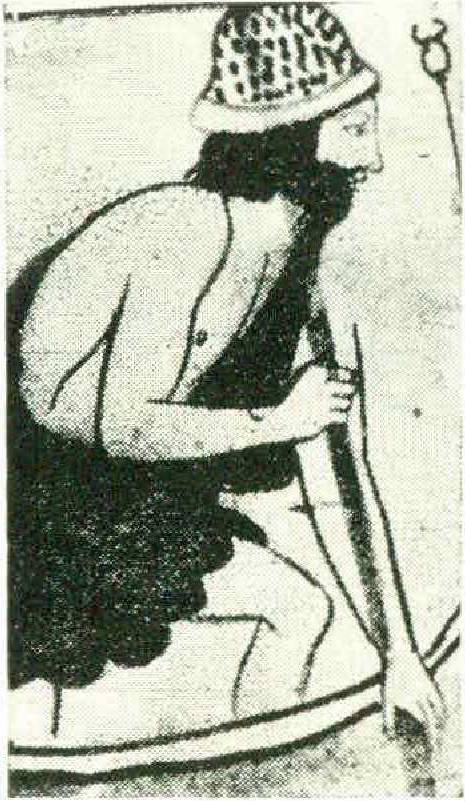
Lucian, who represents the last flowering of the true Attic wit, was born in Samosata, in Syria, and died at an advanced aye in 180 A.D. He experimented brilliantly in almost every literary form except the epic, but most memorably in several series of satirical dialogues — of the Gods, of Courtesans, of the Dead. The following piece is the tenth of the last group, NEKRIKOíI DIÁLOGOT.
CHARON
HERMES
MENIPPOS
CHARMOLEOS
LAMPICHOS
DAMASIAS
KRATO
A GENERAL
A PHILOSOPHER
ORATOR
CHARON. I’ll tell you how it is. This little old boat of mine — well, you can see for yourselves what shape it’s in. Leaky, timbers all rotten, everything falling apart, and if you move an inch out of dead center, over she goes and there’s your voyage. And here you people come, all dressed up fit to kill, with God knows how much baggage! Try to come aboard that way, and you’ll be sorry — especially the ones that can’t swim.
HERMES. Then how do we get across the river safe?
CHARON. Take my advice, and drop everything you don’t need right here on the dock. Come aboard naked — although even then it’s going to be hard to get you all in. Look, Hermes, suppose you kick out anybody who tries to get on with his clothes and stuff. Stand over there and keep your eyes open. This trip is strictly for nudes.
HERMES. OK. Well, come on, who’s first?
MENIPPOS. I am. Name’s Menippos. Here goes
everything I own into the river, even the shirt off my back. Do I pass?
HERMES. You pass. Sit down over there by the rudder, and watch the show. — And who is this handsome type?
CHARMOLEOS. Charmoleos of Mégara. They call ine “Lovable Charm.” In life, a kiss of mine was worth a lot of dough.
HERMES. They’re no good here. Throw them away, and the lips that made them, and all that curly thick hair, and those pretty cheeks, and that simply adorable skin. There you are, sir: sitting pretty, back to nature. On board! — And this gentleman with the crimson gown and the golden crown and the so-black frown: your name, please?
LAMPICHOS. Lampichos, late King of Geloi.
HERMES. Why all that gear, O Lampichos?
LAMPICHOS. Why not, O Hermês? Doth nakedness beseem a royal king?
HERMES. Royal thou art no more, and extremely dead. Come on, throw it away.
LAMPICHOS. Behold. I cast my wealth into the weir.
HERMES. And your pride, Lampichos, your contempt. They’d swamp the ferry.
LAMPICHOS. But my crown, my splendid cloak — may I not keep them?
HERMES. Not a chance. Throw them away. LAMPICHOS. If I must. And now that I’m stripped clean?
HERMES. Give up your cruelty, your deaf heart, your rage ol vanity.
LAMPICHOS. Then 1 am naked indeed! HERMES. Come aboard. —Next! 1 mean you, over there, with all that meat on you. What’s your name?
DAMASIAS. Damasias. Pro athalete. HERMES. You look it. Oh, yes, sure; I’ve watched you wrestle.
DAMASIAS. Sure you have, so you know I don’t mind being bare-ass.
HERMES. Is that what you call it, draped in all that steak? Slice it olT. man, slice it all off, and even then get into the boat one foot at a time. No, drop those victory garlands and press notices.
DAMASIAS. Naked it is, Mac, as nood as any dead gent present. And as thin.
HERMES. I here’s a lot to lie said for losing weight. Come aboard. —Who’s next? Ah, Krato! How does it feel to leave everything behind — money, fun, the soft life, social standing, even the epitaph they put on your tomb? No more ancestors, no more victories, no glory, no statues with unbelievable inscriptions; doesn’t it hurt to lose them all?
KRATO. 1 don’t like it, but so what? What else can 1 do?
HERMES. You’re asking me? Never mind. — You, over there, in the uniform. Why all the medals?
GENERAL. Because I have done the state some service, Hermes. 1 won their battles, and they have honored me.
HERMES. Park your medals on the ground. There are no wars in Hades, General, and we don’t know what weapons are for. — And that majestical gentleman, that more than impressive Shape with the pensive expression and the alarming eyebrows? That person, I mean, with the long whiskers?
MENIPPOS. That is a philosopher, Hermes, or you might call him a loolosopher. Get him undressed, and you’ll see some laughable sights behind the underwear.
HERMES. Philosopher, dephilosophize yourself, and then take off your clothes. Oh, God, what self-esteem, what ignorance, what malice, what shrunken thinking, and all in one person! His futile investigations, his impenetrable maxims, his boneheadecl conjectures! What a blundering drudge he is, what a fool, what an endless fool, with his dribbling little ejaculations of theory —yes, by God, and his liny private comforts, his money, his tickling crushes, his squishy helpless lusts! No, he won’t get by me like that. Take off your lies. Get rid of your self-complacency, that superior air of yours. As you stand now, you’d send a fifty-oar galley to the bottom.
PHILOSOPHER, l will divest myself, il that is what you’re suggesting.
MENIPPOS. And that beard too, Hermes, that beard! Talk about long and thick! He could sell that for upholstery and retire on the proceeds.
HERMES. Sure. The beard must go.
PHILOSOPHER. But I perceive no barber among us.
HERMES. Cut it off’ with an ax, Menippos. Use the gangplank for a block.
MENIPPOS. No, let me have a saw. That will be funnier.
HERMES. The ax will do. Good. Now that you’ve been disclosed, Philosopher, you look more like a man and smell less than a goat.
MENIPPOS. Trim his eyebrows?
HERMES. Good idea. The way they jut out from his head, you’d think he was trying to moor himself somewhere. But my dear Philosopher! I do believe you’re crying. What, afraid of death? Come aboard anyway.
MENIPPOS. He’s still clutching the heaviest baggage of all, Hermes.
HERMES. What’s that?
MENIPPOS. His slippery sliding tongue. He made good use of it on earth.
PHILOSOPHER. Then you must give up your plain speaking, Menippos, your independence, your blessed honesty, your laughter. You were the only one of us philosophers that ever laughed.
HERMES. No need to give those things up. 1 hey weigh nothing, and they’ll even help us on our crossing. But here we have an Orator! My dear sir, you must leave behind that thesaurus of language— your antitheses, your similitudes, your colonic clausulae, your gemlike periods, your barbarisms, your solecisms, all the excess baggage of your tongue. ORATOR. Oke.
HERMES. Then there we are! — Hawsers away, pull in the gangplank, up anchor, break out the sail! Keep an eye on the rudder, Charon. Hold her easy. — But you look downhearted, friends; especially you of the late whiskers. What’s troubling you?
PHILOSOPHER. Sir, I was meditating on the immortality of the soul.
MENIPPOS. He’s a liar. It’s something else that’s bothering him.
HERMES. For instance?
MENIPPOS. He hates the idea that he’ll never sit down to a first-class dinner again, or sneak out at night to make the rounds of the whorehouses with his cloak up over his face, or get up early in the morning to cheat his students of their money with his so-called wisdom. That’s what’s on his mind.
PHILOSOPHER. HOW about you, Menippos? I suppose death doesn’t bother you.
MENIPPOS. Why should it, since death was my own choosing? — But while we’ve been talking, haven’t you heard a noise coming from the upper world, as though people were shouting?
HERMES. There is shouting, yes, and not only from one place. What you hear is a happy crowd of people getting together to give thanks for the death of Lampichos. The women are taking care of his wife, and her babies are being stoned quite generously by the town boys. Somewhere else there’s a group applauding the funeral oration that has been preached in Sikyon for our friend Krato here. And, yes, there’s Damasias’ mother keening with the other women at her dear Damasias’ wake. Menippos, Menippos, you seem to be the only one who has died without stirring up some emotion or other. You are really resting in peace.
MENIPPOS. Far from it. Just wait till they’ve buried me, and you’ll hear the dogs howling and the buzzards creaking their wings.
HERMES. Good man, Menippos! — But we’ve arrived. The first thing you ghosts have to do is go straight to the magistrate’s court. Charon and I arc going back for another boatload.
MENIPPOS.Bon voyage, Hermes! Let’s be going, gentlemen. What are you waiting for? Every man must come to judgment, and they do say that the punishments are striking: burning wheels, retrograde stones, liver-fed vultures, all sorts of things. This is the place where the punishment fits the life.