Computerizings
VOLTA TORREY is editor of the TECHNOLOGY REVIEW, an alumni publication of the Massachusetts Institute of Technology.
BY VOLTA TORREY
The drawing board and T square are becoming relics. They will be replaced by a window resembling a television screen and an electronic computer. An engineer will draw a crude sketch on this window with a pen that leaves a line of light, and the computer then will straighten his lines, determine the angles and curves, and complete the drawing for the engineer to inspect, modify, destroy, or approve.
By turning a knob on the computer console, the designer will be able either to enlarge a small part of his sketch and change a detail or to reduce the image so as to see it in relation to other things. The magnification can be so great that an oscilloscope screen less than a foot square will serve as the equivalent of a sheet of drawing paper a third of a mile wide and long.
At M.I.T., with a program called the “Sketchpad,” you now can draw a rough rectangle or circle on such a glassy blank and have it appear almost instantly in perfect form. You also can make a three-dimensional drawing of a proposed gadget or part for a machine and then have the computer rotate it and thus show you how it will look from all sides. Even without any previous experience with a computer, an engineer can learn to use this new sketchpad in a few days.
“On some far-off day,” the Joint Computer Conference in Detroit was assured this year, “it may be possible to call up last year’s automobile on the oscilloscope, to wave the magic wand of the light pen, and in a short time to create the modified version from the old.” How far off is that day when the blueprints for an old car can thus be turned into plans for a new one, Detroit does not know, but the magic wand clearly can be seen emerging in the lines that draftsmen are drawing.
The solemn young I.B.M. men in white shirts will replace the inksmudged printer’s devils in shops throughout the land before moving on to invade the auto companies’ drafting rooms. Metropolitan newspapers in New York, Washington, and other cities have ordered a computer system capable of feeding electrical impulses to as many as twenty typecasting machines at a time. The computer will see to it that the lines are filled out properly, that words are hyphenated where necessary, and that a machine never stands idle because of someone’s coffee break.
Automation’s first victims were the unskilled and clerical workers; craftsmen are finding their knowhow worthless now; and as the computers are further developed, the managers of industrial enterprises will themselves be increasingly affected. In the 1980s, some prophets say, machines will make so many of the decisions that men now are employed to make that the ranks of middle management can be greatly thinned out. Some men will move upward in status and salary, but others will move downward, and the line between lower and top management will be more difficult to cross.
Other seers are less certain that artificial intelligence will rival human intelligence so quickly. They point out, too, that though replacement of managers by machines may become technically feasible, it may not be economically attractive. Even these skeptics, however, expect the number of decisions made in the depths of complex wiring networks to increase and the number made from office chairs to decrease. Managers, they say, may soon find their roles more nearly like those of astronauts in space vehicles controlled from afar and less like those of ship captains in preradar days.
Within a decade or so, the desk of the manager of a mail-order catalogue-sales operation is likely to be a computer console rather than a place to sort papers. Tiny lights on the computer’s flow panel will indicate the orders coming in and the actions being taken to fill them. The manager will have learned to recognize irregularities in these light patterns that are indicative of troubles, and will be able to eliminate many of the difficulties by simply adjusting controls at his fingertips. By the time things get so far out of hand that angry customers start trying to get him on the telephone, he will no doubt be in conference with other specialists.
The Ford Motor Company’s steel division in Dearborn, Michigan, has a telemetry system ready to collect and record data on each strip of hot steel that is rolled. These data will include the order number, gauge, width, and such facts about the processing as the roll force and speed. The information will be recorded in a digital form suitable for a computer’s use, and the system’s human monitor will have a desklevel console, finished in black textured vinyl, at which to sit and watch indicators of what is going on. Radiation Incorporated, which built this Data Logger, says it has inherent design flexibility and can be used for controlling a wide variety of industrial operations.
Some computers already are capable of carrying out several human beings’ instructions simultaneously. To use one of these giants intelligently a man needs time to think, but letting a costly machine loaf while he broods is not good business. So efforts are currently being made to devise methods of having a single large computer serve several masters at once. Whenever one user pauses, the machine can turn its attention to another man’s problem and thus keep itself fully occupied.
Several typewriterlike consoles have been attached to a large machine at M.I.T. in such a way that an operator at each one of them can proceed almost as though he had exclusive access to that machine. The number of consoles can be multiplied, and the users can be miles apart. Such arrangements are being explored in a governmentfinanced project called MAC, an acronym for both “multiple-access computer" and “machine-aided cognition.”The MAC project’s goal is to place the “logical power” of a computer at the service of people wherever, whenever, and in whatever amounts they may want it.
This new kind of power, its developers believe, may ultimately be distributed in somewhat the same manner as electrical power is nowadays, and possibly almost as widely, to factories, offices, and residences.
“Small companies will be able to enjoy the benefits of time-sharing by subscribing to the service of a local computing facility or a large computing utility,” one of the enthusiasts about MAC predicts. “Organized as a utility, a computing service could include access, at a charge, to a vast array of computer programs, information libraries, and automated consulting services, such as business forecasting and analysis.” Thus, computer time-sharing could become the basis for a new public thinking utility.
The keystone of modern computer technology is the memory or information storage unit. To serve many people promptly, a machine must have a place to store each person’s data from which those data can be retrieved very quickly whenever they are needed. The memories of today’s machines are much bulkier than human memories and probably take up more space than is necessary. Engineers have consequently been trying for several years to perfect ways of making enormous computer memories more compact.
An attractive possibility that several laboratories have considered is to use electrical superconductivity. When kept at very low temperatures, some materials lose all resistance to the flow of an electric current, and thus could be made to retain information in the form of electric currents for indefinite periods of time. Putting data in that form poses no serious difficulties.
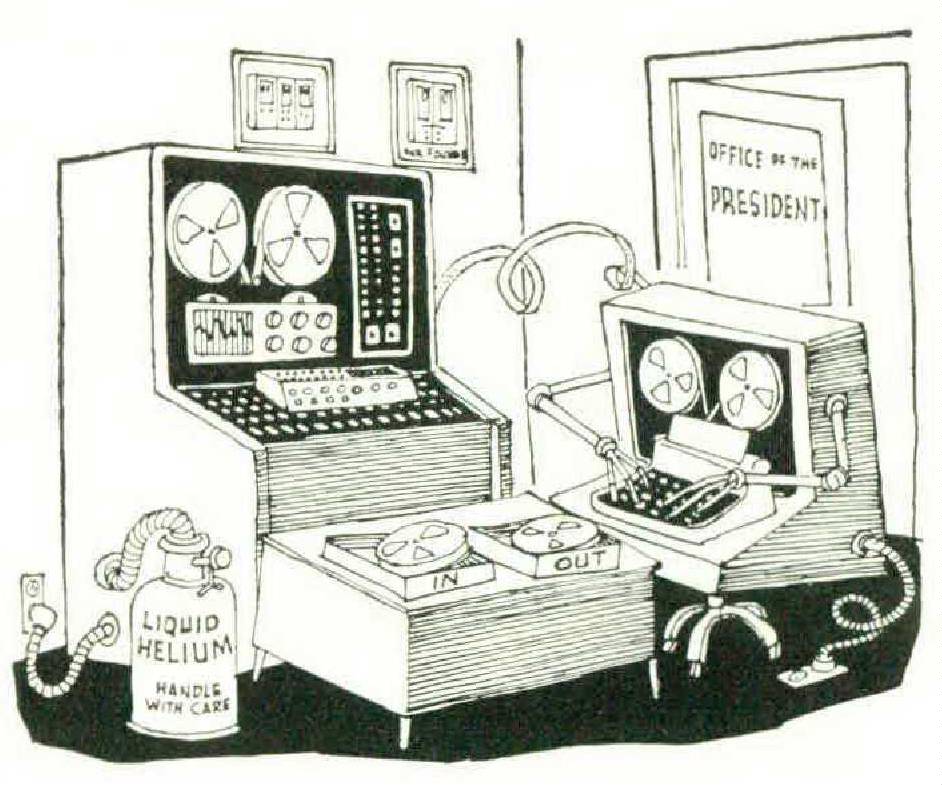
The quantity of information stored in a computer is customarily measured in bits, each bit representing a binary digit (a 1 or a 0). RCA’s David Sarnoff Research Center recently announced that it has an experimental superconductive memory in which 16,384 bits of information can be filed, even though it is smaller than a playing card and only 120 millionths of an inch thick. This thin film is kept immersed in liquid helium at a temperature close to absolute zero.
Further automation of industry, its management, and its regulation will of course require frequent exchanges of columns of numbers between machines in widely separated establishments. But this process need no longer be risky.
All kinds of data can now be sent and received very fast, with complete accuracy, by sequentially coding and decoding them to expose errors, thus compensating for defects in the communication channel. Like an intelligent person, a machine receiving data can be made to recognize its own failure to understand a message perfectly. It then can automatically request the sending machine to retransmit the misunderstood portion. Thus, when noise somewhere along the line becomes bothersome, the rate of transmission of information is slowed down; but as soon as the line is clear, the transmission rate is stepped up again.
This use of coding to overcome weaknesses of transmission channels is called SECO, for “sequential coding,” and it requires costly, sophisticated hardware. It is still in what the engineers call the “breadboard” stage, but a working device attached to an ordinary telephone line has shown that theoretical possibilities which have been known for many years can now be realized. The military services and the space explorers are likely to be the first users of SECO, but others, too, may someday be able to afford it.
Small special-purpose computers as well as large general-purpose machines are being developed swiftly and may be put to equally intriguing uses. One of these applications, for example, may be to gauge how well a young child can hear before he has learned to talk and answer questions. The electrical activity in his brain when auditory stimuli are fed into his ears can be recorded and analyzed to determine the extent to which those stimuli are being received by the brain. This is a task for a computer rather than a man, because the brain is never quiescent but has a so-called spontaneous electrical activity against which a small signal is difficult to detect. With a computer, however, it is relatively easy to obtain very rapidly an average of the individual responses.
Computers designed for direct examination of living beings should both facilitate physiological research and help doctors attend promptly to our ailments. The use of these and other machines now feasible, however, will require the cooperation of experts in an array of academic disciplines and the education of new kinds of specialists.