Albums for Christmas
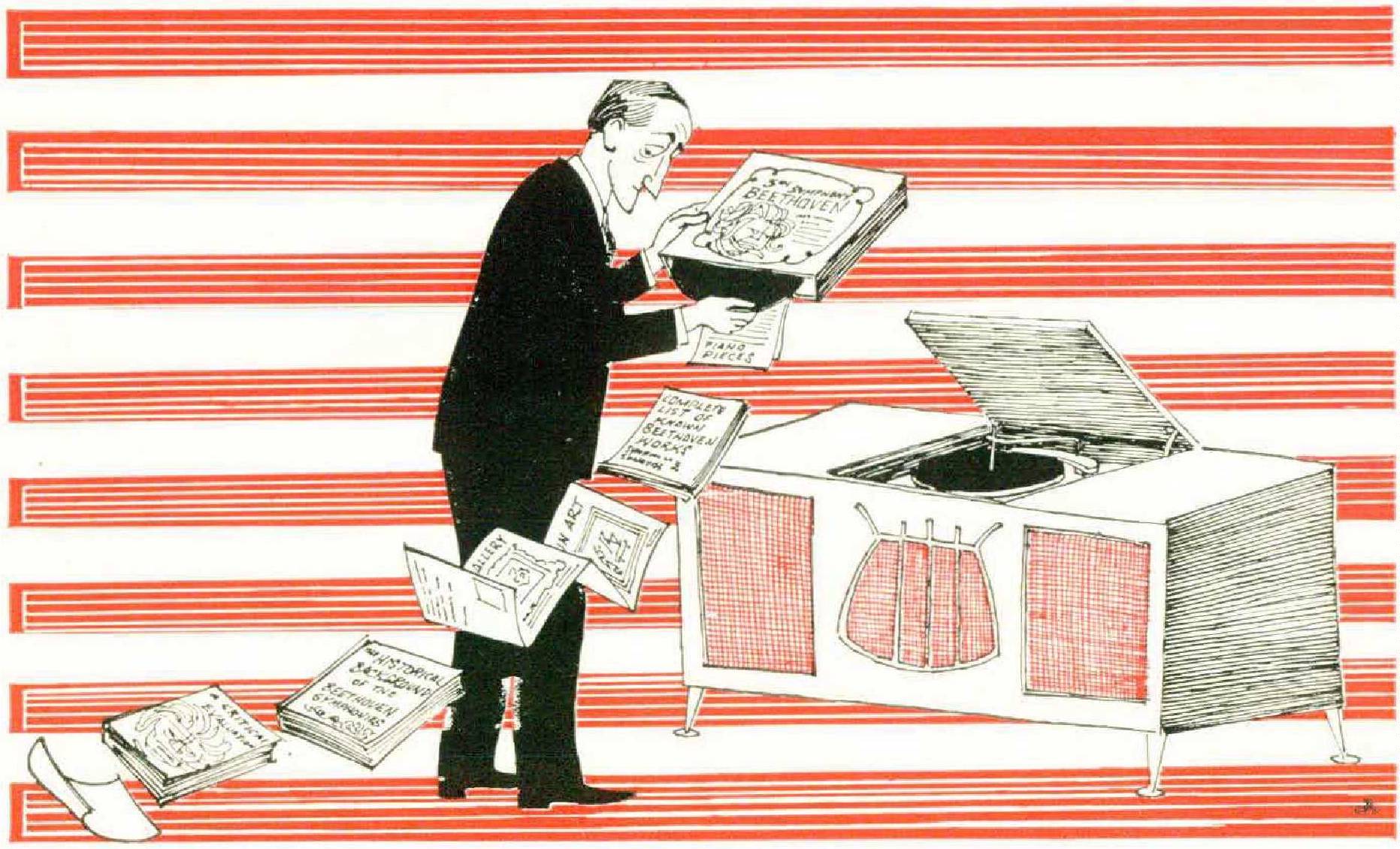
The modern formula in record packaging is beginning to resemble Alexandre Dumas’s recipe for Roast a l’lmpératrice, according to which a turkey is cooked inside a pig, a pheasant inside the turkey, a partridge inside the pheasant, a quail inside the partridge, a lark inside the quail, an olive inside the lark. At the end only the olive is eaten, with the rest thrown away. With similar prodigality, records nowadays seem to be adorned with art reproductions, smothered in reading matter, encased in exotic fabrics, and festooned with gold lettering.
Cynics might assert that such albums are designed for the coffee table rather than the record shelf (where, it might be noted, they seldom fit) and that their release dates are almost invariably timed for the weeks before Christmas. Nevertheless, they frequently present an agreeable blending of the musical and decorative arts, and the record that lies at the center often turns out to be as delectable as M. Dumas’s olive.
Two new RCA Victor releases — Mendelssohn’s incidental music to A Midsummer Night’s Dream and Beethoven’s Symphony No. 6 in F, the Pastorale—are cases in point. The Midsummer Night’s Dream music is housed in what may well be the largest record album ever issued (LSC/D-2673, stereo; LM/D-2673, monaural). The disc itself is the customary twelve inches in diameter. The blue and gold portfolio-type case, however, measures 17¼ by 13 ½ inches and opens up to disclose (in addition to the record) two engravings by John Boydell of Midsummer Night’s Dream illustrations published in London in 1803 and never previously reprinted. With or without these trimmings (and a standard-size edition is available), the recording itself offers a performance of the Mendelssohn score that is so clear and straightforward that one does not know whether to describe it as beautifully simple or simply beautiful.
The artists involved are Erich Leinsdorf and the Boston Symphony Orchestra. Mr. Leinsdorf has had the interesting idea of presenting not only the orchestral excerpts that are always played and the songs and choruses that are less frequently given, but the spoken passages from Shakespeare that lead into the musical portions. The solo singers are Arlene Saunders, soprano, and Helen Vanni, mezzo-soprano; and Inga Swenson, a veteran of the American Shakespeare Festival at Stratford, Connecticut, recites the appropriate lines, which, so the brochure says, were selected by Mr. Leinsdorf himself.
Few recordings demonstrate more convincingly the tonal purity and instrumental precision which Leinsdorf is eliciting from the Boston Symphony these days. Perhaps there is more sunlight than moonlight in his direct approach to this most romantic of all scores, but he makes the music glisten with a hundred sparkling and crystal-clear details. Surely the Wedding March has seldom been played as brilliantly, festively, or joyously as it is here.
Fritz Reiner’s treatment of the Beethoven Pastorale Symphony is equally lucid, balanced, and tonally bright, and the packaging is even more sumptuous. This time, instead of an outsize portfolio case, RCA Victor has issued a standard-size album that makes up in thickness what it lacks in height and width (LSC/D-2614, stereo; LM/D-2614, monaural). Its title is The Pastoral: In Music, Words and Pictures, and its contents include fourteen pages of color reproductions of paintings by Courbet, Constable, Corot, Pissarro, Degas, Gainsborough, Van Gogh, and others. Interspersed with these are snatches of Tennyson’s “The Brook,” Wordsworth’s “Tintern Abbey,” Thoreau’s Walden, Whitman’s Leaves of Grass, and other works. The literary excerpts are rather scrappy and not particularly Beethovenish, but the pictures are lovely and blend together pleasingly. There is no lack of excellent Pastorale Symphony recordings, but no others have nearly so much visual appeal. As in the case of the Mendelssohn, the recording is also available in a regulation jacket, without adornments.
In addition to these special yearend releases, Victor has put out four lavish new entries in its “Soria Series” recordings. These are the work of Dorle and Dario Soria, the imaginative team who once headed the Angel Records operations in the United States and who now devote themselves to the planning of unusual record packages for Victor.
Of the newest batch, the most valuable is The Horowitz Collection (LD-7021, monaural only: two records), which sets forth the talents of Vladimir Horowitz not only as a pianist but as an art collector. Horowitz last year shifted his recording allegiance to Columbia, but he was a Victor artist for a quarter of a century, turning out some of the most spectacular piano recordings of our time. This album offers a cross section of pieces made between 1942 and 1955, some of which have not been issued previously on LP. They represent a remarkable display of Horowitz’s genius for penetrating to a work’s essence even while he dazzles the ear with sheer technique. From the graciousness of Czerny’s Variations on the aria “La Ricordanza” to the steely strength of Prokofiev’s Sonata No. 7 in B flat, Opus 83, and Samuel Barber’s Sonata for Piano, Opus 26, Horowitz seems supremely in his element. To one bedazzled listener, the clou of the collection is a pianistic version of Saint-Saens’s Danse Macabre, which has a ghostly diablerie that makes many an orchestral recording of the work seem earthbound and dull.
To go along with this music, the Sorias provide a booklet containing excellent color reproductions of four paintings owned by Horowitz — Manet’s Mme. Manet dans le Jardin à Bellevue, Picasso’s Acrobate au Repos, Rouault’s Tête de Jeune Fille, and Degas’s Les Courses — lovely pictures all, however remote their connection may be with the music in the album.
A closer tie-in between music and art is found in two other new Soria albums; a generally gay and bouncy program of Elizabethan music played by the Julian Bream Consort and illustrated with paintings of the period (LDS-2656, stereo: LD-2656, monaural), and a powerful complete recording of Puccini’s Tosco (LDS-7022, stereo; LDM-7022, monaural: two records).
This is a Tosca that exploits to the full Puccini’s emotional range, from pathos to passion. But what sets it apart from most other Toscas is the almost symphonic texture that Herbert von Karajan achieves from his orchestra, the Vienna Philharmonic, and his leading singers, soprano Leontyne Price, tenor Giuseppe di Stefano. and baritone Giuseppe Taddei. Individually their contributions arc notable for both dramatic characterization and vocal strength; together they blend into a performance that never flags in its musical interest and impact. The sixty-page brochure, with its color reproductions of sketches for the premiere of Tosca in Rome in 1900, serves as a visual embellishment to the music.
The fourth Soria album represents, at least to this listener, something of a disappointment. It is a performance of Schubert’s great Symphony No. 9 in C Major, made in 1941 by Arturo Toscanini and the Philadelphia Orchestra (LD-2663, monaural only). The Schubert C Major was a work that fascinated Toscanini: he programmed it repeatedly, starting with the first symphonic concert he ever led, in Turin in 1896; and he recorded it three times. This recording, made during a brief period of guest conducting in Philadelphia and never before released, is his earliest interpretation on records. It may also be his best, for it moves more easily and with less rigidity than the others. And yet this reviewer confesses to an uneasy feeling that Toscanini’s sense of urgency and crispness, which achieved such miraculous effects in other music, was misplaced in Schubert. As arresting as this meticulous and forceful performance is, it seems to leave the symphony lifeless. It might be noted that there are those listeners who, on the other hand, have over the years regarded Toscanini’s Schubert C Major as a uniquely stirring and successful interpretation; of such differences is musical controversy made. In any event, the recording is handsomely packaged, with a brochure split between Schubertian scenes and Toscanini portraits.
Angel’s most massive album of the year is a thirteen-record set of the complete piano sonatas of Beethoven played by the late Artur Schnabel (GRM 4005, monaural only). These famous recordings, one of the landmarks of the phonographic art in the pre-World War II era, were issued on LP by Victor seven years ago and sold out a limited edition, considerably to the astonishment, so it is said, of RCA officials. Angel, which is again making the records available in a sturdy maroon and gold slipcase as part of its Great Recordings of the Century series, is hopeful that another sellout will be forthcoming.
Columbia’s contribution to the deluxe-package market is an album entitled The Badmen (L2S 1012, stereo: two records). Its aim is to recapture, in song, story, and pictures. the spirit of the West in the era of Jesse James, Billy the Kid, and other outlaws less celebrated but hardly less nefarious. To this end, a whole posse of folk singers, including Pete Seeger, Ed McCurdy, Harry Jackson, and others, has been assembled to sing Western ballads and sagas, with guitar interludes and accompaniments by Charlie Byrd and Sandy Bull. In addition, several survivors of badland culture have been asked to tell, in their own words, what it was like in the old days. Among those giving their reminiscences are George Bolds, who actually lived in Dodge City, “the toughest city in the West,” and Homer Croy, who has spent a good part of his life interviewing people who knew the James boys.
The aural picture of the bad old days, both spoken and sung, is impressive and flavorsome. But the accompanying seventv-two-page brochure is, if anything, even more startling than the records. Beginning with a full-page photograph of three badmen hanging from a Union Pacific railway trestle after a lynching in 1894, it unfolds a graphic pictorial story of an era of bloodshed, violence, and villainy. Television, it appears, has hardly scratched the surface.
Record Reviews
Beethoven: Nine Symphonies
Herbert von Karajan conducting Berlin Philharmonic Orchestra, with Gundola Janowitz, soprano; Hilde Rössel-Majdan, mezzo-soprano: Wakdemur Kmentt, tenor; Walter Berry, baritone; and the Wiener Singverein; Deutsche Grammophon SKL-101/8 (stereo) and KL-1/8: eight records
Herbert von Karajan has previously recorded all nine of the Beethoven symphonies, but his new set outdoes his old, as well as most other competitive versions, in sheer brilliance of musical organization and beauty of orchestral playing. The dramatic dynamism of Toscanini, the gemütlich warmth of Bruno Walter, the craggy power of Otto Klemperer (to cite the three principal rival albums) all have attractions of their own. But von Karajan’s new complete cycle moves easily into their company. Some of the lesser symphonies seem deliberately underplayed, almost miniaturized. Even the Seventh is given low-pressure treatment. But in the Third, Fifth, and Sixth, keen attention to structural detail and to nuances of phrasing and color helps to build a powerful cumulative effect. The climax is reached in a performance of the Symphony No. 9 in D Minor that can only be described as tremendous. It is possible to argue that where Beethoven marks a passage ff, von Karajan sometimes plays fff, but the power and exaltation of the musical concept are indisputable, as are the skill and refinement of the musicians of the Berlin Philharmonic. From its shimmering opening to its stunningly sung choral finale, this is the finest Beethoven’s Ninth of which this listener has any recollection. The one reservation concerns the sound — intrinsically pure and clear, and vet afflicted with an annoying surface crackle in the louder passages.
Lalande: De Profundis
Alfred Deller conducting Vienna Chamber Choir and Vienna State Opera Orchestra, with Mary Thornas and Honor Sheppard, sopranos; Alfred Deller, countertenor; Robert Tear, tenor; and Maurice Bevan, baritone; Vanguard BGS-5052 (stereo) judging by Michel-Richard de Lalande’s setting of Psalm 130 — “Out of the depths have I cried unto Thee, O Lord” — French church music in 1689 reached a degree of eloquence and grandeur it has seldom known since. This large-scale work, written for the court of Louis XIV and said to be a favorite of Louis XV’s, was rediscovered only in the 1930s. In this rich-sounding, well-sung performance it is at once serious and graceful, devotional and lively, blending traditional liturgical styles with a directness of harmony and melody. Mr. Deller, doubling as conductor and soloist, directs a radiant performance.
Rossini: The Barber of Seville
Vittorio Gui conducting Glyndebourne Opera Company and Royal Philharmonic Orchestra, with Victoria de los Angeles, soprano; Luigi Alva, tenor; Sesto Bruscantini, baritone; Carlo Cava and Ian Wallace, basses; Angel S3638 C/L (stereo) and 363S C/L: three records There is no dearth of good recordings of The Barber of Seville, but this is the most enjoyable of them all. Its superiority stems not from the quality of its soloists (they are excellent, but so are those in other recordings), but from its restoration of usually deleted passages (including a large chunk of the Finale), its corrections of the scoring (based on Rossini manuscripts in Italian libraries, according to conductor Vittorio Gui), and, finally, its superb sense of
ensemble. This is opera in the Glyndebourne tradition, first established by the Mozart recordings of the 1930s. In fact, there is a Mozartean suavity and refinement startlingly different from the earthy and raucous good humor with which The Barber is usually performed — and recorded. The men of the cast are lively, able, and musical, and Miss de los Angeles — singing in the mezzo-soprano register intended by Rossini — is a lovely Rosina. The sound is rich and ample, and stereo high jinks have been studiously avoided, as have all other kinds.
Bach’s Greatest Hits
Ward Swingle conducting the Swingle Singers; Philips PHS 600-097 (stereo) and PHM 200-097
The full jacket description reads “Bach’s Greatest Hits: A Unique Jazz Vocal Treatment of Johann Sebastian Bach by the Creative Swingle Singers.” The adjectives are accurate, for these performances are both unique and creative. The Swingle Singers, a small French group, using jazz vocalization syllables such as pom-pom, papa-dah, dooby-do, and the like, sing their way through thirteen Bach preludes, fugues, bourrées — even the Air for the G String. Moreover, they sing the notes just as Bach wrote them, while the swinging percussion group which accompanies them beats out a 4/4 rhythm. The effect is fresh, spontaneous, delightful. The bourrée from the English Suite No. 2, for example, with its bright repeated vocal patterns, becomes almost a joyous Christmas carol; and the famous “Sleepers, Wake” chorale prelude seems perfectly at home in new contours and colors. What kind of audience this record is aimed at is an open question; the guess here is that it will appeal, strangely enough, more to Bach lovers than to jazz fanciers.
Musical Memories of France
Les Cadets de Bourgogne, Choeur du Cercle Philharmonique de Chambery, Musique Folklorique Alsacienne, and other groups; London TW 91302 (monaural only)
This regional anthology of French provincial music is distinguished by the presence of that noblest of drinking songs, ”Chevaliers de la Table Ronde.” Not all the verses are included in the robust rendition by Les Cadets de Bourgogne, but the graph-
ic description of the deceased tippler’s funeral and interment — in a wine cave with his feet against the wall and his mouth beneath the spigot — is given intact, as is the moral: “La morale de cette histoire, C’est de boire avant de mourir.” Fair warning: most of the remainder of the regional material (from Alsace, Brittany, the Vosges, and other parts of France) is musically lackluster, indifferently performed, and chiefly of local interest.
Stories of Sherlock Holmes: The Adventure of the Speckled Band; The Final Problem
Basil Rathbone, reader; Caedmon TC1172 (monaural)
These readings by Basil Rathbone of two Sherlock Holmes stories are reminiscent of a remark by Dr. Watson in The Hound of the Baskervilles. “I trust there is nothing of consequence which I have overlooked,” said Watson, whereupon Holmes pointed out to him exactly how much he had missed. In like manner, it is appropriate to observe that, far from representing complete stories, these readings by Mr. Rathbone, although smooth and atmospheric, are considerably abridged. In The Speckled Band whole pages are omitted, to accommodate the tale within the limits of one LP side. The excisions are less injurious to The Final Problem, a shorter and less detailed story, but they will nevertheless be annoying to many a good Sherlockian. Bringing Sir Arthur Conan Doyle’s incomparable detective to records is a laudable enterprise, but after this latest Caedmon attempt, the game, alas, is still very much afoot.
Streets I Have Walked
Harry Belafonte, with an orchestra and the choir of Junior High School No. 59, Springfield Gardens, New York; RCA Victor LSP-2659 (stereo) and LPM2659
Harry Belafonte is a popular singer who manages to infuse his own style into a song without impairing the song itself. This collection encompasses several Negro spirituals, Portuguese and Israeli numbers, an ancient Japanese court song, and a little-known, pleasantly subdued version of the Australian favorite, “Waltzing Matilda.” All are sung with lively lyricism by Belafonte, and an added element of freshness is given by the young voices of a New York City junior high school choir.