The Yiddish Theater
STEFAN KANFER is the young author of an off-Broadway musical and several short stories and articles. The Yiddish theater is, literally, in his blood. His great-grandfather was in Abraham Goldfaden's first Yiddish theater troupe in Iasi, Romania, and his grandfather was the author of Yiddish plays produced in Europe and America.
by Stefan Kanfer
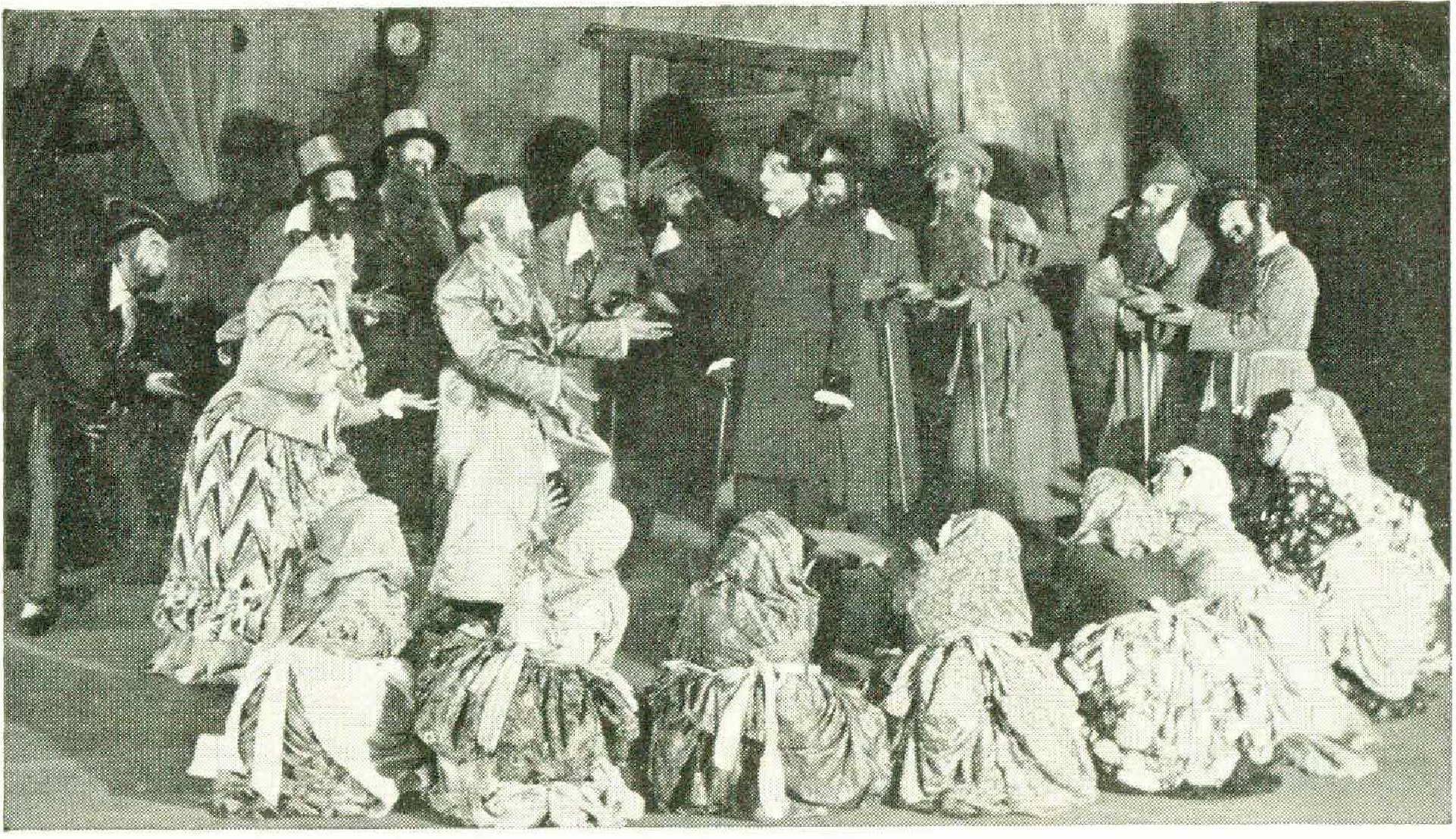
To BE or not to be — ” The actor pauses for effect, then moves downstage.
“Let it be, that’s what we paid for!” shouts an old man in the orchestra.
Othello gestures to Desdemona, boards a gondola — and promptly sails the entire length of the orchestra pit, which has been especially flooded for this one scene. As Othello prepares to debark he loses his footing, and he and the boat capsize. He climbs out and plays the rest of the act wringing wet.
“We want Shakespeare!” an enthusiastic audience shouts after a performance of The Merchant of Venice.
“He’s dead, Shakespeare,” the stage manager explains, standing in a spotlight before the curtain.
“Liar!” a young man shouts. “We want Shakespeare.” The cries continue until the lights are dimmed and the exits opened.
The time is almost three generations ago. The place is the lower East Side. And these are scenes in Act One of that unique amalgam of art and absurdity, realism and fantasy, inspiration and ham acting, the Yiddish theater.
The tragicomedy of the Yiddish theater is really two stories, one of the people who created and produced it, the other of the audience who applauded it, heckled it, loved it, learned from it, and finally neglected it and let it dwindle away.
In the beginning that audience was almost entirely composed of Jewish refugees from Russian and Slavic pogroms and from ghettos in nearly every European state. Some had been to a play at some time in their lives, but many had never seen an actor, never seen a stage, never seen a theater even from the outside. The Talmud is hostile to the theater; there are no dramas, secular or religious, enacted in Orthodox synagogues. So there was no tradition of playgoing among the early Jewish immigrants. The theatrical magic was fresh and miraculous. To them it was not a paraphrase of Shakespeare that they saw in the Yiddish theater. Shakespeare himself was speaking to them. It was not an imitation of Broadway that they applauded; to the young worker on the lower East Side who spent a dollar out of his tendollar paycheck to see The Rabbi’s Melody or Shmendrick it was the theater and the people on the stage were the greatest celebrities in America.
When the giants of the Yiddish theater — Maurice Schwartz, David Kessler, Boris Thomashefsky, Jacob Adler — walked down Second Avenue dressed in black hats and long, swirling capes their audience looked at them with a genuine wonder born out of admiration for achievement. The adulation was spontaneous; it was not inspired by press agents. No press agent, in fact, could possibly have dreamed up the personalities or the eccentricities of the Yiddish theater.
The first all-Yiddish vehicle was produced in 1820 in Hungary. It was an awkward comedy of errors entitled The False Kashtan (Kashtan was a famous cantor of the time), and it was only a moderate success. Ten years later a Yiddish troupe sprang up in Kraków, Poland, playing extempore before indifferent audiences. And then, in 1863, an obscure playwright wrote and produced Serkele in Iasi, Romania. Serkele is significant for two reasons: it was the first legitimate, serious play in the Yiddish language, and it had in the title role an ex-choir-leader named Abraham Goldfaden, who was to become the father of the Yiddish theater.
There was Yiddish before 1863, the old actors used to say, and there was theater, but there was no Yiddish theater because there was no Goldfaden. Goldfaden was a Jewish Renaissance man. He had wit, he could act, he could write, he could compose, he could organize, and he could promote. He was more than the father of the Yiddish theater, he was its Moses, who led it in 1884 from the Balkans across the sea to the promised land, Second Avenue, New York.
The first Yiddish production in America was Goldfaden’s musical Koldunya, which played to standees at the Turn Hall Theatre on East Fourth Street. Encouraged, Goldfaden turned out Recruits, The Contractor, Shmendrick, and a dozen other musicals and melodramas. Goldfaden was not a subtle writer. His plays are painted with a broad brush in primary colors, and his music is of the “yai de dai,” as opposed to “do re mi,” school. But his audience loved everything he did. He prospered, and the Yiddish theater took hold and blossomed. All it needed now was another giant like Goldfaden. As if on cue, Boris Thomashefsky chose at this time to come to the lower East Side.
Thomashefsky was an actor-cum-producer from London who knew even better than Goldfaden what the public wanted. By 1899 he had produced a series of hits and was playing the role of offstage villain by forcing his actors to go to rehearsals early and work late.
Not long afterward, underpaid, overworked, and harassed by Thomashefsky and other producers, the actors rebelled and formed the Hebrew Actors’ Union. It was the first theatrical union in America, founded in 1900 by Joseph Borondess with the help of Samuel Gompers himself. Whereupon Thomashefsky, with characteristic inconsistency and volatility, became the first producer to recognize and negotiate with the union.
So, by the first decade of this century the Yiddish theater had a great writer and a great producer. It also had a great actor, the handsome Jacob P. Adler, who had come in 1890 to make New York his home. More immigrants, who would quickly be converted into paying audiences, were arriving at Ellis Island every day. The future looked bright and limitless. By the end of Act One, when Abraham Goldfaden died in 1908, it seemed as if the Yiddish theater was about to become a permanent part of the American scene.
ACT TWO of the Yiddish theater opened on a prosperous note. Jacob Gordin, who succeeded Goldfaden as the greatest Yiddish dramatist, had written two serious dramas, Siberia for Jacob Adler and God, Man and the Devil for David Kessler, a brilliant, if unsubtle, actor whose vagaries are still recounted on Second Avenue.
It was he who stopped a play in midaction to tell the audience that a singularly inept actress was cast in a starring role merely because she was Thomashefsky’s mistress. And it was he who halted the action of a tragedy halfway through to scrutinize a fellow actor’s makeup. “Look who I have to work with,” he complained to the paying guests. “Like that he wears his wig.” Kessler promptly snatched the wig from his fellow performer’s head and put it on. “Here, like this you wear it,” he said. He waited until the actor wore the toupee to his satisfaction and then allowed the action to resume.
The audience, encouraged by these occasional outbursts, became more vocal than the actors. Spontaneous claques for Thomashefsky and Kessler and Adler sprang up suddenly, and when, from time to time, they played opposite each other, pandemonium reigned.
“That’s a mustache?” shouted a Kesslerite at one dramatic performance. “From even the cheap seats you could see Thomashefsky’s wearing paint.”
“That’s a voice?” retorted a Thomashefsky advocate. “It belongs better on a peddler.”
“Quiet the both of you,” said an uncommitted customer from the back of the house. “The time to argue is during a comedy.”
Frequently the audience would fall under the spell of the performers and there would be silence, broken only by the individual who could not separate reality from the superreality occurring onstage. “Don’t marry him, he’s a no-good” was a common unconscious outburst directed to the heroines of romantic dramas, and “Throw him out, he’s a loafer” was standard advice given to fathers during plays of family life.
Of course, the audience did not always comment on the action. They came to see, to understand, and to wonder, and most of the time they watched in silence. And when they did speak, more often than not they spoke not to the actors but to each other. The work week was six and a half days long in the ghetto, and there were few places where a tenement family could go to see friends in a happy, convivial atmosphere. The Yiddish theater was one of them. It was not uncommon to see three generations at a performance: the old grandmother, the middle-aged mother, and her daughter and son-in-law, who were already fluent in English as well as Yiddish. Sometimes there was even a fourth generation, a baby suckling at the breast. It was one of these babies who squalled loudly during a Thomashefsky opus, causing the mother to say one of the most quoted audience lines in the history of the Yiddish theater. “Shut up,” she told the infant, who refused to nurse. “Shut up or I’ll give it to the actor.”
Plays during those early days lasted, in the traditional phrase, “Three weeks, good or trash.” The next play was announced onstage by the manager. And in three weeks he could expect plenty of repeat business. There was rarely an empty seat. The actors, encouraged by their success, began to learn their craft. They grew tired of the shaking fist, the cocked eyebrow, the breast-beating, and the booming voice. They began to raise their standards. The Actors’ Union grew selective. Each prospective actor had to audition before a highly selective membership.
One of their rejected candidates was the young Maurice Schwartz. Schwartz, who was never one to believe his bad reviews, waited a day and then stormed into the offices of the Jewish Daily Forward. There he collared the first-string drama critic and acted out a scene for him. The critic may have felt that he was watching a madman, but there was no question that the madman had talent. Perhaps he had genius. He agreed to champion Schwartz’s cause. And in a few weeks the Union, softened by the Forward’s repeated mentions of the brilliant but nonunion actor, gave Maurice Schwartz another chance. He was permitted to have a second audition, and this time he passed.
It was one of the most significant memberships the Union ever awarded. Within a year Schwartz was a star; in 1918 he helped establish the Yiddish Art Theatre, a group which maintained consistently high standards in performances and in the plays they chose to do. The Art Theatre made special translations of Shaw’s Mrs. Warren’s Profession; Strindberg’s The Father; Chekhov’s Uncle Vanya; and Sholern Asch’s Uncle Moses. It helped make the Yiddish theater so robust and solvent that in the early twenties twenty-three theaters simultaneously played host to Yiddish productions.
It was the time when the goyim discovered the Yiddish theater, when the tunes began to be hummed north of Fourteenth Street, and when the youths who were to become the leaders of the group theater were watching and learning. One of the youths was Harold Clurman, who says in The Fervent Years: “The Yiddish Theatre, Lincoln Steffens and other observers of the period pointed out, ‘was about the best in New York at that time both in stuff and in acting.’ The ‘stuff’ was frequently Shakespeare, Tolstoy, Gorky, Andreyev, or charming folk operettas and plays modeled after original works by Sudermann, Hauptmann and other contemporary Europeans. The actors were among the best I have ever seen in many years of playgoing all over the world. Most stimulating of all were the audiences. . . . Here the problems of their life, past and present, could be given a voice; here they could get to know and understand one another.”
It was a splendid time, a time when audiences refused to leave an Adler play until, at the final curtain call, the old man ceremoniously removed his wig and showed his magnificent shock of white hair; when even the residents of Chinatown learned a little Yiddish so they could attend the Yiddish theater, which was, after all, only four blocks away; when everybody in New York was making money and buying tickets.
And then the good times ended. It was not the Crash that hurt the Yiddish theater in the late twenties and early thirties; it was the times. The new generations, the ones who knew both English and Yiddish, began to assimilate. Second Avenue, the promenade, the Schubert Alley and Fifth Avenue of the ghetto Jew, was no longer home. The Jews had gone to the Bronx, to Long Island, to the West Side, to Westchester, to everywhere but Dclanccy Street. They discovered Broadway and the movies. And, at last, the newest generation, born and reared in America, could not follow the dialogue that took place on Second Avenue. The familiar exchange — “Do you know Yiddish?” “I can understand it but I can’t speak it” — began the death knell for the Yiddish theater.
Not, however, that the people of the Yiddish theater listened to it. They were too busy. They were doing originals and adaptations. They were playing Shakespeare and Tolstoy. They were writing new melodies, one of which reached the hit parade when the Andrew Sisters recorded Sholern Secunrla’s “Bi Mir Bis Du Schoen.” And the crowds still came. But they were smaller, and they were not likely to come back very often. One by one the theaters began to close down. The old meeting place of the actors, the Café Royale, whose decibel output used to make the Russian Tearoom sound like a library, went out of business. And finally the Yiddish actors themselves began to forsake the Yiddish theater for assignments on Broadway and in Hollywood. Jacob Adler’s children, Luther and Jay and Celia and Stella, all left Second Avenue; Rudolph Schildkraut’s son Joseph passed his screen test and acted in silent films: Ludwig Satz’s nephew Muni YVeisenfreund, who billed himself as Paul Muni, started working uptown and in Hollywood. Jacob Ben Ami went under Broadway management, followed by Manasha Skulnik, Joseph Buloff, and a score of others. Even before the war. Variety was reporting “The Yiddish Theater’s Travail.” By the end of the war there was hardly any travail to report because there was hardly any Yiddish theater to report. The curtain had unceremoniously come down on Act Two.
Now it is Act Three. There is still a Second Avenue, there are still nineteenth-century cobblestones on it, and there is still a Yiddish theater near it. But the three generations that kept it alive are scattered. The old grandmother and her middle-aged daughter are gone. The baby at the breast is a grandmother herself and seldom gets downtown. Her children, who live in the city, only go to Second Avenue to see The Blacks, or The Second City, or some other choice off-Broadway offering.
Still, the Yiddish theater goes on. Four productions played in the 1962-1963 season, but they played, in the words of one actor, “from benefit to benefit.” There are plans for another musical, another comedy, another adaptation, but no one, least of all the actors, kids himself. Seymour Rexcite, the president of the Union, says, “It’s hard to attract young people to the Yiddish theater now. We can’t get them in the audience; how can we expect to get them on the stage? How can we compete with off-Broadway or Broadway or television? Of course we have some kids, but only a handful. It’s funny, people will go to see the Comédie Frangaise, even though they don’t know French, or the Classical Greek theater, even though they don’t speak Greek, but Yiddish, they don’t come to see that.”
The late Abraham Ellstein, who composed dozens of scores for Yiddish musicals and who wrote the only Jewish opera in American repertory, was also realistic, if wistful, when he said: “It’s a shame; years ago there were composers as good, truly, as Rodgers or Loewe. But they went unrecorded, and their music is lost forever. I can’t even find my own scores anymore. It’s all gone, and it’ll never come back.”
And an actor who still works in the few remaining Yiddish productions recently confided: “The Yiddish theater is already dead, but it won’t lie down. A few years from now we’ll all be playing in English. But we’ll have our revenge. We’ll gesture in Yiddish.”
If the Yiddish theater is dead, its soul is still vigorously alive. It lives, and will continue to live, in the writers who were touched by it, like Clifford Odets and Irwin Shaw; in the performances of actors who were influenced by it, like the Adler children, and Morris Carnovsky, and Walter Matthau, and Paul Muni, and hundreds of others; it will continue to live in an occasional nostalgic Second Avenue revival; and finally, it will continue to live as a great theater legend.
Where else but in the Yiddish theater could you find a woman like Molly Picon, who plays not only in Yiddish but in English and French, and who acts, sings, and writes her own lyrics?
Where else would you find a giant like Jacob Adler, who replaced himself with children even more brilliant than he? And who in his old age forgot just how many children he did father, and so instructed his valet to give passes to any child who looked like him?
Where else could you find a star like Miriam Kressyn, who sings, dances, and wears such dazzling costumes that the women came (and still come) backstage just to “feel the material”?
Where else would you find an actor bold enough to do what the young Maurice Schwartz did? Imagine a young actor today, turned down for a part by, say, David Merrick. Now imagine him storming up to the Times, grabbing Howard Taubman by the lapels, and doing the soliloquy from The Caretaker. Then imagine the Times taking up the actor’s cause. And then imagine Merrick accepting the actor for the part after all. The mind is dizzied. The legend of the Yiddish theater is secure.
In the last decade there has been a plethora of epitaphs for the Yiddish theater. One of the most trenchant ones was told to me by a veteran Second Avenue actor not long ago as we walked past East Fourth Street, near the scene of Abraham Goldfaden’s first triumph.
“Years ago,” he said, “this was a favorite ghetto story: John D. Rockefeller learned that his Japanese gardener had just adopted a little boy. So Rockefeller went to the gardener to congratulate him, and while he was there he took a peek at the child. The kid looked as if he had just wandered in off Orchard Street. Rockefeller said to the gardener, ‘How is it that you, a Japanese, adopted, of all things, a Jewish child?’
“ ‘Because,’ the gardener said, ‘Jewish children take care of their parents when they’re old.’ ”
The actor sighed to himself.
“Nu,” he said at length, “the Yiddish theater is old. And where are the children?”
“It’s only a story,” I said.
The actor nodded. “It’s only a story.” And he walked downtown with me in silence, remembering.