The Basque Troubadour
My cousin and I had come down to the village after a day in the high, wild passes of the Pyrenees, where he had taken me to see a Basque net hunt for doves. It was nightfall, and there was a drizzling rain. We were wet and cold, and we stopped at a little bar for a warming drink.
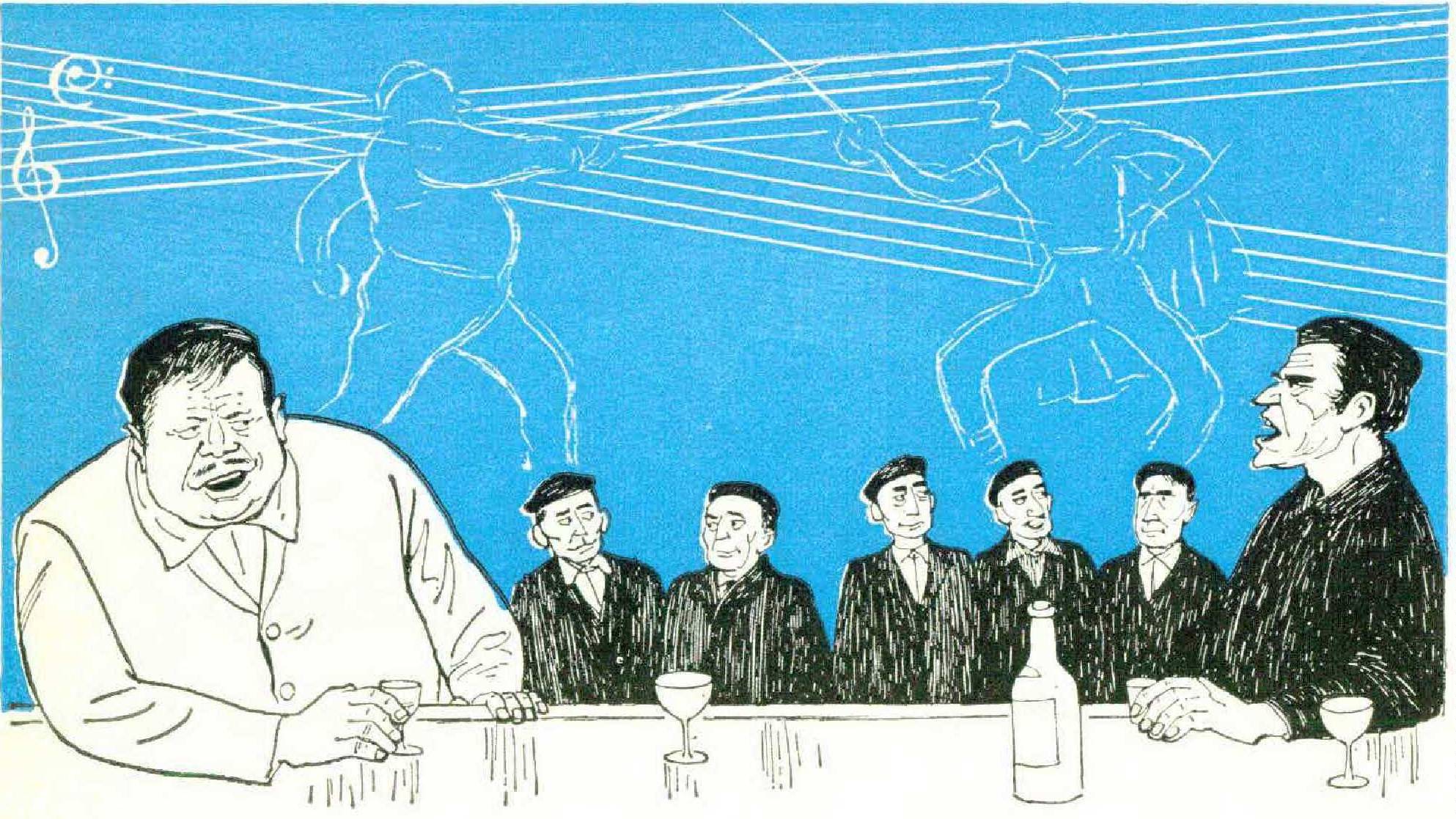
There had been a market that day, and the bar was fairly crowded with those paysans who had stayed late and were now faced with the unlikely prospect of outwaiting the rain. And as on market days, they were in noisy good humor. We found a place at the end of the bar, next to a mountain of a man with a ruddy face and a beret tipped back on his head. He and his comrade were trading stories, and every once in a while a rich laugh would come gurgling up from jowly depths.
My cousin and I sipped a steaming mixture of coffee and brandy. “Bertsolari,” my cousin said in a low voice.
The word rang a bell somewhere in my uncertain Basque vocabulary. “Troubadour,” my cousin explained, inclining his head toward the man’s broad back. “He is a troubadour.”
“Will he sing?” I asked.
My cousin shrugged. “Perhaps. But I don’t think so.”
The door to the bar opened, and a figure came in out of the darkness, shaking the water from his umbrella. He wore the unmistakable garb of the shepherd, a wide beret, leggings wrapped tightly around his ankles, and a long blue cape for a raincoat. His face was one of the ancient Basque type, long and razor-lean, and there was a pride almost to arrogance in his bearing. He waved in answer to the greetings, and his black eyes flicked over the bar. When his gaze came to the huge man standing beside us, it stopped. He nodded with dignity, hooked the handle of his umbrella into the collar of his cape, and walked to the other end of the bar.
“Ah,” my cousin said, biting his lip in satisfaction. “There will be singing, all right.”
The noise in the bar resumed, but now there was an undercurrent of glee and expectation running through the laughter. Somewhere down the bar, someone sang a snatch of song, and another joined in. There were hoots of disapproval, because it was badly sung. I learned later that it was supposed to be.
“We are in song,” my cousin whispered. “Soon, it will begin.”
I looked at the paysan standing next to us. He was hunched over the bar, but in an easy attitude of waiting. His eyes were crinkled in flesh, and there was a mischievous smile on his lips. The transition from rough music to the business at hand was a subtle one. The little bursts of song and the cries of derision moved down the bar, like erratic descending notes on a keyboard.
The chill that coursed my back was not from the cold. Out of this burly giant came a tenor voice that was unexpectedly beautiful. Without looking up, and still hunched over the bar, he began to sing a story. It was a story of a young shepherd damned to live forever in the cruel crags and swirling night mists of the high mountains. He dwelt at length upon the miseries of this exiled son of Cain, whose only moments of happiness came when, on clear nights, he was permitted to look down into the valley and see the warm light that peeped from the window of the house of a paysan, and to contemplate all the familial joy and comfort that the light meant.
When he finished, there was a roar of bravos and not a small amount of laughter at the expense of the shepherd who had come in out of the rain. My cousin rubbed his hands together. “That was delicious. He is in good form tonight.”
The laughter had not even died down when the shepherd’s response stilled the rest of it. He sang in a rich baritone, and, unlike the paysan, he stood dramatically facing the villagers, with one hand holding the bar and the other cocked on his hip, so that his cape flared out behind him.
For a moment, it seemed that the shepherd was but adding to the paysan’s story. His song began with the young shepherd on his high rock, sorrowfully regarding the faraway light in the darkness. Then, with sudden resolve, the shepherd decided to descend to the valley and peek through the window so that he could taste vicariously the joys he was missing. It was, of course, a malicious revelation. Instead of the blissful scene he had expected, he saw an untidy kitchen, brawling children, and the final coup — the paysan’s wife beating him over the head with a broom for drinking too late with his comrades after market.
The shepherd was nearly finished with his response before it came to me that he had not only turned the paysan’s own story against him, but had done so without changing the melody or the rhyme.
Suddenly, as the shepherd had finished his response and his champions had shouted out their approval, a silence fell over the bar. It was complete and unexpected on the heels of so much sound and noise. As if in a play, the blackgarbed villagers turned to their drinks, struck silent attitudes of thought, or spoke to each other in low tones, savoring verses from the exchange.
Next to us, the paysan hunched over the bar. But now his head was sunk deeper between his massive shoulders, and the expression of good humor was sharpened by deep furrows of concentration on his brow. He had need to think, because there was no doubt that the shepherd had capped his opening sally in fine style.
As for that dramatic personage, he had not changed his position at all, but still stood facing the room with his cape flared out behind him, staring ahead but seeing nothing in the intensity of his own thought. It was so quiet that one could hear the rustling of the open fire in the family room that adjoined the bar.
“I think the shepherd has got your man on the run,” I whispered to my cousin.
“He is not my man,” said my cousin, offended. “I make it a practice to be impartial in these affairs. However, the shepherd takes himself too seriously for my taste. I think he fancies himself to be another Etchahoun.”
“I remember that name,” I said. “Once in America my father sang some verses of Etchahoun and another man.”
“Ochalde,” my cousin said. “It was such a meeting as this. They were both very strong, the best of their time. Etchahoun was from the mountains, and Ochalde from the valley land. They met in a bar when they were very old. What they sang was good, and it was remembered. But for my taste, the best of Etchahoun’s verses came from the tragedy of his youth. Do you know the story?”
“No. I don’t know that much about him.”
“When Etchahoun was a young man,” my cousin said, “his wife put horns on his head. So he lay in wait one night with a gun beside the bridge over which his wife’s lover was to pass. In his passion, he altogether forgot that he had made a rendezvous to meet his best friend at the same bridge. A figure came in the darkness, and Etchahoun fired his gun. When he approached the dying man. it was to see that he had shot his friend.
“He fled to the high mountains to take refuge at the campfire of the shepherd boys, his hands still stained with the blood of his friend. This happened nearly one hundred and fifty years ago. And the story he sang in his heartbreak of what he had done was remembered and brought down by the shepherd boys and is still sung today in the Basque country. It is very beautiful.”
There was an obvious shuffling of feet that broke the silence in the bar. Nodding to the villagers as if heeding a signal, the shepherd began to sing. The tempo of the exchange would be quickened to verse-for-verse. It was his turn to choose the rhyme and melody. And a good job he did of it, too. In contrast to the slow, mocking cadence of the first round, he chose a beat that was quick and decisive. As was his nature, his delivery was serious, and since his was the opening thrust, he was bent on keeping the paysan on the defensive.
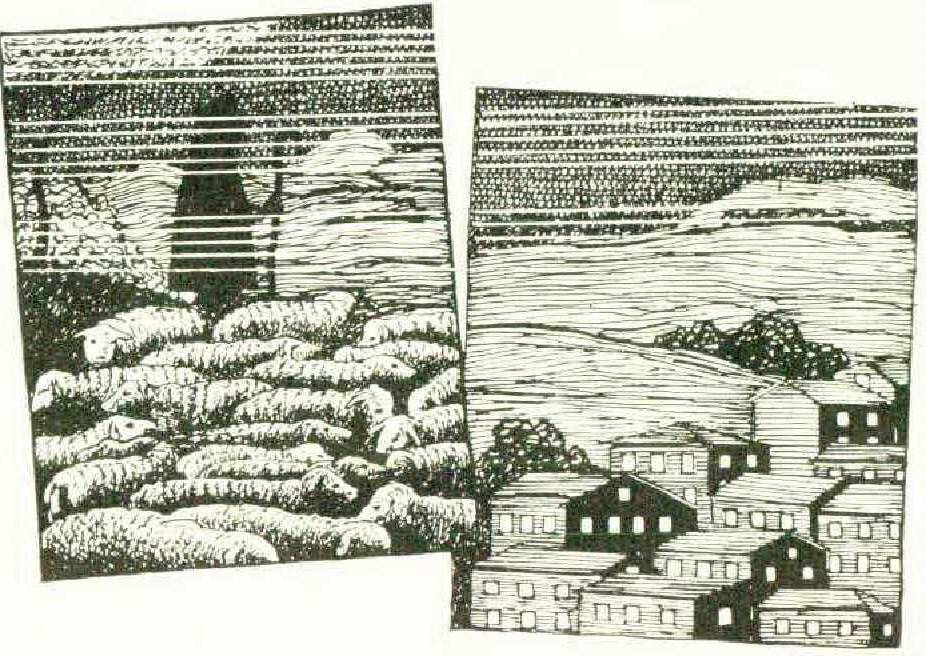
For a while, he succeeded. He sang of the shepherd returning to his mountains borne down with the disillusionment of what he had seen in the paysan’s house. Because he had to continue the thread of what the shepherd had sung, it seemed that the paysan was forced to follow along. In his first response, he admitted that what the young shepherd had seen was true, and in the second, he commiserated with the unhappy youth. Sensing something, the shepherd pursued his theme warily. He told of the young shepherd’s returning to his lofty peaks and noticing, as if for the first time, the peace and beauty of the starry night that was his realm.
Still, the paysan followed. He told of the henpecked and harried paysan’s decision to run away to the mountains and find there the peace of a shepherd’s life. Now, the shepherd realized fully that there was a trap afoot, but because of the paysan’s agreement with everything he was saying, and because there could be no hesitation in the exchange, he seemed at a loss as to what to do. So he expounded further on the young shepherd’s beginning realization that his life was, after all, the very best.
It was in this moment of indecision that the paysan turned the tables. Hard-pressed to keep his expression grave, he told of finding the young shepherd sitting on his perch, caught up in his contented thoughts while his sheep were being stolen by a smuggler and were even then on their way to the Spanish frontier. The paysan had calculated well both the shepherd’s fiery nature and his devotion to his sheep. In retort, the shepherd told of the fierce pursuit and accosting of the smuggler before the frontier was reached. Now, the paysan sprung the trap. He sang of the young shepherd and the smuggler in a frightful battle, belaboring each other with their wooden staffs; and it looked as though the shepherd was going to take a whipping and lose his sheep in the bargain. In response, the shepherd could do nothing but defend his honor by telling of a glorious victory and Lhe retrieving of the sheep.
Then the paysan’s broad face broke out in a wreath of smiles. This time, his was the final stroke. He sang of the paysan’s flight from the noise and blood of battle, his own disillusionment with the mountains and the life of a shepherd, and of his return to his home, where a worried wife and children greeted him with loving arms and kindness.
So the second round had gone to the paysan, and his champions whacked away lustily at his strong back, and even his detractors were forced to shake their heads in admiration at the way he had turned the trick. The shepherd made an exaggerated bow, but because this was a serious business with him, his face showed no humor whatsoever. The paysan acknowledged the gesture with a mock bow of his own. His was a character that reveled in this combat of song, and if he was as serious, his mirth concealed the fact.
If I had been incredulous about what had already passed, I was to listen openmouthed to what was to follow. Because in the third round the exchange was couplet for couplet, and without pause. The metered bursts were hurled back and forth at dizzying speed. It was like a furious argument in which, by some impossible accord, the arguers had to confine what they had to say to two lines, and rhyme them.
And as in a furious argument, it was here that their strengths and weaknesses were laid bare. There were impassioned words by the shepherd, whose nature was truly passionate, and there was humor and satire by the paysan, who refused to take anything seriously. They threw out challenges, assailed each other’s positions, and matched barb for barb, but always short of insult, because an insult cannot be forgiven among the Basques.
I will never be sure who won the honors in that chance meeting in a smoky little bar on a rainy night. Certainly, none of the villagers seemed to be able to agree on that either, and the new kind of argument that followed looked as though it was going to last long into the night. There were frequent repeatings of choice quatrains or couplets, and comparing of them, and much discourse on the quality of the improvising. And in its own way, the discourse was very good, because the Basques are a people who have always lived by song.
So the troubadours had met in the night in a tradition as old as their ancient race, in a tiny village in a lonely mountain stronghold that the worst of civilization had so curiously passed by, and they had tested their poetry and their song one against another. If what they had sung was important and beautiful, it would be remembered and sung again and passed down to the children to be sung again, long after what they themselves were as men had been forgotten.
And if what they had sung was not important or beautiful enough, it would have no more meaning than the fact that they had met, and would pass from memory as easily as the shepherd’s good-bye and leaving into tHe night from which he had so unexpectedly come.