The Barrel Lifter: An Atlantic "First"
A miners son, JORDON PECILE writes: “Like so many others in the coal region who graduated from high school in 1948 to find no jobs, I left my town to make a life where I could find work. I taught boxing in a settlement house in South Philadelphia and then, bored, hitchhiked across the country to load oranges in Pasadena.” A scholarship to Cornell brought him back East; a Fulbright took him to Florence‚ Italy, for a year; the navy sent him to the Antarctic and to Okinawa. Last year he taught English at Annapolis; he is now at Princeton on a fellowship, working for his Ph.D. in comparative literature.
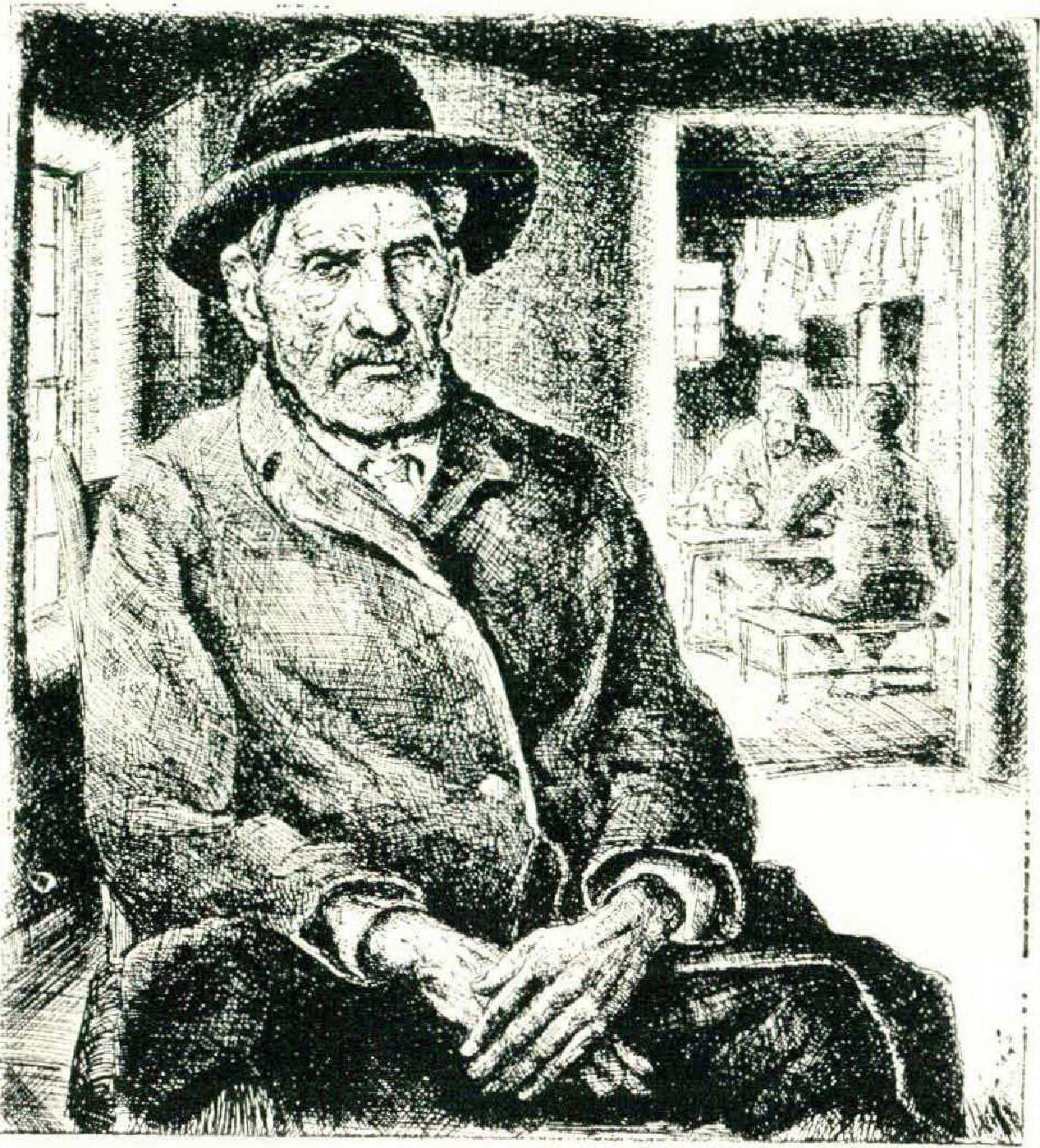
SAVERIO opened the door of his daughter’s kitchen without knocking and stood there, cap in hand. “It’s me,” he said.
She was shifting something in the oven and didn’t pay attention. “Close the door, Papa.”
The old man scraped his sneakers on the doorsill and entered. The Italian program was on, and the kitchen was filled with accordion music and a song about a duck in love with a poppy.
“Close that door,” she said again, “before you make my dough fall.”
He hung his cap and scarf behind the door and went near the stove. “I like so much the accordion,” he said.
She straightened up. Around her head she had tied a dish towel, and it made her look like the women in the old country. “Go up and wash your hands first,” she told him.
By the time he got back, the music was over and the announcer was advertising the meals at the Amalfi. She turned it off. “I’m warming a dish of pasta fazool for you, if you want it. You may as well eat it up because Gloria won’t touch leftovers. She’s spoiled rotten, that kid.”
“It’s no good, to have only one.” He let her turn him around to fix his sweater and tighten his suspenders. He felt a little foolish.
“You stayed in the poolroom all afternoon, I’ll bet,” she said. “I can smell.”
“To stay alone in the house the whole day makes me crazy. When she was alive, there were always people, kids. Now nobody comes.”
“Poor Mama.” She crossed herself.
“I paid the undertaker today, with her insurance.”
“Did he knock anything off?”
“Five bucks. Better than nothing. And he gave me these.” From his pocket he took an envelope of holy cards printed up with a prayer for his wife. “They were left from the wake.”
“You should have made him wait,” she said. She kissed a card and stuck it in the frame of the mirror over the sewing machine. “They appreciate it more then.”
The old man shoved the cat off the chair by the table and sat down. “ I don’t like to owe nobody,” he said. “I’m not like your brother. You know, today again he asked for another loan — for a hernia operation this time.”
“Where did he get a hernia? From holding it all day?”
“It’s an excuse. He has always good excuses.”
“It’s his wife, she puts him up to it. Don’t lend them nothing. They won’t be satisfied till they clean you out.”
“Don’t be afraid. How they treat me, that’s how they’ll get treated someday, or there’s no Judge above.”
She cleared a place and put food in front of him.
“Look how I have to go from house to house for my meals,” he said. “Like a dog.”
“It’s your own fault. You don’t want to listen. Suffer, then.”
She handed him some paper towels. He fixed them around his neck and bent over the dish. If he listened to her. he would move in with her and make her the only beneficiary of his life insurance now that Petrine was gone. And then where would he be? He knew what that policy was worth.
“Look how good you could live here,” she went on. “And then what worries would you have left? You could sleep nice and comfortable right on this couch.”
She chased the cat off the couch and smoothed the covers with her big hands. It looked lumpy, but it would be warm in the kitchen in the winter, and better than sleeping in that big, half-empty bed of his marriage.
“How handsome we could live together, me, you, and Gloria,” she said. “And with your pension coming in regular, we could get along like rich people, the way I manage. You don’t catch me buying the dear cuts of meat like your daughter-in-law does, that she don’t know how to shop, and nobody will drink your money down either.”
“A drink would go good right now, Amelia.”
“You could live ten years longer if you come here, Papa. But I must see my name on the policy first. Or do they think I’ll do all the dirty work and then let them appear, nice nice, in time for their shares?”
“Do I get that drink or no?”
“I must go down the cellar for it.” She forced her shoes on. “Sit still, I’ll go get it.”
WHILE his daughter was in the cellar, Saverio reached across the table and uncovered her dough. He was picking an anchovy out of the cold tomato smeared over a pizza when he saw the cat come forward and watch. The old man stared back, then he popped the anchovy in his mouth and wiped his fingers. “Get the hell out of here,” he whispered hoarsely and slapped his thigh. The cat disappeared down the cellar steps.
“What did you do to the cat?” Amelia asked when she came up with the flask of wine.
“What did I do? Nothing. Nothing bothers cats — they’re whores.”
“Not that one, she’s too shrewd. You should see how quick she cleaned up my cellar. And you know, there’s not a bird will come near this yard anymore.”
She wiped the flask with her apron and gave it to him. “You have to be shrewd to get along in this world,” she said. “You have to think of number one. That’s why, if I’m going to keep you, I want to keep the policy too.”
“Your mother wanted me to divide it between you and Ralph. She even wanted your sister in New York to get her fair share, but she was afraid to say it.”
“Her fair share? Connie didn’t even show up for the funeral. Look, I’m the widow, I’m the one who wears flour sacks for aprons to save money. You think I like going around looking like this? It’s only me who must pay here, fix there, be both man and woman. It’s no fun, I tell you.”
“And what you want from me?”
“I want you to come here now that Mama’s gone and help me out a little, with your pension and the policy. This is the one home where you won’t have an equal. Keep that in mind.”
He kept it in mind, all right, that curse, “May you have an equal in your home.” In silence he gummed his meal while she took the first pizza out of the oven and the kitchen filled with the aroma of hot tomato and oregano. Just like her mother, he thought, the way she handles dough. Petrine had been a hard worker, but he never expected to miss her this much. Now he missed not only her, but the feeling of family she seemed to have taken with her. A month ago, he had been boss; now he was treated like a child by his own children, and he had to worry about an ancient curse. And about that accursed policy.
What to do about the policy was the only important decision left in his life. It was something to keep him in the center while they circled like hawks. Piece by piece, the old man dipped his bread in the wine.
From the alley came the laughter of girls, shrill good-byes. “She’s home from school, my honey,” Amelia said and quickly untied the dish towel from around her head. “Why don’t you button up your coat, days like this?” she asked her daughter.
The girl was big like her mother. “You here, Grandpop?” she said and rubbed her cold hand on his bald spot. “My God, it’s hot enough in this kitchen. There you go, baking up a storm again, Mama, then you yell because I’m heavy, I told you a million times, bought bread is better for my sandwiches.”
“I wanted to use up the flour from Surplus,” Amelia said.
“It’s embarrassing, the way everybody in the lunch hall looks at me when I unwrap them flying saucers you make me. All that crust.”
“Don’t talk foolish,” Saverio said.
Gloria dropped her notebook and scarf on the sewing machine and glanced sideways at her hairdo in the mirror above. “Is this from Grandmom’s funeral?” she asked and picked up the little card in the corner.
“It was an extra. Did you call up about that ad yet, young lady?” Amelia said. “She’s trying to get a job for after school, Papa, watching kids. And light cleaning.”
Gloria put the card back. “It was some rich lady on the other side of Wilkes-Barre, practically. She wanted to know what I was.”
“What did you say?”
“I said Italian.”
“So?”
“She said, ‘I’ll let you know.’ ”
“Maybe she’ll get in touch with you,” Amelia said.
“She won’t. I won’t say I don’t care, but it really doesn’t bother me that much.”
“Go change your dress before you sit down — go ahead, honey, go.”
“You’ll have to unlock the parlor tonight, Mama. Some of the kids will be around to pick me up.”
“Who’s going to pick you up?” demanded Saverio.
“Just relax, Grandpop. They’re only girls.”
“Where you going, out with girls in the night?”
“Downtown, Stores are open Friday nights. Holy God, you’d think I was going to get seduced or something.” She kicked her shoes under the sewing machine and stamped upstairs.
“See?” Amelia pulled a chair next to him. “She’s growing up. It won’t be long now before she’s eighteen, and then the social security checks stop, and where can she get a job in this town? As God is my judge, I don’t know how we’re going to get along.”
“Make her quit now,” he said. “What does a a big thing like her need with a diploma? Let her go in the factory.”
“They won’t hire her, they want experience. I’d gladly go myself, but what’s the use? I’d never make production, with these varicose veins.”
He was tired of listening now and got up to go. “Just so she don’t fool around, like your sister in New York.”
“God forbid. My Maria Gloria’s serious.”
“Hey, serious,” he laughed. Out of his pocket he took a roll of bills and started to count, watching her eyes fasten on the fistful of money. He slipped a dollar on the table by his dish.
“Always the big shot.” There was gall in her voice, but she smiled. “Go, go stand drinks for them freeloaders in the poolroom, but take that buck back. Am I your daughter or not?”
“Keep it. Thank God I can still pay my own way.” He pocketed the roll. “Who has the horse in the stall never has to walk,” he said and smiled back.
“No wonder Ralph likes to borrow from you. Money burns a hole, don’t it?” She folded the bill and tucked it down her bosom. “Right now, I am a little short,” she said. “But here, take this pitz with you.” She covered the still-steaming pizza with waxed paper and wrapped it in a newspaper.
“Good idea. Sometimes I have a little hunger in the night.”
SHE watched by the window as he walked up the alley. I’ll bet he has hunger in the night, she thought. I have not been a widow for five years now without knowing how it is to reach out and feel only the cold sheets when you are used to sharing the bed. She went to the table and poured herself some wine.
“Is he gone? I hope he’s not going to make a habit of eating here,” Gloria said from the stairs.
“Oh, he’ll be back. I can tell.”
“He haunts me. I can’t eat in peace with him here.” She pulled the flaps of her chenille robe together and sat at the empty place.
“Maybe he’ll buy you that class ring you want so bad. How about that?”
“Really, I’d rather go without it. I get so sick of the way you and Uncle Ralph are always chiseling him.”
“Our family’s not the same anymore, honey, since your grandmom died. That old man never was too shrewd, always ready to give the shirt off his back. What me and you don’t get, somebody else’ll grab. That’s why I want to get the policy in my name right away.”
“If he’s around the house, I might as well say good-bye to all my friends.”
“Why? That’s what I keep the parlor locked for. To entertain in.”
“But you know what a greeny he is. Whenever I’m walking with a boy downtown, he follows us. Right into Neil’s Lunch sometimes. And him, why, he knew every damn tramp in town in his day.”
“Hey! Don’t talk so fresh. Grandpop just wants to make sure you’ll be wise. Nobody marries girls who are too liberal. Look at your Aunt Connie in New York.”
“Oh, God,” Gloria cried. “It’s disgusting. He’ll cough and spit all over and keep his stinking pot under the couch. Aren’t things awful enough around here the way they are? Why must you ask him to come?”
Amelia slammed the girl’s supper in front of her. “Enough now!” she shouted suddenly and gave her daughter a crack across the face that left red finger marks on the fat white cheek. “That’s nice talk. Nice smart talk. Is that how you’re going to taik about me when I get old, huh? Is that how you intend to treat me?”
AFTER dark it turned much colder, and the old man got up in the night to take the extra blanket out of the chest. Then the smell of mothballs kept him awake. He watched and listened for the dawn, but it was a long way off. Nights were longer now.
By the wine bottle on the side of the bed, he kept her picture, the postcard she had sent from Italy when he wrote for a wife. It showed her handsome and proud, in spite of her dress full of creases from being carried in a bundle on her head the ten kilometers to the photographer’s. She had looked like a woman who would last.
He would not let himself think about the way she had looked in the candlelight in the casket in the next room. Her death had thrown the whole family into confusion. But his, now, his would be their convenience, wouldn’t it? After he changed the policy.
He got up because he could not lie still any longer in that bed, and he sat in the kitchen until morning. Then he ate the pizza. Later, he carried his things to his daughter’s house.
“The policy, did you bring it along?” she asked when she met him in the alley with his arms full.
“Right away, the policy. Here, take something, please.”
“But what did you bring that this sack’s so heavy?”
“I picked what there was in the yard — some tomatoes and peppers.”
“You didn’t leave nothing ripe, I hope. They’re ail crooks, up by you.”
“Only a few pumpkins. Your brother and his wife were there right after the funeral.”
“The heart of some people. And after his performance at the grave, that he almost wanted to throw himself in.”
When they reached the kitchen, he laid the policy on the sewing machine. “Leave it there,” she said. “Gloria can call the insurance man when she goes out. On Monday he can make the change, maybe.”
“Every night must she go out?”
“Saturday night they all go out. She’s not a baby no more, you know. I can’t control her like I used to. Anyway, she works harder during the day, this way. Now she’s up scrubbing the bathroom.”
He sat on his couch and took out a stogie.
“Must you smoke that thing in here? Can’t you wait till you go down the poolroom?”
“I feel tired,” Saverio said, but he put it back.
“Lay down, then, and take a nap. Let me go put your clothes away.”
He leaned back. Upstairs the girl was singing an American song. She means all right, he thought, even though she likes to act grand. What does she know? They were not born wise in this country, like over there. Here, they got too much. His own three he had never begrudged anything, when the mines were working. Especially the youngest, his pretty, weak-minded Connie. All what you want, my Costanza. That night when he heard them talking about her in the poolroom, he saw blood, and thank God they locked him up or he’d have killed her for sure. Before morning, she was packed and out of his house. And who could accuse him for that?
“A lick and a promise, that’s how she cleans,” Amelia said when she came downstairs. She had her coat on. “What do you want me to get from the store for Sunday?” she asked.
“Get something good. Got enough money?”
“Depending on what you want. For supper I made a nice soup to warm you up.”
He reached in his pocket. Then she said, “I got another notice about the school taxes. They’re going to sell my furniture, as usual.'’
“Is this enough? Ask what the girl wants.”
“I’d like to see them try it once.” She snapped her purse shut. “You know me when my hair stands up. I can be a regular Carnera.”
“Camera! I was stronger than him, ten times.”
“Gloria, honey,” Amelia called, “come here a minute. What should I buy for Sunday?”
The girl came to the stairs, still singing. She had a pink Turkish towel wrapped around her head. “I’m sick of macaroni,” she said and came down.
The old man dug inside his sweater. “I brought you something, Maria Gloria,” he said.
“Ooh, look,” cried Amelia. “Grandmom’s good earrings. Lucky girl!”
“Wear for my wife,” he said.
“Grandpop, they’re for pierced ears.”
“Well, your lobes were pierced, honey,” Amelia said.
“Well, I only wear the other kind, Mama. My God, what do you think I am?”
“A dope, that’s what.” Amelia picked the earrings out of his hand. “These are real cameos. By rights they should belong to me.” She went to the mirror.
“I want a class ring, that’s what I need,” said Gloria. She twisted the towel around her head tighter. “But you know what I’d really appreciate, Grandpop? I’d really appreciate it if you wouldn’t use my towel in the bathroom now that you’re going to stay with us.”
He was not sure he understood, so he kept quiet.
“It’s unsanitary to use other people’s towels, Grandpop. The colored towels will always be mine, OK? You can use the white ones.”
“Get back to work!” Amelia came forward and pushed her daughter up the stairs. “Keep your towel in your own room from now on, if you’re so fussy. Don’t bother the poor old man.”
“Don’t mind her, Papa,” she said when the girl was gone. “She’s worried about getting pimples, that’s what it is.”
But he was on his feet. “What’s the matter with me?” he said. “I make her sick? If she thinks I make her sick, I go.”
“Oh, Papa,” Amelia said, her big hands on his shoulders. “She’s only a kid. What do you want from a kid? God knows what those teachers tell them.”
He let himself be pushed down. He tried to uncurl his fingers, but they wouldn’t straighten out. They were hard like horn. The blue scars made by falling slate in the mines and the black dirt deep in the cracks wouldn’t rub off. What, then? If he wiped himself, didn’t she?
“What makes her so special, that I’m not good enough?” he asked. “Better I go.”
“Simmer down, Papa. Don’t worry about her, she’ll get over it. Soup is never eaten as hot as it’s cooked.”
No, he thought, we must cool life off, kid ourselves. Otherwise?
“If I am in the way —” he said.
“Oh, Gesùmaria, don’t start that again. She’s young yet, what does she know? One way or another, we must try to get along. Have patience, you too.” She stuck out her chin and knotted her woolen babushka. “I must go now before the stores close. Lay down, why don’t you, till I get back. Then we’ll eat. I’ll get something tasty.”
At the door she said, “Leave her alone while I’m gone, she’s nervous. It’s always tough on her, this time of month.”
After she left, he spread some newspapers on the floor by the couch to spit on, and he lighted the stogie. He put up his feet. The couch smelled of the cat. What a shame, he said to himself, to drag things out like this. At least it was not always so bad. When I came over, I had hopes. But who lives by hopes dies in despair — there’s justice in that dark saying, and no escape from it.
Still, he persisted, I made some good times. And he remembered the Feast of Saint Mauro: someone singing “Away, Marie!” above the band, and him, drunk and boasting at the beer stand. His paisans, shrewd, putting up ten dollars against the contractor. And him, to show his strength, hoisting a barrel of beer on his back.
And bravos then. The music and the lotteries stopped, and the nuns appeared at the convent windows. His paisans formed a circle to give him space. And him, with that barrel on his back, he didn’t know what to do with it — couldn’t just let it down. So he turned, everybody followed, and he led a procession to the grotto next to the churchyard. There, at the foot of the Madonna, he placed the barrel. And there his paisans swung him up and carried him off above the crowd.
When the barrel lifter opened his eyes again, someone was running the sweeper in the parlor. There was food on the table, and the cat was watching it.
“Is it already time to eat?” he asked.
“Gloria must get dressed to go out.”
He got up and went to the mirror to comb his hair. He saw the card in the corner of the glass, and he thought of his poor wife. There was a prayer on the back he liked to say for her, but the English was hard to remember. He crossed himself instead.
“Mama, tell him to hurry. Leo will be coming any minute.”
“Don’t start again, you,” Amelia said.
“Every night she must go out. Like that other one,” said the old man.
“She’s only going to a drive-in. He’s a good driver, this fellow Leo, he’s safe.”
“If he’s safe, there’s something wrong,” Saverio said.
“Remember, honey, what the priest said last Sunday — lilies that get festered smell worse than weeds. Pay attention.”
Gloria was feeding the cat by her chair. “What does he know about it?” she said.
The old man took his place. Everything smelled good. There was Pastene in the broth that tasted wonderful, but it was too hot, and Amelia had filled his dish so full he couldn’t blow over it. “Excuse me,” he said as he leaned across the girl to spill some back in the pot.
“Grandpop, don’t you dare!” She jumped up and seized his wrist so hard that he upset the dish.
He saw the soup spread across the oilcloth. Amelia grabbed a clishrag. “My nice soup. Oh, God,” she said.
The soup had burned his hand, but the girl held on. “Just who do you think will finish that soup after you pour your slop back in it? Around here, we don’t eat other people’s leftovers.”
His stomach was suddenly cramped with gathering rage, and he felt sick. Gloria let go, but by then the woman wiping the table and the whitecheeked girl were no parts of him. He wanted to thumb his nose: Here, to you both. With the help of the chair, he rose and looked for his policy.
“You fake,” Amelia yelled then at her daughter. “What a little troublemaker you are. Must you make us all miserable with your false manners? Go, go upstairs and get dressed for your whoring.”
Gloria stared at her mother and started to cry.
She still doesn’t believe, Saverio thought, she is still unknowing. He realized it was wrong to keep this inside him, wrong for all of them, and he reached out to touch her bent neck, but in midair he could not control the trembling of his outstretched hand, so he pulled back.
The policy was there, on the sewing machine, and he lifted it up.
“Where are you going?” Amelia asked. “Wait. She didn’t mean no harm. Maria Gloria, your grandpop’s going.”
The girl had picked up the cat. “Maybe he’ll learn a lesson,” she said. She was stroking the cat, and she was still crying.
“Sit down and eat your supper, Papa. Where will you go?”
Go where? He stood, with both hands trying to hold the policy steady. Go and get drunk, where should he go? Then it came to him, that prayer in English on the back. O Mary, Mother of Sorrow, conduct us to a place of refreshment, light, and peace.
He turned and faced the card in the mirror, the picture of Mary, mourning, and he laid his policy down. “You can keep that,” he said to Amelia and reached for his cap.
Halfway down the alley, he found himself humming the song about the duck in love with the poppy.