The Trouble With Florence
It is a considerable strain to be about to visit Florence. To revisit Florence must, I think, be purely pleasurable, for then one could sit about in cafés deciding which of its innumerable delights to savor again. A first look at the place has heavier responsibilities, for there must be borne in mind the possibility that it will also be the last look.
The English edition of the Michelin Guide to Italy lists under “Chief Things to See,”“Other Important Things to See,” and “Other Things to See" a total requirement of three piazzas, ten churches, five palaces, five museums, two cloisters, two monasteries, and one cathedral, loggia, bridge, garden, and academy each. All these, bearing in mind the readiness with which almost any one of these items subdivides into galleries, chapels, baptisteries **, campaniles, panoramas, frescoes ***, tombs * A and sharp instructions to “note the Rape of a Sabine by G. da Bologna (1583),” make a wellladen dish; and while I am laboring under the thought of so much aesthetic pleasure in store, Botticelli suddenly springs to mind.
Botticelli convicts me at once of my personal lack of fitness to visit Florence. I cannot stand his women.
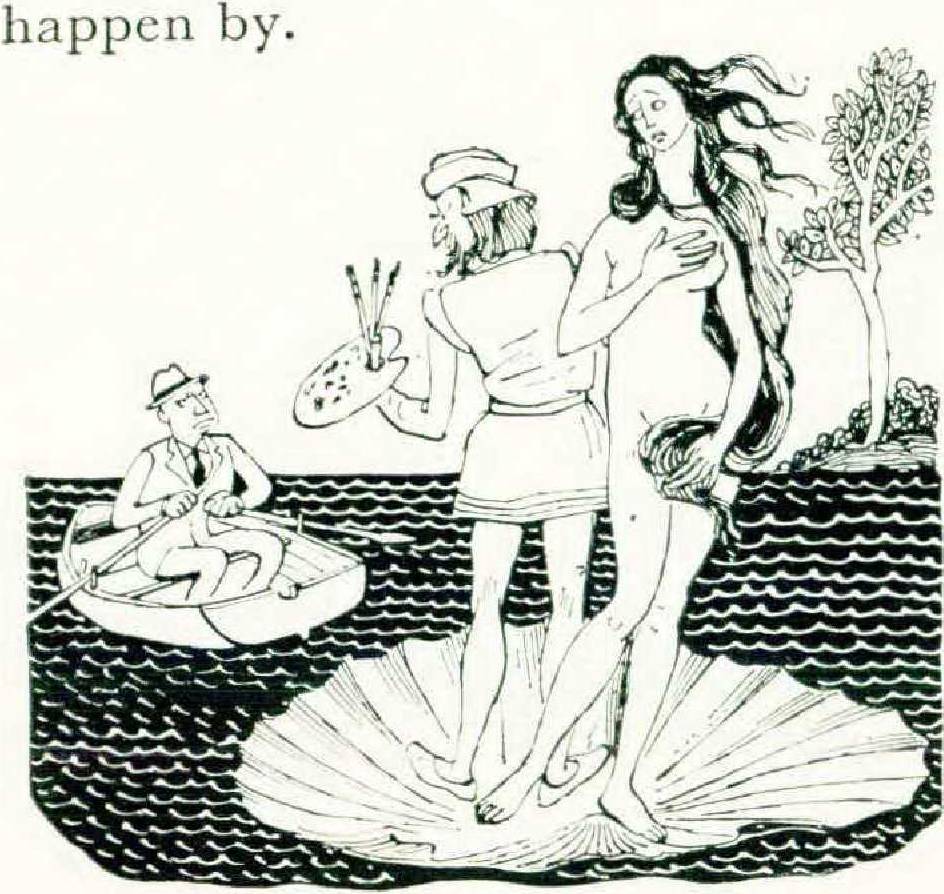
The late Dr. Thomas Bodkin writes somewhere of “the power of Botticelli’s lovely creatures to entice us into a mood of grace and ease and exquisite fancy.” I must beg, ashamedly, to be excused from any such delicious reverie. His “graces” are not for me. Of the Birth of Venus I can only suppose that the artist had the foresight to realize that it would cut up well for jigsaw puzzles. In Pallas and the Centaur, the goddess (“all grace and placid power,” remarks my authority) has precisely that lofty men-are-so-silly expression I used to dread in Paul Jones partners, though none of them carried so huge a halberd. How then am I to conduct myself in the Botticelli Room, when all around me are other tourists in a mood of grace and ease and exquisite fancy? I am hopeless at pretending to be dazed with ecstasy. Standing right in front of the Hermes of Praxiteles at Olympia a year or two ago, I tried the expedient of lowering my head, as though in a kind of trance; but I was bothered by a sliver of ham caught between two teeth and could not concentrate. The Hermes stands in its own arena of sand as a precaution against damage from earthquakes, which is more than has been done for, say, Nelson’s Column, and ought to aid appreciation. But it didn’t.
An occasional failure to be ravished by some supreme masterpiece is no great embarrassment in Greece, where there are always plenty of less-trumpeted bits and pieces that one can meet on more relaxed terms and enjoy without compulsion: fragments of sixth-century pediments; river gods exhibiting their muscles in odd corners; vases innumerable, from which it is possible to choose, to say without prompting, “I like that one.”In Florence, my preliminary reading leads me to conclude everything is a masterpiece. “Florence the Divine,” says Michelin, “gathers every form of beauty between the hills of the Arno Valley. Idealised by a diaphanous amber light, it mingles art and life gracefully under the sign of the red Turk’scap lily.” I find that daunting enough, and the names that crop up as one reads further show that there is small chance of resting one’s wings, even momentarily, on the second-rate. Everywhere the masters have been at work, and in every known medium. It is not as if you could take a quick overall glance at the outside of some building and then go straight in to get an impression of the height of the Dome***. In all probability Michelangelo has been busy out there, adding worldfamous groups of statuary to Brunelleschi’s deathless elevation. Donatello will have carved something immortal at the base of the Campanile**. The doorways are certain to be by Ghiberti, with suggestions from Luca della Robbia. Inside, it is a pure toss-up whether the friezes, frescoes, tombs, bas-reliefs, panels, semi-octagonal apses, paintings, medallions, cells, cloisters, pulpits, bronzes, piers, windows, and tapestries are by Raphael, Giotto, Leonardo da Vinci, Fra Angelico, Masaccio, Michelozzo, Michelangelo, Pisano, Jacopo della Quercia, or any conceivable combination of these geniuses. All are unsurpassed, and only a philistine could pass any of them by or fail to gaze up at the Mosaics*** (Can be lighted by request: fifty lire for five minutes).
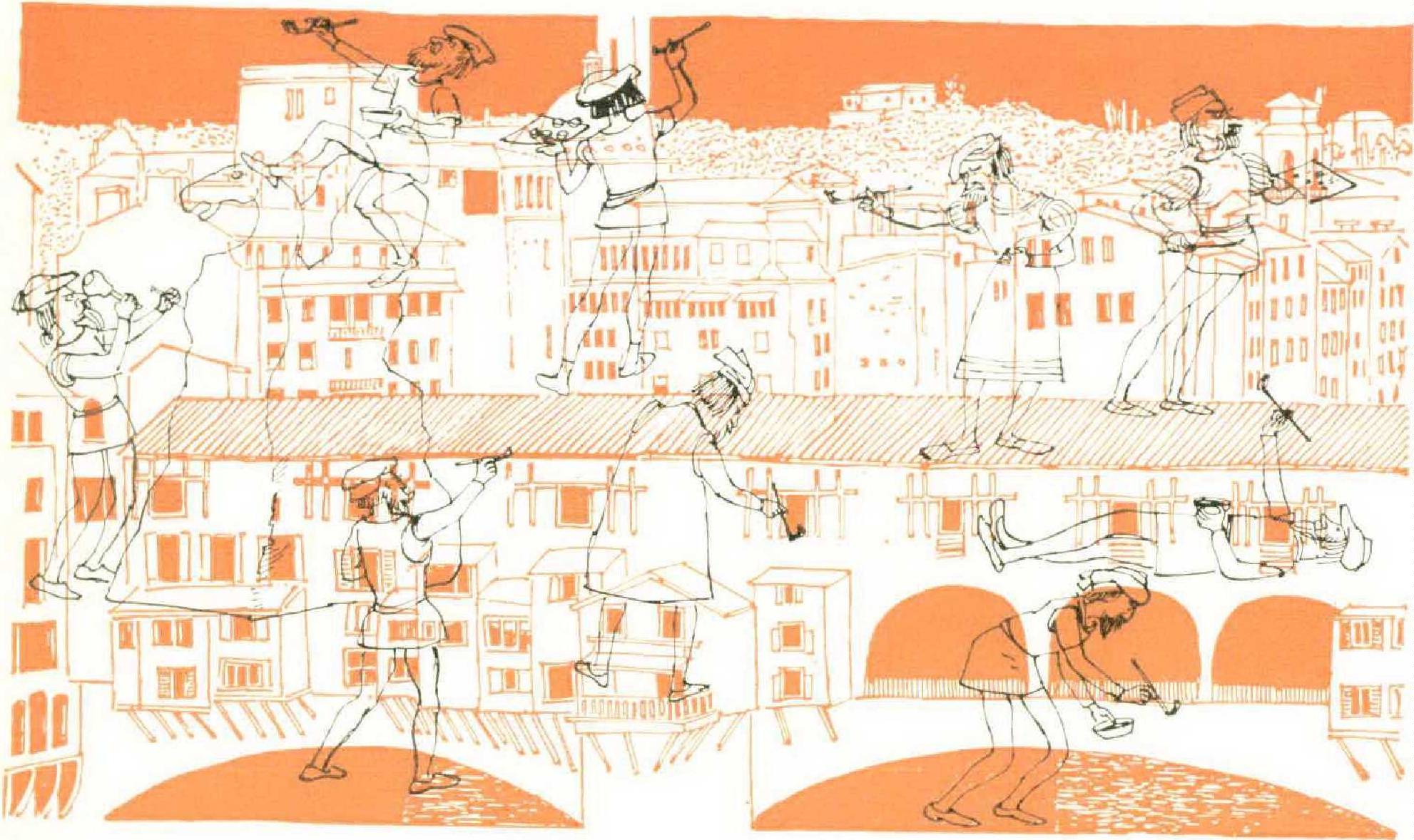
The trouble with Florence is that the moment anybody put up a building, at any time during the fifteenth and sixteenth centuries, a swarm of top-flight artists rushed in with brush and chisel and got to work. They could all do anything. If Michelangelo found that Raphael and da Vinci were already up ladders by the time he got there, he simply threw aside his cartoons and brushes, elbowed Andrea Pisano out of the baptistery, and began to chisel a Madonna. Giotto had probably drawn his last freehand circle by then, but Ghirlandaio and Filippino Lippi would be quarreling over a window nearby, while Donatello handed over a half-finished figure of Hope to della Robbia and went off to borrow some gold paint from Paolo Uccello. Ghiberti, of course, would be working on doors.
It did not matter a rap to Michelangelo that he was already ten years behindhand on the Pope’s tomb; he just could not resist an undecorated building. Nor would the intensity and gaiety of the scene, the din of hammer on chisel, the slosh of wet plaster, the ceaseless rain of wood and marble chips be in the slightest degree lessened if any of the masters I have mentioned happened to be dead or not yet born. There were always plenty of others.
I don’t feel fitted to do justice to their combined labors. And even if I take time off from the glories of the past and sit at a café to watch the world go by, my aesthetic sensibilities, so I see from a book called The Land of Italy, by Jasper More, will still be stretched to the utmost. “And if the Florentines of the present day,”writes Mr. More, “are no longer the guides and philosophers of Italy, they nevertheless retain a distinction and individuality which immediately strike the visitor. . . . In physical form and beauty the Florentines excel.”The prospect of watching these paragons, at the end of a day of unrelieved masterpieces, makes me thoughtful. The only hope, as far as I can see, is that one or two of my fellow tourists will happen by.