Here Be Broadway
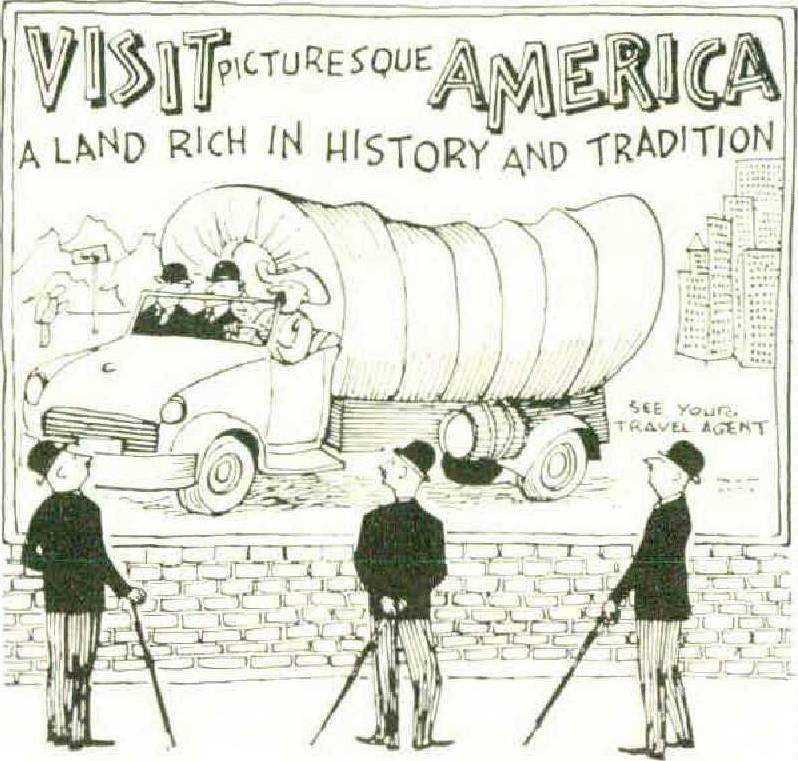
I am glad to read that the United States is going into the tourist business in a big way and opening shop windows in the leading European capitals. We in Britain have been suffering for years from the efforts of our governmental tourist organization to persuade Americans that Britain is still back in the Middle Ages. Around every bend in the road, according to these meaddrunk copywriters, stands a thatched cottage, with a yeoman in a smock sitting outside. Averting their eyes from factories, airfields, docks, and mines, they direct the visitors’ attention to such examples of contemporary living as the Tower of London, six-hundred-year-old inns, and the uniforms of Her Majesty’s Guards. Overseas visitors must get the impression that even British cars are handwoven. We should be only too glad to loan the States some of our picturesque official travel-writers to help this drive for increased tourist traffic. Their copy would probably turn out something like this.
From the white-walled cots of New England across the buffalo-trampled plains of the Midwest to the golden beaches where once the conquistadors gazed out over the Pacific, the lineal descendants of the Pilgrim Fathers have planted their quaint, romantic settlements. On the Great Lakes, those vast expanses of fishing water fringed with solitude, the visitor from Europe may find Chicago, with its 7000 acres of public parks, notable museums, and vivacious inhabitants. It received its charter the year Queen Victoria ascended the throne.
Nearby is Detroit, originally a French fur-trading post, taken by the British in 1760. Visitors can sense in its tranquil thoroughfares the days of redskin and redcoat, o King George’s dragoons, and of trappers in coonskin caps. Then, what can be more romantic than a trip to Cleveland, another living reminder of America’s gracious past? It was founded in 1796 by Moses Cleaveland, whose spirit still walks abroad by the stilly lake.
In Washington, the seemly Southern town chosen as the capital of the new federation and still redolent of a leisurely way of living, you can stroll amid the magnolias and the mint juleps, conjuring up in your mind the oratory of the Fathers of the Constitution and imagining that at any moment Honest Abe will stroll around the corner of one of the frame houses with his wide-awake, string tie, and homely, rustic wit.
The White House will remind you of its famous inhabitants, of the first three Presidents, of the days when politics was a pursuit for gentlemen of good family and extensive estates.
New York will attract many travelers who wish to see the thriving seaport where Sir Winston Churchill’s grandfather flew his racing colours (or “colors,”as local usage would call them). The city is noted for its art galleries and libraries. The typical New Yorker is given to humorous overstatement and democratic manners. New York was visited by Dickens and Thackeray. Lovers of the history of the theater will enjoy a stroll down Broadway, with its memories of such great tragedians as Booth. Not far away from the lively hubbub of this growing metropolis lies the peace of the Catskill Mountains, where Rip Van Winkle slept his famous sleep. New York was once New Amsterdam, and its burgher origin can be traced in the Dutch names of some of the families you may be meeting, like the Roosevelts, the Van Schuylers, and the Vanderbilts. Dutch is still spoken in scattered pockets.
If possible, time should be spared for a visit to Boston. The atmosphere of this fine old town is scholarly, meditative, and tasteful. Settlers from Ireland add a note of simple gaiety to the unhurried grace which distinguishes the inhabitants. At nearby Harvard the traveler can imagine himself in Oxford or Cambridge or, at any rate, back in 1780. The President of the United States is a Boston man, if of newer vintage than the Lowells and Cabots, who are the backbone of the population.
After the North and the East, what is more likely than that the voyager will want to see something of the great rivers that cut their way through the Center and South? Who would not thrill to sail down the rolling Mississippi on a paddle steamer, dicing with gamblers, lounging on the rail, attending burlesque shows and Shakespeare recitals in the fit-ups that dot the swampy margins of the majestic unhurried stream? It is easy as one passes the busy wharves of Minneapolis, St. Louis, and Memphis to imagine one is living in the days of Mark Twain.
Where the great river flows out into the Gulf of Mexico, the people retain the Old World courtliness of their French ancestors. There are a wide variety of seafood and some gay carnivals. A little further on lies Texas, a spreading cattle country noted for its juicy steaks and for the picturesque attire of the inhabitants. Silver and oil have been found.
For the visitor with additional time to spend, what could be more enticing than to cross the rolling prairies and the rocky desert in a covered wagon, right across Indian territory, to the coastal state of California, the Eldorado of the wild orange groves, the mountain lions, the ghost towns.
Wherever the traveler may pursue the trail of history, he will be entranced by the character of the people. Whereas European polish can become inhuman and nerveless, the inhabitant of the New World always retains his unflagging, breezy humor. A stranger in town will often be hauled out of bed to join in a barbershop quartet with the local civic dignitaries. Food is plentiful and is prepared in accordance with long-tested recipes. Tobacco is more often chewed than smoked. Rough but kindly, plainspoken yet with a heart of gold, never for a moment forgetting the Mayflower, the citizen of the United States proffers open arms to the visitor from the old country.