Blue-Chip Firms in Puerto Rico
PROGRESS REPORT TO U.S. INDUSTRY FROM THE COMMONWEALTH OF PUERTO RICO:
The Commonwealth of Puerto Rico now has one of the highest rates of industrial growth in the world —outpacing the entire European Common Market
New plants are opening at the remarkable rate of 3 a week. Here are 27 facts you should know about this flourishing Commonwealth before choosing your next plant site.
1. The Commonwealth of Puerto Rico’s industrial development is moving along at an extraordinary pace. In 1962, the Commonwealth’s net income from manufacturing rose from $320 million to $384 million—an increase of 20 percent.
Even the thriving European Common Market (West Germany, France, Italy, Belgium, Luxemburg and Holland) cannot match this rate of growth.
2. Altogether, there are more than 900 plants humming away in this sunny Commonwealth. Seven hundred and twenty-five of these plants are owned by U.S. firms. Last year, their return on investment 25 percent.
3. In 1962 alone, 139 manufacturers chose Puerto Rico as a long-term, permanent manufacturing site. Many of them were blue-chip firms. A few of these are: Glidden. National Biscuit, Warner-Lambert and U. S. Rubber.
4. Fifty blue-chip firms now operate eighty-six plants in Puerto Rico. Seventeen blue-chip firms have two or more plants there. Five have four or more plants. Altogether, some 100 U.S. firms operate two or more plants.
5. Blue-chip firms now manufacturing a variety of products in Puerto Rico include: Parke-Davis, Union Carbide, Sperry Rand, International Paper and Reichhold Chemicals.
Incentives for manufacturers
6. Puerto Rico is a self-governing Commonwealth within the American Union. U. S. Federal taxes do not apply because Puerto Rico does not have a vote in Congress. “No taxation without representation.”
7. The Puerto Rican Government is free to assess its own taxes and to grant tax exemption to genuinely new or expanding operations. Runaway plants are not wanted and do not qualify for tax exemption in Puerto Rico.
8. Under its remarkable self-help program “Operation Bootstrap,” Puerto Rico grants liberal tax exemption to qualified U.S. manufacturers who locate plants on the island. You pay no U.S. corporate tax and, for ten to thirteen years, no Puerto Rican tax.
9. Special incentives are offered to firms that service local industry, process local raw material, or employ 500 or more.
New Foreign Trade Zone
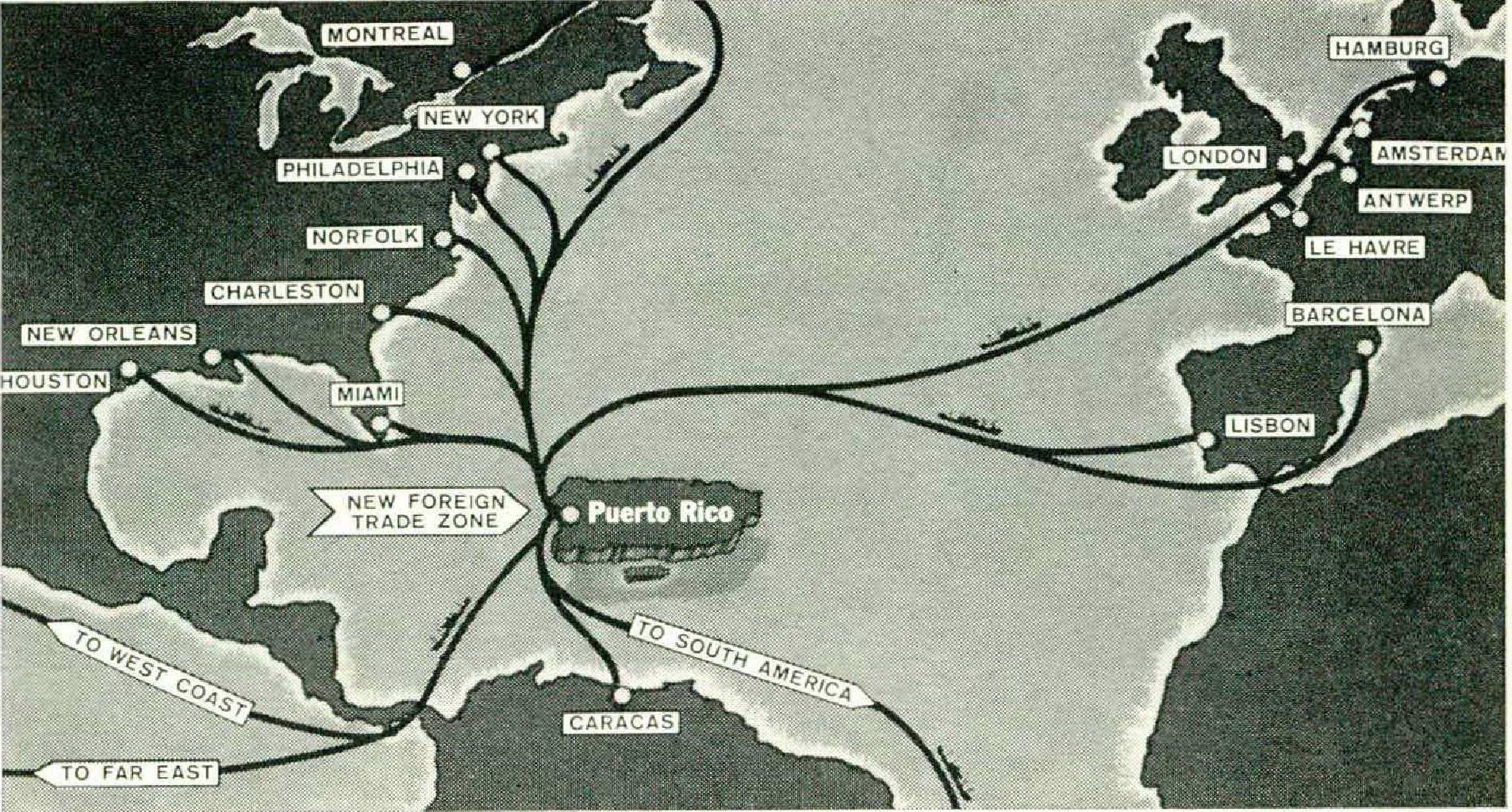
10. The latest attraction for U.S. Industry is Puerto Rico’s new Foreign Trade Zone. It is the only Foreign Trade Zone authorized by the U.S. Government outside the continental U.S. It is at Mayagüez, Puerto Rico’s third largest port. And it is the first U.S. Zone to offer incentives for manufacturing.
11. U.S. firms establishing factories in the Zone are eligible for all the “Operation Bootstrap” incentives.
12. You may import unlimited amounts of foreign components and raw materials to your factory in the Zone and manufacture without paying U.S. customs duties.
Compete in all world markets
13. Puerto Rico’s location (see map) makes it an ideal spot to manufacture for markets in both North and South America as well as Europe and Africa.
14. Since 1954, the island’s sales to world markets other than the U.S. have almost doubled.
15. In 1962, the island’s 900 “Operation Bootstrap” plants increased shipments to the U.S. by 20 percent to a record $497,000,000 or $83,000,000 more than in 1961.
16. In 1962, Puerto Rico purchased almost a billion dollars’ worth of goods from the U.S. mainland. The Commonwealth now ranks fifth among the world’s nations as a market for U.S. products.
Plants available, labor abundant
17. The Puerto Rican Government leaves no stone unturned to help manufacturers prosper. It is constantly building new plants. You can buy them or lease them. Rents are as low as 50 cents per square foot per year.
18. The government will screen job applicants for you — and then train them. The Commonwealth maintains twelve vocational schools offering instruction in over 55 trades—from accounting to zincography.
19. Puerto Rico’s labor force now numbers 670,000 — includes tens of thousands of skilled workers. Puerto Ricans are remarkably able with their hands, and eager to learn new trades.
20. Water and power are abundant in Puerto Rico. Electric power is 20 percent hydroelectric and 80 percent steam-generated. To handle future needs, the government has just built a new million-kilowatt thermoelectric power station.
21. A new $11 million atomic reactor has been added to Puerto Rico’s fastgrowing power system. It was built jointly with the U.S. Atomic Energy Commission.
Excellent transportation
22. San Juan’s $20 million International Airport is the busiest air center in the Caribbean. This beautiful, modern airport handles scheduled and nonscheduled flights from the U.S., Europe,
and South America. Scheduled flights alone total almost 400 per week.
23. Puerto Rico has 3 major seaports. They are at San Juan, on the north coast, Ponce, on the south coast, and Mayagüez on the west coast. Thirtyseven ocean lines carry cargo between these and major world ports.
24. New “trailerships” carry cargo in sealed truck bodies between these ports and U.S. Atlantic and Pacific ports. A sealed truck body is lifted off the trailer and onto the ship. At the port of debarkation, the body is lifted off the ship onto a waiting trailer. This saves time, prevents pilferage.
Strong ties to U.S.
25. The island’s judicial system is similar to and linked with the U.S. courts, with ultimate appeal available to the Supreme Court of the United States. Property and investments are not only protected by the Puerto Rican Constitution, they are also guarded by all the guarantees of the U.S. Constitution.
26. Puerto Rico is economically a part of the United States. The island’s currency is the U.S. dollar. Money, people and goods move freely between the U.S. and Puerto Rico. The island’s postal system is a part of the U.S. postal system. The people are U.S. citizens and serve in the U.S. Armed Forces.
Good place to live
27. Over 5,000 U.S. executives live and work in Puerto
Rico. One executive reports: “The climate is probably as close to paradise as man will ever see.” The temperature usually stays in the balmy 70’s. You golf, fish, swim and sail. 52 weeks a year. And you have more time for your family.
This is one in a series of national reports to U. S. industry on Puerto Rico’s economic and cultural development during its first 10 years as an American Commonwealth. For extra copies, write: Progress Report #11 Commonwealth of Puerto Rico, 666 Fifth Ave., New York 19, N. Y.
Blue-chip firms in Puerto Rico
No. of plants
Company
American Can 2
American Hardware 1
American Motors 1
Beatrice Foods 1
Beaunit Mills 1
Borden 1
Brunswick 3
Burlington Industries 1
California Packing 1
Carborundum 1
Central Soya 1
Colgate-Palmolive 1
Commonwealth Oil Refining 1
Consolidated Cigar 8
Continenal Can 1
Daystrom 1
Ford Motor 1
General Electric 4
Glidden 1
Goodrich (B.F.) 2
Grace (W.R.) 1
Gulf Oil 1
Heinz (H.J.) 1
Hunt Foods 1
International Paper 4
International Shoe 5
No. of plants
Company
International Tel. & Tel. 1
Johnson & Johnson 1
Kayser-Roth 8
Kimberly-Clark 1
Libby, McNeill & Libby 1
Midland-Ross 2
Mohasco Industries 1
National Biscuit 1
Parke-Davis 2
Phelps Dodge 2
Philadelphia & Reading 1
Ralston Purina 1
Reichhold Chemicals 1
Shell Oil 2
Sherwin-Williams 1
Sperry Rand 2
Sprague Electric 2
Sterling Drug 1
Stokely-Van Camp 1
Sunbeam 2
Union Carbide 1
U.S. Rubber 1
Warner-Lambert Pharmaceutical 2
Wilson 1