Pup, Pup, Pup
SARA WEEKS is a Boston housewife, mother of two,whose book for children, TALES OF A COMMON PIGEON, was published in 1960. This is her first appearance in the ATLANTIC.
Yesterday, when I put on my boots to trudge out through the snow with the garbage, I thought about my last ski trip to the north country. It was a memorable trip: In five days I skied for half an hour, mostly uphill. But I learned more about cooking then than I ever have since.
Three of us went to a little logcabin built by my friends’ parents on their honeymoon. On the morning of the third day the other two vanished into the path we had dug that morning. “Have dinner ready by the time we get back,” they said airily. From the cabin door I watched their hats glide around the corner of the drifts. There was an awful lot of snow. Pans of it, melting to make our water supply, covered the woodstove.
I wasn’t overjoyed at having drawn the evening cooking detail. At fifteen, I knew I wasn’t much of a cook. This troubled me, since the meal I had drawn was to be the high point of our stay: roast chicken, rice, canned peas (the dessert was chocolate pudding, which Betty had already made). Even though I didn’t stuff it, I worried a good deal about that chicken — how hot the stove should be, how I would know when it was done — and I had a real dilemma about the rice. This all happened in the days before packaging became so elaborate. I had two cellophane-wrapped bundles of what was simply called long grain rice. No instructions. I knew there was something mysterious about rice, but what I couldn’t remember was whether you allowed one cup of rice for three people or three cups of rice for one person. I decided it would be much worse not to have enough, so I followed the generous proportion, measuring nine cups of rice into a large saucepan and covering it with snow-water. I put a lid on it and then went off to the woodshed to chop up a little more kindling. I wasn’t much better at chopping, so I suppose I was there about twenty minutes.
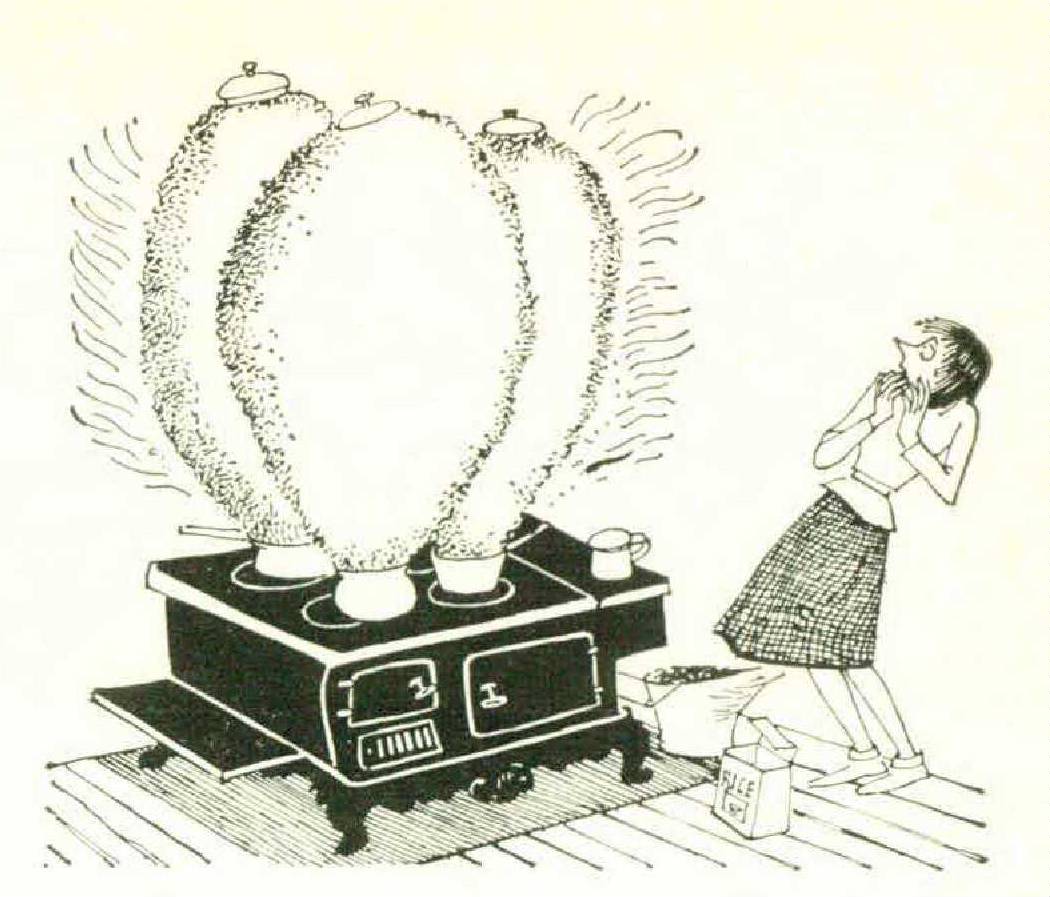
A very peculiar sound greeted me on my return, a sort of gentle little pup, pup, pup. The lid of the saucepan rose a bit with each pup. I was shocked when I lifted the lid to see that the pan was solid with rice that wasn’t even cooked but still seemed to be rising. I emptied half the rice from that pan into another and again filled both with snow-water. It wasn’t any time at all before both were going pup, pup, pup. The bulk of the rice was increasing at such an alarming rate I could hardly keep up with it. All the saucepans in the cupboard (five) were full — and rising — when I sacrificed the dishpan. Luckily, by then the rice was nearly cooked. At about that time my two friends came back. They stood in the doorway, horrified. “What is all that?” said Betty. “Where’s the chicken?” said Peter. The chicken was delicious. So was the rice — that night. But two days later, none of us could even bear to mention it. We ate it for every meal, with prunes or raisins in it for breakfast, in soup for lunch, just plain for supper. The dishpan was still full. Peter disappeared with it just before we left. I never did ask him what he did with it, but he took the path to the outdoor loo.
Occasionally I’m haunted by a strange nightmare. I am plodding along through a vast white landscape — mountains and hills covered with snow. I’m very cold and tired, and it gets harder and harder to move one foot in front of the other. Suddenly I look down and lind that I’m not walking through snow at all but through mounds of cold rice.