The Blue Ridge Parkway
pleasures and places
BY JOHN T. STARR
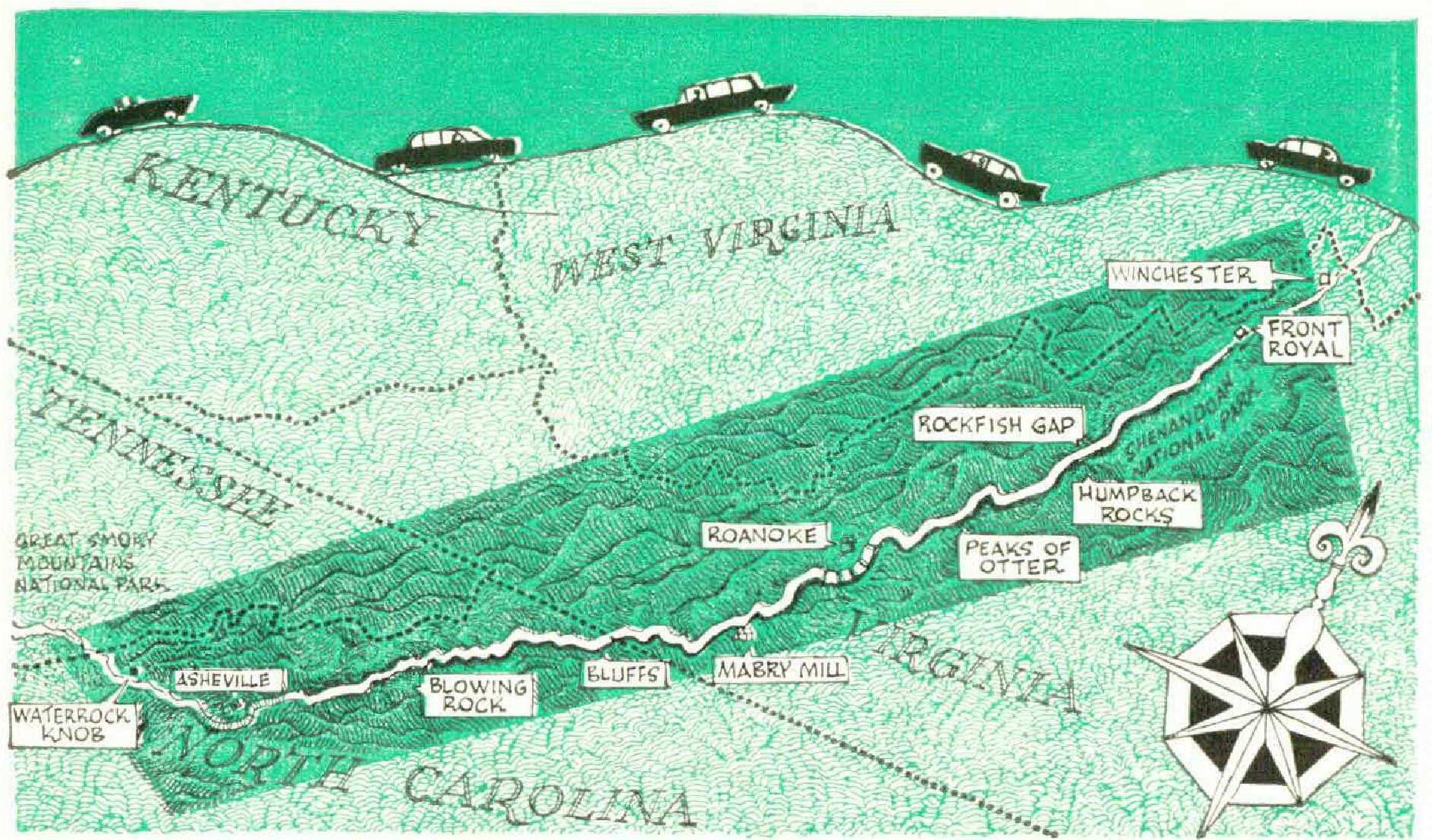
I have driven on the Blue Ridge Parkway many times in the last ten years, but I find that I look forward to a trip over it with as eager expectation as ever. I love mountains, and this road makes easily available some of the most spectacular mountain scenery in the Eastern United States. It follows the crest of the Blue Ridge in Virginia and North Carolina. Eventually to be 469 miles long, it will connect the Shenandoah National Park with the Great Smoky Mountains National Park. About 400 miles of the road has been completed, and the only important parts yet to be built are a section around Roanoke, Virginia, and some stretches south of Asheville, North Carolina, much of which is already under construction.
The Parkway is a vacation road. It is designed for the motorist who wants to get away from truck-crowded highways and who is in no particular hurry. Speed is restricted to 45 miles per hour, and there are few who want to drive faster, for the road is almost constantly curving, first opening up views on one side, then on the other. At intervals there are overlooks with parking areas. Often set like balconies into the mountainsides, they are perfect for looking down into the deep coves or at the jumble ol mountains, which in some places crowd close to the Blue Ridge.
The Blue Ridge Parkway is really a continuation of the well-known Skyline Drive, which runs the length of the Shenandoah National Park, but officially it begins at Rockfish Gap, Virginia, where highway U.S. 250 crosses the Blue Ridge. Off to the east, 20 miles away, is Charlottesville, with Jefferson’s home, Monticello, and Monroe’s Ash Lawn. Richmond is 66 miles beyond. About 15 miles to the west of Rockfish Gap is Staunton. This town, the birthplace of Woodrow Wilson, is on the famous Valley Road, which is now highway U.S. 11.
The miles are numbered on the Parkway southward from Rockfish Gap. Six miles along the way (at Mile 5.8, to be exact) are the Humpback Rocks — huge pinnacles projecting upward from the mountain ridge — with a pioneer mountain farm nestled almost in their shadow. The farm buildings, which were gathered by the National Park Service from here and there in the mountains, have been put together to show visitors how the mountain people lived and, indeed, how a good number of them still live. The log structures are almost all roofed with wood shingles, laboriously split by hand from white-oak logs. The barns and corncribs are small, because crops were small. They have never been painted and have weathered to a silvery gray that shines in the sun.
As my family and I explored this farm one afternoon, we could picture the life of the Blue Ridge people. The living was not easy. The Blue Ridge might be in the South geographically, but the winters can be hard, and snow is not unusual. Heat was from an open fire; th sleeping quarters were, more times than not, a cold loft; water came from an outside well. I find that I am using the past tense, but there are people who still live in these mountains in much the same way. Over in the next valley there may very well be a family living on a farm like this.
Beyond the James River are the Peaks of Otter (at Mile 84), conical peaks extending above the mountain mass. Several years ago, a herd of elk was brought from the Rocky Mountains and introduced into this area. But the herd has not increased as had been hoped. In fact, the Park Service people fear that its numbers may have fallen off. An elk is a fine, large animal, and to many mountain hunters with large families to support, shooting one means a lot of meat on the table. But to the tourist the elk are worth watching for.
South of Roanoke and not fat north of the North Carolina line is the Mabry Mill, one of the Blue Ridge Parkway’s feature attractions. This old, weather-beaten structure was built by one Ed Mabry, an enterprising mountaineer, who operated it for many years. In addition to his mill, which is powered by water collected from a number of springs by an ingenious arrangement of wooden flumes, Mr. Mabry ran a blacksmith shop, boiled sorghum juice into syrup, and even made a crude sort of soap. This industrial complex has been maintained by the National Park Service.
As often as I have seen the Mabry Mill, I seldom pass it by. For one thing, the mill is usually running, and there is the opportunity to buy sacks of water-ground cornmeal and buckwheat. The best griddle cakes and corn bread are made from waterground meal. Mountain-made blackberry syrup is often on the table at breakfast time in some of the eating places along the Parkway, and bottles of it can be bought at gift shops and some of the small country stores along roads that cross the Parkway.
In North Carolina the country is higher, more rugged, and even more sparsely settled. The Parkway skirts, in places, the edges of precipitous bluffs which fall sharply away into deep valleys. This is rhododendron country. The mountains are almost covered with rhododendron bushes, and in June they come alive with purple, red, and white blossoms. June is not the only colorful time of the year, though. All during the summer, flowers bloom along the Parkway — black-eyed Susans and yellow coreopsis in July, rich orange snapweed and the rare cardinal flower in August, asters and goldenrod in September, to mention just a few. In late September the deep red of the black gum and dogwood begin to change the green forest, to be joined in October by the yellowbirches, the gold of the tulip tree, and the orange of the sassafras. By mid-October the color is at its best, and this is one of the most delightful times of the year, but in a few short weeks most of the bright leaves will have fallen.
The Blowing Rock resort area is at Mile 295. This is an old-time western North Carolina vacation center located high in the mountains at a 4000-foot elevation, and it was popular long before the Blue Ridge Parkway was thought of. It is a good place to stop overnight.
Not far away is the town of Boone, where nightly during July and August Horn in the West is shown. This is one of the many outdoor dramas in the Southern Highlands. It tells the story of the pioneer people who settled in these mountains and as the folder describing the play puts it, “carved freedom out of tyranny in a wilderness that is now the very ground on which you rest your feet.” This is a highly professional production that has been running for ten years, and it is worth seeing. Another outdoor performance that must be mentioned is Unto These Hills, which plays nightly during the summer, except Monday, at Cherokee near the southern end of the Parkway. This, too is thoroughly professional.
Just south of Blowing Rock is Grandfather Mountain, where a toll road goes to a point near the top. At Mile 355.4 a free road (North Carolina Route 128) goes to the Lop of Mount Mitchell, 6684 feet above sea level —the highest mountain in the East. The views here are magnificent.
The whole southern portion of the Parkway is spectacular, with the elevation of the road itself exceeding 5000 feet in a number of places. From Waterrock Knob overlook, a four-state view—North Carolina, Tennessee, Georgia, and South Carolina— and a broad panorama of the Great Smokies are possible on a clear day. South of here, the Parkway loses altitude rapidly, dropping down as it passes through the Cherokee Indian reservation, so that when it reaches its end at highway U.S. 441 in the Great Smoky Mountains National Park, its elevation is barely 2000 feet.
But with all its appeal to those who love magnificent scenery, the pioneer past, and, perhaps most of all, the getting away from truckinfested highways, the Blue Ridge Parkway has one serious drawback, a scarcity of really first-class accommodations. The cities of Roanoke and Asheville have excellent hotels and motels where almost any taste and pocketbook can be satisfied, and the village of Blowing Rock has a large number of motels. Good food, too, can be found at these places. But in the long spaces between, one can have difficulty.
The Bluffs Lodge at Mile 241 is superbly situated high on the crest of the Blue Ridge with a long view off to the east. This is a popular stop, and its twenty-four rooms are often taken early in the day. The rooms are well furnished and comfortable, each with tub and shower. Prices are $7.00 for one and $10.00 for two, with extra beds available at $2.00 each. Since the lodge is heated, the season extends from May through October, making it a good central point for both rhododendron and fall foliage excursions. For reservations, the address is Bluffs Lodge, Laurel Springs, North Carolina. A nearby coffee shop serves good food, specializing in Southern Highland cooking. Especially good are the country ham — the real salty kind — and the buttermilk biscuits.
For further information on the Parkway, write to the Superintendent of the Blue Ridge Parkway, National Park Service, P.O. Box 1710, Roanoke, Virginia.