The Dog Race
The theater, poetry, and rebellion are quick in the blood of BRENDAN BEHAN, the Irish playwright; and in this episode drawn from his volume of reminiscences, BRENDAN BEHAN’S ISLAND,illustrated by Paul Hogarth, which is to be published this month by Bernard Geis Associates, we see the lively, colorful background from which his writing has emerged.
BY BRENDAN BEHAN
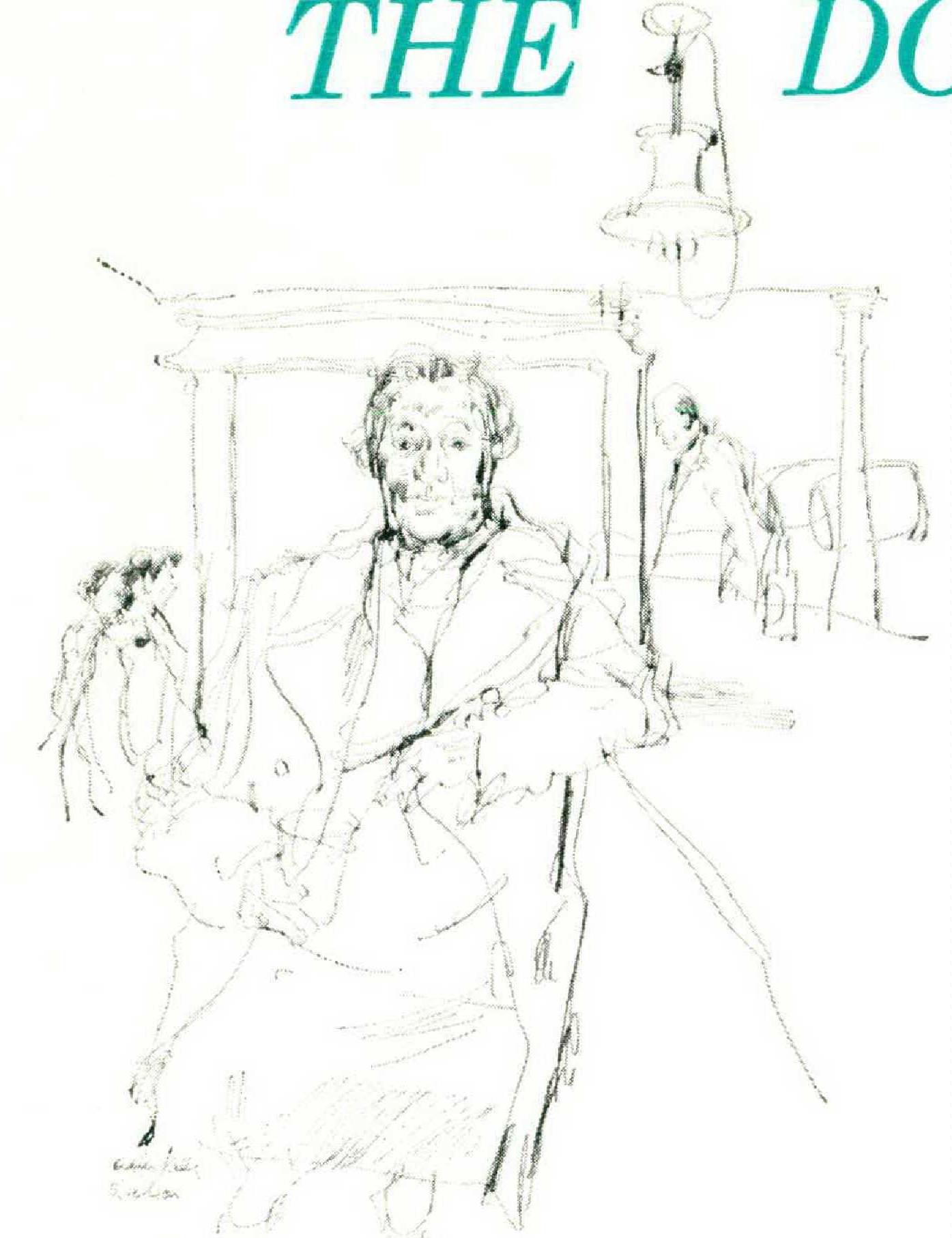
YOU’LL meet all our native writers at the races — both horse and dog. There, at least, I must allow them a purer passion than the interest English Tory writers, bred in the hunting country of St. John’s Wood, pretend in horse and hound. The Irish writer goes to the racing for the drink; and for outdoor drinking and intellectual conversation, it’s hard to beat the dogs. Coursing is the best because you can stand in the tent and see the whole course without moving out at all.
I believe with Lenin that the main object of all political activity should be the abolition of the village idiot; and the inefficient attempts of two greyhounds to turn a hare, which nearly always finishes in the hare’s being torn to bits, is sufficient excuse for me to retire to the whiskey tent and give myself an anesthetic against the horrors and the screams outside.
I spent a day at a coursing meeting on the Boyne, with a priest of the Irish College in Paris who translated the verse of Paul Éluard, and saw him nod his head with a sad smile when someone remarked that a hare seldom lived more than a day or so after a course, even when it got through the escape and into its enclosure with the other refugees, from the shock it had to its nervous system.
One of the honorary writers said they should have a psychiatrist for the hares on the other side, and there was a general guffaw in which I joined. Not because I thought it was funny or because I approved of torturing clean fine beasts that did no more than nibble a piece of grass and sit peacefully on their forms in a field. I do not enjoy the track racing so much, not, indeed, that I miss the screams of the live hare, but there is less time for drinking and conversation and watching and listening to the honorary writers and overhearing their lying stories of high life in Paddington and the time they got drunk with the literary lady: Hey, shewer, as shelter as yewer settin there, May Deeditt turns rowend, hey, bedad, and she says, says she, “What matter about iz hevin the melodic line, if we hev the drink?” Hey, bedad, iz what she said.
At the track, one misses all this, and the only time an opportunity for conversation presented itself on the occasion of a track meeting, there were so many deathly pale countenances in the bar, among the real dog men, that we all, myself and the honorary writers, had to join in the long and bitter silence, broken only by the music and song coming from the track across the road:
Oh, make us love Thee more and more. . .
“Sweet Heart of Jesus,” muttered an elderly bookmaker, “are they going to be there all night?” And added to the barman, with resignation, “Bring us another, Mick.”
I did not look even at May Deeditt’s melodic china, for the gloom and angst at my own table would have done credit to Kafka, and any little quip on my part about the time I dropped the jeton into Jean-Paul’s soupe de l’oignon (being an urban and more traveled liar) would not have been well received.
This was an occasion when, in that bar, opposite Grangegorman Race track, all and sundry sat in a deep and despairing gloom. At my own table, where I sat with the Platinum-headed Trainer and the Owner, my hand shook as I raised my tumbler to my mouth. For this reason: our dog, which I shall call Molloy, was not thought much of against the favorite (called the Hero of Seventeen Ninety-eight), and the Platinum-headed Trainer and the Owner had decided to have a coop about him, by causing him to run very quick indeed in this race, beat the opposition, and make him win an awful lot of money for anyone with the foresight to bet on him with the bookmakers sometime before.
Now, I have experience about stopping dogs. I know nothing about horses, dogs, or cabbages, except to look at or eat, but I had the privilege of working for, and still have the privilege of knowing, a famous London burglar and smuggler who did a very successful job of dog manipulation. A slum and underprivileged child like myself, he knew nothing of agriculture either, but with the simplicity of a corner boy he got over a fence at a London track and removed a board from the back of two kennels, fed sausage rolls and saveloys to the occupants, and then went out and backed the third and made a whole lot of money. He did this many times, till they started building kennels back to back, surrounded by electric wire, and lit up all night like a German concentration camp.
But here in Ireland there was a difference between a man’s stopping someone else’s dog and giving something to his own to stimulate its running. It was often done, and once the beast was removed from the track without being taken over by the stewards and having his spit analyzed, there was no danger. But in the case of the stewards’ having their suspicions aroused, not only was there a danger but a positive certainty of a criminal charge against the trainer and owner and a sentence of at least twelve Irish calendar months from the judge — and a longer sentence if it so happened that the judge had been at the track that night and had backed something else in the same race.
The Platinum-headed Trainer had a doctor friend who frequently advised on matters of stimulation, and he had come from Liverpool (another city of doggery and boggery — poverty-stricken kips, every one of them) with a preparation used in heart cases that worked scientifically and accurately in stimulating the running of a greyhound if timed and measured in the proper quantity.
This mixture was tried and found to be indeed the thing for making quick greyhounds quicker, and it worked like magic. In the words of the poet, this dog Molloy would meet himself coming back, after judicious injection. But one of its magic properties was that after it worked to its peak capacity, it was static for a moment or two and then began to work in the opposite direction, making the poor dog very tired.
That evening I called down to the kennels and, by appointment, met the Platinum-headed Trainer and the Owner. They sat by Molloy with a wristwatch, and as the bells chimed the Angelus from the city churches in the distance, the Platinum-headed Trainer raised his hypodermic needle, lifted the dog’s right rear leg, and intoned: “Stand aisy, you,” pressed his needle into the great vein, lowered the dog’s leg, and said: “That’s that.” It was twenty miles to the track, and we were to leave in our entries with the kennelmen at the track one hour before the first race, which was at eight o’clock.
Molloy was in the second race, at eight fifteen, and his dose was scientifically measured to put him in peak speed at that time. He would continue to be very lively for a while after that till he could be collected with the winnings and brought home. Fifteen minutes it would take until he got drowsy and sleepy, falling finally into a deep coma from which the noise of a hydrogen bomb or a Redemptorist preacher would not wake him. By that time, we figured he would be safely tucked up in the back of the car, bowling home on the rocky road to Dublin.
WE STARTED off in great form and went out through the Phoenix Park, which is especially lovely on an April evening, and where you can see the deer in the distance and maybe the first of the squirrels, and fellows and girls locked together in the long grass and giggling and squirming, and taking no notice whatever of the Lenten regulations, which in our diocese ordain that there shall be no mixed laughing during the seven weeks.
We came out on the Chapelizod Road, past that place on the Liffey’s banks where Tristan and Iseult rested a while, if you can call it resting, and not far from that other spot notorious to all culture vultures, under the Magazine Wall, where Humpty Dumpty had a great fall in Finnegans Wake by the Rev. Seamus O Seoighe, 1 S.J., (ret.). And all passed off very civil in our motorcar, with Molloy there sitting up at the back with his little cover on his middle and panting away there like a whore on duty — which is a known thing that if the slowest greyhound in the world saved his breath and became a total abstainer from panting and licking, he would save that much energy that he could look back and shout “Come on” to a cheetah instead of, as happened when the matter was put to the test, the cheetah’s jumping impatiently over the greyhound to get home.
The next thing I’m looking up at a banner spread across the road which reads: “God Bless Our Lord.”
I chuckled, a thing I don’t remember having done before, and went to say something, but the Platinum-headed Trainer looks around from the front seat and putting up a warning finger says, “Nark it, Brendan, nark it.”
“Yes, you better,” says the Owner. “It’s not a lucky thing to mock religion and we going out to do a stroke.”
I subsided; and then we came to another one, which read: “Grangegorman Stands By The Rosary.”
Ah, ‘twas then I fell in. There was this priest was over from Hollywood, America (I do not say that “America” from affectation as if none of us had heard of Hollywood before — some of my best friends are Hollywoodians — but there is also Hollywood, County Wicklow, and Hollywood, County Down, and I’ve a reason for making this clear), and he was preaching what they called a Rosary crusade and had been received, like Billy Graham, with great rallies all over the big cities of the States — Boston, New York, Philly, Chi, L.A., etc. — and in London, where, now I come to think of it, he held a huge rally at Olympia; but for some reason he had never held a meeting in Dublin. Many of the faithful wondered why this was, and some made out it was because the ecclesiastical authorities here did not like his technique; and now there was this little town of Grangegorman giving us in Dublin the rub — that they, the people of Grangegorman, stood by the Rosary whatever the bigcity freethinkers or the narrow-minded municipal Jansenists might do.
As we came nearer the town, it was obvious that they were having a big rally that very night, and as we approached the dog track I laughed, but fearsomely and with covert glances at my unsuspecting companions in the front seat and with sympathy at poor old Molloy beside me. There was bunting and flags and little altars, and all that lively grandeur of an Irish religious festival that gives bad Catholics like myself the totally unearned satisfaction that ours is the church of Raphael and Leonardo, and, indeed, as I remarked to Hannen Swaffer when he told me he was a spiritualist, we keep a better type of ghost.
“Listen,” I said, “I think they’re holding a Rosary rally.”
“Look here,” said the Platinum-headed Trainer, “it’s no skin off your nose what they’re holding.”
We came nearer the track, and the bunting was intensified, and a big banner left over from the Eucharistic Congress of 1932 was stretched across the avenue leading to the gate. It showed St. Patrick with green whiskers and a big fat snake the width of a porter barrel trailing after him, and under it was written, “Fáilte, a Thighearna um Cháise,” which means, “Welcome, O Lord, at Easter”; only the fellow had made a mistake in his Irish and had written, “Fáilte, a Thighearna, urn Cháise,” which made it read, “Welcome, O Lord, at cheese.” I said nothing about that and only tried to warn the Owner: “But they’re holding the rally at —”
“Listen now, and for Jesus’ sake and for the last time, it’s all bloody equal to you where they bloody well hold their bloody rally. They’re not interfering with you, and they’re not asking you to go to it, and you know what these country people are. I suppose you want to get us run out of this kip the way you got us run out of Belcuddy the time you started arguing the toss about Ireland being sold to the English by Nicholas - stick that you said was a Pope.”
“Nicholas Breakspear.”
“Nicholas anything you like. Didn’t the man prove to you there was no Pope called Nicholas anything, and now you’re trying to get us pitched out of this place.”
“I’m only trying to tell you that this Rosary rally is being held in —”
The Owner turned and roared at me: “I don’t care a fiddler’s damn where it’s being held.” Then he softened and said: “Now, keep easy, for Jesus’ good sake, till I hand this dog over at the track here.”
I sighed and held my peace, and we went over and through the owners’ gate and into the kennels.
Molloy was jumping up and down, and he was a pleasure to see, making the other old bowlers look like an advertisement for Bile Beans.
The chap at the kennels took the dog, wrote in his book, and looked up: “Youse know, of course, about the Rosary rally, men?”
The Platinum-headed Trainer and the Owner smiled ingratiatingly and said: “Ah, yes, a great thing, too. I mean, I’m not overreligious myself, God forgive me —”
The kennelman nodded soothingly. “Er-emyes-er-em-we-all-shure-er-em-err —”
“But it’s a great thing all the same. A man all the way from America.”
“Ah, yes,” says the kennelman, “shure we told the priest when he asked for the loan of the track. ‘The dog men,’ says we, ‘the dog men, they may take an ould jar and that.’ ”
“True,” said the Platinum-headed Trainer, owning up to it. “It’s true for you.”
“ ‘And sure,’ we told him, ‘they may have their faults, but there’s not one of them will begrudge you the track for such a good purpose.’ And after all” — he turned to us — “it only means putting racing back for an hour and a half.”
“What?” asked the Platinum-headed Trainer.
“What?” asked the Owner.
“They’ll only have the track for an hour, and all races are put back until it’s cleared.”
They nodded and went toward the gate without saying anything, with me following. As he let us out, the kennelman said, “I suppose you can kill an hour in the hotel opposite”; and he smiled and added, “Some of the dog men are going to pass the time even better — by coming to the rally.”
We went into the hotel, and the Owner, always a fair man, said: “Two glasses of whiskey and a glass of gin and tonic.” The gin was for the Platinum-headed Trainer, who had spent some of his time among the Anglo-Irish of Scotland Road, Liverpool.
“I can see us eating an awful lot of porridge,” said the Owner, “when they find that dog asleep in the kennels at racing time. Twelve months !”
I went out during the rally when they had really got down to the business — praying hard, fervent whispers coming from thousands of voices in the dark. The Platinum-headed Trainer and the Owner looked crazily at their malt and gin when I came back a short while later half dragging the dog and beckoning them out urgently.
“Into the car, tor Christ’s sake,” I roared, and off we got.
“I went to the kennels and told the kennelman that the dog would start barking at a quarter past eight and start all the other bloody dogs barking too. The bastard gave out that it would be against the rules of the Greyhound Association to hand out the dog till after the race, but I told him he thought more of his Greyhound Association than he did of the Catholic Church, and that I wasn’t going to stand for an unseemly disturbance during a solemn part of the Benediction, and that I’d complain to the American priest about him. So he gave me the dog, and I’m to bring him back when the rally is over.”
“Thanks be to the good Lord Jesus,” said the Owner fervently, and the Platinum-headed Trainer crossed himself and said: “Amen.”
We stopped at numerous pubs on the way home, and I was permitted and, indeed, if I may say so, encouraged to sing several blasphemous songs.
But our poor oul’ slob of a hound, fast and all as he might be with the help of the few jabs or a couple of pellets, was nothing compared with the fastest greyhound that ever lived — Master Magrath, stuffed now in Kensington Museum (and would to God that we were too):
And swift as the wind o’er the green field she flew.
But he jumped on her back and held up his paw —
“Three cheers for old Ireland,” says Master McGrath.
- James Joyce.↩