I'm Sorry, But..
C. S. JENNISONwrites light verse and prose with equal facility and is a frequent contributor to the ATLANTIC and other magazines.
Every profession has its zealously guarded trade secrets. If you don’t believe me, ask the famous artist how he mixes his paints, or the successful chef how long he simmers his beef stroganoff, and see how much satisfaction you get. Chances are ten to one that your questions will be met with practiced and masterly evasion.
I’ll give you a couple of examples.
Last Tuesday, we were having a problem with our upstairs plumbing, and when the plumber arrived in Due Course and a new Impala (which is what plumbers always arrive in) I led him hurriedly up to the bathroom.
“I wish you’d tell me,” I said, “why we have a regular torrent of water coming through the livingroom ceiling.” The plumber thought for a moment.
“Sure, I’ll tell you,” he replied. “It’s because it’s so deep on the floor up here.”
See what I mean about evasion? The man wasn’t about to let me in on the mysteries of his chosen calling.
Later, by sneakily leaving the bedroom door ajar and watching the plumber through a clever arrangement of strategically located mirrors, I saw him nonchalantly tighten a loose pipe behind the washbasin, thumb through an old copy of Life that was lying on the windowsill, take a nail file from the wall cabinet and lovingly clean his fingernails, and spend ten or fifteen minutes observing the passing traffic through the window. Then he walked out into the hall, where I met him, and said he’d finally located the trouble and — let’s see — that would be twelve dollars and forty-three cents for labor and parts.
The same day, I took my car to a service station, because the little red disk on my dashboard marked “GEN” kept lighting up. The garageman said it was a lucky thing I’d brought the car in, since anyone could see my generator wasn’t working properly. He then checked the oil and water, asked me to run my motor, made a phone call, bummed a Pall Mall from a passing mechanic, and, when he thought I wasn’t looking, hit a small black box under the hood three or four times with a wrench handle, at which point the generator light went off. While I was paying the garageman the fixe dollars I owed him, I asked what was wrong with the generator.
“That’s just the way generators are, lady,” he hedged, pocketing the money and disappearing in the direction of the Coke machine.
Well, now that my living-room ceiling has dried out and I have learned to carry a pair of scissors around in the car to tap that black box under the hood when the generator light goes on, I don’t judge the plumber or the garageman too harshly. After all, as an unharried housewife in a world of Pressing Community Projects, I have my own little trade secrets and areas of evasion. For years, people have been trying to find out how I managed to remain uninvolved in public works, but up until the present time I have simply smiled enigmatically and avoided the issue. Like the plumber and garageman, I knew that if I exposed my private methods to the world at large, I would render the methods useless to myself. Because of a recent move to a new city, however, I feel I’m now in a safe enough situation to tell all, even though the information I’m about to impart will endear me to no one in my former neighborhood. In fact, in a small way, I’ll probably be putting myself in much the same position Thomas Wolfe did when he wrote You Can’t Go Home Again.
Before I go any further, I want to point out that nearly every modern wife and mother at one time or another finds herself up to the armpits in a quicksand of hometown activities and enterprises. Far from being the captain of her own soul, she isn’t even the third mate; she’s a deckhand. I know whereof I speak. Eight or nine years ago, there was a desperate period in my life when I was secretary of the P.T.A., food buyer for the school hot-lunch program, chauffeur for the girl scouts and Free Dental Clinic, treasurer of the local Republican group, head of the Red Cross drives, chairman of the church Ways and Means Committee, president of the Country Culture Study Club, and — oh, yes — director of the yearly lawn party for the Youth Center.
I won’t go into the time consumed by each of these separate duties, but let’s just take the lawn party. In an attempt to make the occasion festive, the various booths and tables were painstakingly decorated with colored crepe paper, an orchestra was hired for dancing, and other fundraising ideas included a grab bag, a raffle, a white-elephant auction, a food sale, a candy booth, and a bingo game. Along with organizing the party, helping to tack a flock of inflammable streamers around the place, and supervising the grab-bag concession, I had to bake six pies for the food sale, make three boxes of fudge for the candy booth, contribute prizes for the raffle and bingo game, give five dollars toward the price of the orchestra, and collect and donate items for the auction and grab bag. The second year I was in charge, the lawn party netted the Youth Center around fifty dollars, which, for some obscure reason, was about what I figured I had personally put into the affair, in the way of cash alone.
Right then I decided things had gone too far, and I began struggling to formulate some sort of Community Nonparticipation plan. At first I tried greeting the continuing pleas for aid and succor with legitimate excuses, but this approach got me nowhere. When I explained that my family needed me and that I was tired and my arches were sprung, the other women said their families needed them, too, and they were tired, too, from their exhausting trips to Florida and all, and couldn’t I help out again just this once? After a number of sleepless nights, during which I wrestled with my conscience and talked to the walls, I eventually came to the inevitable and reluctant conclusion that I would have to take more drastic measures. In order to extricate myself from the morass of organizational activity in which I was wallowing, I realized, there was only one thing left to do. Lie.
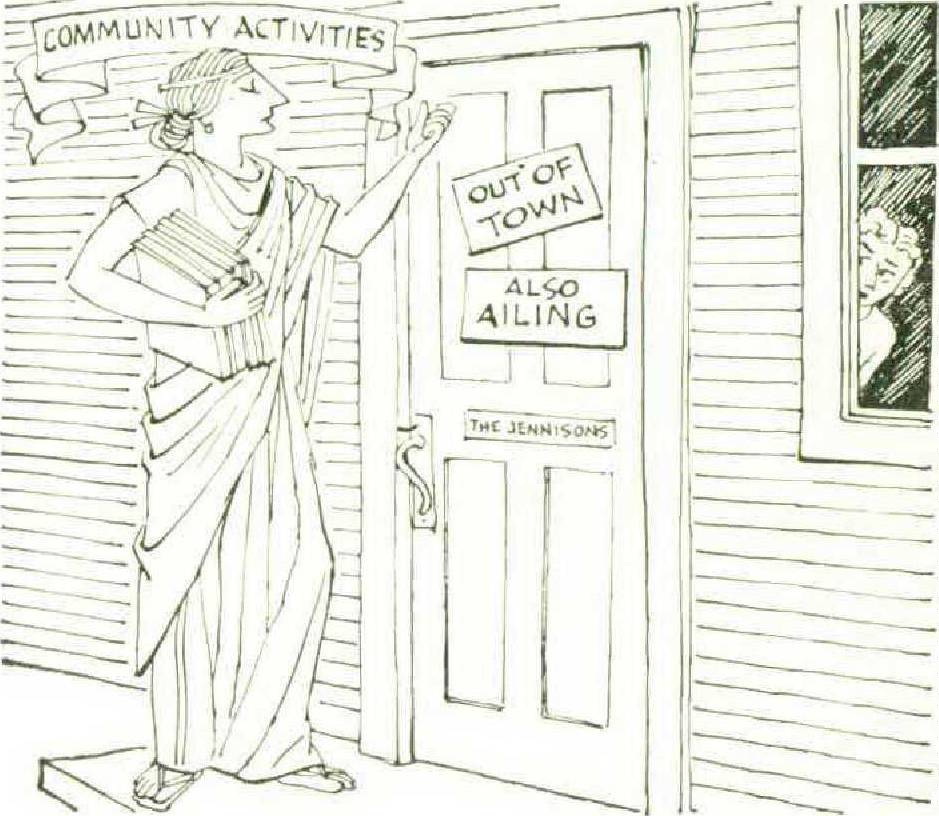
That’s right. Lie. It’s a rule that takes a fair amount of initial fortitude to follow, but once you get the hang of it, it’s easy. So don’t shillyshally. Make up your mind to start practicing right away. The next time you’re asked to bake cookies for the Croquet Club food sale or whip up a pair of new curtains for the high school washroom, say you’d like to do it, you really would, but you’re afraid it won’t be possible. Then lie. Only remember that Just Any Old Lie won’t do. For instance, never say that your Aunt Agatha is visiting from Alaska, because invariably your mythical aunt will be pressed into service as well, and you’ll end up making an extra batch of cookies and a second set of curtains to cover your unplanned prevarication. Experience will soon teach you that there are only two lies that are dependable and irrefutable. One is that you’ll be out of town, and the other is that you have That Bug That’s Going Around. Nobody can prove you won’t be out of town, and being at the mercy of the current vague and peripatetic bug will preclude your presence at even the worthiest local function.
That’s all there is to it. Simple, isn’t it? I suppose I could make a lot of money for the new Rabies Clinic or the Home for Wayward Fathers by going on a lecture tour and telling the nation’s weary housewives the secret of my success. And I’d like to do it. I really would. But I’m afraid it won’t be possible. You see, next month I expect to be out of town, and right now I’m laid up with That Bug That’s Going Around.