Where Does It Say That?
GURNEY WILLIAMS is editor of cartoons for LOOK and has written several light articles for the ATLANTIC.
Lunching today in a restaurant, I witnessed a phenomenon. At the next table sat a man and a woman. A waiter approached, handed each a menu, and stood patiently by. The woman placed her copy, unread, face down on the tablecloth and rummaged a package of cigarettes and a lighter from her handbag. The man glanced briefly at his menu and said, “I’ll have the roast beef.” Without hesitation, the woman said, “I’ll have that, too.”
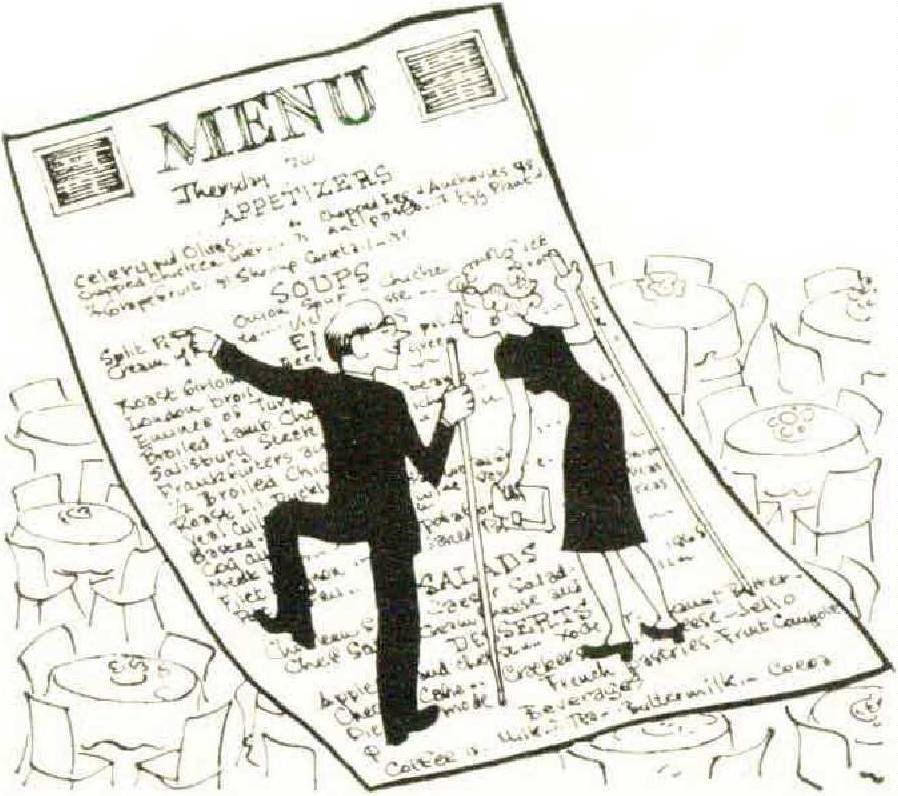
While this performance may not have astounded you, it seemed remarkable to me because it was the first time I had ever heard any variation of the following pre-order skirmish.
DINER (to companion). “I think I’ll have the leg of lamb.”
COMPANION. “Lamb? Where does it say that?”
DINER (pointing). “Right here; third item from the top.”
COMPANION. “Third — oh. That looks good.”
I mean, I continue to wonder why it is necessary to see Baked Idaho Potato or Rice Pudding or Flamhon au Jambon D’or in cold type before deciding that it “looks good.” Some people say it “sounds good.”
My Aunt Daisy, a classic exemplar of this restaurant foible, goes one step further. In addition to “Where does it say that?” (Chef’s Salad) and “That looks good,” she asks the waiter’s opinion of it. I am looking forward to the day when she will be told flatly that the chef came to work with a monumental hangover, scooped the spilled salad ingredients from the floor, and mixed everything by hand in a cardboard container while wearing his gardening gloves.
Even worse —and certainly more realistically — I can envision Aunt Daisy lunching alone in a little place I frequent which has no menu at all. You just sit down and the waiter tells you what is on hand for the day.
I see it this way.
Aunt Daisy, shown to a table, requests a menu. Told that there is none, she seems bewildered. “Well, then,” she asks, frowning, “how am I going to know what I want?”
The waiter reels off the specialties, of which Aunt Daisy remembers only the fried chicken.
“Where does it say — I mean, can I see it?” she inquires.
“See it?” repeats the waiter. “You want to see the chicken before it’s fried?” He looks with some desperation toward the door, perhaps hoping that an inebriated patron will enter and require the services of several waiters to eject him. Any such diversion would be preferable to Aunt Daisy, he tells himself.
“But,” Aunt Daisy continues, “how do I know if I want fried chicken unless I see it on the menu?” She is now thoroughly confused. “That is, how can it look good when —”
It would be cruel to go on.
I’ll close quickly by saying that the next time anyone asks me where it says Club Sandwich, I’m going to say, “Here. Looks good, too. All twelve letters of it.”