The Critic Art
BY A. C. GREENE
A few years ago I was appointed a sort of catchall critic on a small-town newspaper. I was worried, at the start, because my reviews seemed to lack the professional aesthetic tone achieved by my big-city and periodical critic compatriots.
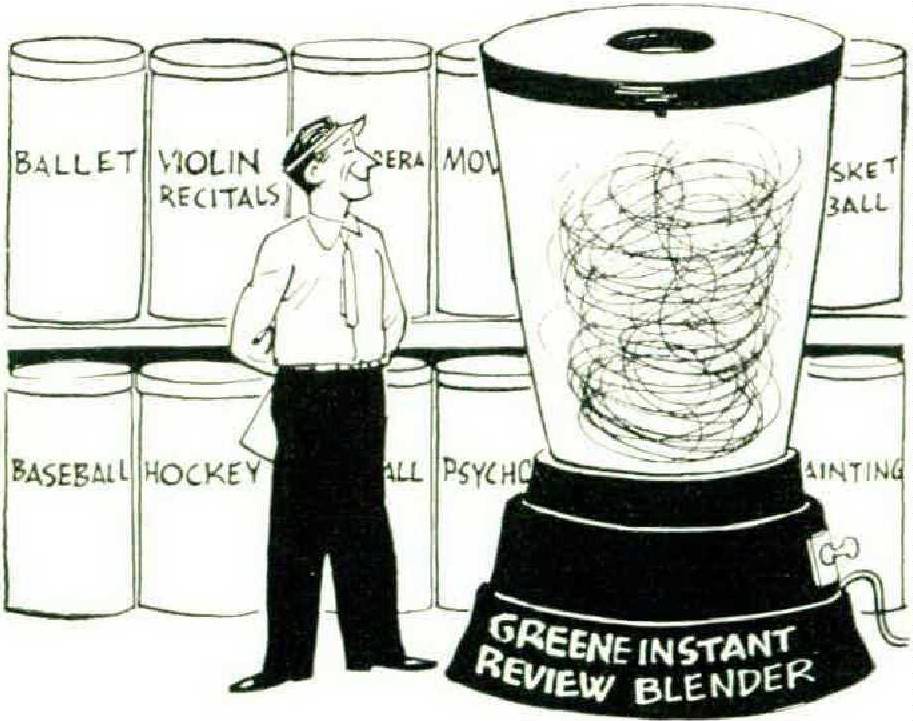
As so often happens in life, I discovered the solution to the problem too late to help my own cause, as I stopped being a critic. However, in case others face the need to write (or read) contemporary criticism, let me say that the solution is fairly simple: review one medium in terms of another.
For example, you are doing a criticism of a symphony orchestra concert. Then write in terms of a painting exhibit: “Maestro Pogany worked from a muted palette, applying first an underlayer of brown tones with a somber display of Tuonela, then adding pastels with a brace of French modernists.”
The technique is even more adaptable to soloists:
“Using lighter strokes as he sketched in the fugue, Violinist Hraknurv flew across the central figures, splashing primary colors as he went, doodling for a moment in contemplation of the coda. . .”
It is a shame that you cannot simply reverse the process and apply musical terms to painting, but it isn’t done. Musical terms have been appropriated by the architectural commentators. (There aren’t very many of them, so you might be able to get away with thieving the semantics, if there is no question of your conscience.)
“On the other hand, Blatburg often described Shambles House, the now famous étude in tonality which he achieved shortly before the ‘Dancing Mud’ motif began dominating his composition, as ‘staccato in conception but legato in execution.’ ”
If colored photos accompany the piece, particularly blobby night shots, then another type of architecturalmusical vocabulary is used, which, for purposes of identity, I privately call “lifetime" style:
“High above the growling bass of the traffic at its feet, the golden soprano of the Knifegrinders Trust and Mercantile Bank soars into lilting, spatial lyrics of almost Wagnerian power.”
Poetry nomenclature is also employed in architectural criticism, but I, for one, think this can be disregarded. Poetry nomenclature is used in just about all forms of criticism. Frankly, I predict that, if it is not already old hat, poetry nomenclature in criticism soon will be old hat — even for small-town newspapers.
Having mentioned painting, I’d best get it out of the way. Working painters usually wear old clothes and go sockless, and I have found that any of the arts which arc practiced in this way are usually handled in either psychiatric or philosophical jargon:
“But why this instinctive groping toward womb acceptance in the work of Von Shinier? One must look for total disappearance of entity into the symmetry of his bold withdrawal in rejecting the whole society of his predecessors to achieve the fluid empathy his canvases cry out for with their huge areas of nothingness and inchoate movement.”
Now and then, in the thinner magazines, is a tougher, more personal kind of philosophy-art criticism encountered:
“Then this critic said to Normuh Sklizk, ‘No, damn it, no. He can’t confuse life with living. He absolutely has not the authority to tell me I am a man.’ Which, of course, is exactly what Composition #9 by Northwest tries to do.”
Most critics who write in the first person are pretty tough, philosophically speaking, regardless of the field:
“As music, it schizzed — and I failed to derive inwardness from it. . . .”
“Sometimes I ask myself, ‘Can he have read Kierkegaard? Can he? Can he? And then go on such a metaphysical binge as the spiritual spewings of his quasi-novel, Spluster’s End?’ ”
Ballet criticism has preserved a certain purity, but in some instances use can be made (I’m quite serious) of sports writing:
“The corps de ballet, having kept the spectators in the tense mood created when the principals left the field, itself retired, and there was an unbearable moment before Undaluva came leaping onstage in a wild burst of footwork, whirling across the arena until we, whose memories go back that far, were holding our breaths, half believing, half fearing that another Nijinsky was about to score.”
Actually, ballet criticism is based on two simple points which, if kept in mind, reduce it to routine: never say anything was bad, except in French, and always mention Nijinsky.
Book reviewing is a troublesome, nonprofit sort of work at best, and for my part, I suggest not dabbling in it. However, on a now-and-then basis it seems best handled, currently, from a tauromachian frame of reference.
“Having disposed, in his first two chapters, of the picadors (rather crudely draped under the Freudian cloak of a double seduction, this reviewer thought), O’Malville then blows a tremendous deguëllo in chapter three, ushering in his beautiful afternoon of sangre y arena, leading, predictably, to the moment of truth in which his protagonist sees his own soul, and Dorothy’s, passing irretrievably through life, as it were, in a series of poorly executed veronicas.”
You may ask, where, then, does the critic use literary terms? Serious students of LP records can answer that instantly — modern jazz reviews:
“Butterball Baker negates the stream of consciousness theory, never deviating from the chapter and verse of Bubba Benson’s arrangements. ‘I try to choose our literature from the classics in a nonclassic manner. To me, jazz is definitive of mind or it denies its raison d’être. The genius virtue of the combo as opus is its keen attention to the penned manuscript.’ ”
The weakest spot in my theory of modern criticism is that of the theater. I can’t seem to put my finger squarely on its source. The closest I can manage is to say that much theater criticism sounds like someone apologizing for a domestic wine:
“Certainly this playgoer would not recommend She Can’t Can-Can as the kind of stage for steady consumption — heady as a few draughts may be. Nor will critic ask connoisseur to forget his vintage O’Neill or even good Miller '49 for it. But docs one want the bouquet, the richness of the great years, week in, week out? Is it, one asks, after swishing a thoughtful mouthful, theater?”
You must be careful, I will say in closing, not to get into the predicament one of our sports writers found himself in when, for a lark, he wrote up a wedding as though he were covering a track meet. He wound up in a journalistic morass of double entendre and libelous description which was hilariously successful but which cost him his job.
Of course, I must add that sports writers (and critics) do not make a great deal of money on small-town newspapers, so the loss was easily survived.