All Heaven in a Rage
R. P. LISTEN is an English free lance whose poetry and light articles appear frequently in the ATLANTIC.
Ushant was off the starboard bow at 4 P.M. At 4:10 we passed the Porsal buoy, from which the tower on Vrach is seen in a line with Plouguerneau church steeple. There was a moderate sea, and the vessel was rolling and pitching. And I guess it must have been around here that the bird came aboard.
The first time I cast eyes on it, though, was at 8:30 the next morning, and I took it lor a small tawny owl. By now we were out in the Bay of Biscay, and the Île de Ré was somewhere near but a long way out of sight. Nothing was to be seen but a lot of blue water when this Breton bird appeared, fluttering wildly about the fo’c’sle. Finally it took refuge in a ventilator shaft and sat inside it peering out. like an old lady in a subway entrance waiting for the rain to stop.
It was a starling, the second mate said. Sailors know everything. Fortunately I had not given utterance to my belief that it was a small tawny owl. But the second mate must have been gifted with second sight, because he straightaway told me a long yarn about a barn owl that had once come aboard at Bordeaux and sailed with them to London. This barn owl had perched under the crosstrees all day, where there was a nice dark hollow and it could pretend it was up a tree. It stayed there for three days and went ashore at dusk at Shadwell, setting course for Shoreditch. Its intention, clearly, was to head over Hoxton, Highbury, and Holloway and hole up, hooting, on Hampstead Heath. It was, in short, a bird of purpose and determination, and although it had probably never dreamed that its perch would sail out of Bordeaux Harbor, once it found itself at sea it settled down as comfortably as it could and thought up its next move.
Less could be said of our starling. The sunshine was dazzling, and the bay was bright blue. If the starling had been the tawny owl I at first took it to be, it might well have been discommoded, but starlings rather care for bright sunshine and are birds in whom self-confidence normally runs to excess. I was rather surprised to observe that this bird’s accustomed bumptiousness collapsed so utterly in an unforeseen situation that it hid in a ventilator shaft instead of perching on the wheelhouse roof and exchanging low wolf whistles with the donkeyman, as one would have expected.
I was also rather distressed. “A Robin Redbreast in a cage Puts all Heaven in a rage,” as William Blake so justly remarks, and I did not care to imagine what fury might be aroused in heaven by the sight of a starling in a ventilator shaft. There was the mitigating factor that we had not put it there, but could we be sure that heaven knew this?
However, the sea remained calm, with a long, slow swell coming from the northwest. We were setting course at 144° and making eleven knots. The second mate was staring at the Decca Navigator, tapping his teeth with a pencil and dreaming of home. The starling was silent and motionless in his ventilator shaft and appeared to be temporarily reconciled to his situation.
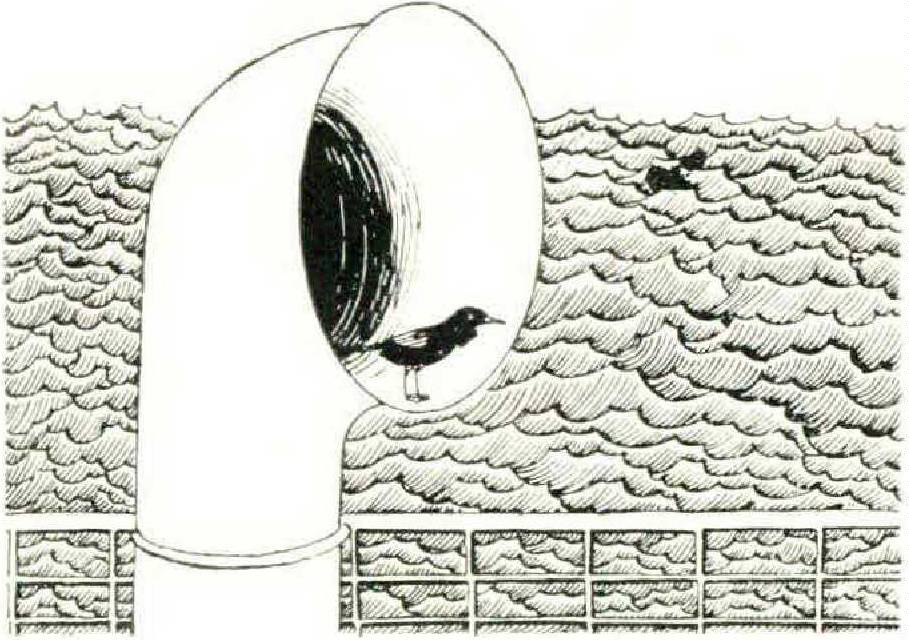
At midmorning I returned to the bridge. The course was still 144°, and the starling was still immobile in his ventilator shaft, but ten minutes later he suddenly took off. The Île d’Oléron now lay to port, but if the starling looked for it he could not see it, since it was out of sight. He emerged from his shelter without a moment’s hesitation and flew off to starboard. In that direction lay, three thousand miles away, America, and if he had continued with sufficient determination on his course, west and a little south, he might have come ashore at last at Charleston, South Carolina, though he would have been rather tired. But he lacked even this crazy ambition. Less than half a sea mile from the ship he commenced to swoop here and there among the waves, examining them from close quarters. After a few minutes he reappeared no more, and I very much fear he plunged to a watery grave.
His sudden dash in the wrong direction reminded me ol an uncle of mine who, in a long-ago war, was blown out of his trench by a shell. It blew him into the middle of no man’s land, where a lot of earth that had been blown with him fell on him and buried him. And that would have been that, except that the next shell, more considerate than most, unburied him again. Finding himself, to his surprise, alive, he picked himself up and ran, without considering in the least where he was running to. and after he had run a short way he fell into the German trenches. Whether this was good or bad luck it is difficult to say, but at least he is alive now and in Durban, which is more than one can say for the starling, who is either dead or in Brittany. It is possible that he may have returned with a trawler to Quimper — I am speaking now not of my uncle but ol the starling — or smelled his course up the seaways to Quiberon Bay. But I doubt it.
Within an hour we were off the mouth of the Gironde, with the sacred shores of the Médoc visible in the southern distance. If the starling had only waited a little, he could have gone ashore at the point and become an honest citizen starling of Poitou. And if he were too tired to fly. he could have gone back to Royan with the pilot boat. It is a horrible lesson to us all on the need for patience and faith.
As for me, I callously ate a hearty lunch of roast beef, cabbage, and boiled potatoes, and afterward lay heartlessly in the sun on the deck and in the lee of the wheelhouse. watching the Pointe de Grave slide by and the Tour de Cordouan fading slowly out to sea. “He who shall hurt the little wren Shall never be belov’d by men,” as William Blake so truly says, but there are some circumstances in which one feels that starlings simply have to look after themselves.