The Romance of Vichy Catalan: An Introduction to Bottled-Water Label Reading
JAMES BOOTH is the pseudonym of an American who has mainly lived abroad for the past decade, taking the waters and engaging in other pursuits. He is currently a resident of Madrid.
Every American resident on the Continent should have a hobby to given pattern and perspective to his investigations of the local scene. Some choose Gothic architecture; some bullfights. Mine is bottledwater labels. As a key to a country’s culture, they are much more rewarding than swaddling and toilet training and rather more accessible for study. Their fine printed commentary has intrigued me for years, and, particularly after my discovery of a few months ago, I feel richly rewarded. I’ve found Vichy Catalan, Spain’s leading potion for curing almost anything while quenching a thirst. The buyer of Vichy Catalan buys not only a bottle of water, he buys an encyclopedia on a four by seven label. Except for the words “Vichy Catalan” in half-inch type in the upper part of the center section and an illustration apparently portraying a volcanic mountain range (I suspect the artist’s intention was to depict the valley in which the waters are bottled), the label is divided up into sections of small type. The careful student will empty a liter bottle before he reads them all, but he should not let length deter him from carrying on to the end.
For example, under the title Observaciones, which might be translated as “General Commentary,” we find an encapsulated history of Spain over the last seventy years in one sentence. “These waters received the name of ‘Vichy Catalan’ by the Royal Order of the 15th of June, 1891, which was later confirmed by the firm and definitive edict of the Supreme Tribunal on the 28th of November, 1908, and, since that date, they have been presented on the market without any interruptions, having acquired within the medical class and the public generally a renown, greater with each use, for their achievement in the treatment of the diseases of the stomach, liver, spleen, chronic rheumatism, etc.” Now, a sentence like that demands a little contemplation before its full significance is understood. We learn first that Spain had Kings, or at least royalty, capable of giving orders. Then there is, or at any rate was in 1908, a Supreme Tribunal. And furthermore, whatever the vagaries of Spanish history, some things have persisted unchanged throughout all the vicissitudes of the stormy twentieth century. We get a hint of drama and danger and a lesson of the triumph of stubborn determination when we consider the seventeen years of doubt between the Royal Order of 1891 and the edict, “firm and definitive,” of the Supreme Tribunal in 1908.
Is there even a suggestion of liberal unrest here? Why, after all, should a royal order have to be confirmed by anybody’s edict, even a Supreme Tribunal’s? What other bottle label adumbrates the weakness of a ruling dynasty?
Our historical investigations become more complex and more intriguing as we fit further pieces into the picture. Just under the boldface name “Vichy Catalan” is the phrase “Declared of Utility to the Public by the Royal Order of the 5th of March, 1883.” Then, toward the end of the Observaciones section we find the phrase, “ . . . the trade name ‘Vichy Catalan,’ which has been legally registered in Spain since 1890.” Now, in possession of all of the facts, we can see a degree of coherence emerging in the story. Though, as any good historian should, the author of the label leaves a few mysteries for the reader to ponder.
We can now see how the tragic death of Alfonso XII and the uneasy earlier years of his Austrian widow’s regency are woven into the fabric of Vichy Catalan’s history. One can easily imagine Alfonso, on March 5, 1883, probably after a spat with his current wife, Maria Christina, meditating, calming his liver, and sipping a glass of water on the terrace of the palace. Undoubtedly, he is thinking of his first Queen, the beautiful Mercedes. Casually he glances at the green water bottle at his side. The label, which even then must have had an extensive medical section, catches his eye. He reads and realizes that had Mercedes only drunk Vichy Catalan, the fever never would have taken her off. Thinking how useful it would be to have her around still, he declares, “It is of Utility to the Public,” and his words are henceforth immortalized. (As any King should, he assumed that in his person he embodied the needs of the public in general.)
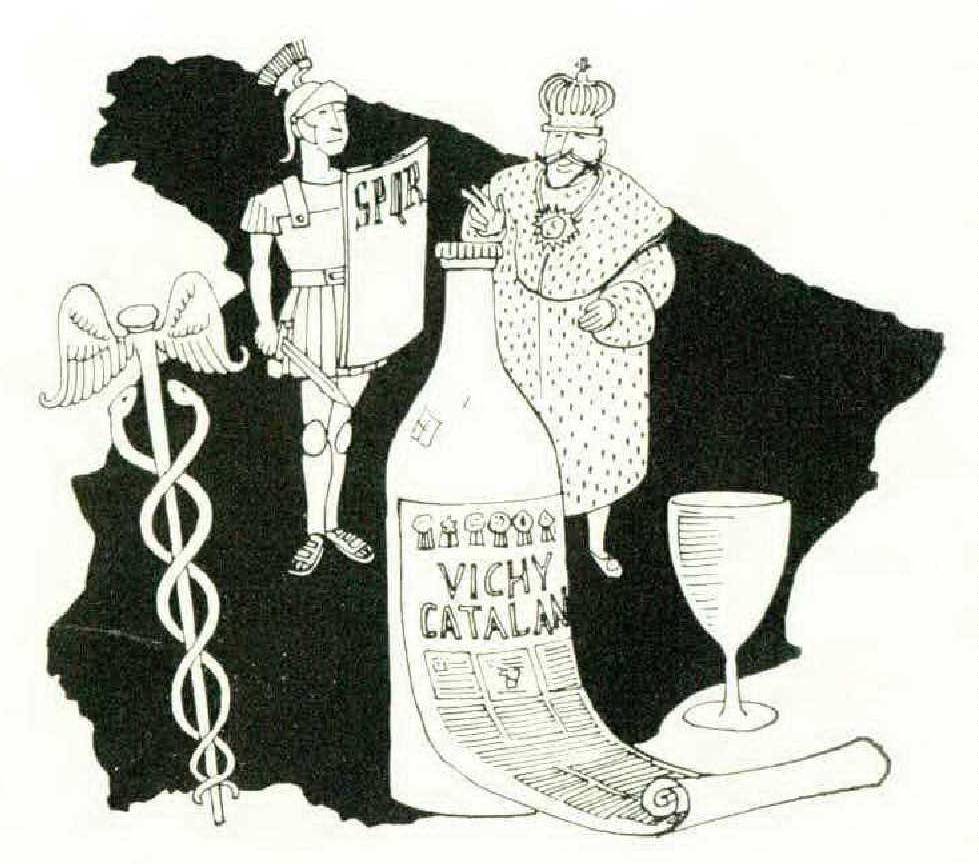
Inspired by royal approval, the bottlers get their trade name registered in 1890, but something complicates their position. In 1891 they seek further royal sanction. Alfonso’s loyal widow, either ignorant of or oblivious to the train of thought that led her husband to declare Vichy Catalan “of Utility,” affirms his opinion and issues an order giving the waters the name they already had. Triumph again for Vichy Catalan. But then, it seems, there follows a time of troubles. The royal order needed further confirmation, and needed it from a nonregal source. The inroads of parliamentarianism appear on the scene. Only the edict of the Supreme Tribunal saves the day for Vichy Catalan. As for the dynasty, it is perhaps significant that Alfonso XIII appears to have played no part in the story. He was King in his own right by 1908, but, as if foreshadowing his abdication, he was either unable or unwilling to issue any royal orders about Vichy Catalan. At this writing, Alfonso’s son languishes in exile in Portugal, but Vichy Catalan still proudly displays on its label in green undertint the words, “Under the Protection of the State.”
A history may end with the protagonist — in this case, Vichy Catalan — thriving under governmental protection, bottling on without interruption, come Kings, republics, or dictatorships, but nothing in Spain begins its history as recently as 1883. Propriety demands that the narrative be carried back to Imperial Rome, at least. This case is no exception. “These waters were already in use in Roman times, as the numerous votive coins found in the courses of the pipes that carry them demonstrate.” In addition to establishing a proper genealogy, there is excitement here in the hint at buried treasure, the wealth of the Caesars gumming up a water pipe. Unfortunately, the historical references come to an end here, leaving us intrigued by one last puzzle. Who built those pipes?
Next to its historical commentary, the medical section is the most stimulating part of the label. By all odds, to the drinker, it is the most reassuring. “Taken straight or mixed with milk, wine or beer, it gives excellent results in acid dyspepsia, in debility of the stomach, flatulence or gas pains, for defects in secretion. Gastritis from overeating, chronic blockages of the liver, spleen or prostate. Small kidney or liver stones. Chronic inflammation of the uterus and the consequent sterility. King’s Evil; rheumatic dermatitis. A specific for: Glycosuria; Diabetes.”
The opening words of this section arc a clever combination of comedy and commercial calculation worthy of the best depth-prober in the field. No sane Spaniard, once weaned, would ever touch milk. Beer is generally considered a medicine in its own right, and mixing it with another medicine would be pointless. Cutting wine with Vichy Catalan produces a vile-tasting mixture that no one would drink. In addition to the implicit entertainment value in the phrase, there is an intimation of the sort of suffering that one connects with doing what is good for one’s health. Now, a Spaniard feels guilty when he drinks water; it makes him feel less than a man. But given the excuse of medical need, combined with such horrible or ridiculous suggestions as mixing the medicine with milk, beer, or wine, he can ease his conscience, laugh at his fate, and quench his thirst simultaneously.
The medical references do not, of course, end here. No European water worth bottling would stop so far short of panacea as this. Down at the bottom of the label, in what I call the Transportation and Technical Section (it deals mainly with the shipping and bottling methods, and so forth), the final sentences remind the technically-minded that no matter how much they may marvel at the embottling “without contact with the atmosphere” and “without loss of natural gases,” at the “resistance to climatic change” and the “preservation of natural carbonic acid,” the purpose of the processes is medicinal and not mere technical virtuosity for its own sake. “The very rich natural waters of Vichy Catalan are the life’s blood of the stomach, the liver, the spleen and the rheumatic patient. ... In the tropics, the waters work marvelous cures of hepatitis and other disorders of the liver.”
When one’s interest tires of medicine, there is the chemical section, an imposing column on the left side of the label, to turn to. Here the chemical composition of the waters, “according to the most recent analysis by Doctor B. Oliver y Rodes of the Academy of Medicine and Surgery of Barcelona,” is set forth. In addition to the fifteen substances listed, ranging from ordinary old sodium bicarb to free quartz, SiO3H2, and sodium fluoride, we find, perhaps as a concession to the atomic age, “radioactivity 154 volt hours a liter.” (The Curies and the Roentgens can look out for their own units. Vichy Catalan uses volt hours.) For some reason, the bottlers and Doctor Oliver y Rodes have overlooked the possibility of curing cancer. Incidentally, Vichy Catalan contains no reported contamination from strontium 90.
If the drinker isn’t sufficiently awed by the variety of chemicals he is imbibing, he should shift his gaze to the right, to the Prize Column of the label. Here, under a note that the Vichy Catalan springs produce 183 liters of water at 60° centigrade a minute, he finds the list of awards won in competition with the other waters of Europe. The silver medal of Nice was acquired in 1884, the year after a royal order first declared Vichy Catalan “of Utility to the Public.” Naples came through with a gold medal in the same year. In 1889, even Paris awarded an honorary medal. Along with two other silver medals and one more gold one, we find a diploma (Barcelona, 1892) and, as the latest honor bestowed, a grand prize from Barcelona in 1929 (probably to make up for awarding a diploma 37 years earlier.) Alongside Vichy Catalan, a bottle of Coke, or even of “Old Kentucky” type bourbon, looks like a tenderfoot beside Dan Beard.
One may say that our potables are too young, too frail to match labels with a veteran, but what wine, even a Kaiser Jesuitengarten Trockenbeeren Auslese Spatlese, informs its drinker how high up the hillside grew the grapes from which it was pressed? Vichy Catalan, as any label reader knows, is taken from a spring 10 meters (about 33 feet) above the floor of the valley.
The label writer has put in something for all the varied interests of mankind. The money grubber finds an extensive dissertation on prices and taxes. He is further assured that “Upon return of the bottle to any establishment [selling it] it will be obligatory to satisfy the public with one peseta and twenty centimos. (Price according to the Official Bulletin of the State, No. 317, 12 November, 1948.)”
There is, strange to say, even a passing comment that explains why I and all its patrons that I know persist in drinking Vichy Catalan, even after we have memorized the label. In the General Commentary Section, sandwiched in between references to its noble history and its medicinal properties, is the phrase, “. . . at the same time, it constitutes an excellent table water, of agreeable flavor.”
LOVE KNOT
BY T. S. MATTHEWS
Make the old seducer sigh;
But angels smile, and publish the banns:
Love is a knot nobody can untie.