Buried With Mr. K's Statistics
The former president of Inland Steel Company, CLARENCE B. RANDALLhas for some years served as special assistant to President Eisenhower in the area of foreign economic policy, and at intervals he has found time to write the books which have made him many friends in this country, A CREED FOR FREE ENTERPRISE;his autobiography, OVER MY SHOULDER; and THE COMMUNIST CHALLENGE TO AMERICAN BUSINESS.
WE AMERICAN businessmen seem to have a special limitation in our thinking about the Soviet Union. With our minds concentrated on our earnings for the current quarter, we have not raised our eyes from the papers on our desks long enough to acquire the information needed to refute the latest brag coming out of the Kremlin. Most of us have known war, and we permit ourselves to talk glibly about weaponry, regardless of our competence, but we fall easily into serious error when we undertake to discuss the growing industrial potential of our new world competitor. The Russians know this and exploit our inadequacy.
Their new weapon in the Cold War is the economic statistic, and this abrupt change in tactics leads some knowledgeable people to suspect that the Soviet hard-core objective may not be military conquest, which they know they cannot achieve without complete self-destruction, but economic supremacy, which they honestly believe is within their power.
Certain it is that the Soviets have unexpectedly become data-proud. Having never before been given to publishing facts about themselves, they have suddenly, in the last three years, released information about their economy. Why this striking about-face?
There are three possible explanations: First, they are undoubtedly driven by necessity to develop better control data in order to manage the gigantic structure of central planning upon which they rely for production.
Second, not even a dictatorship can govern effectively in a vacuum. Even in Russia, public opinion has force, and the display of progress serves as an incentive for greater effort.
Third, proof that they are gaining rapidly in the economic race with the West is a powerful argument in their propaganda effort to win over the uncommitted nations. They hope to show that their way is best, that what they have done, others can do.
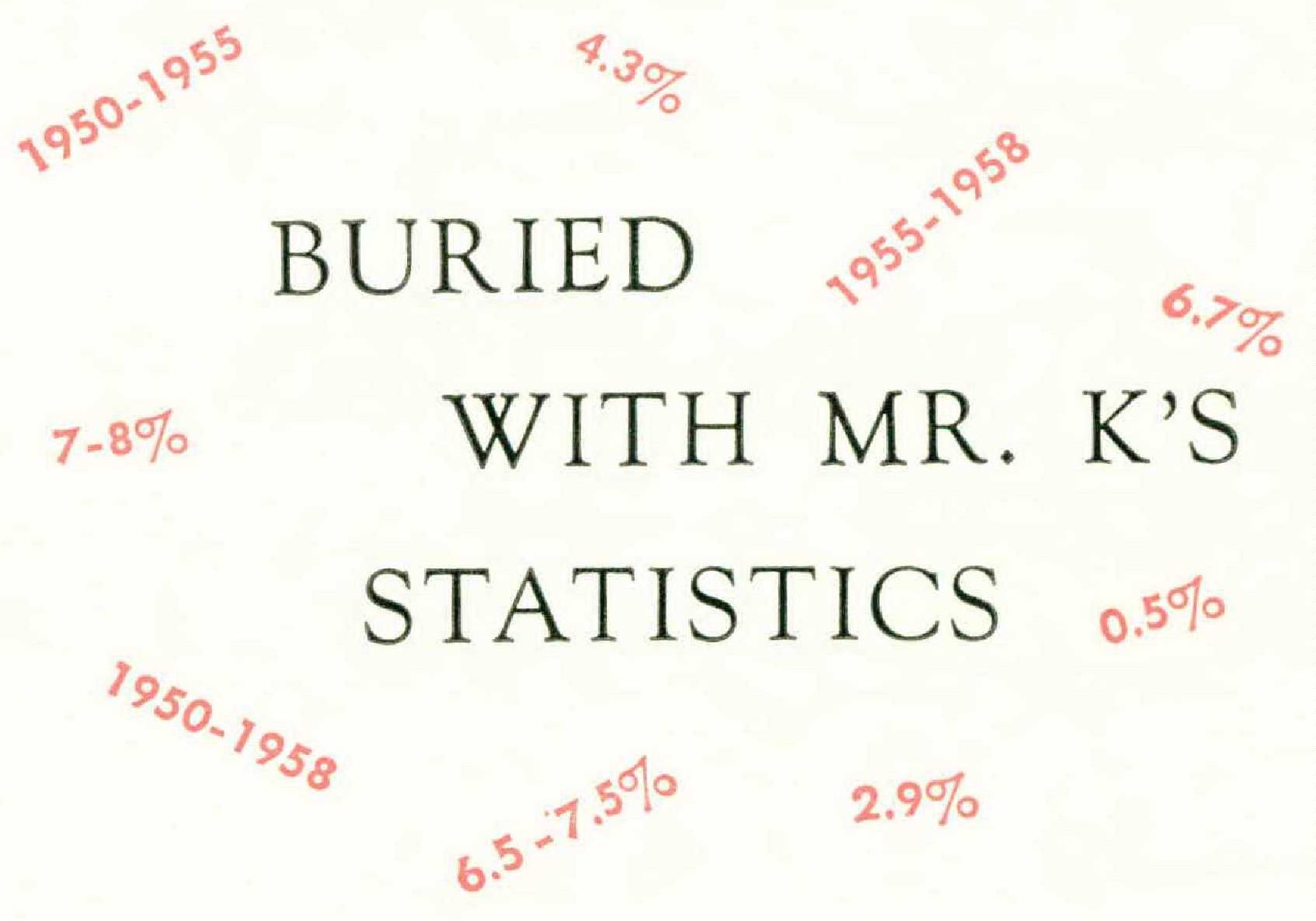
Here is a statistical table that is illustrative of the sort of comparisons they are employing today. It is devastatingly simple and is designed to show that the Communist pattern of production has steadily outstripped that of the United States, as measured by their relative percentage increases in gross national product from year to year.
These are the figures:
SOVIETS UNITED STATES
1950-1955 6-7% 4.3%
1955-1958 7-8 0.5
Total period,
1950-1958 6.5-7.5 2.9
To the uncritical mind, this is proof of the superiority of Communism over private enterprise. No trained economist would be deceived, but there are few such in the emerging countries.
It would be folly, of course, for us to ignore the record or belittle Russia’s economic achievements. What the Soviets have accomplished in a relatively short period of time is quite amazing; their enormous industrial progress is undeniable; and the challenge which they presently offer us in the field of world competition is formidable. We must never lose sight of it and must put forth our best effort as a nation if we are to hold our own. But we do not have to swallow mere propaganda.
The entire cult of Communism is based upon distortion of the truth. The Soviet use of statistics will therefore always present a problem. Even when basic data are accurate, comparisons are shot through with deficiencies, gaps, omissions, discrepancies, inconsistencies, and deliberate misrepresentation.
The most recent proof of this is to be found in a new book by the dean of contemporary Soviet economics, S. G. Strumilin. This distinguished academician apparently has such eminence in his own country that he dares to speak the truth. The data which he has just published confirm Western conclusions that the Soviets have had an increasing tendency toward multiple counting in computing their official index of industrial production. For example, they not only count the value of the automobile but the value of the steel from which it is made and the value of the iron ore from which the steel is produced. His deflation of the Soviet industrial growth rate reduces it to a level far closer to Western calculations than any Soviet estimate hitherto available.
To begin with, we know less than we should like to know about the competence of the statistical staffs or the accuracy of the methods employed in the collection and collation of data. With us, at every step in the production process the results are analyzed and reported upon by disinterested professional auditors who bear the responsibility of protecting the public interest and certifying as to the reliability of the facts reported. Not so in Russia. No counterpart of the certified public accountant will be found in the entire country, There, at each step in the production process the man reporting will inevitably use every means at his command to make his own performance look good, and those at the top have no purpose other than to make the nation look good.
The deliberate distortion of statistical comparisons to show Soviet production in a favorable light in relation to that in the United States is illustrated by the table just given. To include the year 1958, which was a cyclical downswing in the American economy, and exclude 1959, which was a big year for America, gives a false comparison of the rate of economic growth of the two countries.
The technical problems involved in making comparisons between the Soviet economy and our own would baffle the ablest statistical expert, even if he had ready access to all the facts, and even if they were trustworthy.
Take value realization, for example. Prices have a very different meaning in a totalitarian economy. In a free market the consumer determines the price for each commodity by registering his daily decisions as to whether to accept the offerings or withhold his purchasing power. The Soviets have administered prices. Ignoring the wants of the people, which would be reflected in free markets, central authority establishes the terms of the offerings, so that price ceases to have the meaning that it does in our economy. They do not even adhere to a single standard but have varying prices for the same article, depending upon the political purpose sought to be accomplished. They also have severe underpricing of both land and capital.
Production costs in Russia are figured on the Marxian theory, which recognizes no cost but that of labor. With few exceptions, capital is supplied without cost; there is no charge for rent on either plant or equipment; there is no payment of royalty in the extractive industries; costs for raw material, fuel, and power are distorted.
Converting their units of value into ours for purposes of comparison is all but impossible because of the different pricing systems and strict control over the terms of international monetary exchange. The ruble is not freely convertible in the world money market, and most of the Russian trading is conducted on a barter basis. This being true, who is to say what the true value of the ruble is compared to the dollar? Only when two economies can be measured against a common standard can there be an objective judgment as to their relative merits.
The fact that the Russian industrial development is still new, and the country still primitive, gives the Soviets a temporary advantage when comparing the present with the past. When a balloon is beginning its ascent toward the stratosphere, it rises rapidly for the first mile, but it slows down progressively as it goes on up. The high growth effectiveness of large new investment is well recognized among economists as a temporary phenomenon. Growth generating capacity takes on added burdens when a young economy grows older and is confronted with problems of maintenance, depreciation, and obsolescence. Higher costs set in when the richer, more easily won supplies of ores, fuels, and other natural resources become exhausted. Eventually pressures build up that compel a shift of emphasis away from the rapid growth sectors into light manufacturing, housing, and the production of items that make for better living. All of these factors will have important bearing on the future growth rate of the Soviet Union.
It must be remembered, too, that the U.S.S.R., as a late-comer to industrial development, has had the advantage of being able to exploit the enormous backlog of twentieth-century technology, which has been readily available in the West. We have had no secrets, and it was right that this should be so, for the cross-fertilization of ideas created by the free interchange of technical information has been a most important factor in our success. Once this backlog has been exhausted, Russia will have to rely, as does the United States, upon current discoveries, and will be compelled to increase greatly its expenditures for research.
Finally, we must weigh the factors which material statistics can never reveal. First, there is quality in production. The Russians are more impressed with tons than they are with excellence. They do not build overload capacity into electrical generators. They omit the subtleties that make for perfection of performance and long life, in their haste to increase the number of units.
Second, the special character, direction, and path of the Soviet economic growth are altogether different from ours. Russia’s intense preoccupation with missiles has created a striking unevenness between urban and rural sections, between precision in rockets and shoddiness in housing.
As to the actual catching up with the United States in the economic race, the Russians still have a long way to go. Predictions for 1960 show that we will have a gross national product of at least $500 billion against $225 billion for the U.S.S.R. Our population is 177 million, against their 214 million; our labor force, 72 million, as compared with their 109 million. Division of the product figure by that of the population gives $2820 per capita for each participant in our free economy, against $1050 for each Communist. This would seem to indicate some considerable deferment for the burial service over which Mr. K promised his countrymen that he would preside.
In 1959 the Russians had one million automobiles, while we had 59 million. When he was in this country last year, Mr. K explained this as being a planned and altogether desirable discrepancy. He said that if people had cars, the government would have to build roads, and that this was a frightful waste of the nation’s resources. Much better, he thought, to build enormous complexes of multiple communal dwelling units close to the industrial plants, so that the workers could walk to their places of employment. The wisdom of this arrangement would be hard to explain to an American father of four children who owned his own small home and automobile.
We produced half again as much grain as Russia, twice the vegetables, and three times the eggs, while the Russians grew eight times as many potatoes. Those figures tell a great deal about the balance of their diet.
Their steel production was not far below ours and they exceeded us in coal, but they had one third of our oil, one tenth of our gas, and one third as much electricity.
All in all, the productive effort of the Soviets is clearly so formidable as to put us earnestly upon caution and to call for new understanding and fresh effort on the part of every American, but Soviet production is by no means the wave of the future. We can win — and on our terms — if we make up our minds to do so. The important thing is to keep our sleeves rolled up.