They Shall Have Music: How to Be Binaural

OF SIXTY-FIVE records sent to me in August for review, all but seven were stereophonic. And all the autumn announcements of new phonographic gear bear heavily on the wonders of sonic 3-D. Like it or not — and some of us may not — we are
faced with a revolution in livingroom listening.
Perhaps the revolution is premature, and perhaps it has occasioned too much clamor. But a full decade has elapsed since we were afforded the twin boons of high fidelity and the long-playing record. Stereophony — priced within our means — is a comparable advance. It will open, to everyone reading this, a whole new realm of aural delight. It is worth paying for, although there need be no hurry. Mainly, it should not be resented. Good men, as earnest in their love of music as you and I, worked hard to bring it into being.
The main question at this time is: What do you need to convert to stereo?
When I say “convert,” I am assuming that you now own a sound system — either a ready-made phonograph or a high-fidelity rig which you want to keep and add to, not discard. If you are starting from scratch) you simply go shopping, systematically and by ear, until you hear something you really like. At best, if you are fortunately situated, geographically and otherwise, you then bring this array into your living room and try it out. If it does not satisfy, you try again. One thing about stereo gear is that it shows itself much more promptly than onesource sound to be suitable or unsuitable to a listening room. When you have the right equipment, properly placed, the sound will be richer and easier on the ears than you ever expected. If it is rackety, you have shopping or experimenting to do.
Before proceeding further, here is another assumption: it is to disc stereo, not tape stereo, that you plan to convert. Most tape-stereo enthusiasts already have converted, I should suppose. To be sure, there are some new developments in tape stereo — four-track tape, a new slow speed, a tape-loading cartridge — but they are so far from perfection that it would be fruitless to appraise them yet. For the present, at least, disc is the big thing.
What you will need for conversion depends on (excuse my being obvious) what you have already. Certainly you will need another amplifier and loudspeaker. You will need a stereo pickup cartridge, with four connections instead of two. If this is a magnetic cartridge, you will need either a complete new preamplifier control unit or some kind of supplementary device. (Hermon Hosmer Scott calls the one he makes a Stereo-Dapter. I suppose this was inevitable.) If your setup includes a record changer, you may need to replace that, too. And if you live in a town with a so-called good-music radio station, you probably will want separately functioning AM and FM tuners to take advantage of stereo broadcasts.
Nearly all makers of radio tuners now offer FM-AM combinations with separate controls and outputs. If you already own an old FM-AM single-control receiver, it may be cheaper for you to buy a new AM tuner (they cost as little as $25) than to have a serviceman rewire your old two-way job, which probably uses some of the same circuitry for both modes of broadcasting.
Makers of record changers now arc offering models suitable for stereo. However, none (so far as I know) are claiming that their old models will serve stereo purposes. There is a reason for this. The record changer is a compromise device; it has to do too many things to do any of them perfectly. (A “perfect” one could be made, but it would have to sell for about $300.) In consequence, manufacturers have labored in the past to spare you lateral vibration, which the monophonic pickup cartridge would transmit through the loudspeaker. But, in the interest of economy, they did not devote much attention to verti-
cal vibration. Unfortunately, stereo cartridges are vertically as well as laterally responsive, so vertical motor-shake is faithfully reproduced as a solid roar. (Not always, I must add: already I have had word from one delighted owner of an old Garrard RC-80 that his machine is quiet as a stereophonic ghost. So don’t buy till you try.) Most good twelve-inch precision turntables seem amply quiet for stereo. If yours is not, it may need some oil or a new rubber idler wheel.
Owners of precision turntables are also owners of precision tone arms. To my mind, the thing to do with one of these is to keep it and, if you have room, add another for your stereo pickup. For stereo the principal requirement of an arm is that it should have minimal inertia; it should be as long and light as possible. An occasional stereo record will be warped, and a tone arm reluctant to move up and down will force the pickup to transmit the warp as signal. It will have a frequency of maybe two cycles per second, so you could not possibly hear it. However, your amplifier (unless it is filtered) will overwork itself trying to reproduce it, and nothing else that is on the record will sound very pretty.
There are two additional reasons to keep your monophonic pickup. One is that, although stereo pickups will play monophonic records, they interject a distortion hazard. A high treble modulation on a monophonic record causes the groove to narrow, forcing the stylus upward. A stereo pickup “hears” this as a second harmonic of the tone inscribed on the disc — and you will hear it, too. There is a remedy for this, if you haven’t room for two pickup arms (I don’t want to seem technical, but you may have to advise your serviceman, if he is behind in his reading). It is a switch to connect the two sets of wires from the stereo pickup when you play monophonic records. Easy to install.
The second reason to keep your monophonic pickup is that it may save you the cost of a whole new preamplifier, at least for the time being. (I am speaking now mainly to folk with hi-fi equipment.) Until now it has been almost mandatory to own a magnetic pickup and its associated preamplifier. The pickup yielded better sound than crystal or ceramic cartridges, and the preamplifier afforded variable equalization controls, so you could adjust for balanced sound from foreign or domestic 78s, old Columbias, old Londons, old RCA Victors, Caedmons, Bartóks, or any others. Now all records are made according to Record Industry Association (RIAA) specifications; one equalization serves for all. And in the stereo era the piezoelectric (ceramic or crystal) cartridge is making a strong comeback. There are two that have come on the market, made by Weathers and CBS-Columbia, that compare very well with any of the magnetics I have heard and cost only about half as much (approximately $15, with diamond stylus). The Weathers is somewhat cleaner in tone, and tracks at only two grams, but I suspect the Columbia is the one to buy if you have a record changer. Or butterfingers.
Neither of these cartridges needs preamplification. You can plug one of the pickup cables directly into your new second power amplifier, the other into the tape or TV input on your preamplifier. You will not have any easily accessible volume control for the power amplifier, but you can use the one on the preamplifier to govern the second channel up and down until the two speakers match. Admittedly, this requires a little scuttling around the livingroom, but a dual preamplifier costs between $100 and $170, an amount worth saving. Meanwhile, you maintain your old magnetic pickup and preamplifier to play monophonic records. Switching between it and the new stereo pickup is easily and inexpensively arranged.
An extra amplifier and loudspeaker are of course essential to your venture into 3-D sound. If you own a ready-made phonograph — Magna vox, Philco, Columbia, Webcor, or the like — you probably will find that by the time you read this the manufacturer will have put forth an accessory stereo unit, consisting of an amplifier and a remote speaker, which a licensed serviceman can quickly and easily add to your basic phonograph. Some of these accessory units are completely compatible with your existing unit. Others are not, since thus far most stereo devices have been hastily contrived. Even if you are a firm advocate of the brand-name, readycabineted phonograph, you may find that you can convert it to stereo best by resort to the services of a custom hi-fi dealer.
If you are a member of the fi-folk, your extra amplifier probably is the least of your problems. The course of least resistance is simply to buy another of what you have already (so I now find myself possessor of two Dynakit Mark Hs). It even makes sense in some cases to buy another of the combined preamplifier and amplifier you own already. Altec-Lansing has foreseen this and accordingly offers a little $9 gadget that makes any two of their console amplifiers into one stereo unit. Other makers are sure to follow suit. This gives you two preamplifiers, but this is by no means a bad thing so long as they are accompanied by a common one-knob volume control.
My foregoing remarks about ceramic pickups were not intended to make them seem the ultimate in record reproduction. Probably they are interim items, at least for sound perfectionists, and in time electromagnetic units will come along to supplant them, at which point your dual preamplifiers will be highly desirable. If you are going completely stereo, incidentally, and do not mind spending money right away, there is already a handsome variety of stereo preamplifier control units which put at your finger tips all the facilities for playing disc, tape, radio, or (whisper this) tape copying from disc or radio. Altec, Bell, Bogen, Fisher, Grommes, Scott — everybody is making them. None is inexpensive, but all are as good as their makers’ names would lead you to expect.
One final remark about power amplifiers: stereo reproduction requires considerably less power per loudspeaker than monophonic high fidelity. Forty watts of output had begun to seem almost a necessity to reproduce through one speaker a good, up-close piano recording, but now you can split the forty to get equivalent results. For some reason unknown to me a stereo watt, especially in solid bass delivery, is more effective than a monophonic watt. Hence, what you seek now for your dollar is not higher power but lower distortion.
About loudspeakers, the questions are always twain and the same. Must one’s two speakers be identical? And how should they be spaced apart?
Experts in the business will disagree with me on this. But, by the same token, I am disagreeing with them. In theory, one’s loudspeakers should be exactly the same. In practice, I have paired a 15-inch Tannoy coaxial in a corner horn and an Acoustic Research AR-1, miniature by comparison, and got a decidedly luscious sound from the combination. This is against the rules. However, you can do it pretty reliably if you have a good ear and some intuitive feeling for spatial sonics. By this I mean the ability to stand in a room and feel how it will respond to an eight-by-five-foot source of music generated from yonder wall or corner. Between dissimilar loudspeakers, the essential compatibility would seem to be in the coloration of the middle tone range, where the fundamentals of most instruments’ sounds occur. The absolute tone range of either speaker, from top treble to bottom bass, is not very important.
11 the two speakers cooperate in effortless synchrony through the middle octaves, the main objective is reached. Perhaps one reservation should be stated here. Some new small self-contained loudspeaker units are air loaded and mechanically inelastic, so that they need real power to run them properly. Know what you are buying.
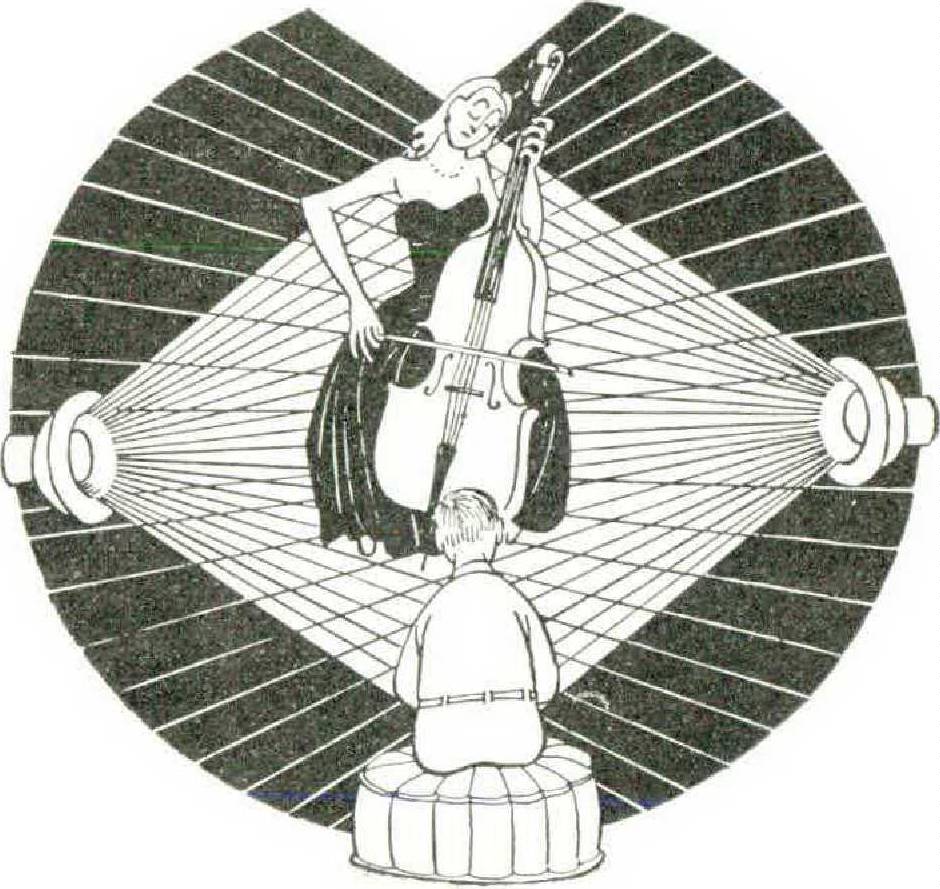
There is no rule yet about the spacing of stereo loudspeakers, for one thing, the makers of stereo records have not decided on any single method of recording. In America they commonly use omnidirectional microphones spaced apart. In continental Europe they seem to use directional microphones spaced closer together but aimed apart. The results are different, so what you must do with your loudspeakers is compromise.
So far, the safest arrangement seems to be two loudspeakers either spaced about eight feet apart and aimed in parallel or spaced a little closer together and angled outward one from the other. There is no sure rule yet, however, and there will not be for some time. The variables are the recording techniques and the characteristics of the listening room. And the conclusion is: keep your system flexible. For the time being, do not mount speakers in the wall (holes in a living room wall are very difficult to move from place to place).
Various expedients have come to my attention. I have heard excellent results, for instance, from two rather small rectilinear speakers placed back to back and set nearly in a corner, so that the sound from each hit a wall at an angle of forty-five degrees. The two reflected beams of sound came out parallel from the corner, with just enough dispersion to lend them a little perspective. Corner speaker enclosures can be used according to the same principle (in case your present speaker enclosure is a corner cabinet). You simply move them out four feet or so along the adjacent walls. This puts them seven or eight feet apart, pointing in parallel at the center of the room, and leaves you a small corner enclave behind them, useful for record cabinets or for your dictionary stand. (Hang a wall lamp over it.)
A couple of parting suggestions are in order. Stereo very much heightens the reality feeling of musical performance. Accordingly, direction becomes increasingly important. And one dimension of directionality is vertical. Stereo recordings, in my experience, are much enhanced in their conviction if the loudspeakers are at ear level, as live music usually is. Further, it is a little safer to have your speakers too close together than too far apart. The optimum illusion is that the sound is coming not from either of your loudspeakers but from the space between them. Nobody would want to inflict a split personality on Jascha Heifetz. . . .
Record Revieivs
Bartók: Violin Concerto
Isaac Stern, violin; Leonard Bernstein conducting New York Philharmonic Orchestra; Columbia ML-5283: 12ʺ The other top version of this wonderfully clever concerto also is American: Menuhin and Dorati, for Mercury. Both editions are excellent, but I think I slightly prefer this new one; it is a little crisper. This concerto always make me think that Bartók was paying his respects to Dohnányi; it sounds less like a concerto than like a set of variations, very up-to-date (1938) but still so cordial and comprehensible that the best descriptive word for it is sunny. The sound is highly adequate.
Beethoven: Trio in E Flat, Op. 3
Jascha ILeifetz, violin; William Primrose, viola; Gregor Piatigorsky, cello; RCA Victor LAI-21SO: 12”
We owe something to the three men heard here and to RCA Victor. Seldom do three such virtuosos join forces in chamber music, although there could be no higher avenue for their talents. Here they demonstrate the young Beethoven, aged twentyseven, showing early his awesome talent for (as Leonard Bernstein has phrased it) knowing which note to put after the note before. The trio really is a sort of serenade, untroubled, simple, and sure, played here with mastery that baffles comment and recorded in sound that does the mastery justice.
Mahler: Symphony No. 2, “Resurrection”
Bruno Walter conducting soloists, Westminster Choir, New York Philharmonic Orchestra; Columbia M2L-256 or M2S601 (stereo): two 12ʺ
The Second Symphony is one of Mahler’s most enormous constructions, yet it never loses its intimacy, even when Gabriel blows his horn and the angels sing in the last movement. It is always a song, no matter how huge and glittering. The first and third movements, incidentally, use tunes also heard in The Youth’s Magic Horn, in case you wonder when you hear it. Bruno Walter is the absolute master in Mahler interpretation, and this record may be the best ever made of the New York Philharmonic: the sound is utterly magnificent.
The Best of the Stan Freberg Shows
Stan Freberg and assisting artists; Capitol WBO-1035: two 12ʺ
A sad fate indeed I feared was mine when last autumn I heard that Stan Freberg, Saint George of the famous Dragonet, had presented through the summer fifteen CBS radio shows and I hadn’t heard one of them. Capitol has now raised me from my slough of despond with this marvelous two-hour offering of hilarity culled from the transcriptions. Ah, for the interview with the Abominable Snowman (about his career: terrorizing mountain climbers). And ah, again, for the true hi-fi sound of James Cagney tearing off his makeup. That’s enough. If you want more data, buy the records.
Mother Goose
Cyril Ritchard, Celeste Holm, Boris Karloff, speakers; chamber instrumentalists; Caedmon TC-1091: 12” Caedmon gives us here one of the most completely delightful records I ever have heard. 1 think most credit must go to Howard Sackler, who directed it, but some must also be accorded Hershy Kay, who wrote the entrancing background music, and the three readers, who surely never enjoyed themselves more in their lives than when they were making this. I suppose children might get some pleasure from it, but it is plainly and primarily for children who have grown up: namely, us. You can play this for the most sophisticated group of guests, and they will all listen fascinated till the last syllable. No use picking high spots; there aren’t any low spots. However, just because I want it), I will mention Boris Karloff’s bloodcurdling “Who Killed Cock Robin?", Celeste Holm’s almost ecstatic “Twinkle, Twinkle, Little Star,” and Cyril Ritchard’s extremely funny quasiTexas account of the misadventures of Dapple Gray.