The Unsolved Mystery of the Mayas
An anthropologist before the national success of LAUGHING BOY turned him to the field of fiction, OLIVER LA FARGE has always retained an eager and vigilant interest in his first love, the Mayan culture, and the mysteries about it which still remain to be solved.
OLIVER LA FARGE
ONE of the most interesting of all available studies of man’s behavior waits, barely sampled, just beyond our own back yard in what anthropologists call Middle America: the region extending from Central Mexico to southern Honduras and El Salvador. The southerly part of this area was occupied by the Mayas, who developed the highest civilization native to the New World (Peruvian addicts may challenge this claim, but I stand by it).
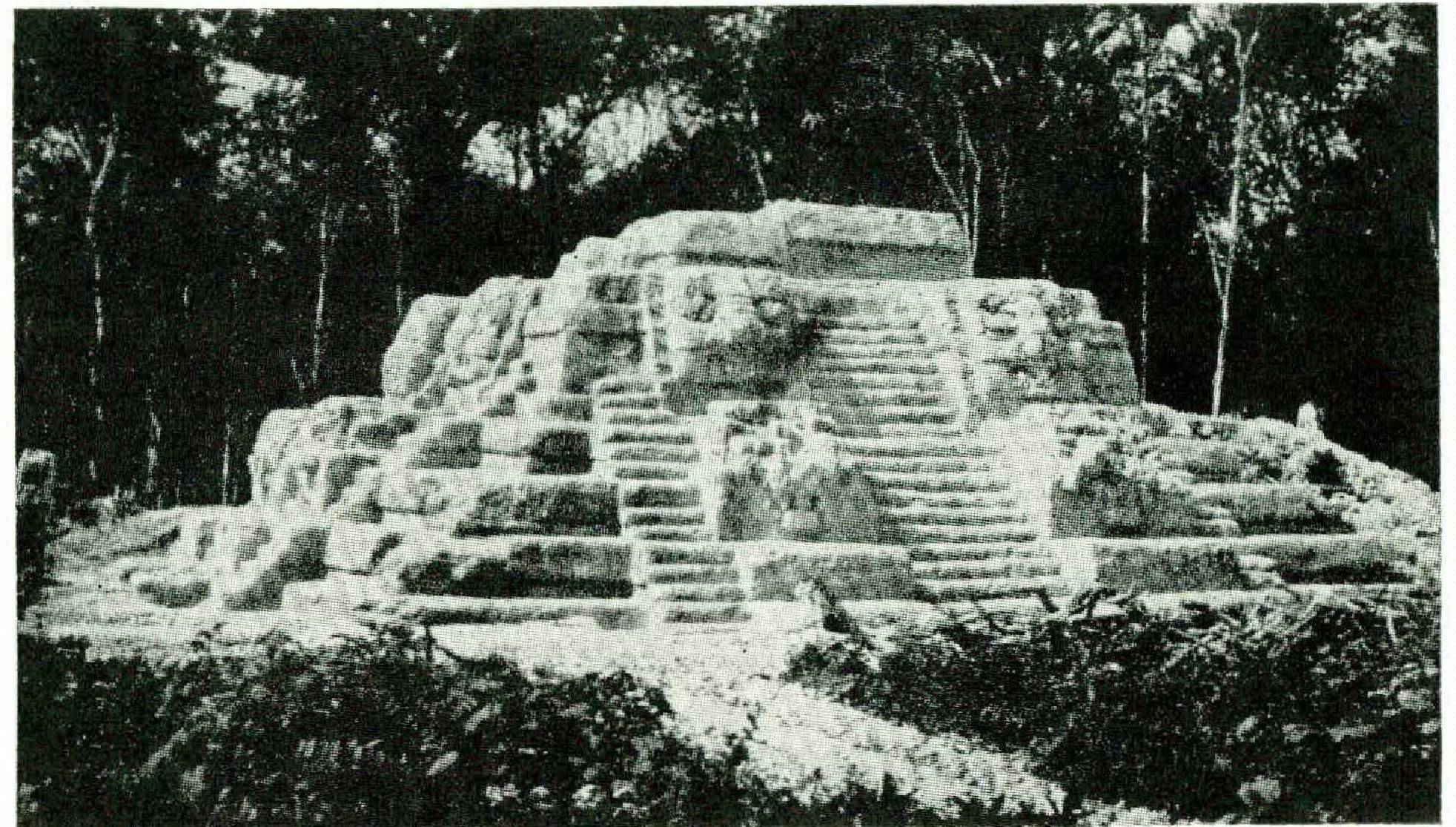
The Mayas appear to us as an intriguing, puzzling people. Of metals they knew only gold, silver, and copper, all of which they used for jewelry, not for tools, yet they carved beautifully in wood and stone. They also painted on walls and on paper, modeled plaster, and drew with brushes, like Orientals, their best work showing rapid, strong, sensitive lines. They knew nothing of the wheel, hence did not use pulleys, yet they erected pyramids of great size, temples, “palaces,” and such structures, and moved large altars and steles from the quarries to the place where they wanted them.
Without metals, but with infinite patience, they carved jade. Their ceramics, fine art, and architecture are comparable to the Greek only in a few instances, but they compare favorably to the Hindu and South Asiatic.
They had a true system of writing. To our knowledge, they indulged in the learned arts of mathematics, astronomy, and history; there are hints of others, yet to be made known. We maynote that the Mayas knew how to inlay teeth and trepan skulls. Judging by what some of thendescendants wrote shortly after the Spanish conquest, they had a poetic, vigorous literature. We know very little about their religion, and are still in the stage of denoting certain figures as “God A” or “God G.”
They seem — again we are unsure — to have been organized into something on the order of city states, ruled, probably somewhat tyrannically, by priest-nobles. We used to believe that at their height the Mayas were innocent of warfare and human sacrifice; the evidence is that this ingratiating picture is too good to be true. But in their heyday they held interstate conferences of learned men and unified their calculations, astronomy, and written forms across hundreds of miles of territory. When they were going full blast, they abandoned the whole central part of their territory — mounds, terraces, pyramids, buildings by the hundreds, monuments, and all — and their culture petered out rapidly, leaving us with a puzzle.
Everything about the Mayas and their neighbors makes one want to know more, to see the digging go deeper in more places, I write about them at this moment because of a development that is causing Maya research to falter. For thirtyfive years the Carnegie Institution of Washington, as an endowed, pure-research organization, was able to plan and carry out long-range work that was the backbone of Maya studies. Now it is ending its program.
To form a just idea of the importance of this change, let us turn from Maya research per se and consider it in relation to world archaeology and the study of man.
ARCHAEOLOGY is a humane science, a branch of anthropology dedicated to uncovering the story of man — his culture, advances, retrogressions over long periods of time. Its potential contribution, both theoretical and practical, is great; modern thinking about mankind’s course is already importantly influenced by it. In this contribution New World archaeology has a special part, and within that field Middle American studies occupy a place of unusual interest.
Best known to most of us is Old World archaeology. It tells us of our own forebears and our own cultural heritage, which give it immediacy, and it deals with what until recently was all but a tiny segment of mankind. One may well ask why that segment, which wandered into the Americas before Columbus, there to remain isolated and relatively backward, should deserve any special study.
The answer lies in the word “isolated.” In medicine, in psychology, in plant and animal genetics we set up experiments, and as an essential part of the experiments we establish control groups. When we seek to study mankind in time depth we cannot have control groups; we cannot cut so many of our kind off from some common influence and sit back and watch the results. Geography, however, has given us one splendid control group in the pre-Columbian settlers of the New World, who entered it via Siberia bringing with them little beyond Old Stone Age cultures and who thereafter, having thinly spread over the land, set about man’s business of populating the world and advancing himself.
Given cultural development without wheat or rice, without sheep, cattle, or horses, without benefit of the inventions and discoveries that Asia sent to Europe, Europe to Asia, and Africa to both, to what extent will man follow the same paths as his brethren, to what extent choose different ones? How many lines of behavior that we regard as dictated by natural law will he show to be local, cultural products after all? Study of New World men, even as far as it has gone, tends to show that one supposedly innate or natural institution or form of behavior after another is local and cultural, from kingship to voting, from Freud’s father-image to believing that one should convert the heathen.
Naturally, being ourselves civilized, we are especially interested in knowing what kind of civilizations these isolated men might produce. If the most advanced invention diffused to them from the Old World was, probably, the bow and arrow, how would these people build, how would they advance? That they had a different agriculture, sharing only cotton with the Old World, was dictated by the available flora. Similarly, the fauna dictated that they had no domesticated animals other than turkeys, dogs, parrots, and llamas — hence no strong beasts of burden. But where they were limited only by their own minds, what way would they go? Herein lies the peculiar interest of Middle America.
I have already sketched the highlights of the Mayas’ “Stone Age” culture. In a general conversation, at this point, someone will insist that such advancement must mean that the Mayas were influenced from the Old World. Then the Maya scholar comes back with his crusher — and it is not only a crusher, but the final evidence of the height of the Mayan achievement. The Hindus may have conceived of zero as early as 300 a.d., but not until 700 A.D. did they produce a symbol for it and thus make possible the place system of numbers we call “Arabic.” We have clear examples of large numbers written in a place system with the use of zero in Middle America from just before the time of Christ, if not several centuries earlier. The important mathematical discovery involved must have been made, according to available evidence, not later than 600 B.C., and probably earlier.
Mayan mathematicians calculated the length of the solar year slightly more accurately than the Gregorian year we now use at least seven hundred years before Pope Gregory reformed our calendar. The earliest inscriptions known show that Middle Americans, well before the time of Christ, had hit upon an important chronometric idea. Retaining on the side a 365-day year for farming and associated seasonal ritual, they measured historical and astronomical time by a pure count of days from a date projected some three thousand years into the past. This means that any distance in time could be calculated by simple arithmetic.
Our modern astronomers use a similar count today, but they came to it a millennium or so later, and our historians still struggle with the arithmetic of years.
(The approximate ages I have been giving will cause some raised eyebrows among Maya scholars. Middle American chronology is based on the chronologer’s choice of any one of several schemes for correlating Mayan inscribed dates with our calendar. Recently, radiocarbon tests, which estimate the age of pieces of carbon according to the amount of radioactivity they retain, show strongly that the generally accepted correlations are three centuries or so too late, thus restoring to tentative respectability a correlation that everyone had cast out. Roughly following this correlation, and also accepting the Cycle Seven inscriptions mentioned later, leads me to the points in time given.)
None of these developments fits our concept of a Stone Age culture. In fact, the more we learn about Middle America, the more it upsets our preconceived ideas. So far, we know little about social institutions of the area except as they existed at the time when the white men fell upon the land, but everything we do know is rich with unusual characteristics. The central area of the greatest ruins suggests some odd possibilities.
Through a casual accident of usage, the term “Old Empire” has come to denote not any empire or governmental unit but a period and region embracing what we recognize as the full Maya culture from its first appearance, about the beginning of the eighth cycle of their era (a cycle equals slightly less than four hundred years), to the time early in their tenth cycle when, within little over a hundred years, almost the whole region was deserted except Yucatan, where the New Empire (a culture, not an empire) developed.
The mere desertion of the central region is a teasing puzzle. We speak of the great sites therein as “cities,” but there is a question whether they were. They are imposing concentrations of pyramids, temples, assorted monuments, and buildings that may have been palaces, convents, or dormitories, but it is not at all certain that they were centers of any great concentrations of papulation. Is it possible that in Middle America civilization developed without cities, urbanity without urban life? If so, we must rewrite considerable hunks of modern social science.
THERE is another great question calling for an answer. The excavations reaching furthest into the past, the stratifications most thoroughly worked out, such as those of the Carnegie Institution at Uaxactún in the Pcten forest, present us with a well-advanced culture — civilized or at least semicivilized people, artists, builders of pyramids— at the earliest level. About 10,000 b.c., hunters roamed Mexico. About 2000 B.C., corn was domesticated and primitive farming communities developed. From then we take a long leap to proto-Maya centers. This is unreasonable. What is equally unreasonable is the appearance that civilization, without benefit of metals, developed in a classically tropical area of drenching rainy seasons. A large part of the area is underlain by a limestone formation that lets the water drain through, so that supplies of drinking water today will barely enable a sizable archaeological expedition to last through a dry season; and the whole terrain is covered by the stupendous rain forests commonly but inaccurately called “jungles.” That is no setting for the development of simple cultures into high ones. It is a region hostile to man even with today’s equipment, a region in which one would look for primitive hunting tribes or peoples practicing rather precarious farming in clearings made and kept open only by great effort.
We expect early farming and village life to develop in fairly open, wooded country where ground can easily be cleared and worked with digging sticks and other such tools. Heavy bush or strong, prairie sod defeat the primitive gardener. In a somewhat more advanced stage, the people will exploit more difficult but more fertile areas, but felling mahogany trees twenty feet in diameter with stone tools, even with jade, seems excessive.
These paradoxes are plainly apparent. They may or may not be real; part of our trouble is that the Middle American forests are as inhospitable to archaeologists as they are to farmers. In order to determine the width of a terrace, I have had to guide myself by compass while I paced it off; I could not sec the score or so meters from one side to the other. An archaeologist could perfectly well spend several seasons doing a thorough job on what he believed to be the center of a ruin, when in fact the greatest part stood a couple of hundred yards from him.
Furthermore, serious archaeology in Middle America is recent. It was inhibited by the very richness of the material. Since that adventurous diplomat, John Lloyd Stephens, reported many of the most famous ruins in the 1840s, the archaeology — so called — of the Mayas and their neighbors has been in great degree the finding, photographing or drawing, and mapping of sites. Piercing the forests to follow up a chicle-gatherer’s report and coming out with a new, major center of temples, pyramids, and works of art are a sporting proposition. In this sport a special score is given for inscriptions or for burials containing gold. For nearly a century, Middle American archaeology was, literally, superficial. It also was overconcentrated on the Maya Old and New Empires, not only in the locus of the field work but in the thinking of its practitioners.
The same thing could have happened in Asia Minor and Persia had it not been that Schliemann, the first modern archaeologist, was hipped on the idea of uncovering historic Troy and hence worked Hissarlik in depth with strong attention to stratification. In Middle America there are hundreds of major sites and uncounted minor ones, some plainly visible to the passer-by, more hidden in the forests within which the traveler goes for days without ever seeing the sky. Naturally there was a certain prestige to the game of finding ruins, nor should the process stop. Some of those most recently discovered have already contributed importantly to our knowledge. Nonetheless, such surface archaeology is little more than scouting, its final result a useful map of our ignorance.
Immediately after World War I, the Carnegie Institution of Washington entered the field. Under it, exploration, siteand inscription-finding, continued but was balanced by a new concentration on a limited number of ruins. Most accessible, most spectacular, and hence best known is its work of excavation and restoration at Chichén Itzá in Yucatan, done in cooperation with the Mexican government and since continued by it. Lately we have been getting archaeology in depth, primarily because of the Carnegie influence. So far, as in the diggings at Uaxactun, the findings have posed more questions than they have answered. In the course of some thirty-five years, the institution was able to make striking contributions to knowledge because it was a pure-research organization, not a teaching one, and could set up a center of studies in addition to its field operations, at which able men — the names of J. Eric Thompson and A. V. Kidder come immediately to mind, along with specialists such as the great epigrapher, the late S. J. Morley — lived in uninterrupted consideration of their subject. This is the goal of all research men, which only a few attain.
In the last ten years a new spotlight of attention has been turned upon a people called the Olmecs, once regarded as maintainers of an obscure, unimportant peripheral culture. There are indications that Olmecs, or people influenced by them, partially surrounded what later became the Maya Old Empire. Further, there is no known Maya inscription older than the eighth cycle, but it begins to look now as if we might have a number of Olmec inscriptions south and west of Old Empire country from the seventh cycle, mostly in higher, drier country. An early advancement of culture in temperate, open country makes sense, although a high Olmec culture ancestral to Maya remains to be proved, and the greatest known Olmec site, at La Venta on the coast of southern Veracruz, as I can testify, is situated in as nasty a tract of semisubmerged high bush as anyone could ask for — which makes no sense at all.
For about seventy-five years we have been seriously at work mapping the problem of Middle America, stopping now and again for a little digging. In the last thirty years men have run a few real, test trenches with intriguing results. Study has broadened out from the Maya zone to the whole area, and we begin to have hints of how the Maya can be reasonably related with the rest. We need more geology, a lot more climatology; the crucial question of what the now forbidding forest areas were like two and three thousand years ago awaits a final answer. We are on the threshold of the knowledge that will turn a lot of bits and pieces into a strange and wonderful story. At this point, by a striking and unhappy coincidence, the Carnegie Institution has withdrawn from the field.
Harvard, Pennsylvania, and Tulane have programs in the area now, and the Mexicans continue large undertakings, especially in central Mexico, but all of them feel the loss of a centralizing element in the Carnegie’s withdrawal, and it is apparent that the broad study has lost structure. The Middle American material is inherently dramatic and of real significance in the understanding of mankind. Anyone with a normal bump of curiosity must hope that somehow the great hole left in Middle American research will be filled and the gathering of knowledge will continue unhampered.