Ruth Draper
American by birth, IRIS ORIGO has done most of her writing in southern Tuscany and in Rome. Her books include a biography of Leopardi; a short study of Byron’s daughter; and THE LAST ATTACHMENT,an account of Byron’s love affair with Countess Guiccioli.
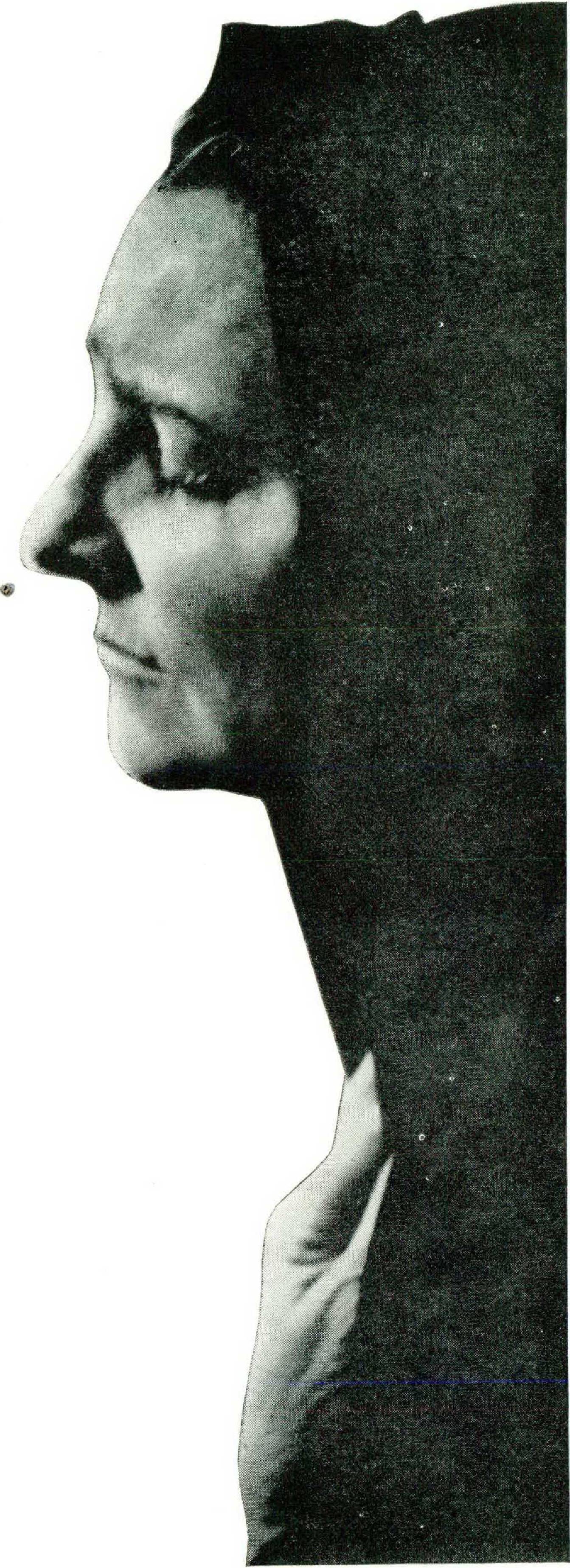
MY WONDERFUL life goes miraculously on.” So she wrote at over seventy, to a friend of thirty years standing; and the life she meant was surely not her own, but that of the full company of actors whom, wherever she went, she conjured up beside her. When did she first begin to summon them? Perhaps she herself could not have said. A cousin, in whose house she often stayed in childhood, recollects that, when she was only eight or ten years old. the other children would gather round her in the nursery at bedtime. “Do the Channel crossing, Ruth!” “Do Mrs. X!” “Do Fräulein!” And suddenly, sitting on the edge of her bed, the small girl in a nightgown would call up, for the benefit of her beguiled, bemused, and soon wildly giggling contemporaries, a whole procession of mercilessly delineated, exquisitely absurd grownups. A little later, it was the guests in her mother’s drawing room who were portrayed, sometimes for an equally appreciative audience in the sewing room or pantry. It was from one of these that, fifty years later, when Ruth was playing at the Gaiety Theatre in Dublin, a letter came: “I’m not surprised at the Posetion you took up, as many a time Bridget Brodrick was trying to control yourself and Master Paul in the Laundry-room with your antics.”
Master Paul was Ruth’s brother, the youngest and closest to her in age of the family of eight — Ruth’s half-brother and sister, William Kinnicutt and Martha, and then Charles, George, Dorothea, Alice, Ruth, and Paul — who lived in Dr. William H. Drapers house on 47th Street, New York. Ruth’s grandfather was Charles A. Dana, the publisher and editor oi the old New York Sun; her father, a brilliant and much-loved doctor; and the guests who came to the house came from the world of letters and music, as well as from that of “Old New York.” As Ruth grew up, there were visits to museums, to concerts, to the theater, and then the first parties as a debutante; there were summers at Dark Harbor in Maine, the place which remained, perhaps, the nearest to Ruth’s heart, and where later on she opened the doors of her house and her heart to her friends, among them those from Italy who had become voluntary exiles during the Fascist years. As bright-eyed and industrious and ruthless as a young squirrel, the girl stored up the inflections and gestures which became her stock in trade. The German Governess, The Children’s Party, The Boston Art Gallery, The Debutante— all date from these early, ineradicable memories.
At first, however, it was only at home that Ruth’s talents were displayed. “Do something to amuse us, my dear,” her mother would say when the conversation flagged after dinner, and at the end of the evening, weak with laughter, the guests would cry, “That child ought to go on the stage!” One of them, the great Paderewski, said it seriously — and it was to him that Ruth listened.
When the Junior League needed talent for a charity performance, it was she who proved so great a draw that soon other charities, too, asked for her help. Again Ruth agreed, gradually adding to her repertoire and attracting a larger audience, but still stipulating that the proceeds were to be sent directly to the charity concerned. It was not until January 29, 1920, that she made her professional debut at the Aeolian Hall in London and filled it to capacity. At last she had become what she had always wished to be — a professional.
FROM then until thirty-seven years later —— until, indeed, only a few hours before her death at the age of seventy-two — the story is one of unbroken triumph. Yet the secret of her vast, her universal success still remains elusive. How was it possible for this slight, bright-eyed little woman to fill her theaters night after night for forty years, in London as in Paris, in New York as in Bangkok, to be applauded by young and old alike, to be appreciated at Windsor Castle and in a Mexican mining town? How was so complete an illusion created with such slender means?
To a degree, this is always true of the actor’s art. “Every night,” wrote Virginia Woolf, “when the curtain goes down, the beautiful coloured canvas is rubbed out. What remains is at best only a wavering, insubstantial phantom, a verbal life on the lips of the living.” If this is true in general, it is peculiarly so of Ruth’s vivid impersonations. Since the parts she played were only those she had created for herself, she never became identified with any of the symbolic, eternal figures of the stage: she was never Electra, Athalie, or Ophelia. Actresses who play these parts — however variously they may interpret them — take on for a season something of the greatness of the minds which first conceived them: the air they breathe is that of Sophocles, Racine, Shakespeare. And when their voice is stilled, their memory is indissolubly bound to the image they brought to life: we say Sarah’s Phèdre and Ellen Terry’s Desdemona.
This world Ruth never entered at all. Her talent was on a smaller scale, but it was a gift entirely authentic, absolutely her own — requiring no props, no costumes, no fellow actors, not even a playwright. Scenery? At the end of the script of her monologues there is a list of her stage requirements, as meager, surely, as can be found in the history of the stage. For Doctors and Diets, “a small rectangular table and a restaurant chair”; for At the Court of Philip IV, “two long, low benches”; for An Italian Church, “a small rush-bottom chair”; for most of the others, nothing at all. Costumes? A few hats, mostly rather battered, a dressing gown, a raincoat, and a collection of shawls. These last were her only indispensable accessories: draped in a hundred different ways, they turned her into an old Irishwoman, a young Italian girl in church, a Dalmatian peasant, a great Spanish lady. By Ruth’s own desire, they draped her coffin on the day of her funeral.
As she dispensed with props, so she laboriously worked out for herself her own technique, alone, disregarding the advice of even the greatest professionals. “Pourquoi ne faites-vous pas la comédie?” asked Sarah Bernhardt, after hearing her. “Mon enfant, ne faites jamais la comédie,” said Duse. Ruth thanked them prettily — and went her own way. For one season only, thinking that she might learn something from working in the company of a great actress, she accepted a minor part in one of Marie Tempest’s plays. But it was a failure: Ruth became a mere shadow of herself, her whole personality muted. The experiment was never repeated. “My dear,” said Henry James, “you have made for yourself a little carpet of your very own. Stand on it.”
Where then did she find her subject matter? In everyone she knew. Her sketches are a series of delicate, brilliant, utterly convincing conversation pieces, in which the only speaker, with many voices, is Ruth herself. For this is what she really cared for: people, daily life. She went round an English garden with her hostess; she sat in an Italian church; she attended a courtroom; she spoke to a child in the street. Then she went home and worked. She worked very hard indeed. “I am happy,” Ellen Terry once wrote to GBS, “not to be clever,” and the reason she gave him was that “you clever people miss so much.”
Ruth, too, seized the things that the “clever people” so often miss, the thousand tiny details of which daily life is made, which chill or warm the heart. Alone in her room, she imagined the people she wished to portray; she thought about their life, their surroundings, their feelings. Then, when she had lived herself into her subject, she worked before the mirror, experimenting with facial expressions and gestures. Sometimes the preparation of a sketch, before she was satisfied with it, took eight or ten years. It was all clone, she once said to my children, by imagination. “Think hard enough about drinking the juice of seven lemons, and you’ll have the right face!”
The script of her monologues was written down, but served merely as an accessory to her memory. The point of her sketches was not in their verbal brilliance — when one came home from the theater, there were few sentences that remained in the memory — but rather in the extraordinary accuracy and delicacy of ear which enabled her to build up, by a thousand imperceptible touches, her finished portraits. Moreover she treated her script merely as a framework. No two performances were precisely the same. A different inflection, an interpolated sentence, a new gesture — these, after forty years of repetition, still kept each part alive.
HER repertory consisted of some forty sketches in which she played fifty-eight parts, in English; French, German, Italian, with an Irish brogue or a Highland lilt, or in the brilliant invented languages of her “imaginary folk songs” and of the flower names of her English garden. “Next week my Funnifelosis will be in bloom . . . and those darling little pale Punnyfunkums. You don’t know the Punnyfunkums? . . . But my poor Glubjullas never came up at all.” She took us to an English bazaar, a Southern dance, a porch in a Maine coast village, a New York hospital, a station on the Western Plains, a windswept beach in Normandy; we shared in a class in Greek poise, a lunch in a smart New York restaurant, and in the efforts of a whole English village to prepare a country cottage for a soldier’s return from the war. Perhaps the most remarkable of her gifts was her power to bring upon the stage, in addition to the part she was playing, a dozen subsidiary characters. In Three Women and Mr. Clifford, for instance, Ruth was each of the three women in turn: Mr. Clifford’s wife, his secretary, and the woman he loved. He himself never appeared, except through them. Yet most of us would agree with the member of the audience who, on his way out of the theater, said to his companion: “Wasn’t Clifford the most long-suffering jackass in that car?” — and only a moment later added, “My God, he wasn’t there!”
Then there is The Italian Lesson. The curtain goes up; we see a smart middle-aged woman in a dressing gown on a sofa: “Good morning, Signorina, good morning. I can’t tell you how excited I am that we have come to Dante at last!” The lady, at the moment, is alone; but within two minutes the stage is so full that we are craning forward in our seats to prevent the baby from falling into the wastepaper basket, to catch the puppy (“Pat him on his head, sweetheart — that’s his tail”), to order the dinner (“It isn’t fish? I always thought it was fish. It looks like fish, tastes like fish”), to fill the opera box (“Oh, anyone, so long as it’s a man ! No, wait, I picked up a charming young Englishman last week, Sir Basil Something — I put him on a scrap of paper in the blotter”), to design a fancy dress (“You’ll find ten yards of blue chiffon in the sewing room. The figure of Hope — a lady, blindfolded, listening to someone, sitting on a ball”), to do the shopping (“a very dirty lampshade on the sofa, and on the mantelpiece a pile of yellow taffeta samples” and “from Brentano’s, by special messenger, a new book called Our Inner Life”). And of course, in between, to read Dante. “Nel mezzo del cammin — don’t you think, Signorina, that is what happens to people in the middle of life? They often become confused . . .”
All this is done with great bravura, in almost rollicking high spirits. We laugh and laugh. It is only when it is over that we realize that we have seen the picture of a woman’s whole file — filled to overflowing, and as empty as a hollow nut.
Ruth’s characters, unlike those of most mimics, are never mere silhouettes: we see them in the round, bearing with them their background, their past and future. In Three Generations, imagine Ruth coming onto the stage (which is completely bare except for a kitchen chair) as the grandmother — an ugly, squat old woman holding a black shawl tightly round her head; beneath it, one has a glimpse of sunken cheeks drawn in over a toothless jaw. She has a low, harsh voice and a strong Jewish accent. She lifts a shaking hand. “Good morning, Judge. My name is Anna Abrahams, seventy-nine years old. I live at 64 Orchard Street, with my daughter and granddaughter. . . . Twenty-five years. . . . That’s my home.”
She has come before the Judge, in a court of domestic relations, to ask him to prevent her granddaughter, who wants to get married and to go out to the West, from putting her, with her daughter, in an old people’s home. “I’m an old woman . . . too old to work. And my daughter, she’s got heart trouble and can’t work. . . . We couldn’t live without Rosie.” Harshly, bitterly, she mumbles her complaints of her granddaughter’s flightiness and the irresponsibility of the girl’s young man. “She go dance every night, she come home late. . . . And the young man — he drink — he make a very bad husband. . . . Rosie she should stay by me. Why she must go away?” Still mumbling, she sits down.
Then, with a most remarkable dramatic effect, the daughter rises. As Ruth Draper throws the shawl back upon her shoulders, a transformation takes place: in an instant, the stooping, toothless old crone has turned into a tall, middle-aged woman of dignity and beauty. (One of Ruth’s admirers once wrote of her “genius for assuming physical height — one of the tests of the great ones. The elder Salvini had it, and Irving.”) Standing very erect and very still before the Judge, she speaks in a faint, flat voice, without acrimony but without hope. One of her sons has tuberculosis, the other has run away; she has heart trouble and a paralyzed arm. “I sent Rosie to business college, so she should have a profession. She has a wonderful job. And now, she only wants to go. . . . No, sir, I don’t like this young man. He don’t
work regular, and he drinks. . . . Please, Judge, tell my girl she should wait. . . . She’s so young
. . . and she don’t understand what life is. . . . And she owes me something.”
She too sits down, and now Rosie springs up, flinging off the shawl altogether. She — how is it done? — is youth itself. Her eyes sparkle, her speech is breathless, even the nervous movements of her hands, as she clasps and unclasps them, have the awkward eagerness of youth. What is her name? “Everyone calls me Rosie!” She is a stenographer, she loves her work, she loves her home — “we’ve got a very nice little home” — but yes, she does want to get married. “I want my mother and grandmother should go to a home for old people — and they don’t want to go!” There is indignation in her voice, and also surprise. But she is a good girl, that is plain. She loves her mother and her grandmother and she has taken great pains to find a nice place for them. “The house has got four sides to it — there’s windows all round — and in the room they’re going to give my mother and my grandmother, the window looks straight into a tree. . . . They got cretonne drapes and cushions in the chairs. They got a piano and a radio and a Victor.” The old ladies, she says, all seem very contented, “knitting and sitting around.”
All this is said with offhand kindliness, in a cool, clear young voice. But when she speaks of her young man, her voice changes, it becomes warmer, deeper; she begins to plead. “Judge, I can’t give him up. I got to go.” They have been offered a job on a Western farm. “You go for four days and nights, and when you get out there’s absolutely nothing to see, only earth and sky. . . . No, we don’t know nothing about it, but we can learn. We’re both young,” No, she replies to the Judge’s questions, her young man does not drink, “Well he drunk some because he was so discouraged, but he won’t drink no more when we get married — he told me.” No, she did not run about and waste her money. “They’ve got every penny I earn.” Yes, she will miss her mother. “I’ll miss her something terrible.” But she must get away. “I want to get out of this. I want my own life.” And then comes the final, desperate appeal. “Can’t you see? They’re different! Judge, don’t make me stay!”
That is all. The Judge tells her to come back next Wednesday and to bring her young man, and we know what the answer will be. Rosie will have her husband and her life. “Come on, Grandma, what’s the use of talking now? . . . Come on home.”
They go out, and it is only then that we realize that it is only one woman that we have been watching; one woman who, on an empty stage, without even a change of dress, has brought before us old age and middle age and youth — despair and resignation and rebellious hope — whose very bones seem to have changed before our eyes. The woman who could do this was not merely a great mimic, but a woman who loved life and human beings.
IT WAS this, I think, above all else that drew the vast audiences that packed her theaters year alter year. “She is not astonishing you,” wrote Brooks Atkinson, the drama critic of the New York Times, “with the brilliance of her talent. She is modestly asking for your interest in various characters, most of whom represented her respect for the human race.” It was this respect which, for till the sharpness of her observation, took the bitterness out of Ruth’s mockery. The laughter she aroused was never that which, when its echoes have died down, leaves one feeling chilled and sad: her audiences, at the evening’s end, took with them a taste as sweet and crisp as that of a ripe apple.
They took with them, too, especially the young and obscure or the elderly and lonely, a certainty that they had found a friend. They thronged into her greenroom and went on writing to her for years letters which touched her more than those of any of her great contemporaries, which she invariably answered and which she kept all her life. The files in which her correspondence is preserved bear witness to these friendships. There are the letters of a little Scottish boy who was waiting for her one day at the stage door and to whom she went on writing even after he had emigrated to New Zealand, ten years later. There are the notes of an elderly man who writes in the style of her own sketches: “Yes, that’s my name. — Sixtyseven. — Yes, unemployed for the last year. Income? Well, it’s two fifths of what it was before.
I had to go in the stalls, because I am a bit deaf. —Inexcusable extravagance? No, it will be something for me to talk about, if I have to come down to sitting by the workhouse fire.”
And then there are the letters of Fred B., the owner of a secondhand book barrow in Walworth, who writes to tell Ruth that she is “a dear sweet lady and the greatest actress in the world,” and who soon becomes a friend, so that she accepts an invitation to see his books. “I shall have the pleasure of calling for you around 5:30 on Thursday, and if buses too full we’ll go by tube to Elephant and Castle and get a tube there. We are working class, and home is humble, but clean and homely, and we are going to get a specially nice tea, with cake and a special treat of flan.” Ten years later the friendship still prospers, and Ruth has sent two seats in the stalls to Fred and his wife. “It’s the first time in her sixty years of life that she ever sat in the stalls, but I was myself not quite a stranger to the posh seats.” For Fred, meanwhile, has come up in the world: he has begun to write about his book collection and has received a check for five guineas from Town and Country. “I’m in luck and so I did not go out with my barrow this cold day.” Fred is sure that he will go on writing now, “and you will see your name creep in, sort of: ‘I remember on one occasion when Ruth Draper was having tea with me . . .’ The proper swank, yet it does get over and astonish people. And they’ll say, ‘Blimey, he knows Ruth Draper. He must be someone.’ ”
THE origins of the drama, in every Western land, are rooted in one great theme: the journey of Everyman between Good and Evil. Ruth Draper’s sketches, too — slight as some of them were — followed that great tradition; they too were morality plays, stories of Everyman’s meeting with Vanity and Passion, with Folly and Despair, but always moving in an ordered, stable world, in which at the last it is goodness that prevails.
Perhaps it was this belief which enabled Ruth, in spite of her own encounters with anxiety and grief, to preserve all her life what was her most irresistible gift: her delight. “My wonderful life goes miraculously on.” If her audiences rejoiced in her, she was no less enchanted by them. “Weren’t they wonderful tonight?” she would say as she left the theater, and the same zest endured on this side of the footlights, in the company of her friends. The moment would come after dinner when the chairs would be pushed into a semicircle and “Do you really want me to?” Ruth would ask as she rose. “Well, just one before bedtime — which shall it be?” And again, as in her own schoolroom days, young voices — those of the children and grandchildren of her first hearers — would clamor: “Please, please, The German Governess!”
Now and again, though not often, a life closes in a manner entirely fitting: the pattern is rounded, complete. To Ruth, whose life had been as active as a bird’s, the lean still years of old age would have been unbearable; the generous hands, always extended to give and to gather in, could never have lain folded. When I saw her last, only three months before her death, she told me about her plans for the coming winter; the season she was going to give in New York, in the Playhouse Theatre. For the first time she said how greatly she dreaded the day when she would have to give up her work, but added, “It hasn’t quite come yet!”
I was reminded then of a passage in Ellen Terry’s Story of My Life in which she described the celebrations for her “jubilee,” after fifty years upon the stage. “Perhaps,” she added, “my chief joy was that I had not to say goodbye to any of the celebrators. I could still speak to my profession as a fellow-comrade on the active list, and to the public as one still in their service.”
Ruth Draper, too, never left the service of her adoring public. Her last season at the Playhouse began on Christmas night and, in spite of bitter weather, she never had a more brilliant opening. The next day, the press was as lavish as ever in its praise. “There is only one Ruth Draper.” On December 29 she gave two performances, but did not admit to any fatigue, and when she came out after the evening show, she drove down Broadway to gaze at the bright lights under the stars. Then, with laughter and applause still ringing in her ears, she went home to bed. When the maid came to wake her the next morning, it was to discover that she had died peacefully in her sleep. She, too, had never had to say good-by.