The Summons of Art
At the urging of the ATLANTIC, FRANCIS HENRY TAYLOR,director of the Worcester Art Museum, flew to Florence for a visit with his friend Bernard Berenson. Their mornings together at Berenson’s bedside produced this self-portrait of a man who for half a century has been recognized as the greatest connoisseur of Italian art.
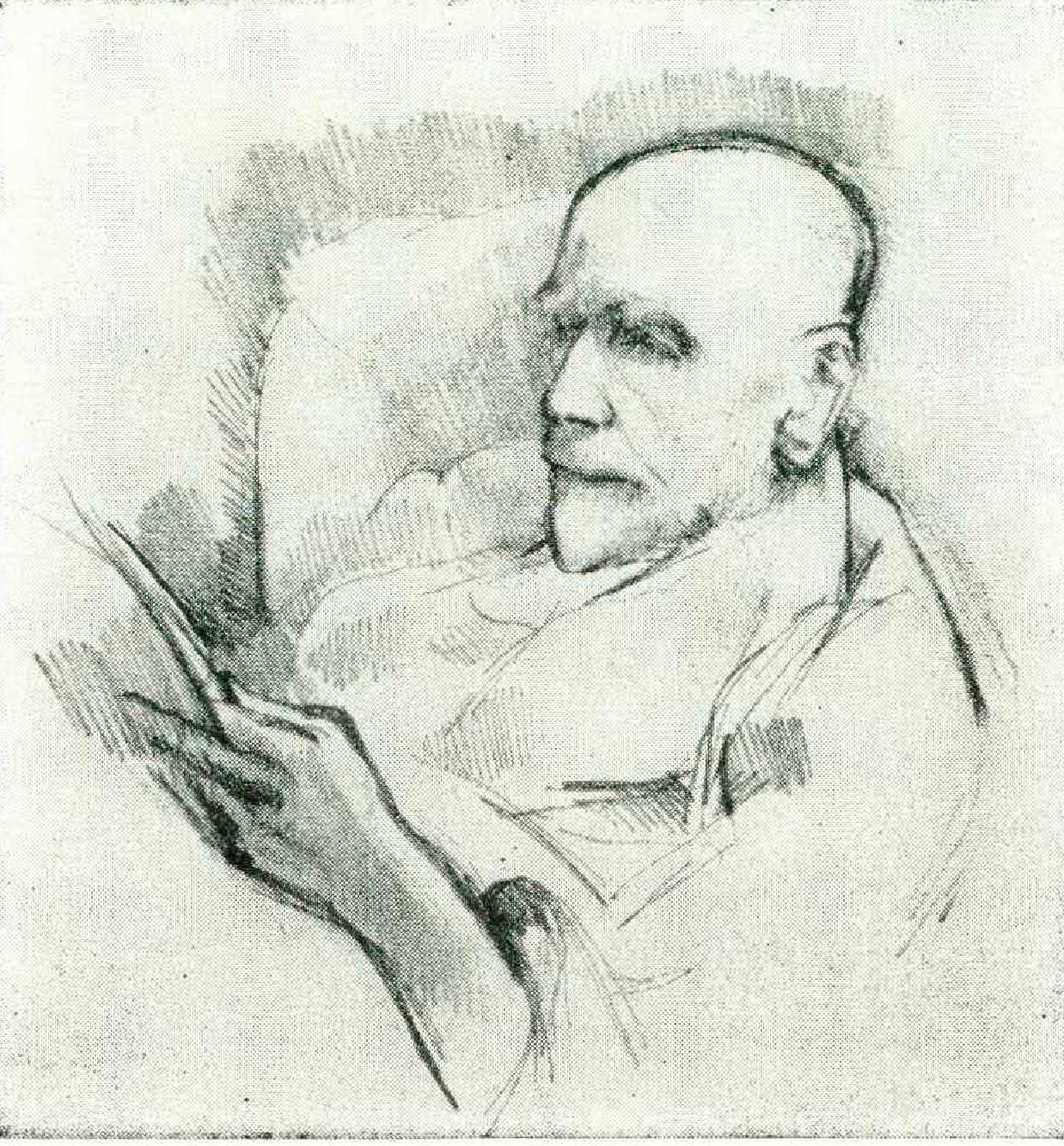
Conversations with BERNARD BERENSON
BERNARD BERENSON is a man who has survived himself; a phoenix who has risen from the ashes of his Edwardian youth to speak once more to a younger generation who know nothing of Berenson the impresario and investigator of the Italian Renaissance. Had he dropped from the scene some twenty years ago, along with most of his contemporaries, his reputation might have faded. But now, at ninety-two and armed with the venerable authority of the sage, he has burst the bonds of art history and ponders over all of the questions relating to our day. His methods and critiques have passed into the subconscious of every connoisseur. In the depth of his human understanding and in his sense of history, B.B. is closer to us in 1957 than he was to the youth of 1914—1918. For as a philosopher he has abandoned his earlier concern with the niceties of attribution, and has come to grips with the fundamental issues which may determine the future of our own Hellenic and Judaeo-Christian world.
The answers to many of these questions he believes may be found in what he calls “the ultimate summons of the work of art itself.” The “ultimate summons” he defines as the imperious and compelling thought which underlies every true work in which the artist at any time, in any place, and in whatever medium has communicated his vision to the spectator. “If the work of art,” Berenson asks, “is not the central core from which everything radiates and emanates, what is the point of all this [talk about art]?” Lying in bed and speculating conversationally over the points he might have covered if he were able to write this article himself for the centenary number of the Atlantic, he carried his ideas a little further and more specifically than he had in his early writings or more recently in his Sketch for a Self-Portrait. He has returned to the convictions of his youth, so well expressed in Venetian Painters published more than sixty years ago, Lorenzo Lotto, and in the three infinitely rewarding and always fresh volumes of The Study and Criticism of Italian Art.
Fashions in criticism and Kunstwissenschaft come and go but Berenson has witnessed, perhaps, more cycles of taste than any other man since Titian, who lived to be ninety-nine. Thus, unlike so many of his colleagues and detractors, he has persisted in living until it has been vouchsafed to him to see the other end of the rainbow. Had he not done so he might have occupied a respectable niche in the critical façade erected by Walter Pater and John Addington Symonds. Refusing to accept the current mode that art history is an end in itself, he further contends that connoisseurship does not depend on the eye alone but can grow only in the well-nourished and furnished intellect.
But connoisseurship to Berenson has never been confused with that empty and fatuous Edwardian conceit called “flair.” It is a serious experience by means of which the eye and the mind unite in the recognition of a thing for what it actually is and not what fashion dictates it should be. He recalled during these recent talks statements he has made elsewhere: “In a sense, the works of art themselves are the only materials of the student of the history of art. All that remains of an event in general history is the account of it in document or tradition; but in art, the work of art itself is the event and the only adequate source of information about the event, any other information, particularly if of the merely literary kind, being utterly incapable of conveying an idea of the precise nature and value of the event in art. (This arises from the fact that words are incapable of arousing in the reader’s mind the precise visual image in the writer’s.) An art that has failed to transmit its masterpieces to us is, as far as we are concerned, dead, or at best a mere ghost of itself.”
Connoisseurship to Berenson, then, is merely the method, the application of scientific principles in the process of recognition and appreciation. Connoisseurship is “based on the assumption that perfect identity of characteristics indicates identity of origin — an assumption, in its turn, based on the definition of characteristics as those features that distinguish one artist from another.” This may express itself in the manner in which an artist always handles drapery or in the rendering of the eyes or mouth of his figures. Mannerisms of drawing reveal themselves in the same way that the mannerisms of handwriting become obvious to a bank teller, for example, in determining the authenticity of a signature on a check. The examination of the object moves from the general to the particular, the generality being discarded as the telltale marks of the author’s identity come into clearer focus. “Obviously,” Berenson concludes, “what distinguishes one artist from another is the characteristics he does not share with others. If, therefore, we isolate the precise characteristics distinguishing each artist, they must furnish a perfect test of the fitness or unfitness of the attribution of a given work to a given master; identity of characteristics always indicating identity of authorship. Connoisseurship, then, proceeds, as scientific research always does, by the isolation of the characteristics of the known and their confrontation with the unknown. To isolate the characteristics of an artist, we take all his works of undoubted authenticity, and we proceed to discover those traits that invariably recur in them, but not in the works of other masters.”
This is the Berensonian method which has governed the art world during the first hall of the twentieth century. It has established criteria for the museums and galleries of Europe and America; it has dominated the universities and has determined the monetary values of “Old Masters” in the market place. Having dedicated six decades to the perfection of his method, Berenson himself lost interest in it. He had already exhausted its possibilities for himself by the eve of the Second World War. The latter brought about an unexpected and enforced interruption to his normal existence in his seclusion under the protection of the ambassador of the Republic of San Marino to the Vatican. He abandoned his “studies in attribulation” and turned to gratification of his insatiable curiosity, to history and philosophy and the broader pleasures of the mind. Like a bored and weary locust he flew away to strip new trees of their recurring verdure and left to others the morphological study of his discarded shell.
OUR conversations in April of this year at I Tatti, the lovely villa high above the valley of the Arno on the slopes of Settignano near Florence, placed in perspective many loose ends. The contrast between the almost ascetic quality of his mind and the sybaritic luxury of its setting seems at first glance a paradox, a congeries of inconsistencies and insincerities. But a few minutes of talking with B.B. convinces even the most skeptical visitor of the compulsion for physical beauty and comfort which has dominated and complemented his spiritual life. The early pictures of the trecento and quattrocento, the exquisite examples of Italian furniture, and the sculpture as well as objets de vertu picked up in his travels through the Mediterranean and the Near East are, like the gardens and the terraced meadows and vineyards cascading to the valley, an integral part of that composite hunger for a past humanism which has made him such a symbol of it in the present day.
He received me at his bedside every morning promptly at nine o’clock and expatiated upon the history of his life, his satisfactions and his disappointments. Much that was hitherto unexplained in his relation to events and individuals came to light — the bitter loneliness of a man who had spent untold years receiving like royalty out of a sense of obligation, mingled perhaps with a latent nostalgic curiosity, persons who seldom touched him below the surface.
Having reached the end of a fabulous career, it is not surprising that today he reserves his severest strictures for himself. And in facing the mirror of his own immediate past it was perhaps comforting and not a little relaxing to use as a sounding board a younger man who shared many of his professional theories but whose primary interest is in Berenson the man rather than in the legend so painstakingly built up over so many decades. There are agonizing moments when he is torn with a suspicion that his life has been both a failure and a fraud, that he should never have left the cloistered precincts of Harvard Yard, that he should have devoted his energies to philosophy and literature and relinquished his mercurial ambitions for the hazardous rewards of the poet and the novelist. Then, too, looking back upon the market place which at one period of his life he frequented not merely because of the material rewards it offered but because he was too deeply involved in human psychology to resist the temptations of the game, B.B. is haunted by its corruption and duplicity. The exploitation by the great art dealers of any expert in that mad period just prior to the 1914 War is something to a great extent unknown to us today, but the memory lingers on and is no less disquieting.
For many years the wisdom of the choice he made in his career has tortured him. There is a passage in the Sketch for a Self-Portrait, written in 1945, in which he says, “I took the wrong turn when I swerved from the more purely intellectual pursuits to one like the archaeological study of art, gaining thereby a troublesome reputation as an ‘expert.’ My only excuse is, if comparison is not blasphemous, that like Saint Paul with his tentmaking, and Spinoza with his glass-polishing, I too needed a means of livelihood. Mine did not take up more of my time but very much more of my energy. Those men of genius were not hampered in their careers by their trades. Mine took up what creative talent there was in me, with the result that this trade made my reputation and the rest of me scarcely counted. The spiritual loss was great and in consequence I have never regarded myself as other than a failure. This sense of failure, a guilty sense, makes me squirm when I hear myself spoken of as a ‘successful man’ and as having made ‘a success of my life.’ I used to protest but gave it up at last, for nobody would believe that my vehement negatives were more than polite modesty or indeed the conceit of an ambition that had not yet been satisfied.”
These anxieties, these apparitions from the past, and the uncertainty of what may follow in the years to come were the deep and absorbing intimacies of our morning conversations. Later in the day at luncheon and at teatime, and in the more formal ritual of dinner, the clouds vanished. He became once again the epitome of Edwardian elegance, the all-knowing and all-seeing critic of literature and the arts, the arbiter of a world that is disappearing. Not only all Italy but all Europe is at his feet, and whatever stature he may have acquired as a self-made intellectual is enhanced by his being the confidant of those who pursue art and like better still to talk about it.
“I have always been a lone wolf,” he said on one occasion. “In fact one of the reasons why I left America was the recognition that I had none of the qualities which would make me a ‘good fellow.’ I had to follow a life of the mind which was my own and stimulated by my passion for the visible world. This has been at the root of the hostility I have inspired, particularly in those who never knew me.”
FROM his earliest days at Harvard the young Berenson was consumed by a passion which went far beyond what is normally understood by ambition. For mingled with this passion there was both a singleness of purpose and a scarcely comprehended intellectual humility. This humility never left him and shines through the perplexed pages of his later writing — Aesthetics and History and Rumor and Reflection — where he is groping with more fundamental and abstract issues than one finds in the limited and confined discussions of The Italian Painters of the Renaissance.
Son of a rabbinical family who fled from the Baltic Provinces of Czarist Russia during the pogroms of the 1870s, he found that the cultivation of the mind was the most natural occupation for him to follow. And it is therefore not surprising that this immigrant boy should look for sympathetic soil in which to grow among the Brahmins. First as a student in the Boston Latin School, and then as an undergraduate at Harvard College, Bernard Berenson found a congeniality in the society which had brought into being only a few decades previously the Atlantic Monthly.
His early impressions of Harvard are recalled with deep sympathy and wistfulness. In fact each year that Berenson has lived abroad he has become more consciously American, patterning his manners and his speech not on the Anglophiles and dilettanti that turn up like chameleons beneath the stones of Tuscany’s wooded hillsides, but upon the descendants of the Puritans. The very fact that he has stood firmly with one foot planted in each continent has given him a perspective which is both detached and unimpressed.
“I owe everything,” he said to me, “to William James, for I was already applying his theories to the visible world. ‘Tactile values’ was really James’s phrase, not mine, although he never knew he had invented it.” Berenson’s gratitude to James for his interest and support at a moment when B.B. was faced with utter poverty he considers one of the most heart-warming experiences of his Harvard days. Not so his recollections of that professional friend of Ruskin and everybody else whom Carlyle referred to as “Goose Norton.” The latter was to B.B. a highly self-conscious grand viveur whose classes had little or nothing to do with art and were “lessons upon the proper deportment of young men in elegant society.” Thus Berenson dismisses Charles Eliot Norton as one of the exploded myths of his age, although B.B. is willing to temper this dark and dismal heresy with the grudging admission that it was Norton who obliged him to read Dante aloud lor an entire academic year and thus initiated him into the Italy of the trecento.
More than to his university or to any formal institution, Berenson believes that he owes his deepest obligation to his own roving curiosity. “The fruit of my life,” he insists, “was my loafing, not my work — when I was woolgathering and satisfying useless curiosities. I didn’t prepare myself for anything but my voracious appetites for the useless, such as reading anthologies of Greek and Provençal poets. I never teared wasting time.”
Herein lies the root of Berenson’s quarrel with the professional art historians of today. To him the understanding of the work of art can come only from the contemplation of it and not from a discussion of the opinions of those professors who in turn have neglected the art itself and depended for their taste upon the acceptance or rejection of the critical opinions of their predecessors. “Never discuss works of art except in their presence,” he says in repeating Goethe’s dictum. “Art history as it is now being taught is an evil thing because it places the emphasis on a nonexistent science and not upon the reality of human experience. . . . Art must serve the soul and not live narcissistically as it does today. Perhaps,” he wryly adds, “I am merely another Canute commanding the sea to retire. But I will keep right on, for the Baptist, after all, did accomplish something by howling in the wilderness.”
THE friendships and the American habits which Berenson formed at Harvard have always remained with him. He has never ceased to be a kind of overseas Cambridge, Massachusetts, don. They were in many ways the happiest years of his life, in which the Renaissance was a challenge and opened up fresh vistas which have become more vivid for him at each new step in his development.
Tuscany was not so much a refuge for him as a Heimat, a land to which he belonged spiritually and would make his own by right of intellectual conquest. On the way he would seize any opportunity which would head him in the direction upon which he had set his heart. “I patterned my own contributions to art history,” he told me, “upon those of Jacob Burckhardt and adopted his attitude of factual observation instead of searching for a willful and self-seeking interpretation of the facts.”
Such objectivity was against the fashionable currents of the nineties, and needless to say was not accepted with enthusiasm by his contemporaries, to whom the embroidery was usually more important than the garment. One notable exception was the wise and omniscient Salomon Reinach, who became Berenson’s patron and protector in Paris. Scholar, archaeologist, student of comparative religions, and historian of ideas, this celebrated editor of the Gazette des Beaux-Arts had entree everywhere. Not only did he befriend the young American and guide him in the proper circles, but Reinach commissioned articles by Berenson for the Gazette and then worked late into the night putting them into French.
Moreover Reinach’s name was an “Open sesame” to doors which seemed impenetrable. At that time the Drawings of the Florentine Painters was being projected. It became imperative that Berenson consult every piece of paper preserved at Windsor, the Louvre, and the Uffizi. Reinach to a great extent made this possible. It is difficult for us today, when the traditional obligation of public servants to be helpful is taken as a matter of course, to realize the pleasure which keepers at that period took in preventing access to the material in their charge. To be sure, they were poorly paid and a nominal fee was exacted and duly pocketed by even the most exalted experts, but the charge of ten liras imposed by the keeper of the Uffizi print room — the equivalent at that time of two dollars in gold — for taking each drawing out of its frame to permit close examination was more than a poor student could bear. Notwithstanding, this major study, probably Berenson’s masterpiece, actually got under way.
In 1895 when Berenson set out for London, the Lorenzo Lotto and the Venetian Painters had already been published in America by Putnam’s. But the books had not yet penetrated England. The young author had high hopes and carried with him some articles which he sent to the editors of the leading reviews. Like India-rubber balls they bounced right back with uniform rejection slips stating “There is at present no interest in Italian art.” And indeed there was none. The artistic decay of Victoria’s reign had already set in, and the afterglow of the Age of Enlightenment and of the collectors of the first half of the century had expired in the Exhibition of Art Treasures held at Manchester in 1857. The interest in “primitives,” which was the simultaneous product of the preRaphaelites and the Oxford Movement in the Church of England, lay buried with the Prince Consort. Interest was to remain stagnant until well after the turn of the century when the new fortunes from the Empire would create new peers to compete for the pictures and gilded plumbing fixtures to adorn their moldy baronial halls. Morgan and the American collectors had not yet succeeded in arousing the anger and the envy of the British public.
THE year 1895 saw in London an event which turned the tide of fashionable taste once more toward Italy. A loan exhibition of Venetian pictures, organized primarily by the trade, was held at the New Gallery on Bond Street. The official catalogue was as sanguine as it was inadequate but it pleased the owners, who were the very flower of society. Herbert Cook of the Cook Collection at Richmond Park alone was not altogether happy; and having met the young American critic whose Venetian Painters he had read, he invited him to write “an objective critique” which he distributed at his own expense.
“Rarely have I seen,” wrote the thirty-year-old Berenson, “a catalogue so accurate as well as tactful, in its description of works of art. ...It has one and only one fault, that the attributions are, for the most part, unreliable. It is, of course, not to be reproached for this fault, since it merely gives the attributions the pictures bear in the private collections from which they come; but it is clear that it needs rectification in this respect, if it is to be of value to students of pictures or to those who are interested in the history of Renaissance art. This, I think, will be readily conceded when we have examined two or three typical instances. To Titian, for example, thirty-three paintings are ascribed. Of these only one is by the master. . . . Of the thirty-two pictures that remain, a dozen and more have no connection whatever with Titian. . . . Five are copies of varying degrees of merit, after well-known originals . . . most of the pictures still unaccounted for are by various imitators. . . . This brief analysis shows the need for some emendation or supplement to the official catalogue. No other name, it is true, is so recklessly abused as Titian’s, but other instances of superannuated connoisseurship are not far to seek. Eight pictures, for instance, are catalogued as by Bonifazio, although not one is genuine. Similar is the case of Paolo Veronese to whom thirteen pictures are falsely ascribed . . . and we shall see later what a small proportion of real, as compared with attributed, Bellini’s and Giorgione’s there is in this exhibition.
“But even apart from the abuse of famous names,” he continued, “the old connoisseurship was guilty of applying at random to a picture the first name that happened to suggest itself, without stopping to inquire whether the resemblance, real or fancied, was due to anything but chance. . . . All these instances have, I trust, made it apparent that the person who cares to get a clear idea of the various masters whose works are exhibited here needs further guidance than is supplied by the official catalogue. To supply, so far as I am able, this necessary further guidance, particularly of the earlier masters, is the object of the following pages.”
Bond Street was a shambles. The owners of the pictures in the great country houses, many of whom had inherited their collections from the time of Charles I or from more recent ancestors who had made the Grand Tour in the eighteenth century, were aghast at the wholesale denigration of their property. The verdict of this young upstart could not, they felt, be true, for had not the eminent Dr. Waagen, the German expert who had inventoried the English collections in the 1850s, established once and for all the authorship of every painting in the British Isles? Such impudence had not been heard since Horace Walpole’s attack on the classical marbles of the Earl of Pembroke.
The dealers, many of them established for a hundred years or more, had likewise come to rely upon the sanctity of traditional attributions, particularly when it was possible to bandy about the stated opinions of Dr. Waagen, of Crowe and Cavalcaselle, even of Ruskin and Walter Pater. The whole structure of the trade was undermined. Moreover in Germany similar revolutionary tendencies were being observed. Dr. Wilhelm von Bode was paying astronomical prices for works of art for the Kaiser Friedrich Museum in Berlin, relying solely upon his own knowledge and judgment. A whole new generation of art criticism had descended upon the tight little world which had managed the commerce of art since before the French Revolution, and once Berenson had lighted the fuse which set off the bomb there was no retreat.
Opinions began to have cash value; the policy of the auction room was determined no longer by the blandishments of the barker but by the written certificates which were offered in substantiation of each lot. Berenson singlehanded had brought about a complete reversal of the established order of the trade. For the next twenty years virtually every masterpiece of Italian art was judged no longer by the classical opinions of the nineteenth century but according to Berenson’s verdict upon its authenticity and authorship.
“I soon discovered,” he confided, “that I ranked with fortunetellers, chiromancists, astrologers, and not even with the self-deluded of these, but rather with the deliberate charlatans. At first I was supposed to have invented a trick by which one could infallibly tell the authorship of an Italian picture. A famous writer on the Renaissance, Vernon Lee, thought it was close and even mean of me not to let her share the secret. Finally it degenerated into a widespread belief that only if I could be approached the right way I could order this or that American millionaire to pay thousands upon thousands and hundreds of thousands for any daub that I was bribed by the seller to attribute to a great master. . . . Needless to say every person I would not receive, every owner whose picture I would not ascribe to Raphael or Michelangelo, or Giorgione, Titian or Tintoretto, etc., etc., turned into an enemy.”
Berenson at thirty was made, and also he was undone. With the publication of the Cook pamphlet the London trade decided that he should be “hunted down and exterminated.” This they would accomplish not by an overt act or open attack but rather by exposing him to that deep chill which the British reserve for foreign scholarship. What made the situation intolerable in this instance was the circumstance that not only was Berenson an Eastern European Jew but he had dared to flaunt an American education in their faces. Their attitude has baffled him throughout his life; and even today, with unconscious naïveté, he observes, “I could never understand the hostility of the Bond Street dealers toward me.”
But there was a silver lining to the cloud which hung over B.B. at this time. Joseph Duveen, who refused to fit into any accepted pattern of the trade, had the wit to see what a formidable combination their native gifts could produce. The story of their years of collaboration may be read upon the walls of the museums and great private galleries of America.
FROM this moment on Berenson withdrew to Tuscany and threw himself into reaping the rewards of the system of connoisseurship which he had forced upon the unwilling art world. Despite the continuing efforts of the trade to discredit him, Berenson’s word remained as absolute in the salesroom as it was in the museums and universities. All of these arenas he assiduously eschewed, forcing the critics, the curators, and the connoisseurs to come to him. I Tatti, with the collaboration of his wife and chatelaine, the sister of Logan Pearsall Smith, was transformed into a humanistic court after the fashion of Guido da Montefeltro’s at Urbino or Isabella d’Este’s at Mantua. His travels he reserved for the refreshment of his eye and the development of that extraordinary catholic and diversified circle of friends who constantly surrounded him — writers, musicians, statesmen, artists, as well as professional friends and enemies.
In recent recollections of these friendships he expresses both wistfulness and hindsight. Henry Adams, whom he met in Washington in 1903, was “like a fine dry sherry. We had much in common but he could not forget that he was an Adams and was always far more embarrassed than I was that I happened to be a Jew.” I asked him about the aesthetic perceptions of two of his great friends, Edith Wharton and Henry James. “I loved Edith Wharton,” he replied, “although I used to laugh at her terrible Edwardian conventionality. She was like an elder sister who was obsessed with ton and the worship of Parisian high life. I always expected her to tell me which fork to use, and usually she did. Artistically she had a fine sense of interior decorating and of the fitness of the right thing for the proper milieu, but she had no appreciation of the work of art for its own sake. Edith Wharton was a wonderful hostess and companion. She never worked after eleven o’clock in the morning. You could live in the same house with her for months and never know that she wrote a word. But she was always open to the severest criticism of her own work, on which she was able to look with astonishing dispassion. She read many of her novels aloud to me and I would proceed to take them apart.
“Henry James,” he continued, “had better visual perception than he realized, but he couldn’t look at anything except through the preconceived blinders of intellectual convictions. The same approach to human psychology extended to the visible world. He often saw but did not care to look.”
IT WOULD not be fair to deny,” Berenson has admitted in his Sketch for a Self-Portrait, “that being an authority brought material advantages. Not only did it enable me to pay for assistance in any work, for comfort at home and abroad, and for expensive journeys, but it gave me the means to acquire the books and the photographs that my study and research required. The only boast I feel like making is that the library I have accumulated item by item over the last fifty [now sixty] years will enable those who come after me to continue my kind of work for generations to come. It will require relatively little outlay to keep it up to date.”
What a collection and what a library I Tatti contains. The pictures are not only very lovely in themselves but they are also the laboratory materials upon which his scientific and literary studies have been based — the magnificent Sassetta altarpiece, the Domenico Veneziano Madonna and Child, the Neroccio, the Daddis — each and every one of them has contributed to his intellectual development. Yet B.B. has not merely lived with these things: he has lived in them and sought from them that essentially Tuscan quality of mind which at the same time preserves and creates anew. They are the means by which he has moved beyond scholarship to a more human understanding. “Every work of art,” he has observed, “has to be first and foremost a permanent joy and inspiration, and cannot be degraded to serve as document in the history of technique and taste or of civilization in general. . . . All of the arts, poetry, music, ritual, the visual arts, the theatre, must singly and together create the most comprehensive art of all, a humanized society, and its masterpiece, free man. . . . Art can offer the purest escape from the threatening tedium of totalitarianism.”
Vision and curiosity — the one is expressed by the works of art which surround him, the other by the books and photographs whose selection and accumulation have been the most consuming passion of his life. The library, comprising about 55,000 volumes, which he describes as “the completest biography of myself,” covers nearly every field of art and literature as well as all the ancillary material, historical, philological, and critical, for rendering the arts intelligible, suggestive, and inspiring. A person properly prepared who would use the I Tatti library, he declares, “could not help coming out as a cultivated apprcciator of all that art is and of what it has done to humanize mankind.”
It is in order to make this laboratory of traditional classical humanism useful to our present harassed, hustled, and dreary Western world, which “excludes leisure, tranquility, permits no unexciting pursuits, no contemplation, no slow maturing of ideas, no perfectioning of individual style,” that he has offered I Tatti with its contents and a substantial endowment fund to Harvard University. It would be Berenson’s wish to see a community of some sixteen fellows, no younger than twenty-five nor older than thirty-five, four changing every year, chosen from America and Europe who would spend half their time in Florence, the other half traveling in what was “the ancient Oecumene, not going farther east than the Euphrates and not farther south than Egypt and the great desert of North Africa.” He would have them liberally provided with funds so that they could have complete leisure in their four years of tenure “to be creative writers and teachers in the interpretation of art of every kind, including the verbal as well as the visual arts and not excluding fiction and verse. Research,” he adds, “for the lust of mere research is not to be encouraged.”
The memorandum outlining the terms of his proposed bequest contains many practical and precise requests which are being carefully weighed by the Harvard Corporation. As a philosophical commentary on education in the arts it is destined to become a classic. B.B. modestly summarizes the proposal by saying, “In a sense I venture to confess that I would like the fellows of I Tatti to continue what all my life long I have been trying to do but have only faintly succeeded in doing. I would like them to take as models Goethe and Winckelmann, Ruskin and Pater, Burckhardt and Woelflin, rather than mere antiquarians or attributors of the type of Cavalcaselle, Bodmer and their likes. I would like them to write about the way artists and their works have been appreciated through the ages rather than to concentrate on the material history or the provenance of the given work of art. In short I want this institute to promote aesthetical and humanistic rather than philological and antiquarian interests.”
These then are the fruits of this unusual life which at its sunset is beset by useless fears and regrets. So great a gift to the cause of humanism would of itself be enough to justify the pretensions of a more meager intellect. But in this case we have the art together with the artifact. Bernard Berenson’s career is a witness to the power of his mind and eye; the disposition of his written words and the sources which inspired them is legacy enough for any man.