The Unwayward Greyhound
THE bus, as a means of travel, has an ignoble reputation — perhaps because it has an ignoble name. When I was a schoolboy it was still called an omnibus, while the vehicle which took us out on mid-term treats was called a charabanc, a name with a certain dignity even when cockneyized, as it invariably was, into “sharry-bang.” Bus, however, is no name at all — merely, as we all learned at school, the tail end of a Latin dative.
Having allowed itself to get such a bad name, how can the bus hope to redeem itself? How, for example, can it ever take that rightful place in literature allotted already to its rivals, the train and the airplane? We have, it is true, The Celestial Omnibus. But who would ever write of The Celestial Bus? At the best it can hope only to be Wayward — or to provide a stop for Miss Marilyn Monroe.
America, however, the innovator in all things, has sought to elevate the status of the bus by calling it a Greyhound. It is by Greyhound that I have lately been traveling from one end of the United States to the other. When I told Americans that I intended to do this their reaction was twofold. There were those who looked surprised and shocked, like the gentleman in San Francisco who remarked, with laconic contempt, “Fourth Class Travel!" And there were those who thought it a wonderfully romantic plan, rather like following the golden road to Samarkand on the back of a camel. “ You’II really see the country,” they said. “And just think of all the fascinating people you’ll meet! ”
These ideas proved to be more or less false. I have, in my time, traveled in buses in many lands. I have traveled in Italy, to the music of Italian opera on the radio— so rhythmical that it seemed to be the vehicle’s motive power. I have traveled in Greece, where we would make wide detours to load on board the entire stock of furniture of a house-mov ing passenger, continuing our journey with an elaborate Victorian armoire roped on behind, and a full-length mirror in which following motorists admired themselves with gestures of amusement.
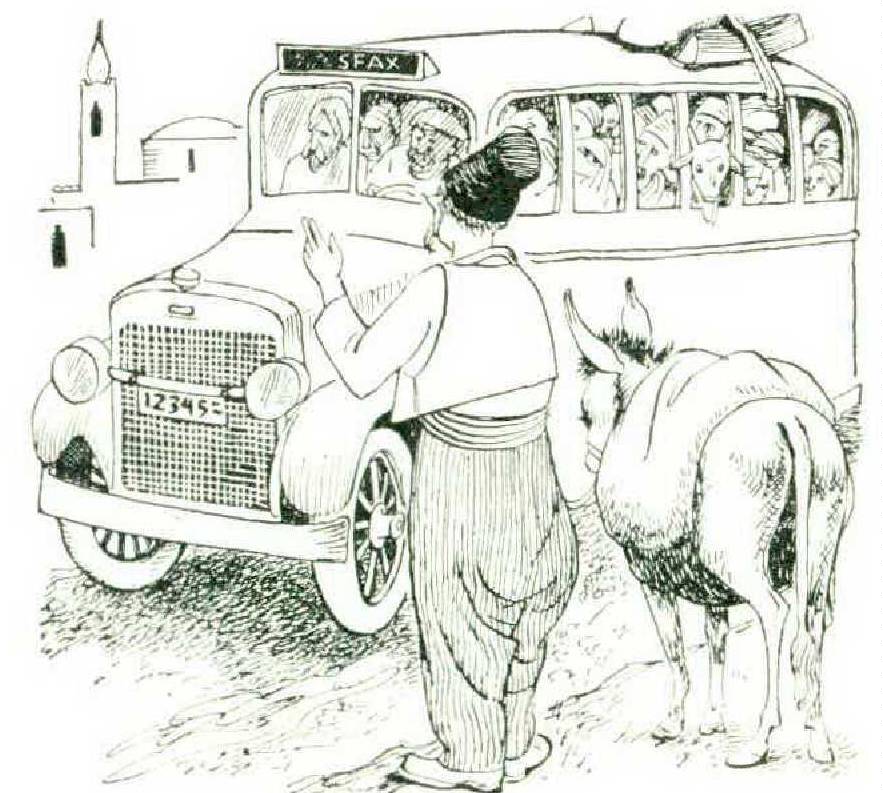
I have traveled in North Africa, in the company of hens and goats and veiled Arab ladies, so bundled up in calico from face to toe as to be indistinguishable from the bundles of baggage around them. I have traveled in Asia Minor, where the journeys — especially along the Russian frontier — were so hazardous, and often lasted (with late starts and breakdowns) for so many days, that the passengers grew into an isolated, united community, as intimate as people who have lived all their lives, and may very likely die, together. On such journeys I did indeed meet “fascinating people.”
Air-cooled comfort
But Greyhound life is different. In the first place, “ Fourth Class Travel or not, these streamlined, silvery creatures provide a degree of comfort undreamt of, not merely in the buses of the rest of the world, but in the railroad coaches and airplanes of America itself. For hundred-mile stretch after hundred-mile stretch I would recline, tilted back in my lushly upholstered seat, stretching my legs luxuriously out before me. (The legs are long, and in Turkey I sometimes had to pay for two seats to fit them into the bus at all.) I breathed deep into my lungs the welcome draughts of air-conditioning, sometimes so cool as to demand a sweater, doing duty for a shawl, around my shoulders, like the indoor mink summer stoles thoughtfully provided by Neiman-Marcus for the ladies of air-cooled Texas.
I enjoyed a speed and a smoothness of movement which enabled me to read one paper-backed book after another or to look over the shoulder of the passenger in front of me to reach such magazine snippets as “ How to Join a Nudist Camp" or “Why I Strip for a Living.”The only comfort lacking in all this was a bus hostess — and I have read that on some of the new double-deckers even these are soon to be provided.
I had to remember, nonetheless, that this was “ Fourth Class Travel,” and to remain a little vague, in First Class social circles, about how I had arrived and how I was going to leave — usually remarking, with a noncommittal shrug of the shoulders, “By road.”In Omaha, Nebraska, I embarrassed my hosts by asking to be met at the bus station. Luckily it was a Sunday, and the station was downtown, so nobody very much saw us. In Reno, Nevada, my host, a man with a nice sense of incongruity, took special delight in transferring me direct from my bus to a two-color Rolls-Royce, 1956 model, painted in Vanderbilt maroon and caramel cream.
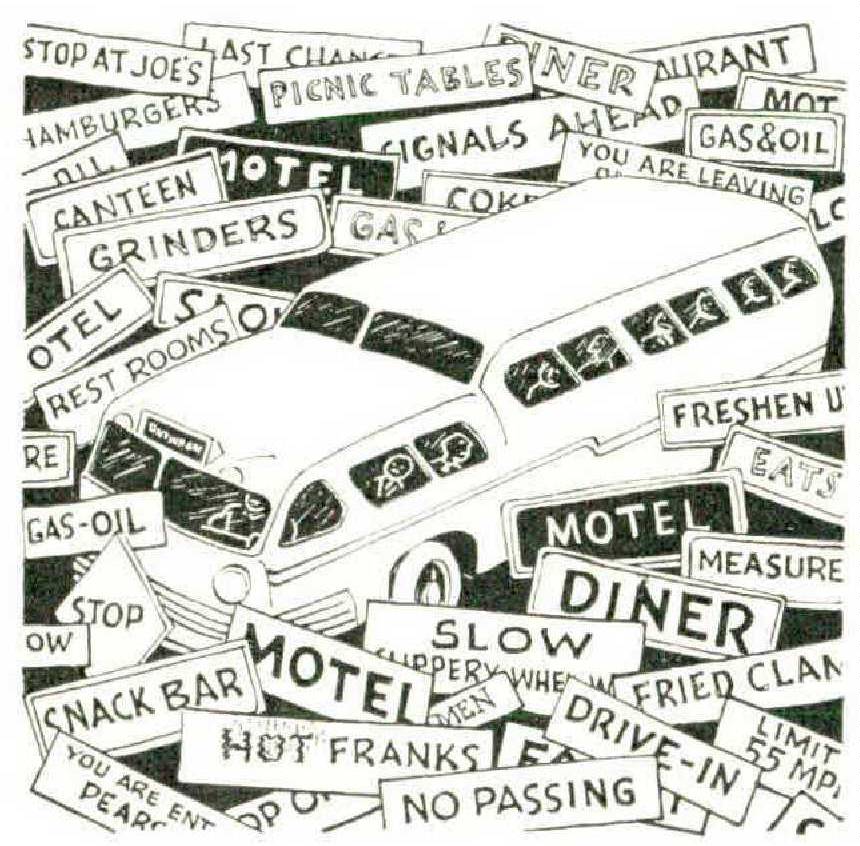
In this way— the Greyhound way — I “saw the country.”I saw its “hiways.”its “thruways,”its “expressways,”and its “freeways.” I read much of its roadside literature: “Gas. Beer. Coke. . . . Trash Can, Picnic Table Ahead. . . . Speed Checked by Radar. . . . Christ Died for Our Sins. Go to Church. . . . Big Blue Tube—is like Louise you get a Thrill—from every Squeeze.”I was able to observe the infinite variations of its motel architecture, from Colonial to Spanish to Mexican Indian to “Super-Futuristic.”
Roadside stands
I was able, every two hours, to drink a drink (nonalcoholic) or eat a jaw-straining sandwich in bus stations and roadside cafés. I grew familiar with their warm smell, compounded of hamburger and hot milk and cardboard; their armory of intimidating machines, steaming for coffee or freezing for ice cream; (he bright but timeworn plastic leather of their bar stools and booths; their counters stacked with candy and souvenirs and their racks with such enticing magazines as Uncensored Confessions and Dariny Romances, Confidential, Top Secret, and Whisper; and, accompanying all, the monotonous psalmody of the juke box, canned and unchanging from coast to coast.
I appreciated also the innumerable products of the American inventive genius, in the form of coin-in-the-slot machines for every imaginable purpose: a rocking horse in the bus station of Houston, Texas; a machine in that of New Orleans to give you “new pep and energy" by means of a severe shaking the moment you stood on its platform; another on the Ohio turnpike that supplied oxygen, together with a “mechanical valet" dispensing shave cream, toothbrush, nail clippers, and styptic pencil. Above all I enjoyed the assembly lines of jackpot machines in Nevada, with their all too inviting levers, and the last long, half-hour stop at the frontier to enable passengers to get rid of their change before passing into the more strait-laced state of Utah.
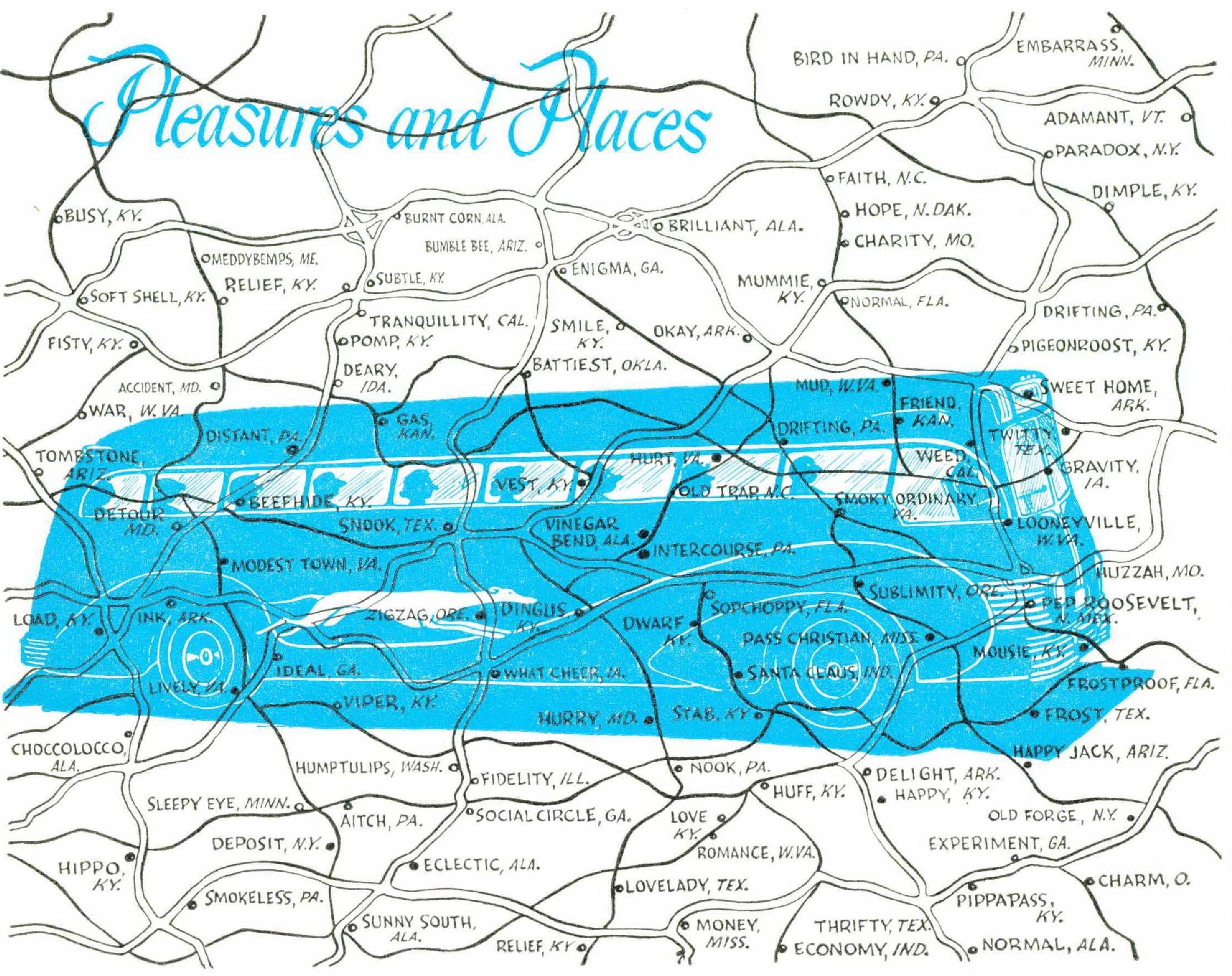
Between buses I did see something of the country; and from their windows, as never from those of a train, I saw such remarkable places as Intercourse, Truth or Consequences. Surprise, and (successively in Arizona) Bagdad, Siberia, and Ludlow.
Fellow passengers
“Fascinating people,”my friends had suggested. Well, yes. But in this respect I fear I was an outsider. The hardened Greyhound traveler thinks nothing of living on his bus for two or three days and nights at a time, as he travels from Buffalo to Salt Lake City; and since nothing draws people together so much as shared discomfort, a community spirit grows up among those passengers who have spent a number of sleepless nights on the bus together. But as a Sybarite, who invariably left the bus toward eight o’clock in the evening, after a mere twelve or thirteen hours, to spend a night in a hotel, I was excluded from this.
Most of my fellow passengers were as silent as I. When they did talk, their remarks served as a rule to point the regional distinctions of a continent only a few degrees less various, with its forty-eight states, than Europe, with its twenty-six countries.
There was the talkative hillbilly farmer from the foothills of the Great Smokies in Tennessee, and t he equally talkative nursery gardener from Florida, in front of us, who listened to him for a while and then exclaimed, “ I never seen a mountain.” He shook his head with distaste. “A thousand feet you say? That’s too high for me to get up.”
There was the truck driver who was returning thankfully from California to his home in Michigan. “California,” he said, “stinks. Nothing ain’t no good there — not even the women.” The coffee, he added with disgust, tastes of soapsuds; moreover you never see the sun for the smog.
At the frontier between Louisiana and Texas a Texan got on the bus, wearing a ten-gallon hat. He was tipsy and he carried a mandolin. Instead of playing this instrument, as he might well have done, he flung it up in the rack, sat down beside me (though the rest of the bus was almost empty), and proceeded to enlighten me, with some incoherence, about the technical processes involved in the extraction of oil from the soil of Texas. This at least enabled me to add a new social species to my collection: one who is boring about boring.
The talkative driver
The bus drivers themselves sometimes talked just a little. At each station, over the microphone, they would chant a long, lugubrious litany of the various places at which we were to call, incomprehensible to all but regular churchgoers; and on the bus itself there was an occasional driver who, in a similarly singsong voice, liked to impart information as to the sights to be seen around us:
“Look, folks, there’s a buffalo on this pasture to your left. . . . This is Taos, folks, one of the largest art colonies in the world. It contains sixty-five resident artists and fifteen art galleries. . . . On the right there you have the ranch at which Eddie Anderson spent a vacation, shooting elk, two years ago. He will be familiar to you all as that talented artist, Rochester, in the Jack Benny show.” But as a general rule a silence reigned, as blessed as on any train.
There are, of course, buses and buses. There was the crowded one which took me to Forest Lawn Cemetery in Los Angeles, its driver causing general laughter when he remarked, “Well, we don’t have room in here for one more soul, do we?” There was the bus up in Vermont, more like a station wagon than a bus, which delivered mails that the driver flung out casually and joyously along the roadside, without stopping. And there was the sight-seeing bus that toured me around historic Boston, past Paul Revere’s house, the Old North Church, and those sites made memorable by the deeds of the hated redcoats, the driver reverently calling for a moment’s silence in memory of “the men who gave their lives in back of this bus at the Battle of Bunker Hill.”
PATRICK KINROSS