Memo to the Staff
WILLIAM O’HALLAREN lives in Granada Hills, California, and is a news writer for the American Broadcasting Company in Hollywood.
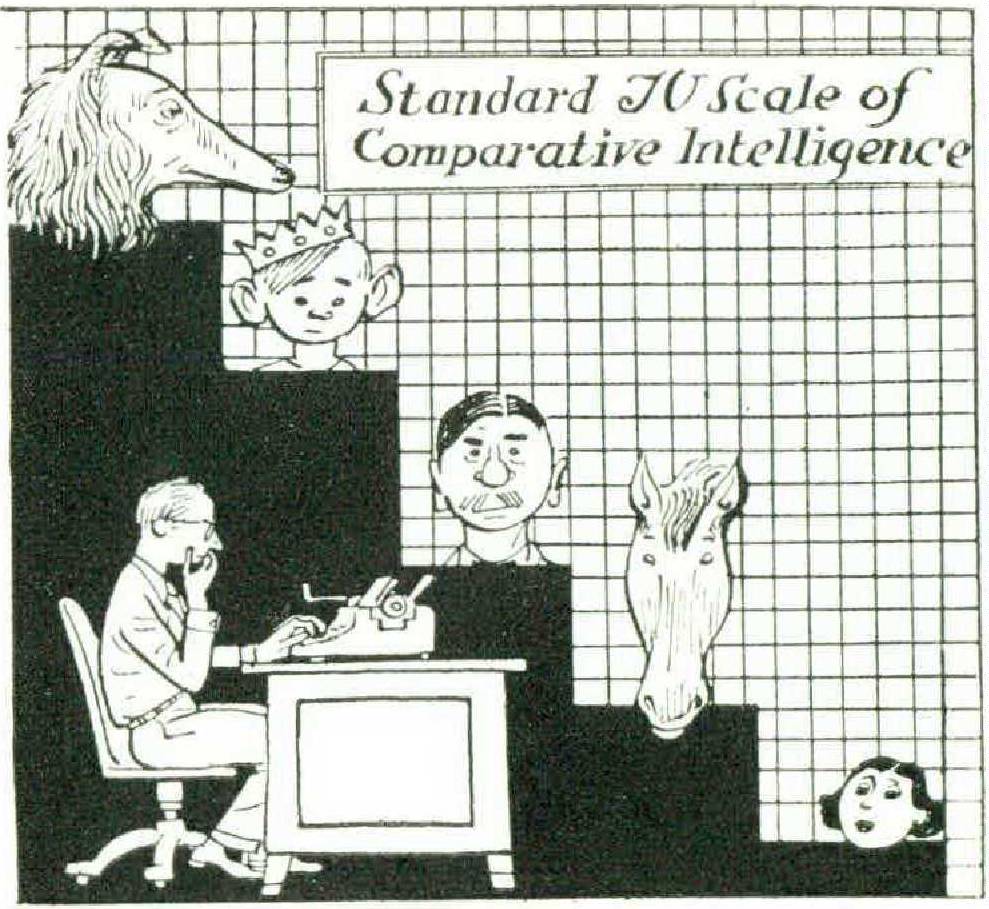
THIS memo is not being sent to discourage any writers, because we think writing should have a place in television, but simply to save you from unnecessary rejections. In reviewing the many scripts we receive for the Rinssie show we notice the literary quality of all is about the same, but so many fall short simply because the writers don’t really understand the characters.
We believe your task will be simplified if you will plant it firmly in your minds that the order of intelligence for this very important half hour of each week is:
Dog
Boy
Man
Horse
Woman
A few older writers, trained in a different school, may be surprised at, or even inclined to quibble with, this order, but that’s only because they aren’t aware how steadily time has been downgrading the Horse. The old-fashioned days in which the Horse solved problems of the plot himself are gone, and he must now be regarded only as a strong, gentle, but somewhat dim-witted friend, his capabilities a bare notch above those of Woman. In an emergency situation about the most you should call on the Horse to do is stamp his feet and neigh, and the same more or less applies to Woman.
Many of our writers have trouble with Dad, and there is a widespread and sloppy tendency to have him settle problems unilaterally in Pleasant Valley — a tendency that proves the writers simply haven’t grasped the dimensions of the character. It is true that Dad, because he is a male adult and the family breadwinner, must be conceded certain capabilities, though not in the class of Rinssie or Bobby. But these are more than offset by his gullibility; he is not able to tell that people are crooks until they perform some overt act, white the Boy develops suspicions much sooner and Rinssie growls at them on first sight. Thunder and Mother, of course, are not expected to be able to sort out crooks at any time.
When we reach Bobby, we find ourselves with a much more versatile subject, able to do almost as much as Rinssie in many fields, though bearing in mind always that he has only two legs, that his sense of smell and hearing are inferior and his teeth negligible. He can always express himself through talk, which must be considered an asset, even though it doesn’t have the dramatic impact of a growl or bark.
In shaping the part for Rinssie in your scripts, you must guard against the recent tendency of writers to portray him merely as a thinker. It is true he makes an attractive picture sitting there pondering the troubles of the subordinate members of the cast. But he must be active, too — an active thinker, liinssie is not the kind of dog to figure out that one of those logs floating toward the mill contains hidden dynamite charges and then refer the matter to a subordinate; he must also bound to the controls in time to shunt the log away and bite the person responsible.
Finally, it is always helpful to have your scripts point a moral, above the obvious one that people are quite pitiful without a dog’s guidance. We would like to offer something positive. Perhaps if you are going to have Bobby trip and sprain his ankle in the woods at night, it could be on the way to a Boy Scout meeting. This gives us a chance to get in some fine shots of the Boy Scout uniform as Bobby drags himself along, and it also offers an excuse for his being out in the woods at night in the first place. Little public service touches like this will not only keep our show in its present high place, but also help keep troublesome pressure off our backs. It’s thinking of this kind that sells dog food and scripts.