First Reader
by MICHAEL JACKSON
MICHAEL JACKSON lives at Laguna Beach, California, where he is engaged in newspaper work. His “Seventh-reel Stretch” appeared in the September Atlantic.
TO READ, a child must see value in reading. I was once an indifferent reader, yet when I acquired a real desire I became a whizz in twenty weeks. So can anyone else.
After being checked out in linger painting and raffia work, I was promoted from kindergarten and first exposed to schoolbooks. I did not think much of them. I was not antiliterature, but I had already memorized Goldilocks and the Three Bears and saw no reason to start learning more stories. I felt about Goldilocks the way some men do about an old tweed coat. I would always rather go back to this story than risk my time on some untried tale. It is hard to improve on a story like that and I was content with it.
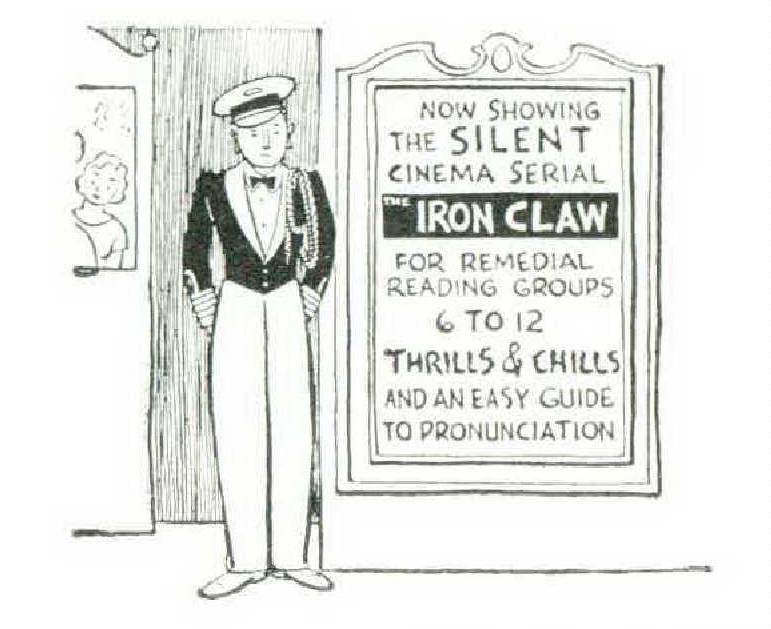
I mastered the alphabet in time, but had little active need of it. “Evaporated,” a word seen on milk cans, came out eva-poor-ate-teed. “Caution,” a street sign word, came out kay-you-tie-on and meant wait for grownup to take you across street. That was my scholastic standing when I began to follow the movie serial, The Iron Claw.
Every Saturday afternoon, as a respite from fresh air and sunshine, our set stocked up on Necco Wafers and Tootsie Rolls to rendezvous in the front row at the Plaza Theater. Those of us who could read would point to the screen directly above us and shout the words, to the envy of our less accomplished companions. “YOU WIN THIS TIME, GRINGO. BUT WE WILL MEET AGAIN.” Some of the kindergarten set would pretend that they could read, too, but they were always just barely off tempo, like party singers who don’t quite know the lyrics.
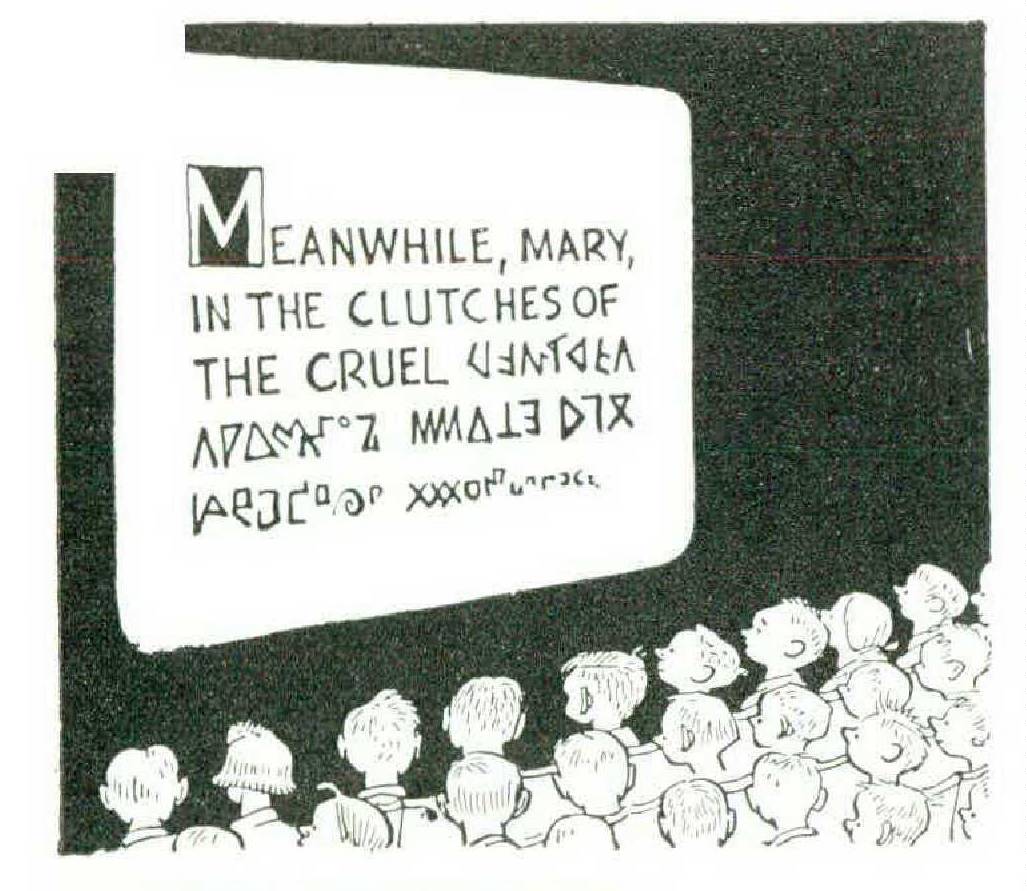
I had been an aficionado of The Iron Claw for about four chapters when I began to suspect that certain nuances and subtleties of characterization and plot were eluding me. I could not read fast enough to digest the words before they vanished from the screen. “MARY, AN IN-NO-CENT WILD FLOW-ER WHO . . .” or “IN THE ME-AN TI-ME, BACK AT THE HIDE-OUT THE GANG PLANS TO . . .” This was as far as I could get before the action reappeared and I was left standing in unseat, pointing at the screen and talking grimly to myself. Movies were designed for the twelve-year-old mentality, and my trouble was I didn’t have it.
The Iron Claw concerned a onehanded evildoer who had a hook attached to his arm stump. He could work it like a pruning shears. This villain was forever trying to trap a lady with Pickford-type curls. At first I surmised that he wanted to clip off her head, but it turned out he wanted to give her a kiss. But there was a man in white riding trousers, who untied himself from ropes placed about him the previous Saturday, and always prevented the iron claw man from kissing the lady. Becoming ever more enthralled by the fugue evolved from this theme, I was rapidly forgetting all about Goldilocks.
At the conclusion of each chapter, the front-row einemagoers would be screaming and crying. The man in white trousers was tied up on the floor next to a box of rattlesnakes. When the swinging knife was low enough, the cord securing the snakes would be severed, and all the snakes would get out to devour the man. There would be a close-up of the man, his eyes rolling, sweat on his forehead. Then we were shown the snakes, heads weaving and forked tongues dart ing.
Afterwards, we all purchased a refreshment called a Frozen Dainty. This was gray shaved ice over which the Frozen Dainty man poured a colored syrup to give a cherry flavor to the germs. The hero’s chances of survival were discussed. It was during these round tables that I began to perceive the value of being a fast reader. I could never win an argument with a third-grader because he would claim that I didn’t read all the words, and that there was plenty going on that I knew nothing about. In rebuttal, I would trip opponents and jump up and down on their chests, but I was forced to concede that their arguments had a certain validity.
The dramatis personae of The Iron Claw were always writing notes or being forced to write them. Only rarely were the notes read by their intended receiver. Every time the man in white pants tried to deliver anything, he was ambushed by a group of Oriental or Latin types. Once a note did get through. The heroine stared at the message, clutched at her throat, then crumpled in a faint. The audience was given a close-up of the message.
I always sat next to Spiggy Hayness, who was a year older than I and a good reader.
“What’s it say, Spiggy?” I kept my eyes on the screen. “What’s it say?”
“It don‘t say anything,” Spiggy explained. “It’s a letter.”
Letters were something people fought over or tried to hide, and The Iron Claw had almost completed its run before I became aware that they had intrinsic value. By that time, I could read entire subtitles before they vanished. TOM — ONLY A HIRED HAND BUT LOYAL AND KIND. . . . RELEASE ME, I BEG OF YOU. HAVE YOU NO SISTER OF YOUR OWN? . . . THE RED GULCH SALOON — WHERE LIFE WAS AS CHEAP AS THE RAW WHISKEY.
What I accomplished in twenty weeks can be accomplished by any child of today. It is up to the educators to give the child the proper incentive. My suggestion is this: let the community raise the money for a good silent movie serial. For twenty Saturday afternoons let all the secondgraders go to the show. With a nurse in attendance to administer sedatives to the inevitable hysterical few, the majority should emerge as capable readers — and that, after all, is what we want.